 Printable Scholar
Satraps and Satrapies: How the Great King Ruled Persia
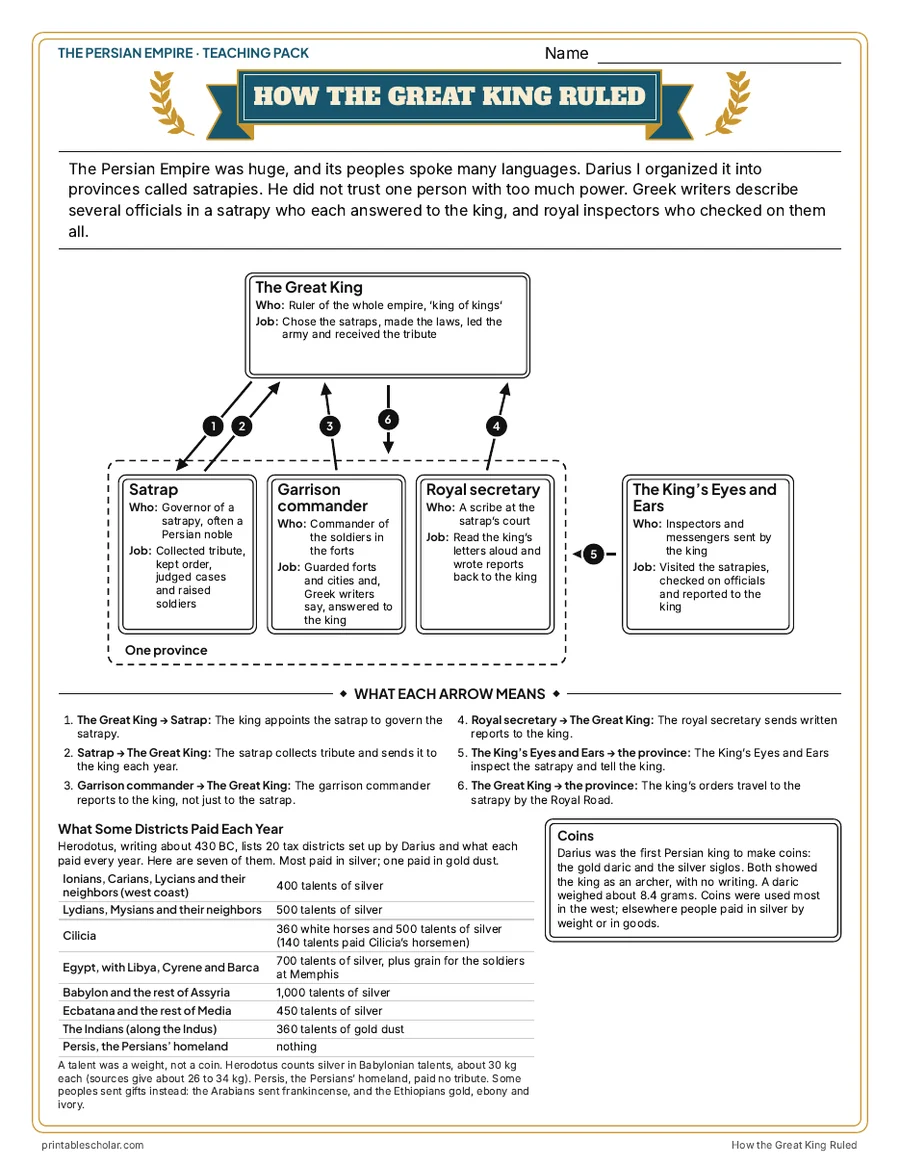
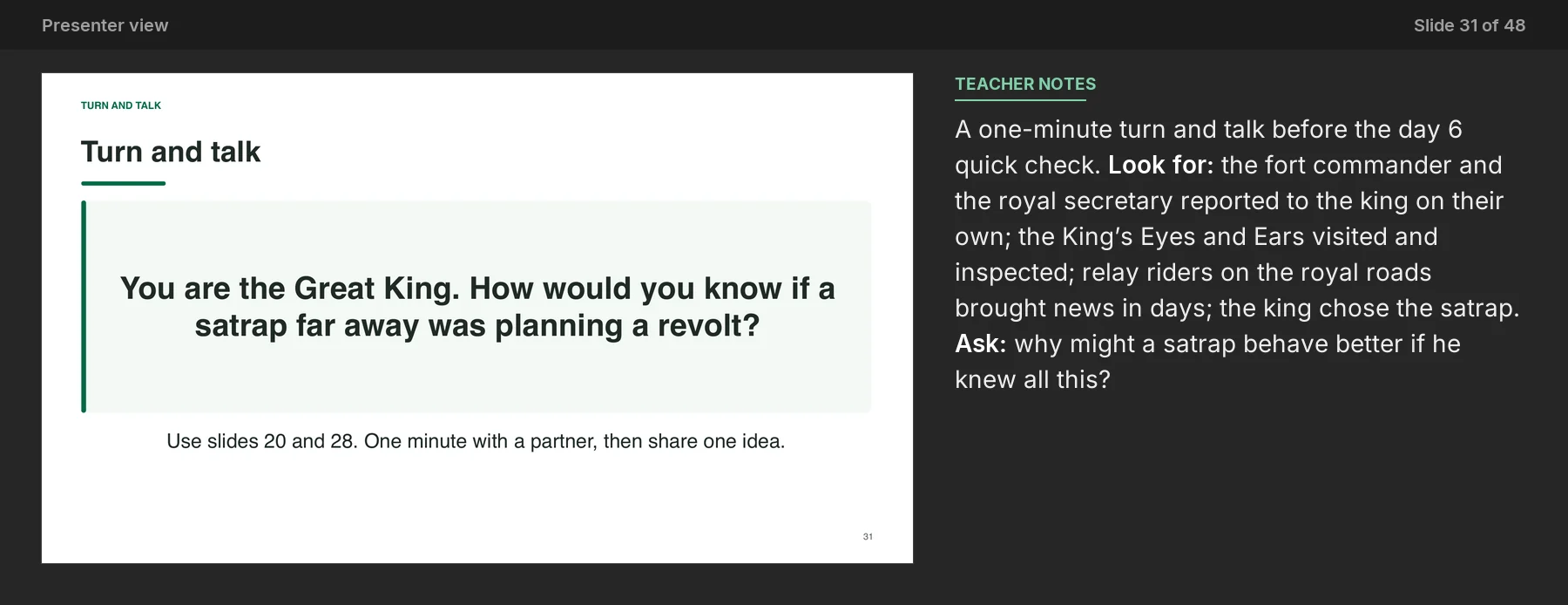
A satrapy was a province of the Persian (Achaemenid) Empire, and a satrap was the governor who ran it. Darius I, who ruled from 522 to 486 BC, organized his huge empire into satrapies, and the Greek writer Herodotus lists about 20 tax districts. The satrap collected tribute, kept order, judged cases and raised soldiers. Greek writers say the garrison commanders and the royal secretaries answered to the king on their own, and inspectors called the King’s Eyes and Ears visited the provinces and reported back, so no one official held too much power.
Free to print
How the Great King Ruled: labeled chart and practice page
PDFs sized for US Letter paper, in color and black and white.
How the Great King Ruled, labeled
The Great King, the satrap, the garrison commander, the royal secretary and the King’s Eyes and Ears, with what each arrow means and what some districts paid each year.
Download PDF Black and white
How the Great King Ruled: Practice
The same chart to fill in, a word bank for the arrows, the tribute table and three questions.
Download PDF Black and white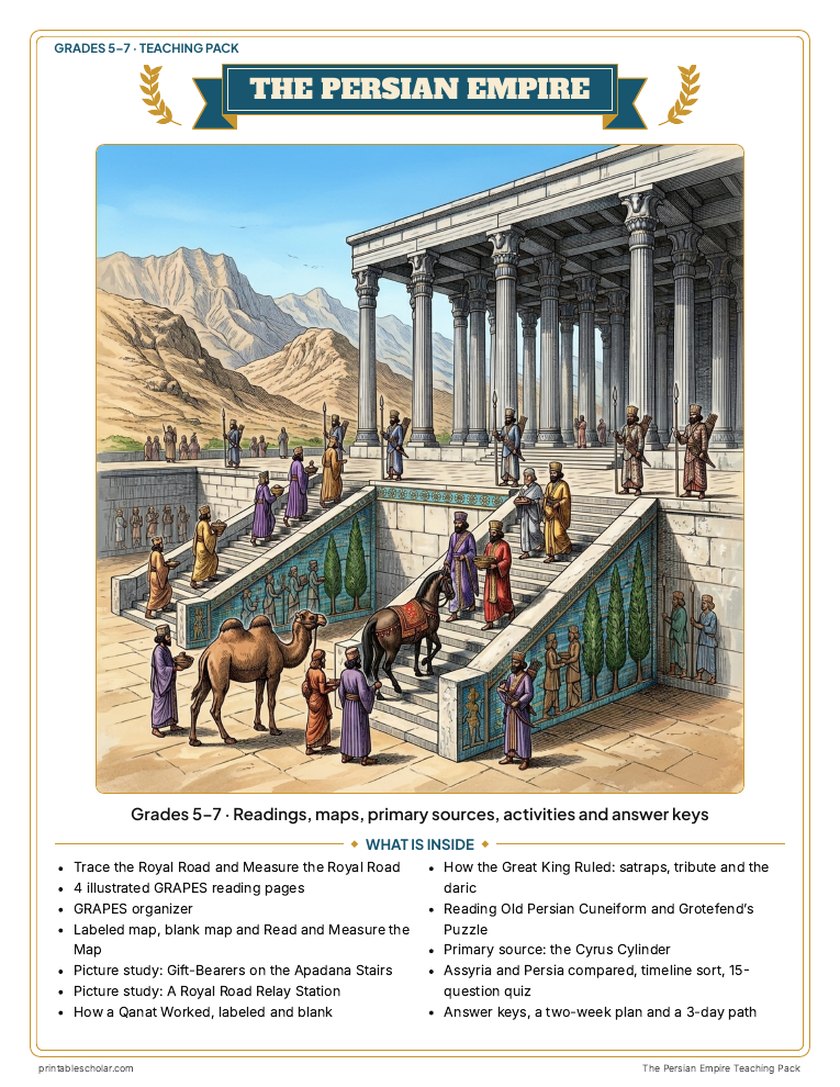
Teaching pack · Grades 5–7
Teaching the Persian Empire? The whole unit, ready to teach.
Two weeks of lessons in one download: slides to present, notes for students to fill in, and printable pages that use these maps and pictures.
Every slide comes with teacher notes: what to say, what to ask, and sample answers.
- 48 lesson slides (PowerPoint you can edit) and 2 pages of guided notes
- 4 illustrated reading pages and a GRAPES organizer
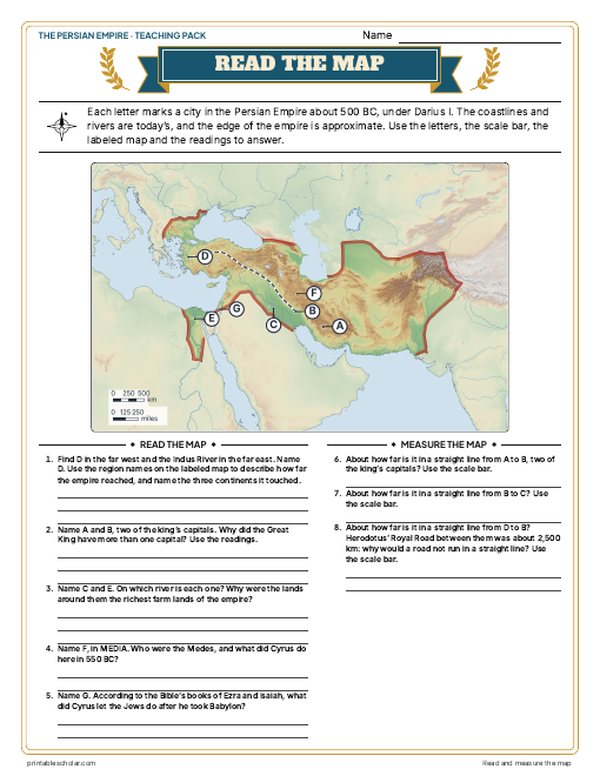
- Maps: labeled, blank, Read and Measure the Map, and "Trace the Royal Road": follow Herodotus' road from Sardis to Susa on a real relief map, then measure it
- Activities: how the Great King ruled (satraps, the King's Eyes and Ears, tribute), how a qanat worked (labeled and blank), reading Old Persian cuneiform and Grotefend's puzzle, the Cyrus Cylinder as a primary source, two picture studies (the Apadana stairs and a Royal Road relay station), Assyria and Persia compared, and a timeline sort
- A 15-question quiz, a teacher guide with a two-week plan and a 3-day path, and answer keys for everything
Every answer is in the pack. The readings, slides, maps and pictures teach everything the sheets and quiz ask, so no textbook is needed.
Get the Persian Empire pack for $7Teaching more than one? Get all eight ancient history packs (Early Humans, Egypt, Mesopotamia, the Persian Empire, Greece, Rome, China and India) for $39: about sixteen weeks of lessons.
Get all 8 packs for $39See all eight packsOr get every history pack (24) in one download:Get all 24 for $49
One-time purchase. Instant download. Color and ink-saving black-and-white editions. Secure checkout by Stripe.
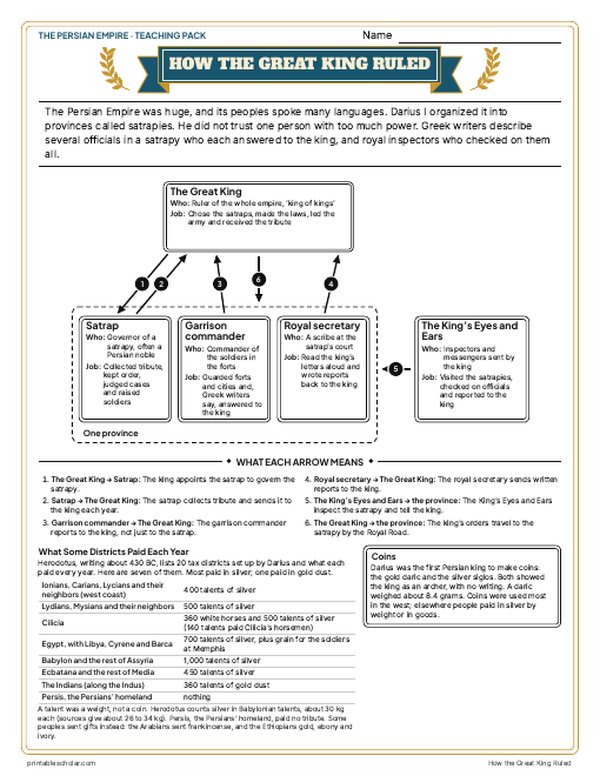
How the satrapy system worked
The satrap
The governor of a satrapy, often a Persian noble. He collected the tribute, kept order, judged cases and raised soldiers for the king.
Checks on the satrap
Greek writers say the commander of the forts and the royal secretary each answered to the king, not to the satrap. The King’s Eyes and Ears were inspectors who visited the satrapies and reported to the king.
Tribute
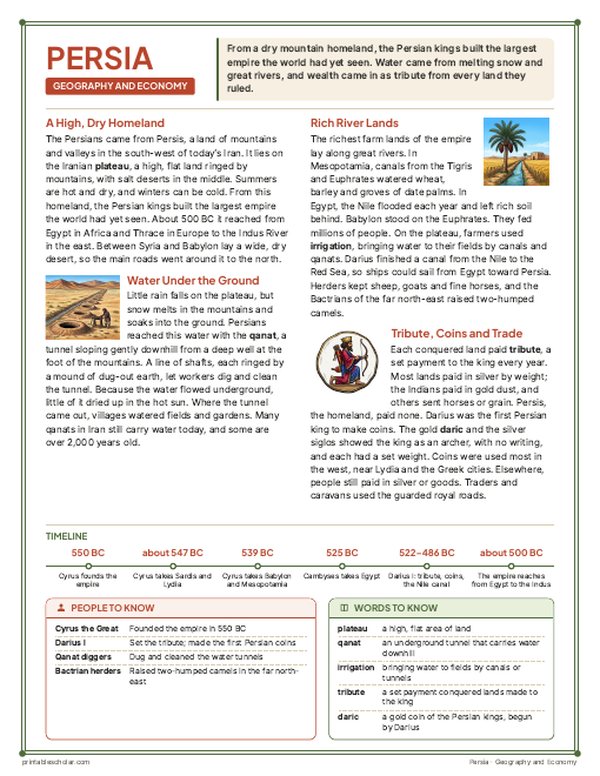
Herodotus lists what each district paid every year: 1,000 talents of silver from Babylon and Assyria, 700 from Egypt, 360 talents of gold dust from the Indians. Persis, the Persians’ homeland, paid nothing.
Coins and roads
Darius made the first Persian coins, the gold daric and the silver siglos. Orders and reports traveled on royal roads such as the Royal Road from Sardis to Susa, with stations along the way.
Frequently asked questions
What is the difference between a satrap and a satrapy?
A satrapy was a province of the Persian Empire. A satrap was the governor who ruled it for the king.
Who were the King’s Eyes and Ears?
Officials and inspectors sent by the Persian king to visit the satrapies, check on the satraps and other officials, and report back to him.
How many satrapies were there?
The number changed over time. Herodotus lists about 20 tax districts under Darius I; Darius’ own inscriptions list more peoples and lands.