 Printable Scholar
Qanat: How Ancient Persians Brought Water Underground
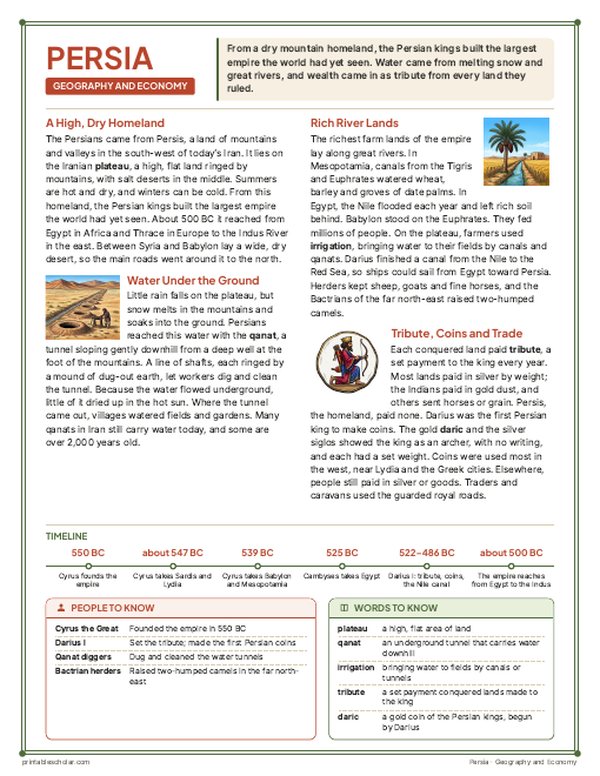
A qanat is an underground channel that brings water from the foot of the mountains out to dry fields, with no pumps. Little rain falls on the Iranian plateau, but snow melts in the mountains and soaks into the gravel below. Diggers sank a deep mother well down to the water, then dug a long tunnel to it from the plain, sloping gently so gravity moved the water. A line of shafts let workers haul up the dug earth and let in air and light. Qanats watered farms and villages in the Persian Empire, and many still carry water in Iran today.
Free to print
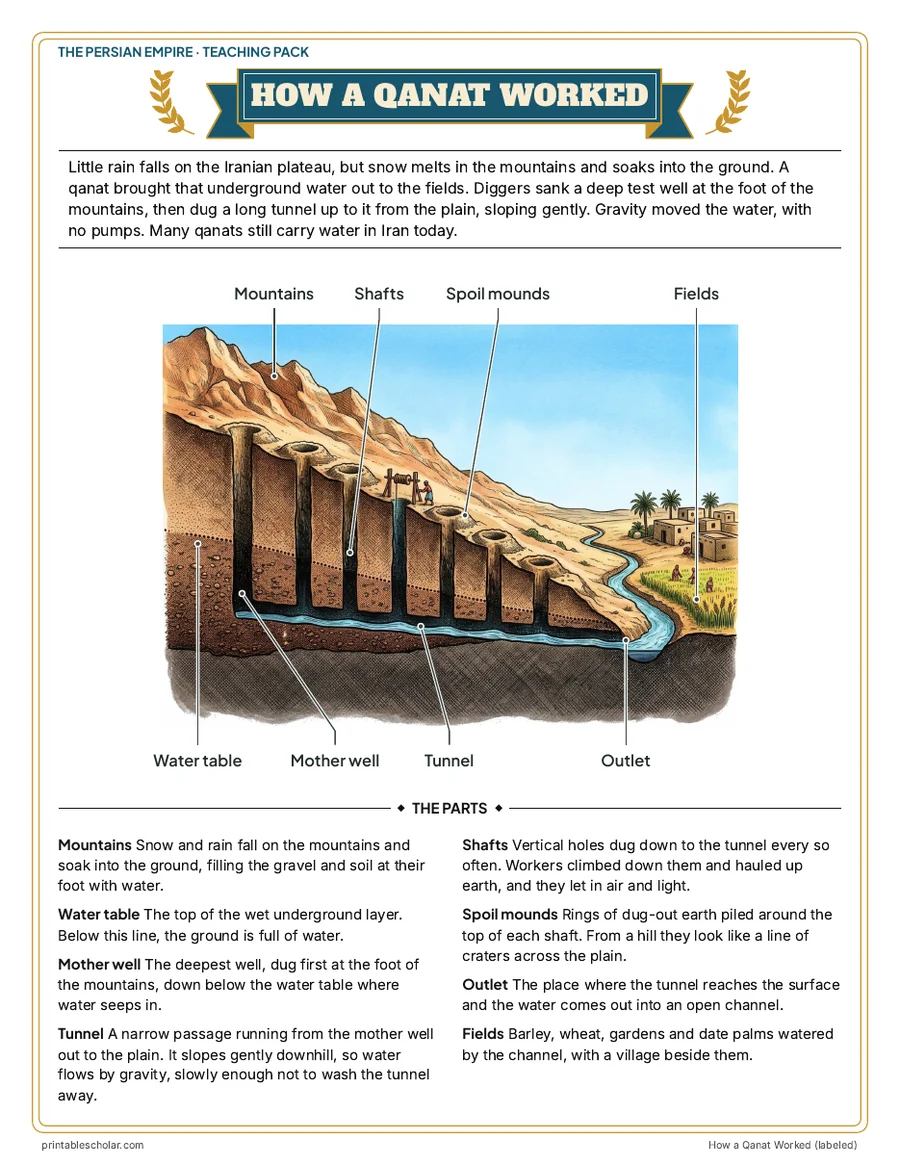
Labeled and blank qanat diagram
PDFs sized for US Letter paper, in color and black and white.
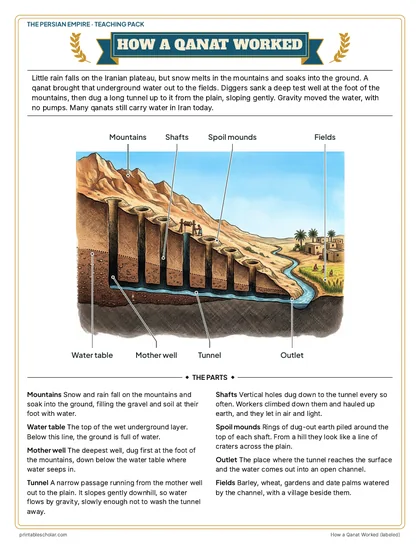
How a Qanat Worked, labeled
A cutaway picture of a qanat with eight parts labeled and explained.
Download PDF Black and white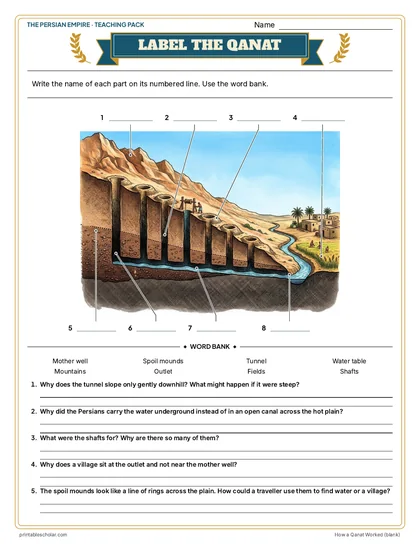
Label the Qanat
The same picture with numbered blank labels, a word bank and questions.
Download PDF Black and white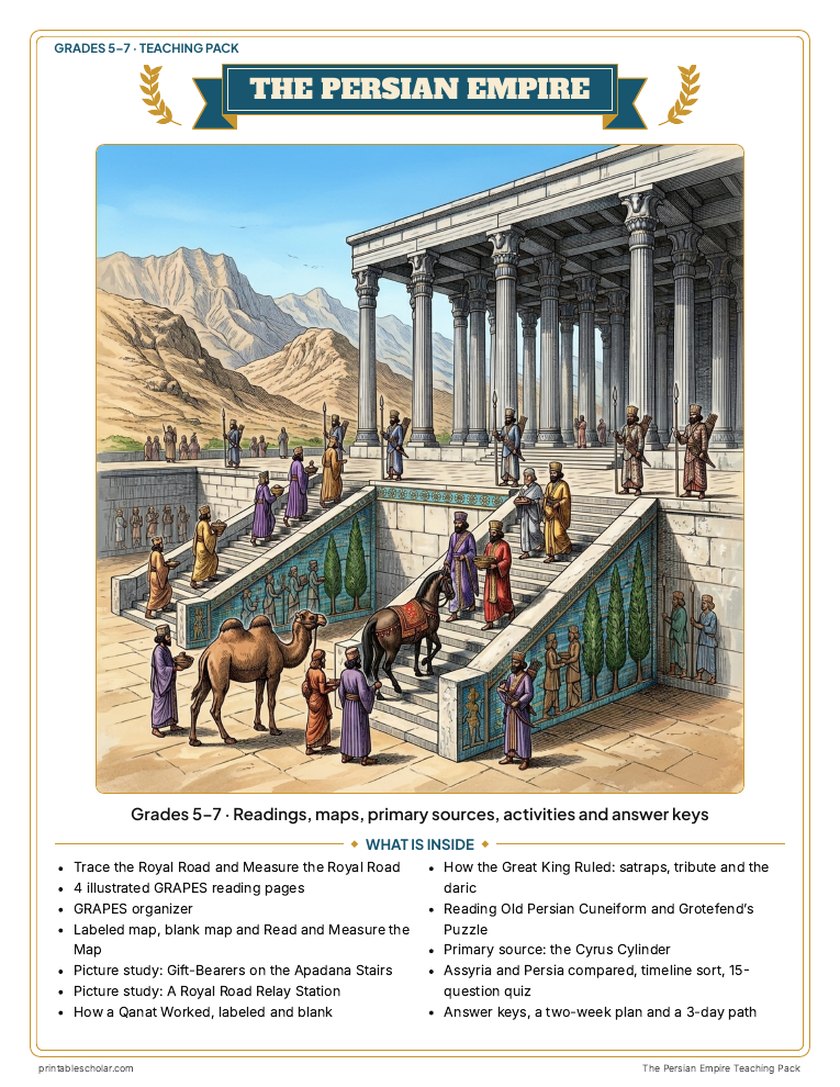
Teaching pack · Grades 5–7
Teaching the Persian Empire? The whole unit, ready to teach.
Two weeks of lessons in one download: slides to present, notes for students to fill in, and printable pages that use these maps and pictures.
Every slide comes with teacher notes: what to say, what to ask, and sample answers.
- 48 lesson slides (PowerPoint you can edit) and 2 pages of guided notes
- 4 illustrated reading pages and a GRAPES organizer
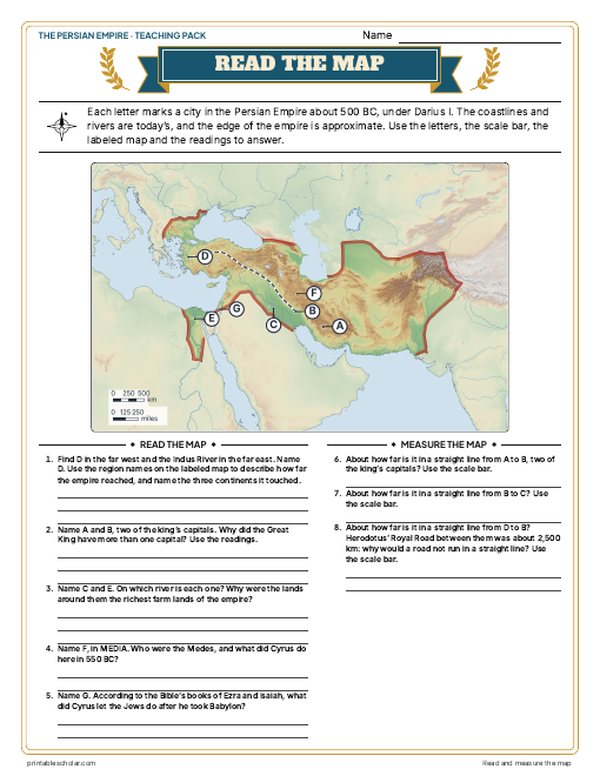
- Maps: labeled, blank, Read and Measure the Map, and "Trace the Royal Road": follow Herodotus' road from Sardis to Susa on a real relief map, then measure it
- Activities: how the Great King ruled (satraps, the King's Eyes and Ears, tribute), how a qanat worked (labeled and blank), reading Old Persian cuneiform and Grotefend's puzzle, the Cyrus Cylinder as a primary source, two picture studies (the Apadana stairs and a Royal Road relay station), Assyria and Persia compared, and a timeline sort
- A 15-question quiz, a teacher guide with a two-week plan and a 3-day path, and answer keys for everything
Every answer is in the pack. The readings, slides, maps and pictures teach everything the sheets and quiz ask, so no textbook is needed.
Get the Persian Empire pack for $7Teaching more than one? Get all eight ancient history packs (Early Humans, Egypt, Mesopotamia, the Persian Empire, Greece, Rome, China and India) for $39: about sixteen weeks of lessons.
Get all 8 packs for $39See all eight packsOr get every history pack (24) in one download:Get all 24 for $49
One-time purchase. Instant download. Color and ink-saving black-and-white editions. Secure checkout by Stripe.
How a qanat works
Finding the water
Diggers sank a test well at the foot of the mountains, deep enough to reach below the water table, the top of the wet underground layer. This is the mother well.
The tunnel
A narrow tunnel runs from the mother well out to the plain. It slopes gently downhill, so water flows by gravity, slowly enough not to wash the tunnel away.
Shafts and mounds
Vertical shafts dug down to the tunnel let workers climb down and haul up earth, and let in air. Rings of dug-out earth around each shaft look like a line of craters across the plain.
The outlet
Where the tunnel reaches the surface, the water comes out into an open channel that waters fields, gardens and date palms beside a village.
Frequently asked questions
Why is a qanat underground?
Water in an open channel dries up fast in the hot sun. Underground, much less of it evaporates on the long way to the fields.
Are qanats still used?
Yes. Many qanats still carry water in Iran today, and UNESCO lists eleven Persian qanats as a World Heritage Site.
What makes the water flow in a qanat?
Gravity. The tunnel slopes gently downhill from the mother well to the outlet, so no pumps are needed.