 Printable Scholar
The Pueblo Revolt of 1680: Causes, Turning Point and Results
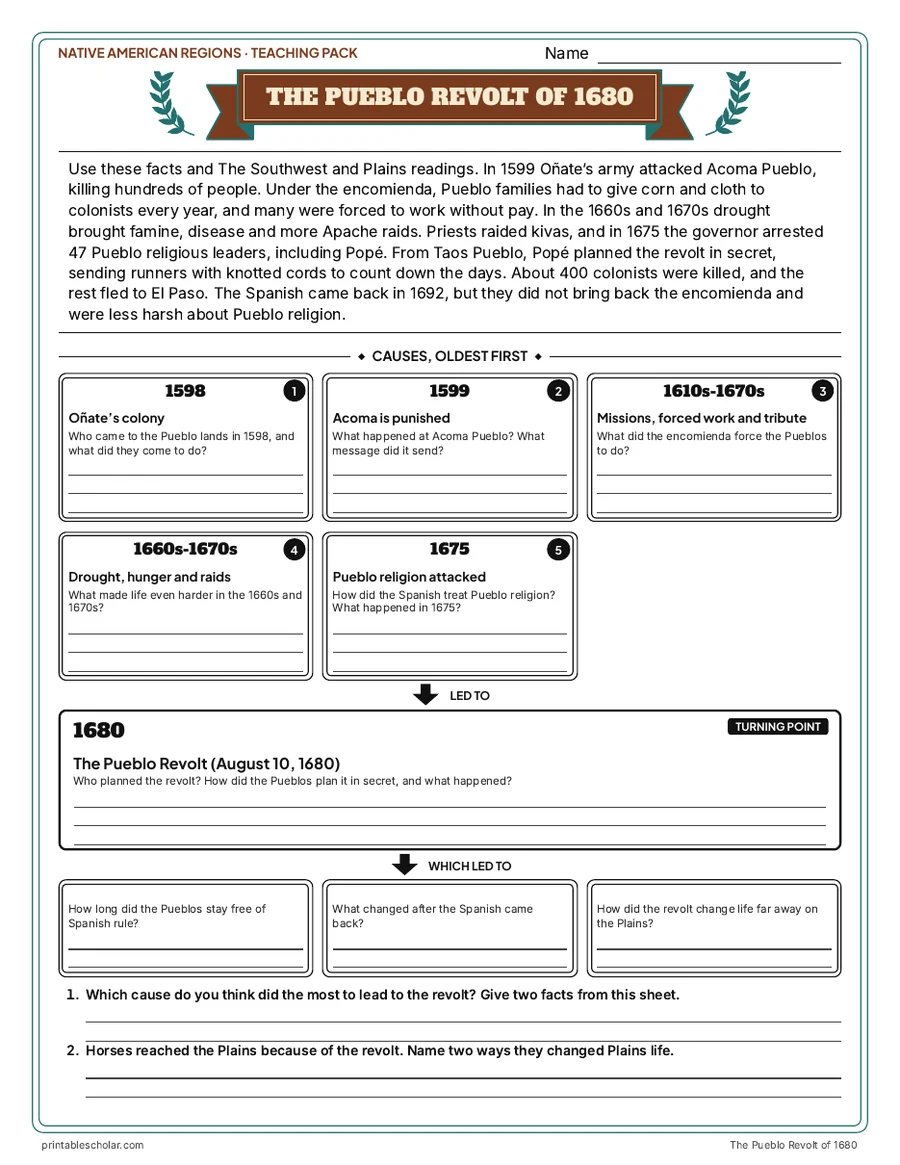
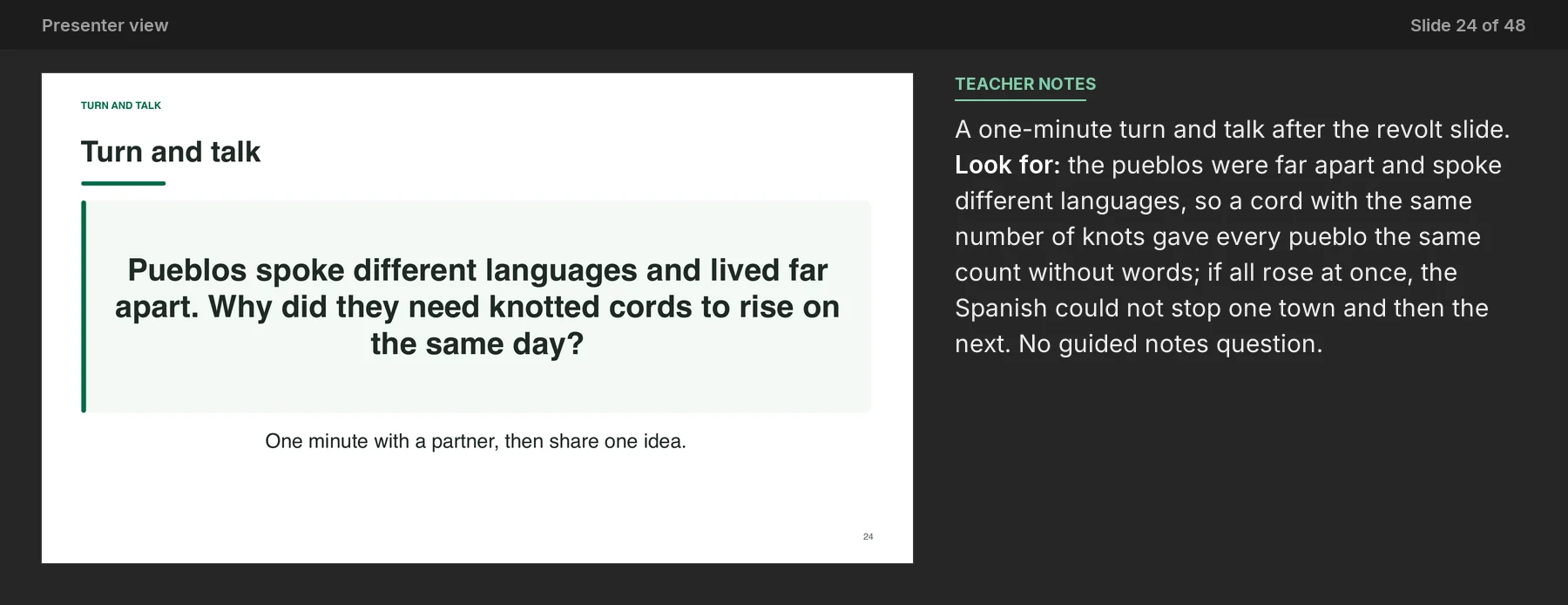
In 1598 Spain set up a colony among the Pueblo peoples of what is now New Mexico. Over the next eighty years, Pueblo families were made to give corn and cloth and to work without pay, priests tried to stamp out Pueblo religion, and drought, hunger and raids made life harder. In 1675 the Spanish governor arrested 47 Pueblo religious leaders, including Popé. On August 10, 1680, Pueblos from many towns and languages rose together in a revolt Popé planned in secret, sending runners with knotted cords to count down the days. The Spanish left for El Paso and stayed away about twelve years. This free sheet walks students from the causes to the revolt and its results.
Free to print
The Pueblo Revolt of 1680: causes, turning point and results
PDFs sized for US Letter paper, in color and black and white.
The Pueblo Revolt of 1680
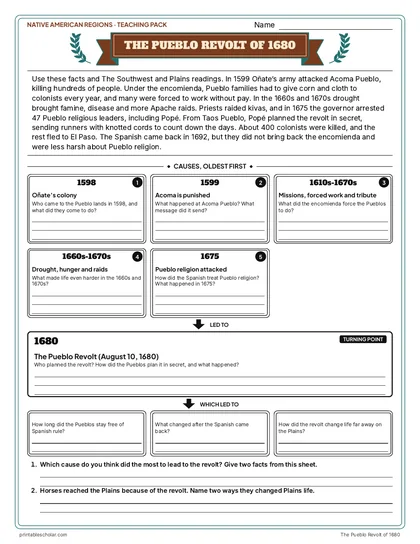
Five dated causes, the revolt itself and three results to fill in from the facts on the sheet, with two questions.
Download PDF Black and white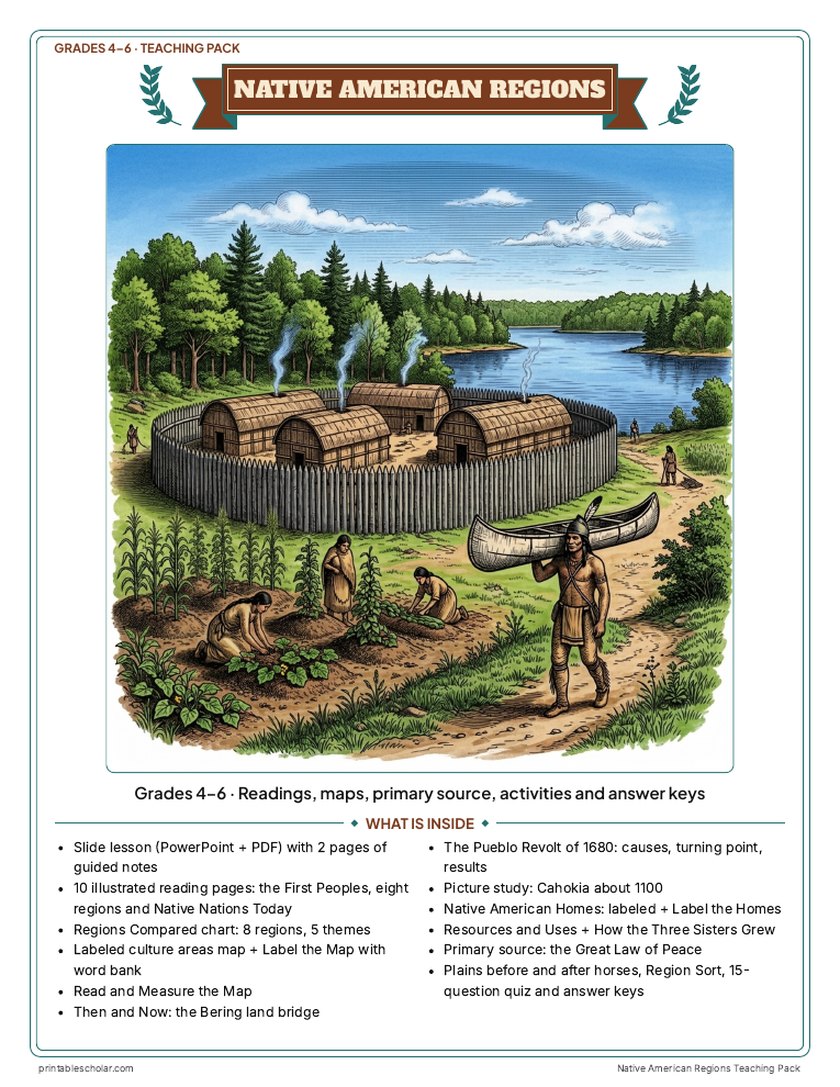
Teaching pack · Grades 4–6
Teaching Native American Regions? The whole unit, ready to teach.
Two weeks of lessons in one download: slides to present, notes for students to fill in, and printable pages that use these maps and pictures.
Every slide comes with teacher notes: what to say, what to ask, and sample answers.
- 48 lesson slides (PowerPoint you can edit) and 2 pages of guided notes
- 10 illustrated reading pages: the first peoples, the Arctic, Northwest Coast, California, Great Basin and Plateau, Southwest, Plains, Northeast, Southeast, and Native nations today, plus a Regions Compared chart
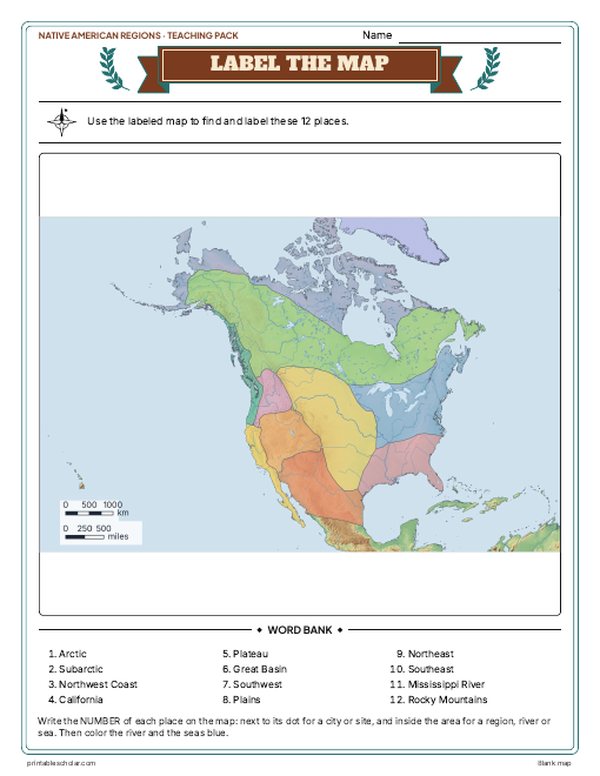
- Maps: a labeled culture-areas map, a blank map with word bank, Read and Measure the Map, and Then and Now: the Bering land bridge
- Activities: a Cahokia picture study, Native American homes (labeled and blank), how the Three Sisters grew, resources and uses, the Pueblo Revolt of 1680 (causes and results), the Great Law of Peace as a primary source, Plains life before and after horses, and a region sort
- A 15-question quiz, a teacher guide with a two-week plan, and answer keys for everything
Every answer is in the pack. The readings, slides, maps and pictures teach everything the sheets and quiz ask, so no textbook is needed.
Get the Native American Regions pack for $7Teaching more than one? Get all six US history packs (Native American Regions, the 13 Colonies, the American Revolution, the Constitution, Westward Expansion and the Civil War) for $29: about twelve weeks of lessons.
Get all 6 packs for $29See all six packsOr get every history pack (20) in one download:Get all 20 for $49
One-time purchase. Instant download. Color and ink-saving black-and-white editions. Secure checkout by Stripe.
What the revolt changed
Twelve years of freedom
After the revolt the Spanish stayed out of Pueblo lands for about twelve years, until Diego de Vargas returned in 1692.
A changed colony
Historians say that when the Spanish came back they did not bring back the encomienda and were less harsh about Pueblo religion.
Horses to the Plains
Horses left behind by the Spanish were traded from the Pueblos to other nations. By the 1700s horses had spread across the Plains, changing how Plains nations hunted, traveled and lived.
Frequently asked questions
Who led the Pueblo Revolt?
Popé, a religious leader from Ohkay Owingeh, planned the revolt from Taos Pueblo, with leaders from many pueblos.
Why did the Pueblo Revolt happen?
Forced tribute and labor under Spanish rule, attacks on Pueblo religion (including the arrest of 47 religious leaders in 1675), and years of drought, hunger, disease and raids.
Was the Pueblo Revolt successful?
Yes, for a time: the Spanish left New Mexico for about twelve years. When they returned in 1692, Pueblo peoples kept more of their religion and ways than before.