 Printable Scholar
The Iroquois Confederacy and the Great Law of Peace
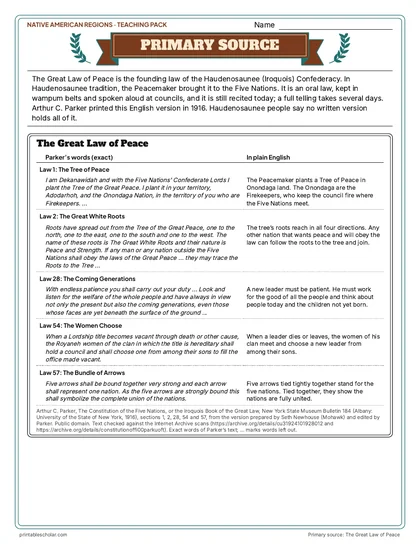
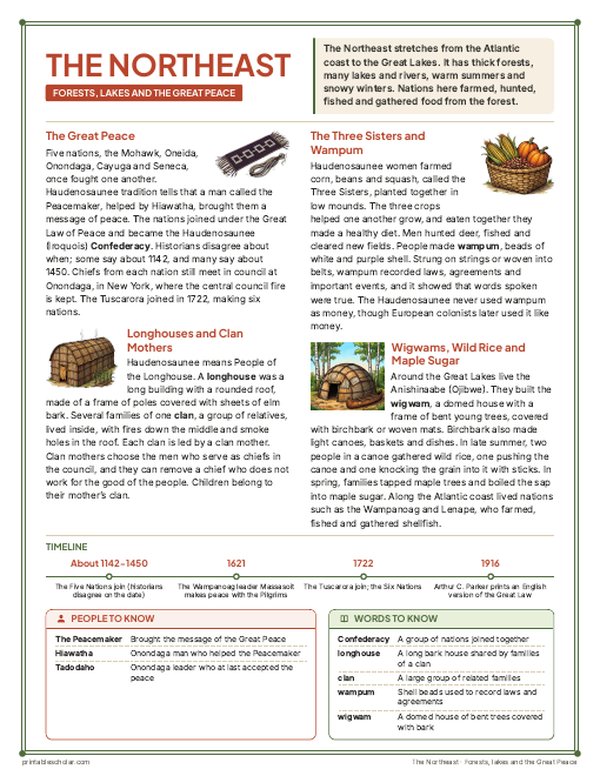
The Haudenosaunee, often called the Iroquois, are a confederacy of nations in what is now New York and southern Canada: the Mohawk, Oneida, Onondaga, Cayuga and Seneca, joined later by the Tuscarora to make Six Nations. Haudenosaunee tradition says a man known as the Peacemaker, helped by Hiawatha, brought the warring nations a message of peace, the Great Law of Peace. Historians disagree about when this happened, from about 1142 to about 1450. The Great Law is an oral law, kept in wampum belts and spoken aloud at councils, and it is still recited today. This free primary source sheet sets five of its laws, in the English version Arthur C. Parker printed in 1916, beside plain English, with four document questions.
Free to print
The Great Law of Peace: primary source and questions
PDFs sized for US Letter paper, in color and black and white.
The Great Law of Peace
Five laws in Parker’s 1916 English beside a plain-English version: the Tree of Peace, the White Roots, the coming generations, the women who choose leaders, and the bundle of arrows.
Download PDF Black and white
Hard words and questions
The hard words explained, and four questions about the laws.
Download PDF Black and white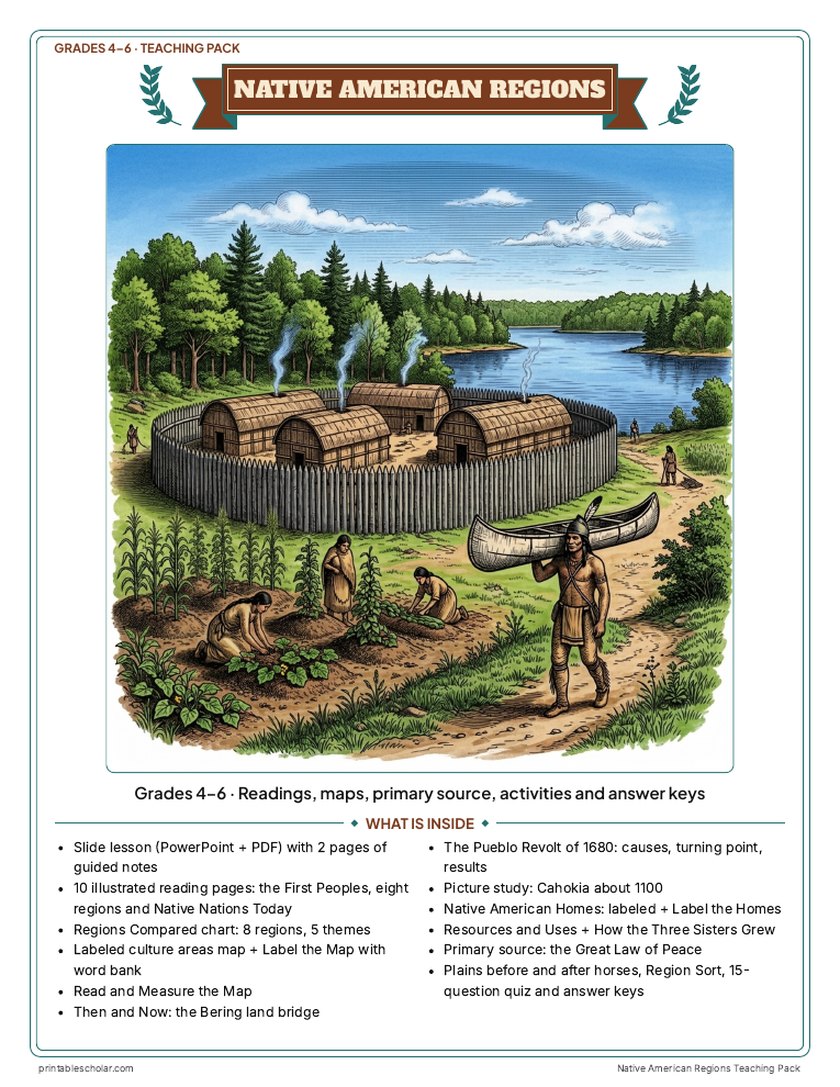
Teaching pack · Grades 4–6
Teaching Native American Regions? The whole unit, ready to teach.
Two weeks of lessons in one download: slides to present, notes for students to fill in, and printable pages that use these maps and pictures.
Every slide comes with teacher notes: what to say, what to ask, and sample answers.
- 48 lesson slides (PowerPoint you can edit) and 2 pages of guided notes
- 10 illustrated reading pages: the first peoples, the Arctic, Northwest Coast, California, Great Basin and Plateau, Southwest, Plains, Northeast, Southeast, and Native nations today, plus a Regions Compared chart
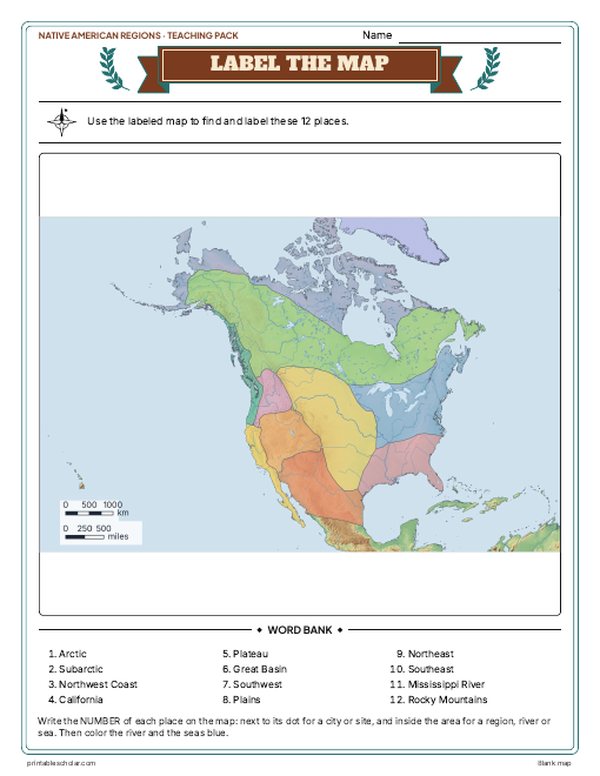
- Maps: a labeled culture-areas map, a blank map with word bank, Read and Measure the Map, and Then and Now: the Bering land bridge
- Activities: a Cahokia picture study, Native American homes (labeled and blank), how the Three Sisters grew, resources and uses, the Pueblo Revolt of 1680 (causes and results), the Great Law of Peace as a primary source, Plains life before and after horses, and a region sort
- A 15-question quiz, a teacher guide with a two-week plan, and answer keys for everything
Every answer is in the pack. The readings, slides, maps and pictures teach everything the sheets and quiz ask, so no textbook is needed.
Get the Native American Regions pack for $7Teaching more than one? Get all six US history packs (Native American Regions, the 13 Colonies, the American Revolution, the Constitution, Westward Expansion and the Civil War) for $29: about twelve weeks of lessons.
Get all 6 packs for $29See all six packsOr get every history pack (20) in one download:Get all 20 for $49
One-time purchase. Instant download. Color and ink-saving black-and-white editions. Secure checkout by Stripe.
How the Confederacy worked
Five nations, then six
The Mohawk, Oneida, Onondaga, Cayuga and Seneca joined in one confederacy. The Tuscarora joined about 1722, making Six Nations.
The council fire
Chiefs from each nation meet in council at Onondaga, where the central fire is kept. The Onondaga are the Firekeepers.
Clan mothers
The women of a clan choose its chief and can remove a chief who does not serve the people.
The Tree of Peace
The Great Law pictures peace as a great white pine whose roots spread in four directions, so other nations can follow them and join.
Frequently asked questions
Who are the Haudenosaunee?
The Haudenosaunee (people of the longhouse) are the nations of the Iroquois Confederacy: the Mohawk, Oneida, Onondaga, Cayuga, Seneca and Tuscarora. They live in New York, Ontario, Quebec and other places today.
When was the Great Law of Peace made?
Historians disagree. Estimates range from about 1142 to about 1450; many say about 1450. Haudenosaunee people keep the law by recitation and wampum.
What is wampum?
Beads made from white and purple shells, woven into belts and strings. The Haudenosaunee used wampum to record laws, agreements and important events.