 Printable Scholar
Native American Homes: Six Homes and Why They Were Built That Way
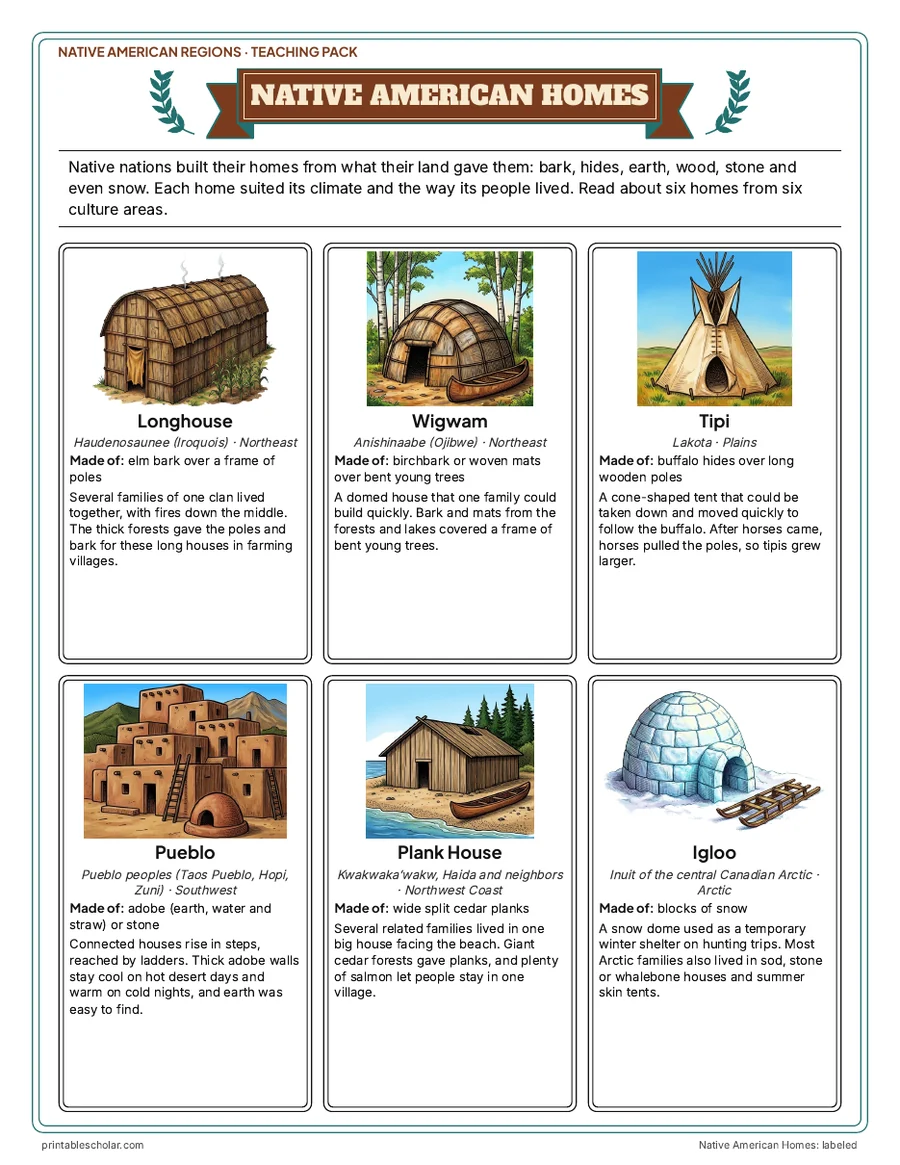
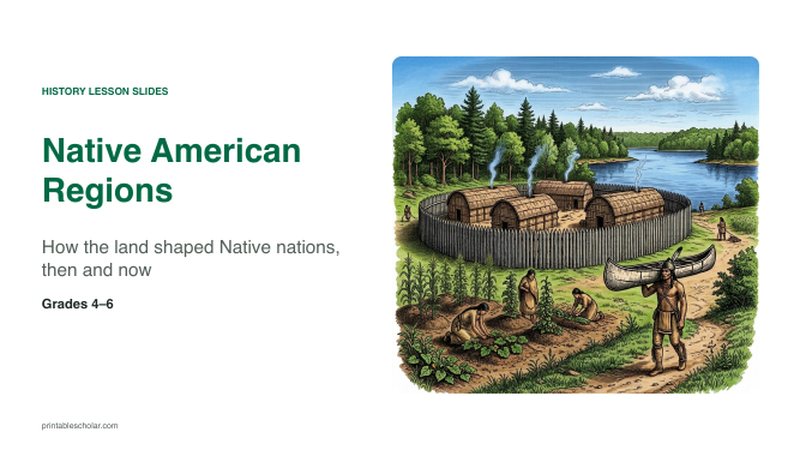
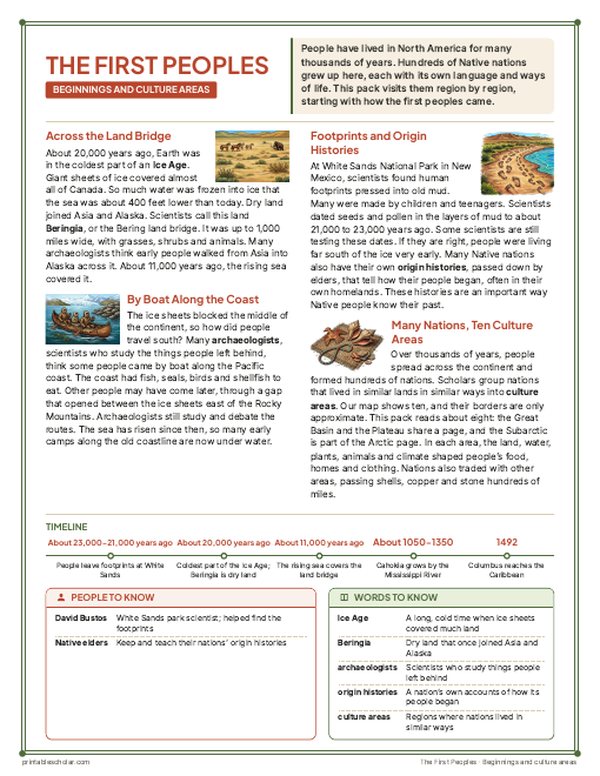
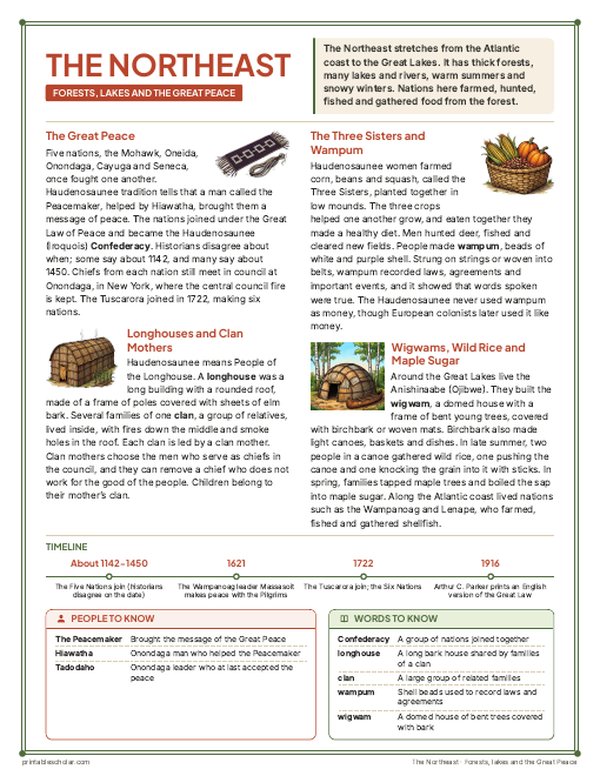
Native nations built their homes from what their land gave them: bark, hides, earth, wood, stone and even snow. A Haudenosaunee longhouse of elm bark held several families of one clan; an Anishinaabe wigwam of birchbark or mats could be built quickly; a Plains tipi of buffalo hides could be taken down and moved; Pueblo towns of adobe stayed cool by day and warm at night; Northwest Coast plank houses of cedar held related families by the sea; and in the central Arctic, Inuit hunters built snow-block igloos as temporary winter shelters. This free labeled page and blank page come from our Native American Regions pack.
Free to print
Native American homes, labeled and blank
PDFs sized for US Letter paper, in color and black and white.
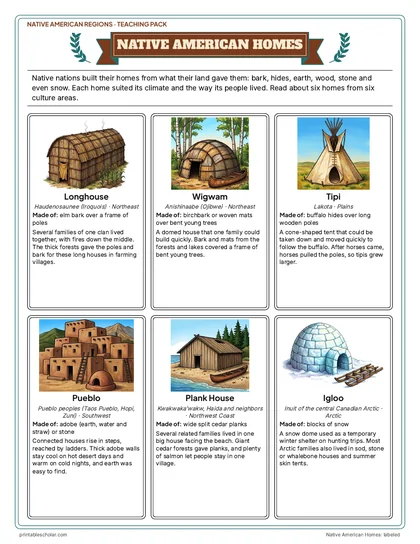
Native American Homes (labeled)
Six homes, each with its nation, culture area, what it was made of and why it suited the land.
Download PDF Black and white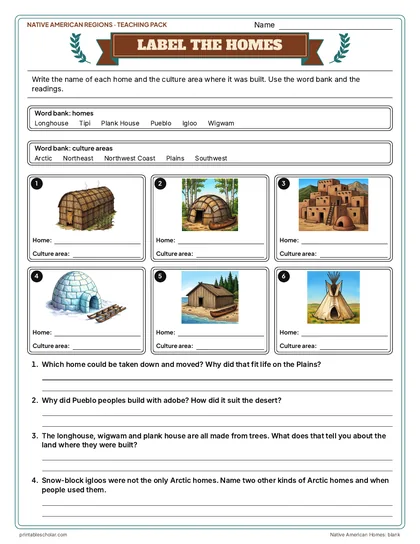
Label the Homes
The same six homes to name, with word banks for the homes and the culture areas, and four questions.
Download PDF Black and white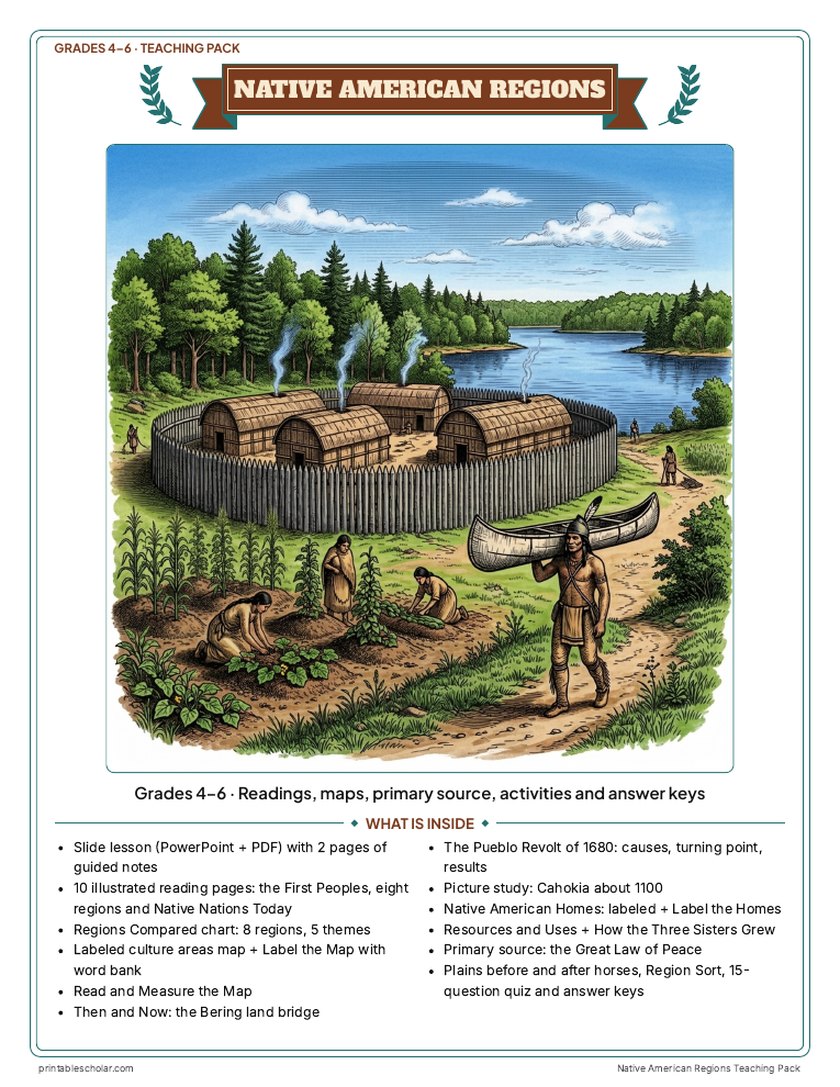
Teaching pack · Grades 4–6
Teaching Native American Regions? The whole unit, ready to teach.
Two weeks of lessons in one download: slides to present, notes for students to fill in, and printable pages that use these maps and pictures.
Every slide comes with teacher notes: what to say, what to ask, and sample answers.
- 48 lesson slides (PowerPoint you can edit) and 2 pages of guided notes
- 10 illustrated reading pages: the first peoples, the Arctic, Northwest Coast, California, Great Basin and Plateau, Southwest, Plains, Northeast, Southeast, and Native nations today, plus a Regions Compared chart
- Maps: a labeled culture-areas map, a blank map with word bank, Read and Measure the Map, and Then and Now: the Bering land bridge
- Activities: a Cahokia picture study, Native American homes (labeled and blank), how the Three Sisters grew, resources and uses, the Pueblo Revolt of 1680 (causes and results), the Great Law of Peace as a primary source, Plains life before and after horses, and a region sort
- A 15-question quiz, a teacher guide with a two-week plan, and answer keys for everything
Every answer is in the pack. The readings, slides, maps and pictures teach everything the sheets and quiz ask, so no textbook is needed.
Get the Native American Regions pack for $7Teaching more than one? Get all six US history packs (Native American Regions, the 13 Colonies, the American Revolution, the Constitution, Westward Expansion and the Civil War) for $29: about twelve weeks of lessons.
Get all 6 packs for $29See all six packsOr get every history pack (20) in one download:Get all 20 for $49
One-time purchase. Instant download. Color and ink-saving black-and-white editions. Secure checkout by Stripe.
Why homes were different
Forests
In the Northeast, forests gave poles and bark for longhouses and wigwams.
Grasslands
On the Plains, buffalo hides covered tipis. After horses came, tipis grew larger because horses could pull longer poles.
Deserts
In the Southwest, few trees grew, so Pueblo peoples built thick walls of adobe (sun-dried mud bricks) and stone.
Coast and ice
Northwest Coast peoples split giant cedars into planks. In the Arctic, most families lived in sod, stone or whalebone houses; snow igloos were mostly temporary winter shelters.
Frequently asked questions
Did all Native Americans live in tipis?
No. Tipis were homes of Plains nations. Other nations lived in longhouses, wigwams, plank houses, pueblos, earth lodges, hogans and many other kinds of homes, each suited to its land.
What is the difference between a longhouse and a wigwam?
A longhouse is a long building of elm bark over poles where several families of one clan lived. A wigwam is a smaller domed home of bent saplings covered with birchbark or mats, usually for one family.
Did Inuit always live in igloos?
No. Snow-block igloos were mostly temporary winter shelters used by Inuit of the central Canadian Arctic while traveling or hunting. Most Arctic families lived in houses of sod, stone, driftwood or whalebone, and in skin tents in summer.