 Printable Scholar
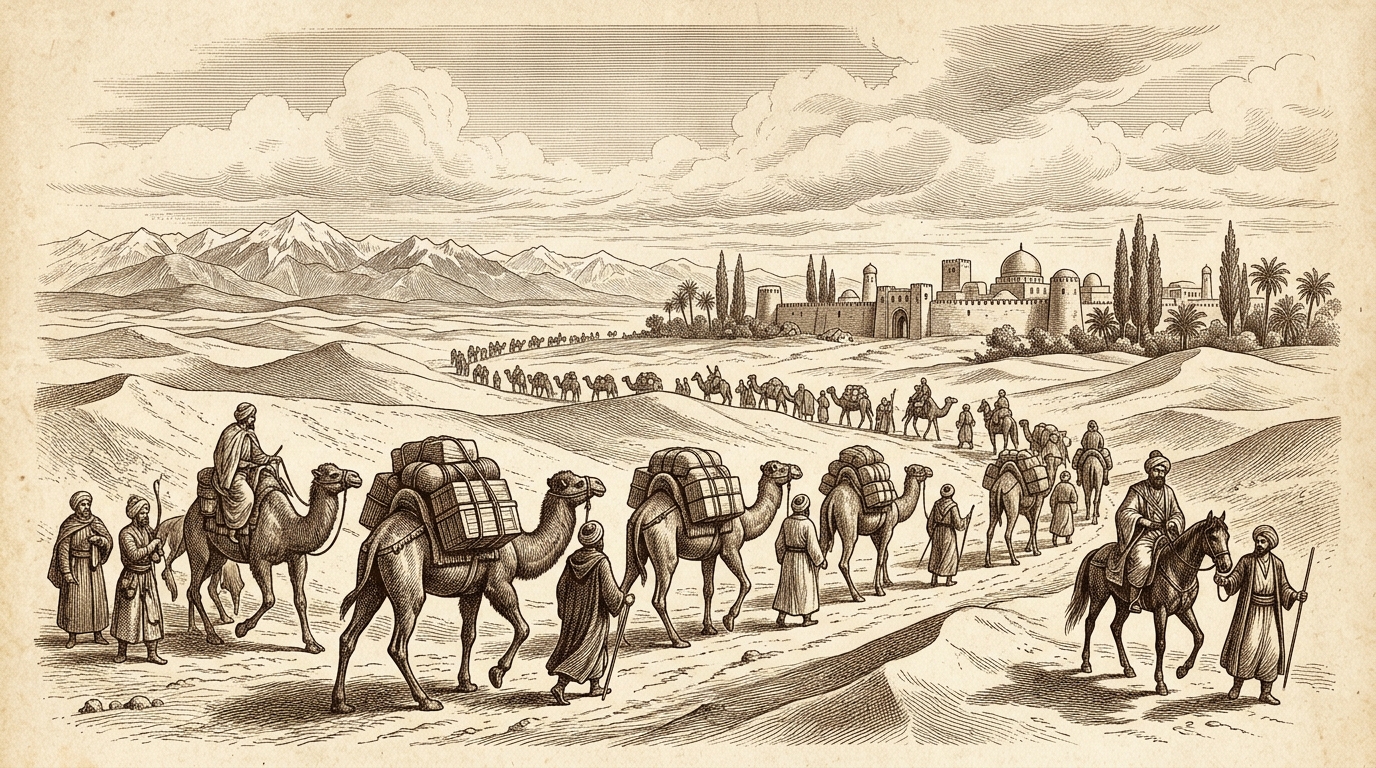
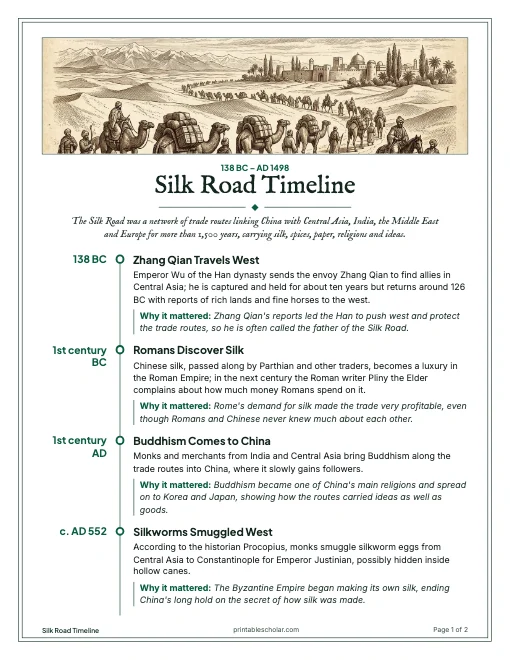
Silk Road Timeline
The Silk Road was a network of trade routes linking China with Central Asia, India, the Middle East and Europe for more than 1,500 years, carrying silk, spices, paper, religions and ideas.
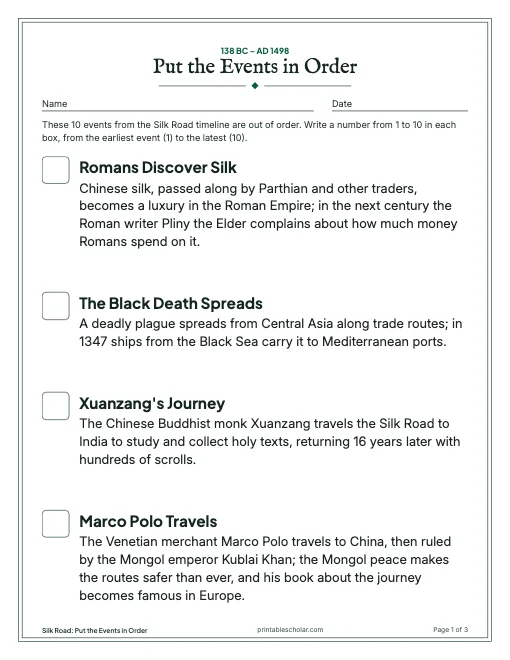
Put the Events in Order
The events shuffled, to number from first to last. With answer key.
Download PDF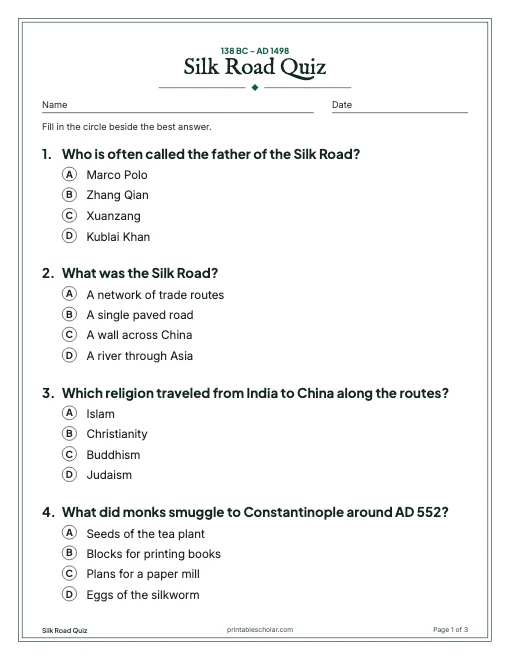
There was never one single road. The Silk Road was a web of caravan tracks across deserts, mountains and grasslands, with trading cities and oases along the way. Few traders went the whole distance. Goods passed from hand to hand, from Chinese merchants to Central Asian middlemen to Persian, Arab and Italian traders, rising in price at every step. China's silk was the most famous product, but camels and horses also carried spices, glass, horses, gold, jade and paper. Just as important were the things nobody could pack in a saddlebag: religions such as Buddhism and Islam, inventions such as papermaking and printing, and sadly, diseases. The routes were busiest when strong empires kept them safe, first the Han dynasty, then the Tang, and later the Mongols. When those empires weakened, and when Europeans found a way to sail to Asia, the land routes slowly faded.
- 138 BC
Zhang Qian Travels West
Emperor Wu of the Han dynasty sends the envoy Zhang Qian to find allies in Central Asia; he is captured and held for about ten years but returns around 126 BC with reports of rich lands and fine horses to the west.
Why it mattered: Zhang Qian's reports led the Han to push west and protect the trade routes, so he is often called the father of the Silk Road.
- 1st century BC
Romans Discover Silk
Chinese silk, passed along by Parthian and other traders, becomes a luxury in the Roman Empire; in the next century the Roman writer Pliny the Elder complains about how much money Romans spend on it.
Why it mattered: Rome's demand for silk made the trade very profitable, even though Romans and Chinese never knew much about each other.
- 1st century AD
Buddhism Comes to China
Monks and merchants from India and Central Asia bring Buddhism along the trade routes into China, where it slowly gains followers.
Why it mattered: Buddhism became one of China's main religions and spread on to Korea and Japan, showing how the routes carried ideas as well as goods.
- c. AD 552
Silkworms Smuggled West
According to the historian Procopius, monks smuggle silkworm eggs from Central Asia to Constantinople for Emperor Justinian, possibly hidden inside hollow canes.
Why it mattered: The Byzantine Empire began making its own silk, ending China's long hold on the secret of how silk was made.
- 629–645
Xuanzang's Journey
The Chinese Buddhist monk Xuanzang travels the Silk Road to India to study and collect holy texts, returning 16 years later with hundreds of scrolls.
Why it mattered: His book about the journey is one of the best records of the lands and peoples along the Silk Road in the 600s.
- 751
Battle of Talas
An Arab Abbasid army defeats a Chinese Tang army near the Talas River in Central Asia; by about 794 a paper mill was working in Baghdad.
Why it mattered: Papermaking spread from China across the Islamic world and, centuries later, to Europe, making books and records far cheaper.
- 868
The Diamond Sutra Is Printed
A Buddhist text called the Diamond Sutra is printed from carved wooden blocks in China; it was found in 1900 in a sealed cave near the Silk Road town of Dunhuang.
Why it mattered: It is the oldest printed book that carries a date, made almost 600 years before Gutenberg's printing press.
- 1271–1295
Marco Polo Travels
The Venetian merchant Marco Polo travels to China, then ruled by the Mongol emperor Kublai Khan; the Mongol peace makes the routes safer than ever, and his book about the journey becomes famous in Europe.
Why it mattered: His stories of China's riches made Europeans eager to reach Asia themselves.
- 1340s
The Black Death Spreads
A deadly plague spreads from Central Asia along trade routes; in 1347 ships from the Black Sea carry it to Mediterranean ports.
Why it mattered: The plague killed about a third of Europe's people and also hit the Middle East and Asia, showing the dangers of a connected world.
- 1498
A Sea Route to India
Portuguese explorer Vasco da Gama sails around Africa and reaches Calicut in India.
Why it mattered: Ships could carry far more goods than camels, so trade by sea slowly took over and the old overland routes faded.
Silk Road Quiz
Check what you learned — read on screen, or download the Quiz with Answer Key above for a worksheet version.
Who is often called the father of the Silk Road?
- A) Marco Polo
- B) Zhang Qian
- C) Xuanzang
- D) Kublai Khan
What was the Silk Road?
- A) A network of trade routes
- B) A single paved road
- C) A wall across China
- D) A river through Asia
Which religion traveled from India to China along the routes?
- A) Islam
- B) Christianity
- C) Buddhism
- D) Judaism
What did monks smuggle to Constantinople around AD 552?
- A) Seeds of the tea plant
- B) Blocks for printing books
- C) Plans for a paper mill
- D) Eggs of the silkworm
What spread west across the Islamic world after the 700s?
- A) The making of paper
- B) The making of silk
- C) The use of gunpowder
- D) The use of the compass
Why is the Diamond Sutra of 868 famous?
- A) It is the oldest map of the Silk Road
- B) It is the oldest dated printed book
- C) It is the first book about silk
- D) It is the first book printed in Europe
Who ruled China when Marco Polo visited?
- A) The Han emperor Wu
- B) The Tang dynasty
- C) The Byzantine emperor
- D) The Mongol ruler Kublai Khan
Why did the overland Silk Road fade after 1498?
- A) Silk went out of fashion
- B) Camels died out in Asia
- C) Trade by sea took over
- D) China closed all trade
Show answer key
1. B · 2. A · 3. C · 4. D · 5. A · 6. B · 7. D · 8. C
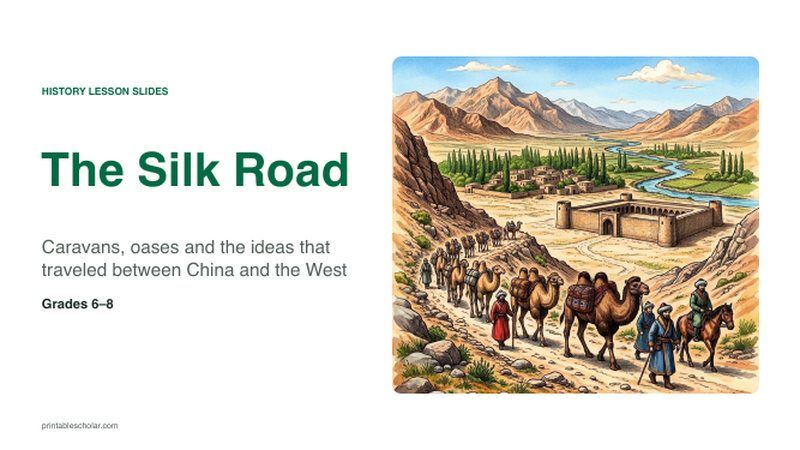 Teaching packThe Silk Road Teaching Pack, $7 — A two-week unit for grades 6 to 8: 43 lesson slides with guided notes, illustrated readings, a Three Ages of the Silk Road chart, labeled and blank maps, Choose Your Road West and the monk Xuanzang's real journey, how ideas traveled, a labeled caravanserai, the real Diamond Sutra of 868, how silk was made, Faxian, Pegolotti and Ibn Battuta, By Land or by Sea?, a quiz and answer keys.
See the pack
See it on the map
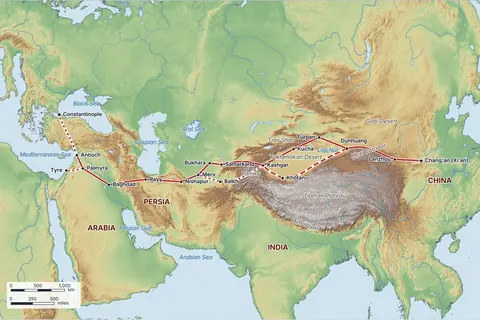 Pair this timeline with our printable The Silk Road map — follow the trade routes from Chang'an to the Mediterranean on real relief. Open the map →
Related timelines
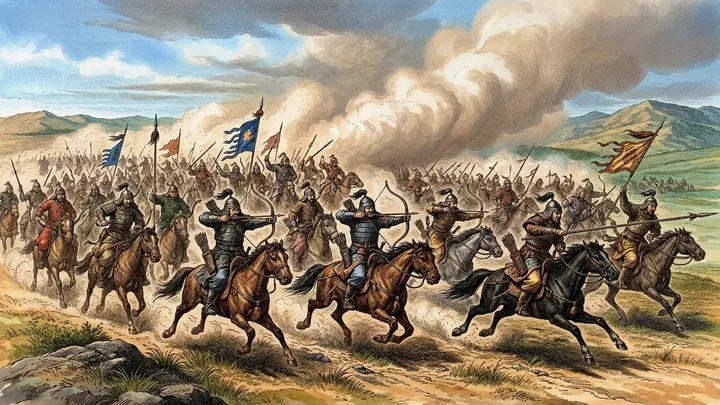 Mongol Empire Timeline — The Mongol Empire was the largest contiguous land empire in history — built by Genghis Khan and his descendants in just a few decades, stretching from the Pacific Ocean to Eastern Europe and ruling over about a quarter of the world's population at its peak. Open →
 Ancient China Timeline — Ancient China produced some of history's most enduring civilizations, giving the world writing, paper, the Silk Road, and two thousand years of dynastic rule. Open →
How to print
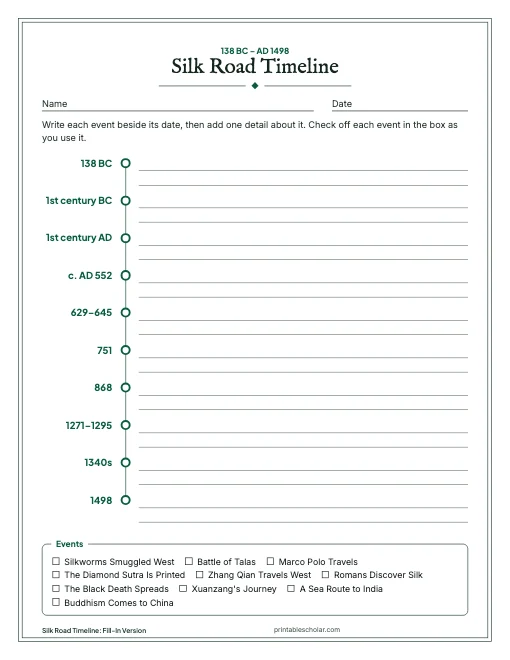
Every sheet above is a ready-to-print PDF sized for US Letter paper (8.5 × 11"). The fill-in version keeps the dates and gives students lines to write each event, with the events listed at the bottom to place — good for review. The ordering activity and the quiz each end with an answer key.
Frequently asked questions
Why was it called the Silk Road?
The name was invented much later, in 1877, by the German geographer Ferdinand von Richthofen. People at the time did not call it anything. He chose silk because it was China's most famous export, the product that most amazed buyers in Rome and Persia. In fact, the routes carried hundreds of goods, and many historians now say Silk Roads, plural.
Did traders travel the whole Silk Road?
Very few did. Most merchants traveled one section, between a few cities or oases, then sold their goods to the next trader. A bale of silk might change hands many times between China and the Mediterranean. Travelers who went all the way, such as Marco Polo, Xuanzang and Ibn Battuta, were rare enough that their accounts became famous.
What paper size should I print this on?
The timeline is sized for standard US Letter paper (8.5 × 11 in.). The Download PDF button gives you a print-ready file that fits the page automatically.