 Printable Scholar
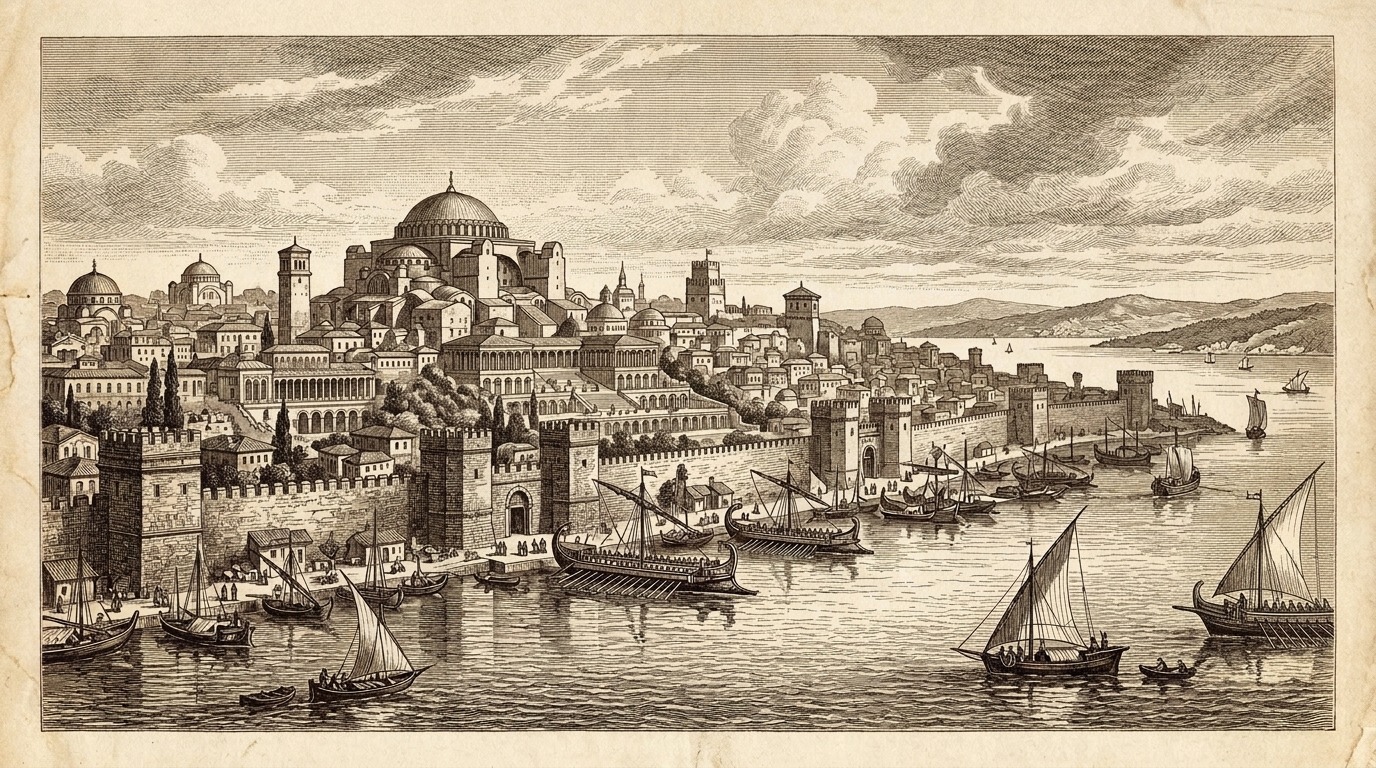
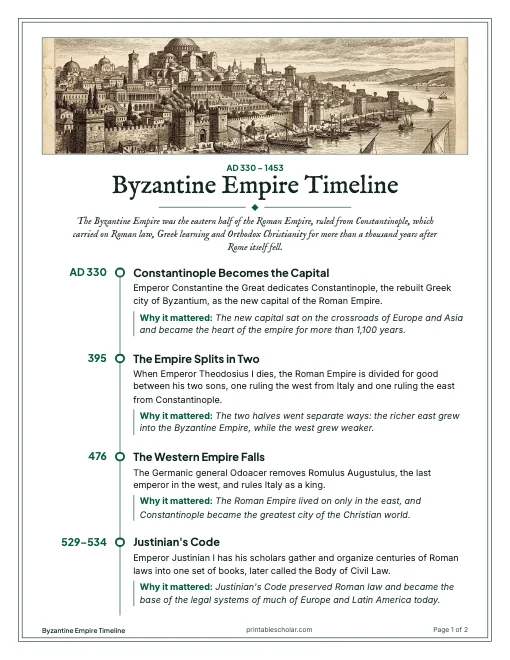
Byzantine Empire Timeline
The Byzantine Empire was the eastern half of the Roman Empire, ruled from Constantinople, which carried on Roman law, Greek learning and Orthodox Christianity for more than a thousand years after Rome itself fell.
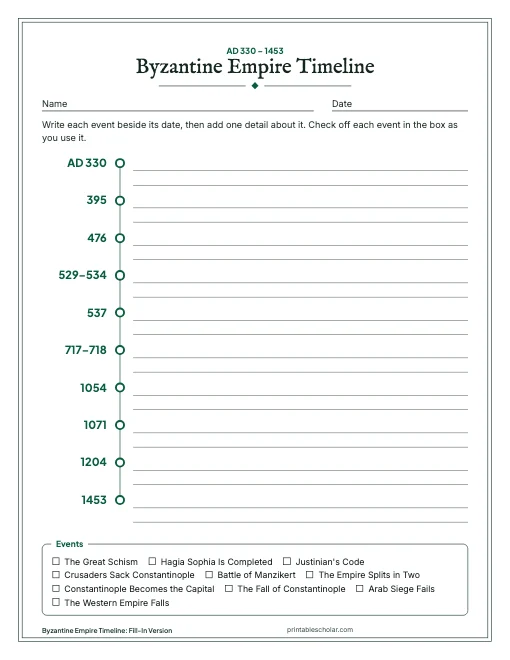
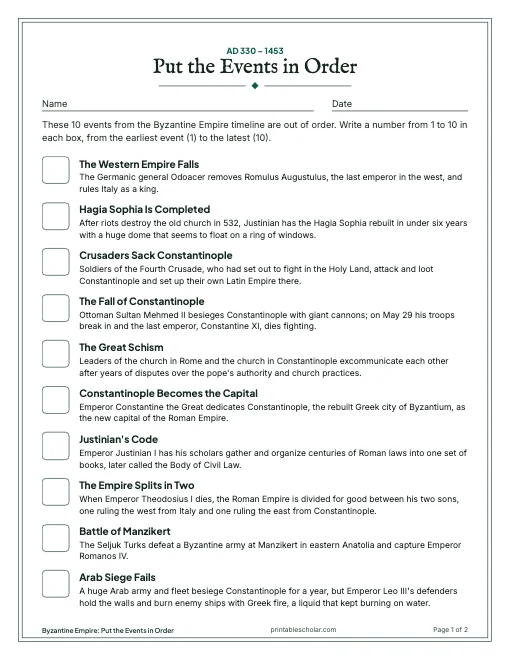
Put the Events in Order
The events shuffled, to number from first to last. With answer key.
Download PDF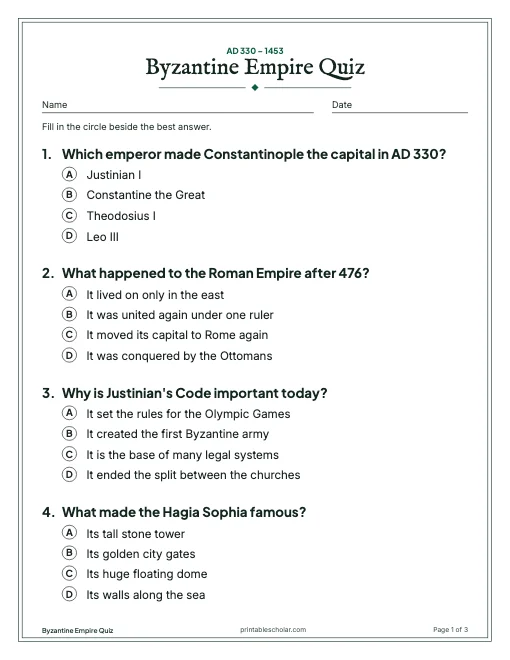
In the year 330, the Roman emperor Constantine moved his capital east to a Greek city on the narrow strait between Europe and Asia. He renamed it Constantinople. The city sat on the main routes between the Black Sea and the Mediterranean, and its land and sea walls made it one of the hardest places in the world to capture. When the western half of the Roman Empire collapsed in the 400s, the eastern half carried on. Its people called themselves Romans; historians later named their state the Byzantine Empire, after Byzantium, the city's old Greek name. Under emperors such as Justinian, it rewrote Roman law, built the great church of Hagia Sophia, and fought to win back lost lands. For the next thousand years the empire was squeezed by enemies on every side: Persians, Arabs, Bulgars, Turks, and even Crusaders from western Europe. It shrank again and again, but it held on until 1453, when the Ottoman Turks broke through the walls of Constantinople.
- AD 330
Constantinople Becomes the Capital
Emperor Constantine the Great dedicates Constantinople, the rebuilt Greek city of Byzantium, as the new capital of the Roman Empire.
Why it mattered: The new capital sat on the crossroads of Europe and Asia and became the heart of the empire for more than 1,100 years.
- 395
The Empire Splits in Two
When Emperor Theodosius I dies, the Roman Empire is divided for good between his two sons, one ruling the west from Italy and one ruling the east from Constantinople.
Why it mattered: The two halves went separate ways: the richer east grew into the Byzantine Empire, while the west grew weaker.
- 476
The Western Empire Falls
The Germanic general Odoacer removes Romulus Augustulus, the last emperor in the west, and rules Italy as a king.
Why it mattered: The Roman Empire lived on only in the east, and Constantinople became the greatest city of the Christian world.
- 529–534
Justinian's Code
Emperor Justinian I has his scholars gather and organize centuries of Roman laws into one set of books, later called the Body of Civil Law.
Why it mattered: Justinian's Code preserved Roman law and became the base of the legal systems of much of Europe and Latin America today.
- 537
Hagia Sophia Is Completed
After riots destroy the old church in 532, Justinian has the Hagia Sophia rebuilt in under six years with a huge dome that seems to float on a ring of windows.
Why it mattered: It was the largest church in the world for nearly a thousand years and its design inspired churches and mosques for centuries.
- 717–718
Arab Siege Fails
A huge Arab army and fleet besiege Constantinople for a year, but Emperor Leo III's defenders hold the walls and burn enemy ships with Greek fire, a liquid that kept burning on water.
Why it mattered: The victory stopped the Arab advance into southeastern Europe and kept Constantinople Christian for another 700 years.
- 1054
The Great Schism
Leaders of the church in Rome and the church in Constantinople excommunicate each other after years of disputes over the pope's authority and church practices.
Why it mattered: Christianity split into the Roman Catholic Church in the west and the Eastern Orthodox Church in the east, a division that still exists today.
- 1071
Battle of Manzikert
The Seljuk Turks defeat a Byzantine army at Manzikert in eastern Anatolia and capture Emperor Romanos IV.
Why it mattered: The empire lost most of Anatolia, its main source of soldiers and food, and in 1095 Emperor Alexios I asked the pope for help, which led to the First Crusade.
- 1204
Crusaders Sack Constantinople
Soldiers of the Fourth Crusade, who had set out to fight in the Holy Land, attack and loot Constantinople and set up their own Latin Empire there.
Why it mattered: The Byzantines took their city back in 1261, but the empire never recovered its wealth or strength.
- 1453
The Fall of Constantinople
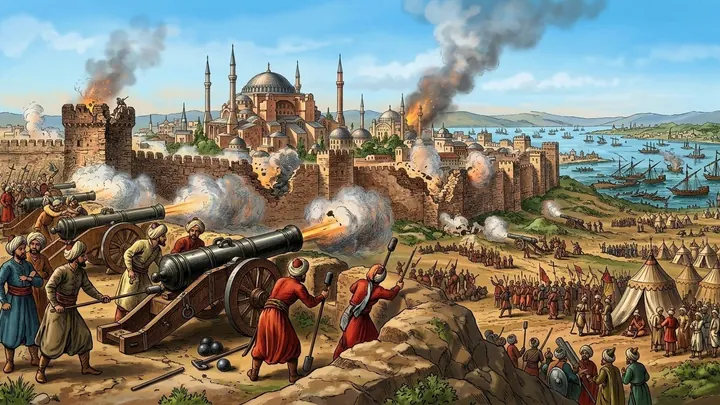
Ottoman Sultan Mehmed II besieges Constantinople with giant cannons; on May 29 his troops break in and the last emperor, Constantine XI, dies fighting.
Why it mattered: The Byzantine Empire ended after more than a thousand years, and the city became the Ottoman capital, later known as Istanbul.
Byzantine Empire Quiz
Check what you learned — read on screen, or download the Quiz with Answer Key above for a worksheet version.
Which emperor made Constantinople the capital in AD 330?
- A) Justinian I
- B) Constantine the Great
- C) Theodosius I
- D) Leo III
What happened to the Roman Empire after 476?
- A) It lived on only in the east
- B) It was united again under one ruler
- C) It moved its capital to Rome again
- D) It was conquered by the Ottomans
Why is Justinian's Code important today?
- A) It set the rules for the Olympic Games
- B) It created the first Byzantine army
- C) It is the base of many legal systems
- D) It ended the split between the churches
What made the Hagia Sophia famous?
- A) Its tall stone tower
- B) Its golden city gates
- C) Its huge floating dome
- D) Its walls along the sea
What was Greek fire?
- A) A liquid weapon that burned on water
- B) A signal of lights on the city towers
- C) A festival held in honor of the emperor
- D) A type of coin used across the empire
What did the Great Schism of 1054 divide?
- A) The empire into east and west
- B) The army into two rival sides
- C) The city into Greek and Latin parts
- D) The church into Catholic and Orthodox
Which defeat cost the empire most of Anatolia?
- A) The siege of 717–718
- B) The Fourth Crusade
- C) The Battle of Manzikert
- D) The fall of Constantinople
Who captured Constantinople in 1453?
- A) The Seljuk Turks
- B) The Crusaders of 1204
- C) The Abbasid Arabs
- D) The Ottoman Turks
Show answer key
1. B · 2. A · 3. C · 4. C · 5. A · 6. D · 7. C · 8. D
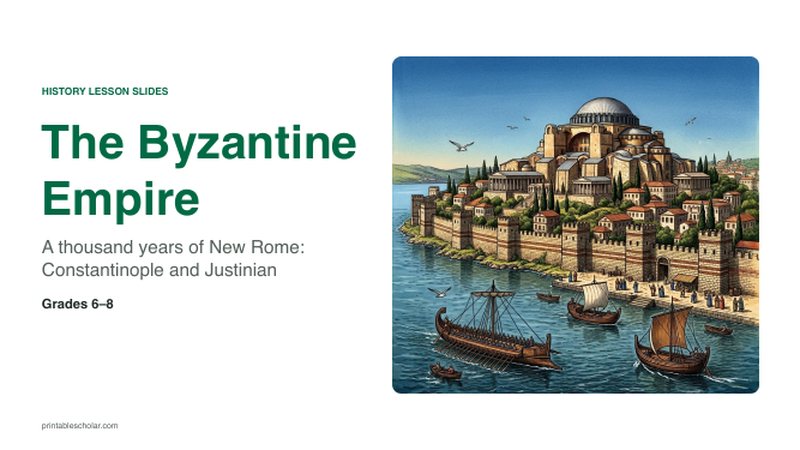 Teaching packThe Byzantine Empire Teaching Pack, $7 — A two-week unit for grades 6 to 8: 44 lesson slides with guided notes, illustrated readings, labeled and blank maps, Where Would You Build the New Rome?, a labeled view of Constantinople about 565, Justinian's court on the real San Vitale mosaic, how the Hagia Sophia was built, why Constantinople fell in 1453, Justinian's Institutes as a primary source, the Orthodox and Catholic churches compared, a quiz and answer keys.
See the pack
See it on the map
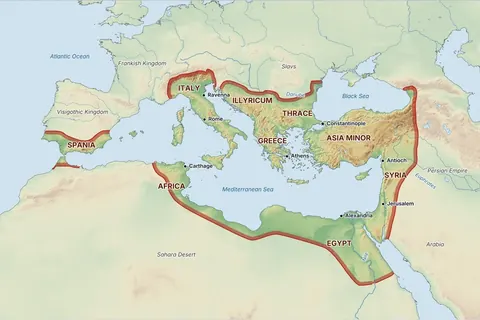 Pair this timeline with our printable The Byzantine Empire map — see the empire that kept Rome alive in the east for a thousand years. Open the map →
Related timelines
 Ottoman Empire Timeline — The Ottoman Empire was one of history's greatest empires — a Turkish state that grew from a small principality in Anatolia into a civilization spanning three continents, lasting more than 600 years before collapsing after World War I. Open →
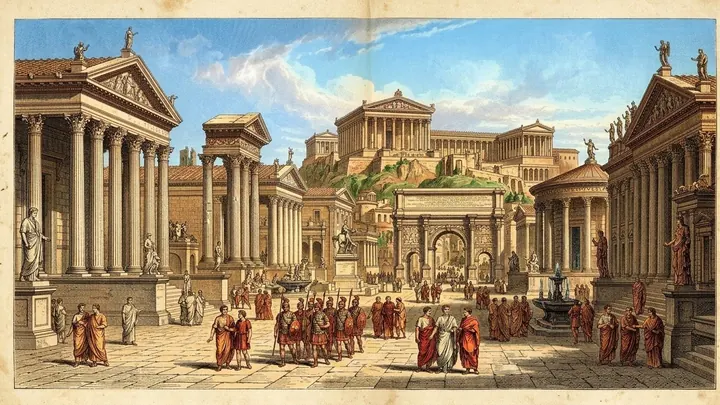 Ancient Rome Timeline — Ancient Rome grew from a small city on the banks of the Tiber River into the greatest empire of the ancient world, lasting over a thousand years. Open →
How to print
Every sheet above is a ready-to-print PDF sized for US Letter paper (8.5 × 11"). The fill-in version keeps the dates and gives students lines to write each event, with the events listed at the bottom to place — good for review. The ordering activity and the quiz each end with an answer key.
Frequently asked questions
Why is it called the Byzantine Empire?
Its own people never used the name. They called themselves Romans and their state the Roman Empire. Historians in western Europe began calling it Byzantine in the 1500s, after Byzantium, the old Greek name of Constantinople, to set it apart from the earlier empire ruled from Rome.
How did the Byzantine Empire last so long?
Constantinople's location and defenses were the biggest reason. Water protected the city on three sides, and its triple land walls held off attackers for centuries. The empire also had skilled diplomats, a strong gold coin used in trade across the world, and weapons such as Greek fire. Even when it lost provinces, the capital survived and the empire could rebuild.
What paper size should I print this on?
The timeline is sized for standard US Letter paper (8.5 × 11 in.). The Download PDF button gives you a print-ready file that fits the page automatically.