Russian Revolution Timeline
The Russian Revolution ended three centuries of Romanov rule, brought the Bolsheviks to power, and created the world's first communist state — the Soviet Union.
In 1917, Russia was falling apart. Three years of World War I had brought catastrophic military defeats, millions of casualties, and food shortages so severe that city workers were starving. Tsar Nicholas II had proven unable and unwilling to share power or change course. In February 1917, mass strikes and soldier mutinies forced him to abdicate — three centuries of Romanov rule ended in days. The new provisional government made a fatal mistake: it kept Russia in the war. Eight months later, Vladimir Lenin and the Bolshevik Party seized power promising peace, land, and bread. They won the brutal civil war that followed, but at an enormous cost — and Lenin's death in 1924 opened a power struggle that would bring Joseph Stalin to power.
- 1905
The 1905 Revolution
On Bloody Sunday, soldiers fire on peaceful marchers heading to the Tsar's palace in St. Petersburg; strikes and uprisings spread across Russia.
Why it mattered: The 1905 revolution forced Nicholas II to create a parliament — but his half-hearted reforms left the underlying problems of poverty, inequality, and autocracy completely unresolved.
- 1914–17
World War I Devastates Russia
Russia suffers catastrophic military defeats and millions of casualties; food shortages grow severe as the war economy breaks down.
Why it mattered: By early 1917, Russia had lost millions of soldiers, cities were starving, and ordinary people had completely lost faith in the Tsar's government.
- February 1917
February Revolution
Mass strikes and soldier mutinies in Petrograd force Tsar Nicholas II to abdicate; a provisional government of liberal politicians takes power.
Why it mattered: Three centuries of Romanov rule ended in days — but the provisional government made a fatal error by refusing to end the deeply unpopular war.
- April 1917
Lenin Returns to Russia
Vladimir Lenin, leader of the Bolshevik Party, returns from exile with a radical program: immediate peace, land for the peasants, and power to workers' councils called soviets.
Why it mattered: Lenin's simple slogans — peace, land, bread — gave the Bolsheviks a clear message that resonated with desperate workers and soldiers.
- October 1917
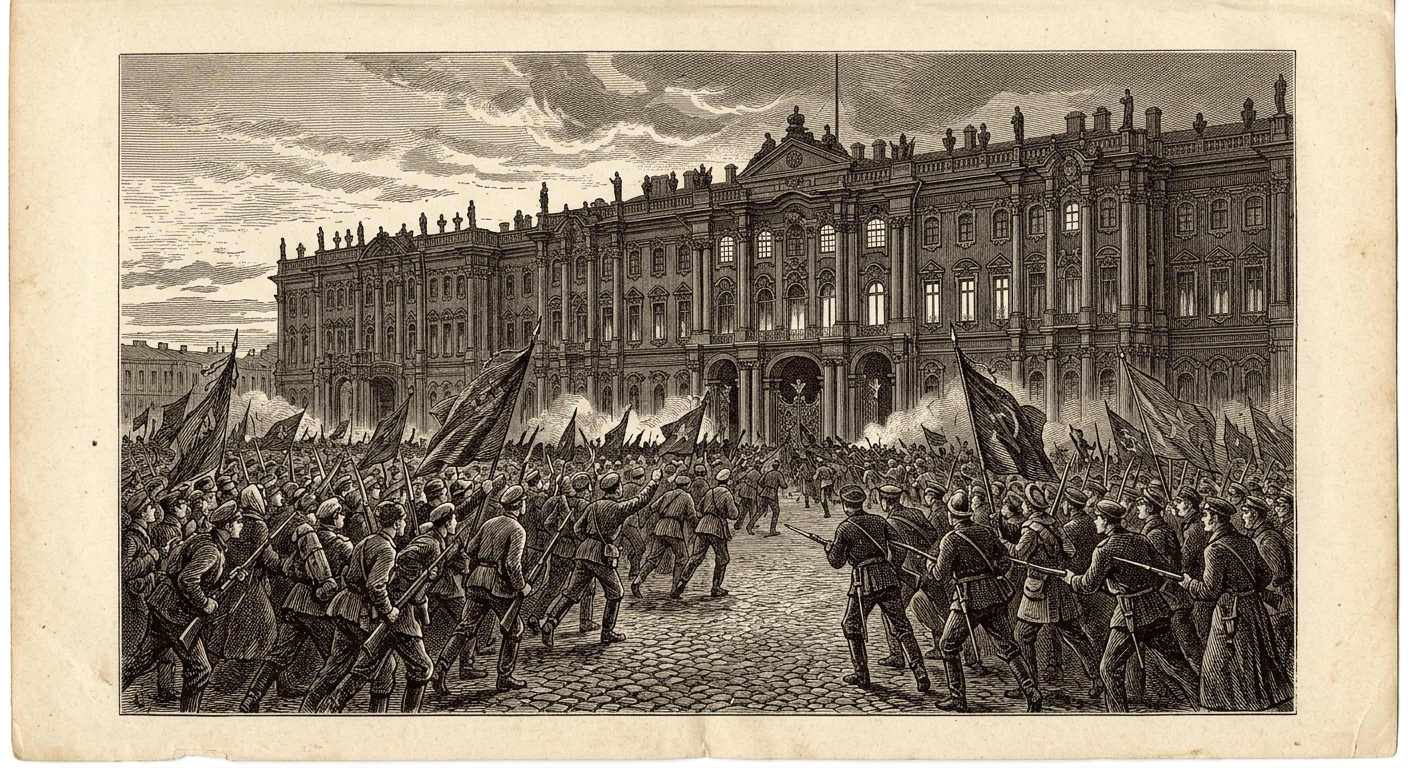
October Revolution
On the night of October 25-26, the Bolsheviks seize key government buildings in Petrograd and overthrow the provisional government in a nearly bloodless coup.
Why it mattered: The Bolsheviks had taken power — but turning a coup in one city into control of a country as vast as Russia would require years of brutal civil war.
- 1918
Treaty of Brest-Litovsk
The Bolsheviks sign a humiliating peace treaty with Germany, surrendering vast territories including Ukraine, Poland, and the Baltic states.
Why it mattered: Lenin accepted enormous losses to exit the war — his priority was securing the revolution at home, not defending territory that would have to be retaken later.
- 1918
Execution of the Romanovs
Tsar Nicholas II, his wife, and their five children are executed by Bolshevik forces in Yekaterinburg.
Why it mattered: The executions ended any possibility of a Romanov restoration and signaled the Bolsheviks' willingness to use extreme measures to hold power.
- 1918–22
Russian Civil War
The Bolshevik Red Army fights the anti-Bolshevik White Army — backed by Britain, France, the US, and Japan — in a brutal civil war.
Why it mattered: The civil war killed more people through war, disease, and famine than World War I had — but the Bolsheviks won, and the Soviet state survived.
- 1921
New Economic Policy
Lenin introduces the New Economic Policy, allowing limited private enterprise to revive the economy after the devastation of war and civil war.
Why it mattered: The NEP showed Lenin's pragmatism — he temporarily retreated from pure communism to prevent economic collapse, proving he valued power over ideology.
- 1924
Lenin Dies — Stalin Rises
Vladimir Lenin dies in January after years of declining health; Joseph Stalin outmaneuvers rivals including Leon Trotsky to take control of the Soviet Union.
Why it mattered: Lenin's death opened a power struggle that Stalin won — establishing a personal dictatorship far more brutal than anything Lenin had built.
Russian Revolution Quiz
Check what you learned — read on screen, or use the Printable quiz button above for a worksheet version with an answer key.
What happened on Bloody Sunday in 1905?
- A) The Tsar was assassinated by revolutionaries
- B) Soldiers fired on peaceful marchers heading to the Tsar's palace, sparking the 1905 revolution
- C) The Bolsheviks launched their October Revolution
- D) The Romanov family was executed in Yekaterinburg
Why did the Russian provisional government fall in 1917?
- A) It was too radical for ordinary Russians to support
- B) It refused to end the deeply unpopular World War I and could not solve the food crisis
- C) The Tsar returned from exile and reclaimed power
- D) The Bolsheviks won a democratic election
What were Lenin's three simple slogans that attracted popular support?
- A) Liberty, equality, and brotherhood
- B) Workers of the world, unite
- C) Peace, land, and bread
- D) God, Tsar, and nation
What happened during the October Revolution of 1917?
- A) The Tsar abdicated after mass protests in the streets
- B) The Bolsheviks seized key government buildings and overthrew the provisional government in a near-bloodless coup
- C) Germany invaded Russia and seized the capital
- D) A democratic election gave the Bolsheviks a majority
What was the Treaty of Brest-Litovsk?
- A) A peace deal that ended the Russian Civil War
- B) A humiliating treaty with Germany in which Russia surrendered vast territories to exit World War I
- C) A trade agreement between Soviet Russia and the Western powers
- D) A treaty that gave farmland to Russian peasants
Who fought in the Russian Civil War?
- A) Russia against Germany and Austria-Hungary
- B) The Bolshevik Red Army against the anti-Bolshevik White Army backed by foreign powers
- C) The Tsar's army against a revolutionary peasant army
- D) The Bolsheviks against the Socialist Revolutionaries only
What happened to Tsar Nicholas II and his family?
- A) They escaped to exile in France or England
- B) They were imprisoned but eventually released after the civil war
- C) They were executed by Bolshevik forces in Yekaterinburg in 1918
- D) They were kept as symbolic figureheads under Bolshevik rule
Who succeeded Lenin as the dominant leader of the Soviet Union?
- A) Leon Trotsky
- B) Nikolai Bukharin
- C) Joseph Stalin
- D) Alexander Kerensky
Show answer key
1. B · 2. B · 3. C · 4. B · 5. B · 6. B · 7. C · 8. C
Related timelines
 World War I Timeline — World War I was a global war fought mainly in Europe from 1914 to 1918. The United States stayed neutral for three years before entering on the Allied side in 1917. Open →
 Cold War Timeline — The Cold War was a decades-long rivalry between the United States and the Soviet Union, fought through arms races, proxy wars, and the constant threat of nuclear destruction. Open →
How to print
Choose Download PDF for a ready-to-print timeline that fits US Letter paper (8.5 × 11"). The blank fill-in version keeps the dates and gives students empty lines to write each event — great for review and quizzes.
Frequently asked questions
What caused the Russian Revolution?
The Russian Revolution had multiple causes: deep poverty and inequality, the catastrophic losses of World War I, the Tsar's refusal to share power or reform the government, and the provisional government's fatal decision to keep Russia in the war. The Bolsheviks, led by Lenin, offered simple solutions — peace, land, and bread — at exactly the moment when the population was desperate enough to accept radical change.
What was the difference between the February and October Revolutions?
There were two revolutions in Russia in 1917. The February Revolution was a spontaneous mass uprising — strikes, mutinies, protests — that forced Tsar Nicholas II to abdicate and brought a liberal provisional government to power. The October Revolution was a planned coup by the Bolshevik Party, which seized power from the provisional government in a near-bloodless operation and established communist rule over Russia.
What paper size should I print this on?
The timeline is sized for standard US Letter paper (8.5 × 11 in.). The Download PDF button gives you a print-ready file that fits the page automatically.