Rules of Hnefatafl
2 players · about 20-30 minutes · ages 8 and up. Vikings, about AD 800-1100.
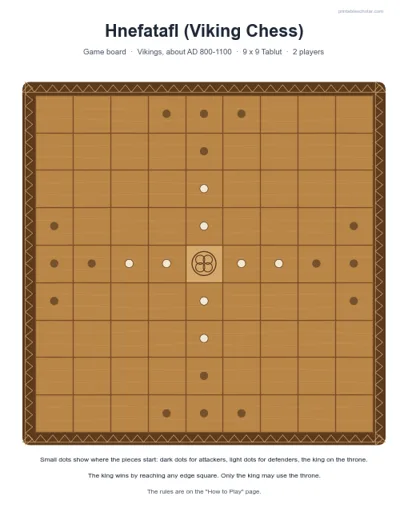
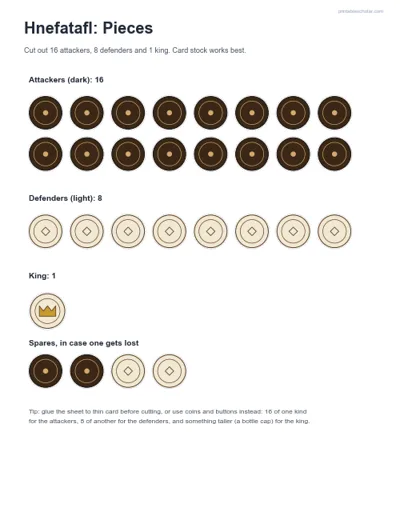
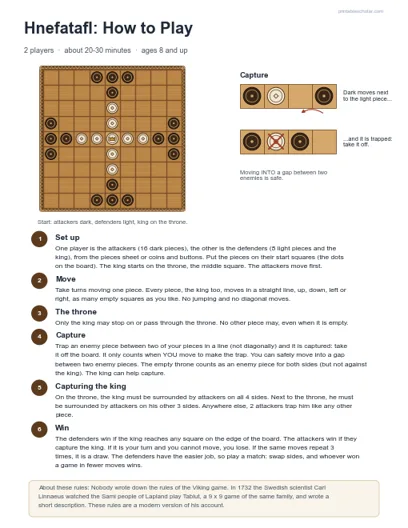
- Set up. One player is the attackers (16 dark pieces), the other is the defenders (8 light pieces and the king), from the pieces sheet or coins and buttons. Put the pieces on their start squares (the dots on the board). The king starts on the throne, the middle square. The attackers move first.
- Move. Take turns moving one piece. Every piece, the king too, moves in a straight line, up, down, left or right, as many empty squares as you like. No jumping and no diagonal moves.
- The throne. Only the king may stop on or pass through the throne. No other piece may, even when it is empty.
- Capture. Trap an enemy piece between two of your pieces in a line (not diagonally) and it is captured: take it off the board. It only counts when YOU move to make the trap. You can safely move into a gap between two enemy pieces. The empty throne counts as an enemy piece for both sides (but not against the king). The king can help capture.
- Capturing the king. On the throne, the king must be surrounded by attackers on all 4 sides. Next to the throne, he must be surrounded by attackers on his other 3 sides. Anywhere else, 2 attackers trap him like any other piece.
- Win. The defenders win if the king reaches any square on the edge of the board. The attackers win if they capture the king. If it is your turn and you cannot move, you lose. If the same moves repeat 3 times, it is a draw. The defenders have the easier job, so play a match: swap sides, and whoever won a game in fewer moves wins.
About these rules: Nobody wrote down the rules of the Viking game. In 1732 the Swedish scientist Carl Linnaeus watched the Sami people of Lapland play Tablut, a 9 x 9 game of the same family, and wrote a short description. These rules are a modern version of his account.
The history of Hnefatafl
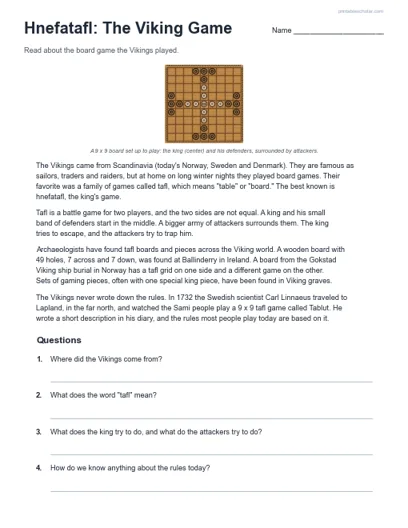
The Vikings came from Scandinavia (today's Norway, Sweden and Denmark). They are famous as sailors, traders and raiders, but at home on long winter nights they played board games. Their favorite was a family of games called tafl, which means "table" or "board." The best known is hnefatafl, the king's game.
Tafl is a battle game for two players, and the two sides are not equal. A king and his small band of defenders start in the middle. A bigger army of attackers surrounds them. The king tries to escape, and the attackers try to trap him.
Archaeologists have found tafl boards and pieces across the Viking world. A wooden board with 49 holes, 7 across and 7 down, was found at Ballinderry in Ireland. A board from the Gokstad Viking ship burial in Norway has a tafl grid on one side and a different game on the other. Sets of gaming pieces, often with one special king piece, have been found in Viking graves.
The Vikings never wrote down the rules. In 1732 the Swedish scientist Carl Linnaeus traveled to Lapland, in the far north, and watched the Sami people play a 9 x 9 tafl game called Tablut. He wrote a short description in his diary, and the rules most people play today are based on it.
Teaching Vikings? The game fits right into a history unit: play it on the day you teach the civilization, then hand out the reading.
 Printable Scholar
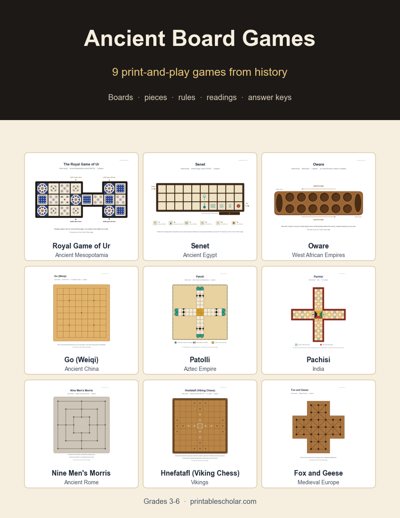
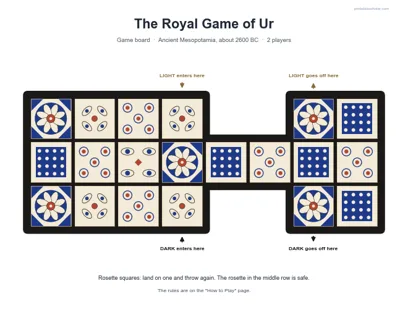 Royal Game of Ur
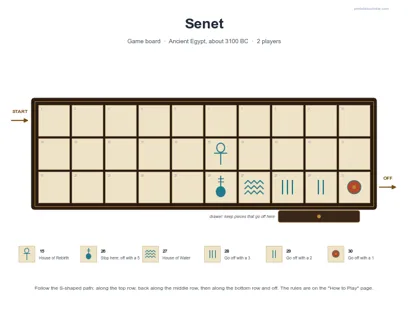 Senet
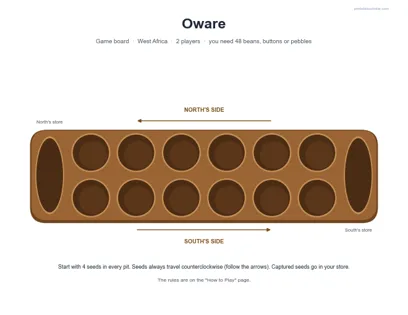 Oware
 Go (Weiqi)
 Patolli
 Pachisi
 Nine Men's Morris
 Fox and Geese