Printable Scholar
How to Play the Royal Game of Ur
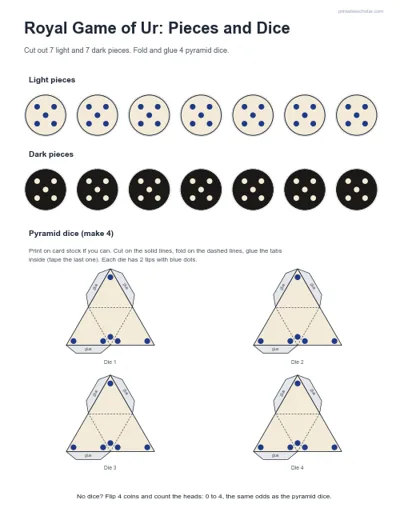
One of the oldest board games in the world: a two-player race across 20 squares, found in the royal tombs of Ur in Mesopotamia. Print the board, pieces and fold-up pyramid dice and play it tonight.
2 players · about 20-30 minutes · ages 8 and up. Ancient Mesopotamia, about 2600 BC.
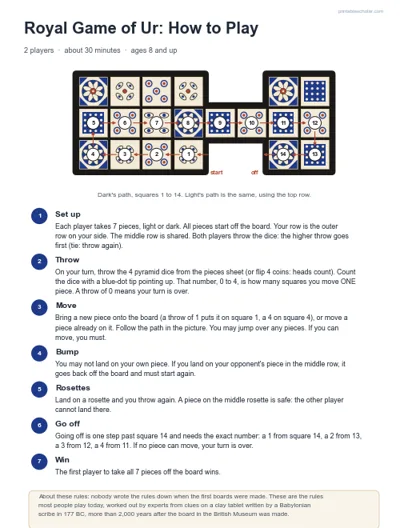
About these rules: Nobody wrote the rules down when the first boards were made. These are the rules most people play today, worked out by experts from clues on a clay tablet written by a Babylonian scribe in 177 BC.
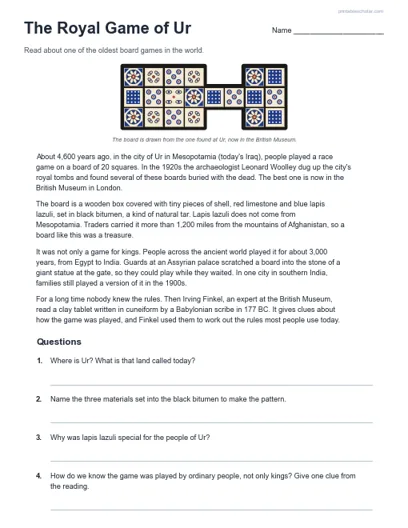
About 4,600 years ago, in the city of Ur in Mesopotamia (today's Iraq), people played a race game on a board of 20 squares. In the 1920s the archaeologist Leonard Woolley dug up the city's royal tombs and found several of these boards buried with the dead. The best one is now in the British Museum in London.
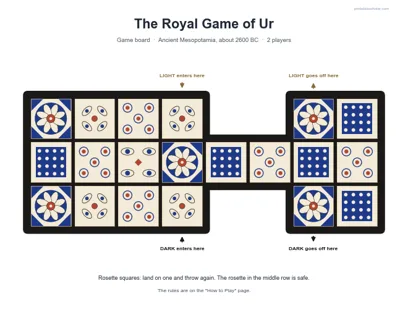
The board is a wooden box covered with tiny pieces of shell, red limestone and blue lapis lazuli, set in black bitumen, a kind of natural tar. Lapis lazuli does not come from Mesopotamia. Traders carried it more than 1,200 miles from the mountains of Afghanistan, so a board like this was a treasure.
It was not only a game for kings. People across the ancient world played it for about 3,000 years, from Egypt to India. Guards at an Assyrian palace scratched a board into the stone of a giant statue at the gate, so they could play while they waited. In one city in southern India, families still played a version of it in the 1900s.
For a long time nobody knew the rules. Then Irving Finkel, an expert at the British Museum, read a clay tablet written in cuneiform by a Babylonian scribe in 177 BC. It gives clues about how the game was played, and Finkel used them to work out the rules most people use today.
Teaching Ancient Mesopotamia? The game fits right into a history unit: play it on the day you teach the civilization, then hand out the reading.
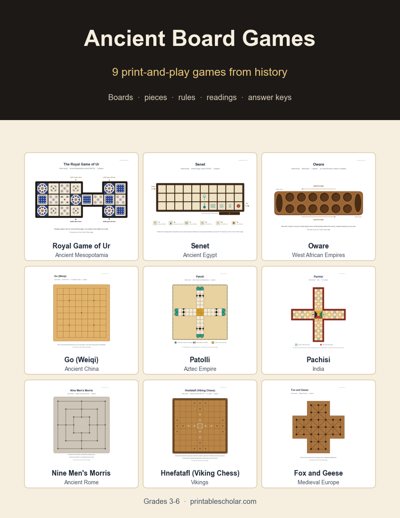
Royal Game of Ur, Senet, Oware, Go, Patolli, Pachisi, Nine Men's Morris, Hnefatafl, Fox and Geese: one print-ready PDF for a whole history year.
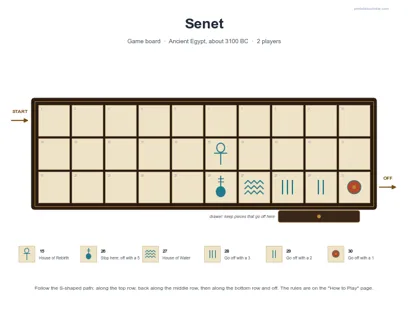 SenetAncient Egypt, about 3100 BC · 2 players
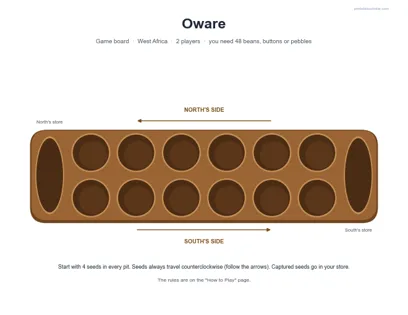 OwareWest African Empires, played for hundreds of years · 2 players
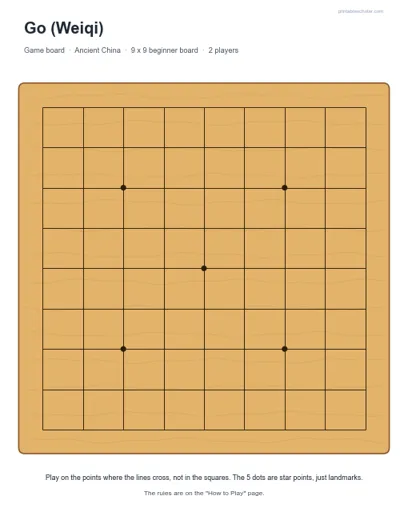 Go (Weiqi)Ancient China, first written mention 548 BC · 2 players
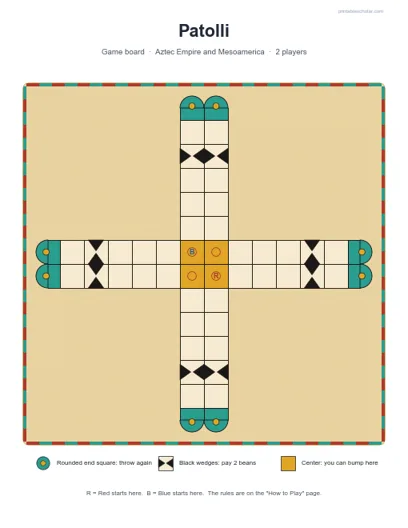 PatolliAztec Empire, played for over 1,000 years, to the 1500s · 2 players
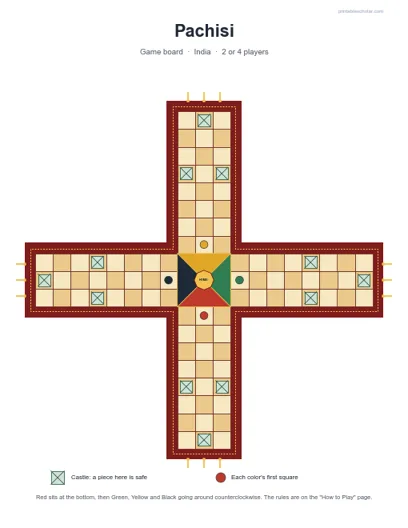 PachisiIndia, known from the 1500s (Mughal India) · 2 or 4 players
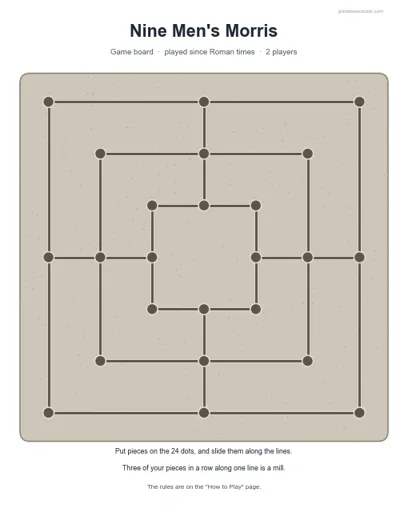 Nine Men's MorrisAncient Rome, about 2,000 years old · 2 players
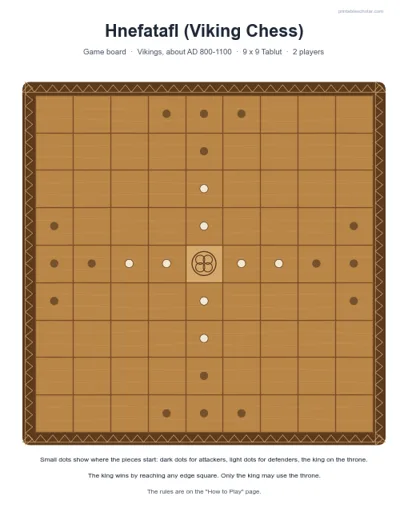 Hnefatafl (Viking Chess)Vikings, about AD 800-1100 · 2 players
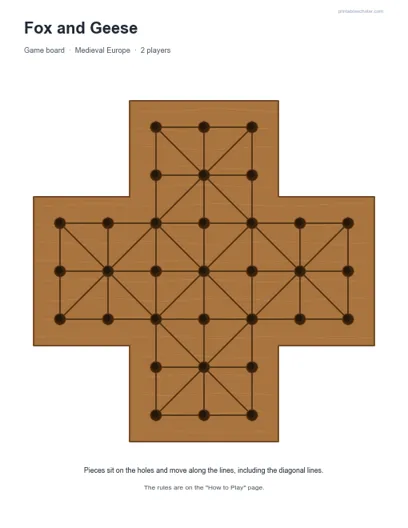 Fox and GeeseMedieval Europe, known from the 1300s · 2 players