Printable Scholar
How to Play Go
Go is the ancient Chinese "surrounding game," still played by millions after more than 2,500 years. Learn how to play Go on a printable 9 x 9 beginner board, starting with Capture Go.
2 players · Capture Go 10 minutes, full game 30-45 minutes · ages 7 and up. Ancient China, first written mention 548 BC.
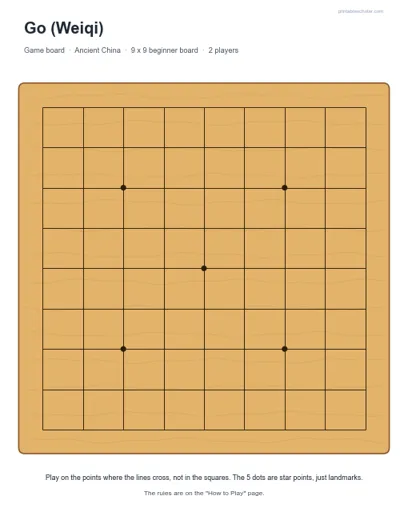
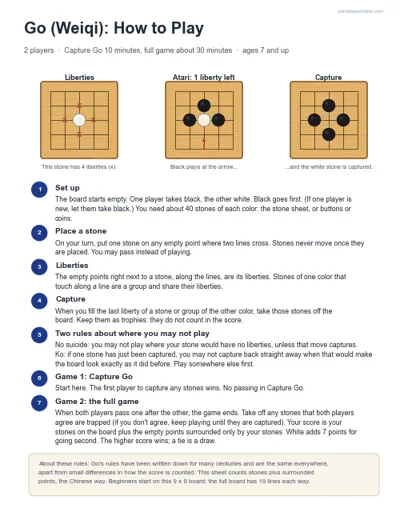
About these rules: Go's rules have been written down for many centuries and are the same everywhere, apart from small differences in how the score is counted. This sheet counts stones plus surrounded points, the Chinese way. Beginners start on this 9 x 9 board; the full board has 19 lines each way.
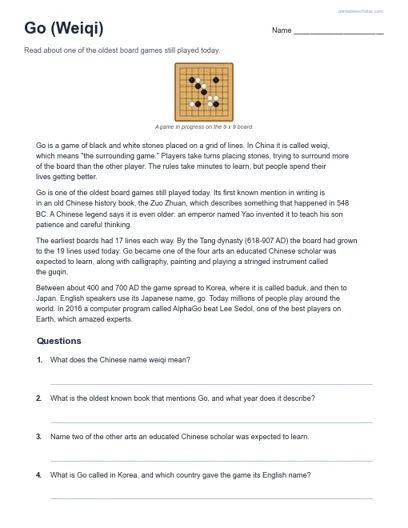
Go is a game of black and white stones placed on a grid of lines. In China it is called weiqi, which means "the surrounding game." Players take turns placing stones, trying to surround more of the board than the other player. The rules take minutes to learn, but people spend their lives getting better.
Go is one of the oldest board games still played today. Its first known mention in writing is in an old Chinese history book, the Zuo Zhuan, which describes something that happened in 548 BC. A Chinese legend says it is even older: an emperor named Yao invented it to teach his son patience and careful thinking.
The earliest boards had 17 lines each way. By the Tang dynasty (618-907 AD) the board had grown to the 19 lines used today. Go became one of the four arts an educated Chinese scholar was expected to learn, along with calligraphy, painting and playing a stringed instrument called the guqin.
Between about 400 and 700 AD the game spread to Korea, where it is called baduk, and then to Japan. English speakers use its Japanese name, go. Today millions of people play around the world. In 2016 a computer program called AlphaGo beat Lee Sedol, one of the best players on Earth, which amazed experts.
Teaching Ancient China? The game fits right into a history unit: play it on the day you teach the civilization, then hand out the reading.
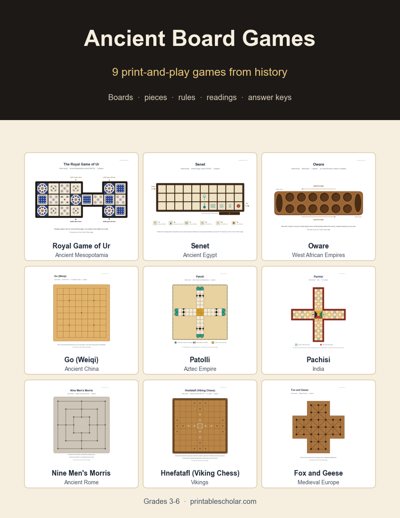
Royal Game of Ur, Senet, Oware, Go, Patolli, Pachisi, Nine Men's Morris, Hnefatafl, Fox and Geese: one print-ready PDF for a whole history year.
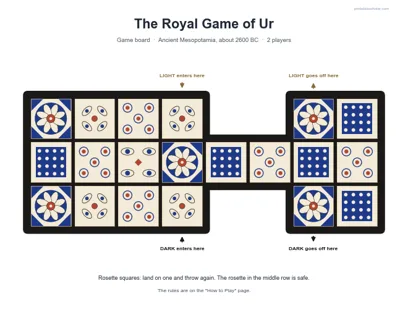 Royal Game of UrAncient Mesopotamia, about 2600 BC · 2 players
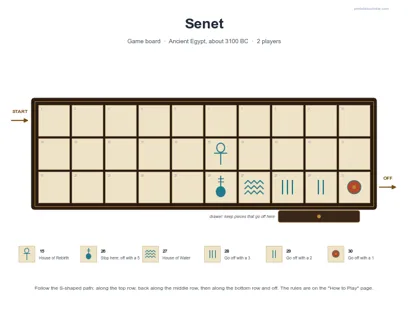 SenetAncient Egypt, about 3100 BC · 2 players
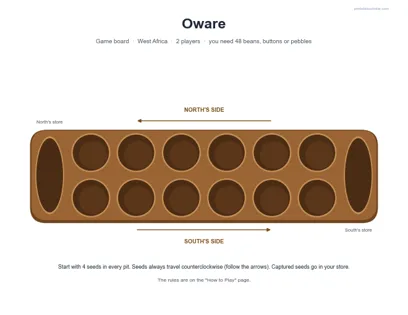 OwareWest African Empires, played for hundreds of years · 2 players
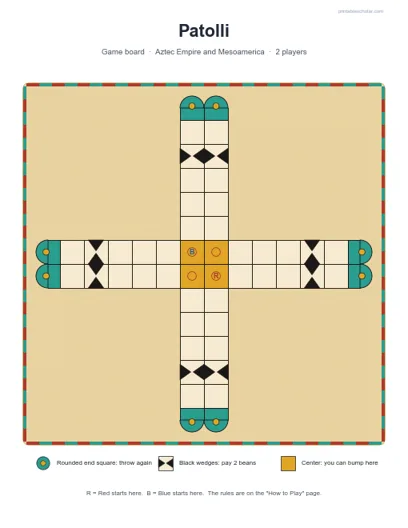 PatolliAztec Empire, played for over 1,000 years, to the 1500s · 2 players
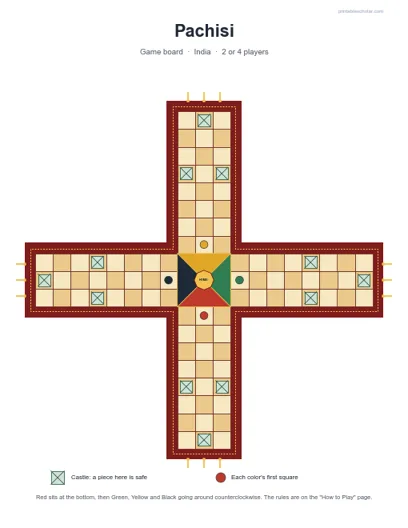 PachisiIndia, known from the 1500s (Mughal India) · 2 or 4 players
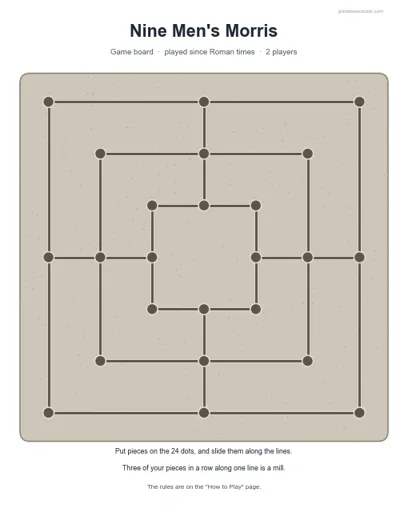 Nine Men's MorrisAncient Rome, about 2,000 years old · 2 players
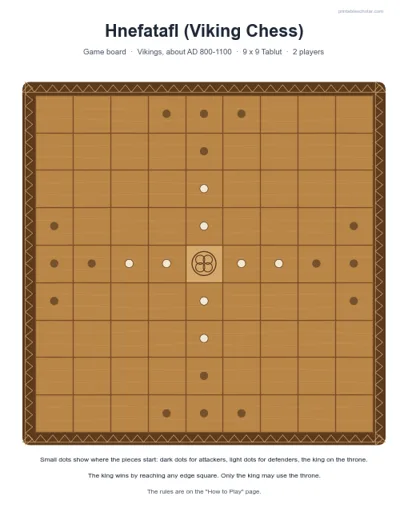 Hnefatafl (Viking Chess)Vikings, about AD 800-1100 · 2 players
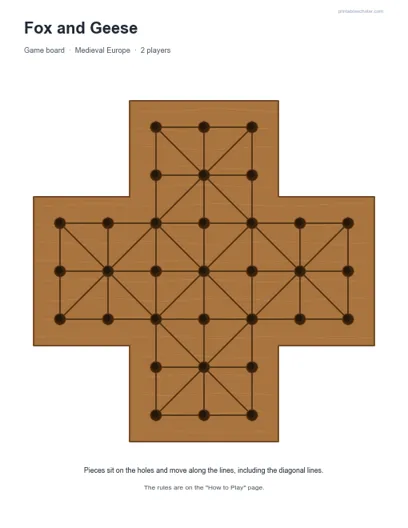 Fox and GeeseMedieval Europe, known from the 1300s · 2 players