Printable Scholar
How to Play Patolli
Patolli was the Aztec race game played with five marked beans on a cross-shaped mat. Learn how to play patolli, then print the board, stones, beans and cacao-bean treasure and play it at home or in class.
2 players · about 30 minutes · ages 8 and up. Aztec Empire, played for over 1,000 years, to the 1500s.
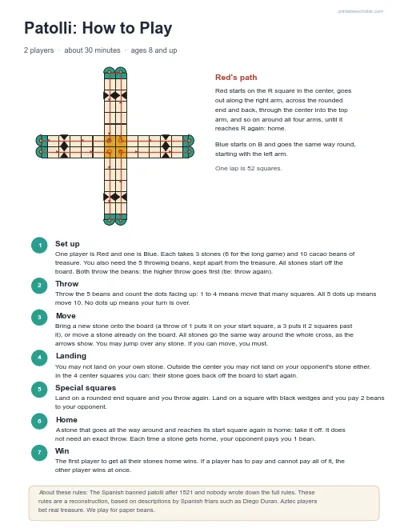
About these rules: The Spanish banned patolli after 1521 and nobody wrote down the full rules. These rules are a reconstruction, based on descriptions by Spanish friars such as Diego Duran. Aztec players bet real treasure. We play for paper beans.
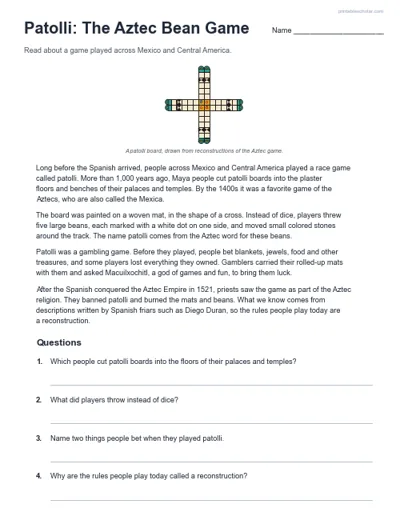
Long before the Spanish arrived, people across Mexico and Central America played a race game called patolli. More than 1,000 years ago, Maya people cut patolli boards into the plaster floors and benches of their palaces and temples. By the 1400s it was a favorite game of the Aztecs, who are also called the Mexica.
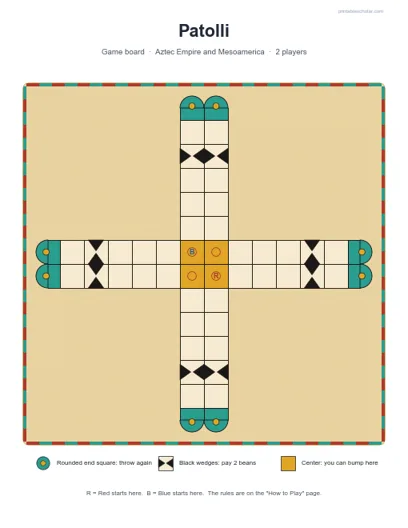
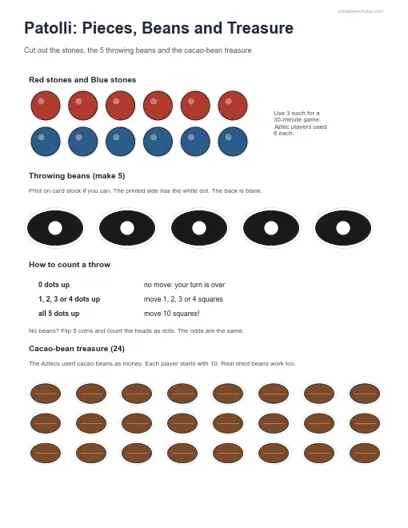
The board was painted on a woven mat, in the shape of a cross. Instead of dice, players threw five large beans, each marked with a white dot on one side, and moved small colored stones around the track. The name patolli comes from the Aztec word for these beans.
Patolli was a gambling game. Before they played, people bet blankets, jewels, food and other treasures, and some players lost everything they owned. Gamblers carried their rolled-up mats with them and asked Macuilxochitl, a god of games and fun, to bring them luck.
After the Spanish conquered the Aztec Empire in 1521, priests saw the game as part of the Aztec religion. They banned patolli and burned the mats and beans. What we know comes from descriptions written by Spanish friars such as Diego Duran, so the rules people play today are a reconstruction.
Teaching Aztec Empire? The game fits right into a history unit: play it on the day you teach the civilization, then hand out the reading.
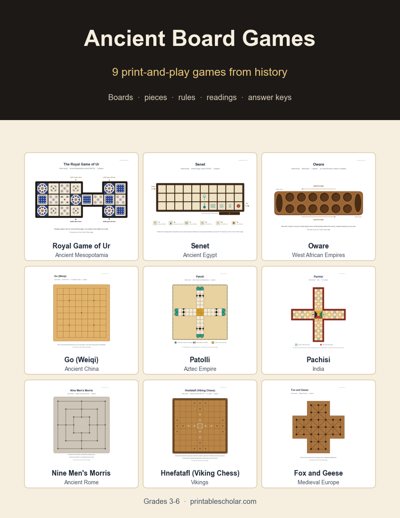
Royal Game of Ur, Senet, Oware, Go, Patolli, Pachisi, Nine Men's Morris, Hnefatafl, Fox and Geese: one print-ready PDF for a whole history year.
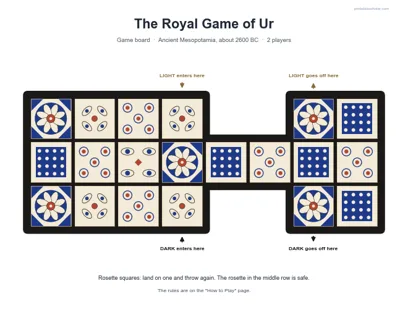 Royal Game of UrAncient Mesopotamia, about 2600 BC · 2 players
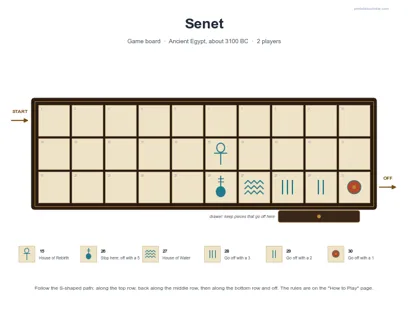 SenetAncient Egypt, about 3100 BC · 2 players
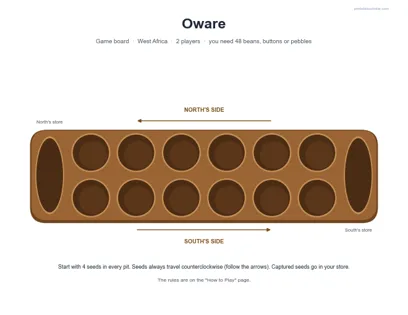 OwareWest African Empires, played for hundreds of years · 2 players
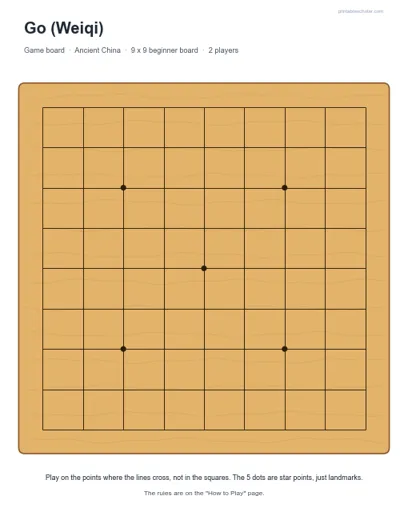 Go (Weiqi)Ancient China, first written mention 548 BC · 2 players
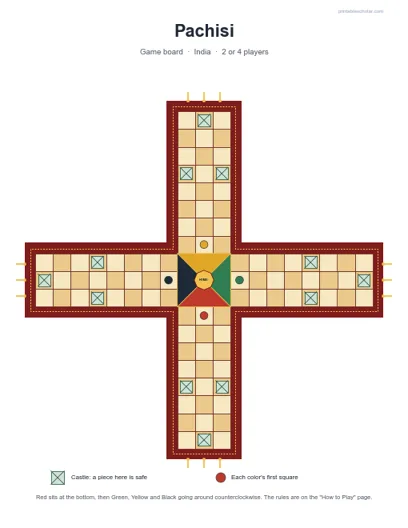 PachisiIndia, known from the 1500s (Mughal India) · 2 or 4 players
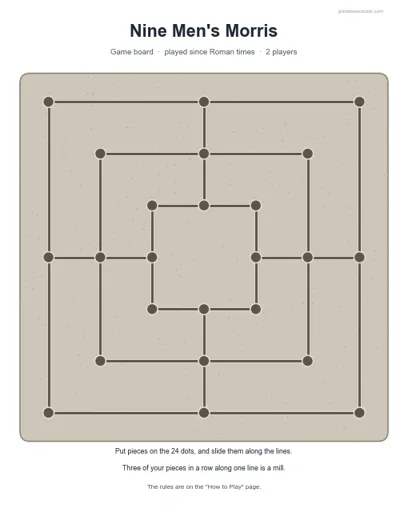 Nine Men's MorrisAncient Rome, about 2,000 years old · 2 players
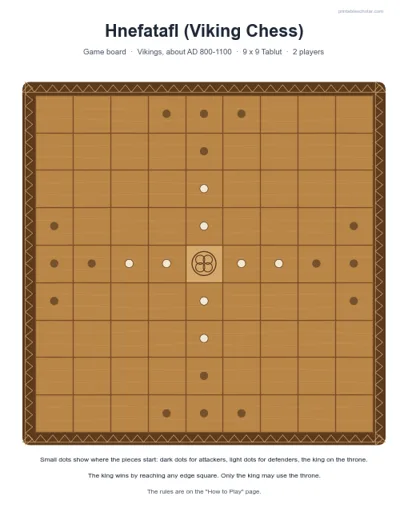 Hnefatafl (Viking Chess)Vikings, about AD 800-1100 · 2 players
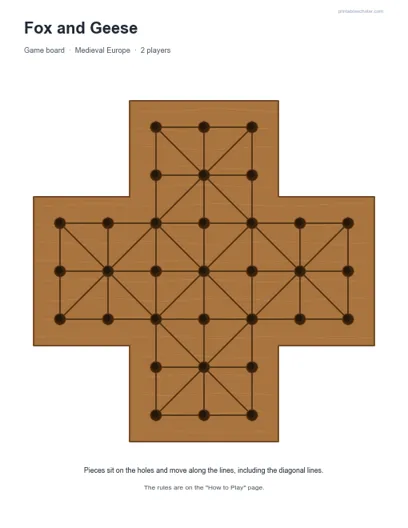 Fox and GeeseMedieval Europe, known from the 1300s · 2 players