Printable Scholar
How to Play Pachisi
Pachisi is the cross-and-circle race game from India, played with cowrie shells on a cloth board, and the ancestor of Ludo and Parcheesi. Learn how to play Pachisi, then print the board, pieces and shells.
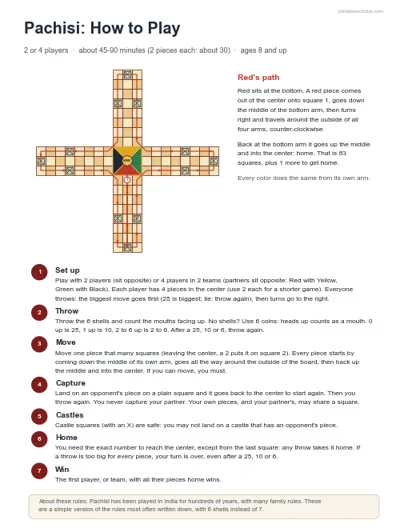
2 or 4 players · about 45-90 minutes (2 pieces each: about 30) · ages 8 and up. India, known from the 1500s (Mughal India).
About these rules: Pachisi has been played in India for hundreds of years, with many family rules. These are a simple version of the rules most often written down, with 6 shells instead of 7.
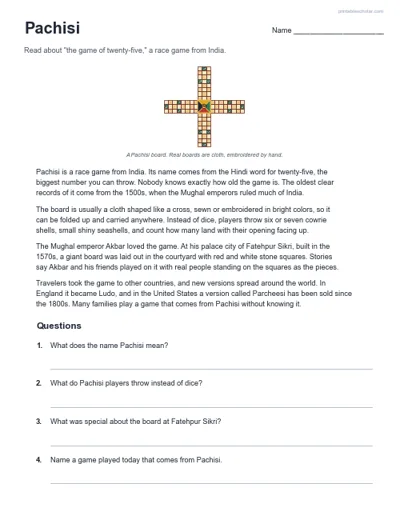
Pachisi is a race game from India. Its name comes from the Hindi word for twenty-five, the biggest number you can throw. Nobody knows exactly how old the game is. The oldest clear records of it come from the 1500s, when the Mughal emperors ruled much of India.
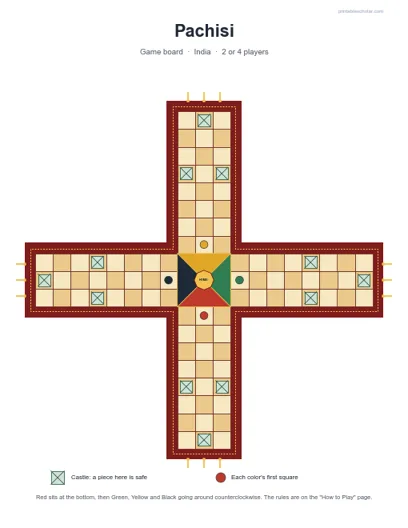
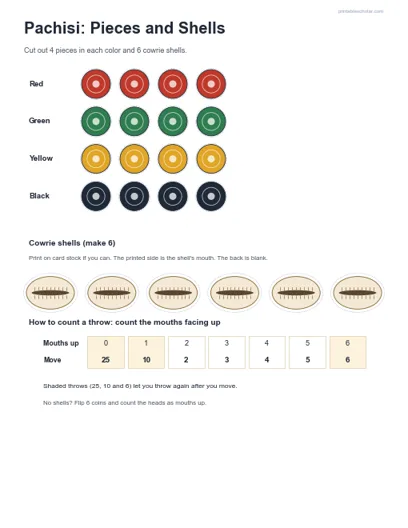
The board is usually a cloth shaped like a cross, sewn or embroidered in bright colors, so it can be folded up and carried anywhere. Instead of dice, players throw six or seven cowrie shells, small shiny seashells, and count how many land with their opening facing up.
The Mughal emperor Akbar loved the game. At his palace city of Fatehpur Sikri, built in the 1570s, a giant board was laid out in the courtyard with red and white stone squares. Stories say Akbar and his friends played on it with real people standing on the squares as the pieces.
Travelers took the game to other countries, and new versions spread around the world. In England it became Ludo, and in the United States a version called Parcheesi has been sold since the 1800s. Many families play a game that comes from Pachisi without knowing it.
Teaching India? The game fits right into a history unit: play it on the day you teach the civilization, then hand out the reading.
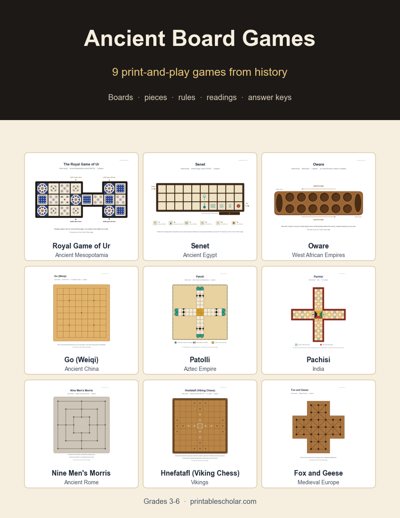
Royal Game of Ur, Senet, Oware, Go, Patolli, Pachisi, Nine Men's Morris, Hnefatafl, Fox and Geese: one print-ready PDF for a whole history year.
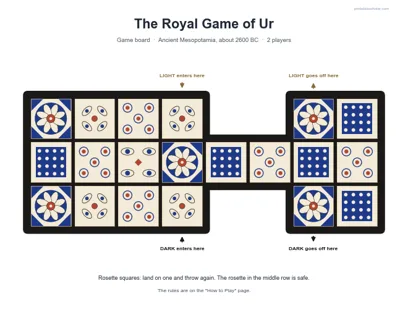 Royal Game of UrAncient Mesopotamia, about 2600 BC · 2 players
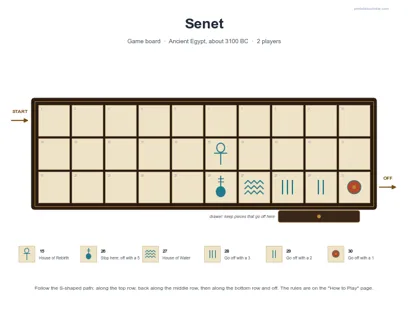 SenetAncient Egypt, about 3100 BC · 2 players
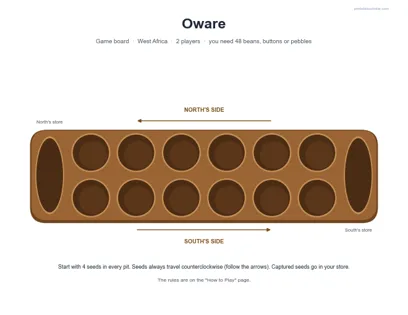 OwareWest African Empires, played for hundreds of years · 2 players
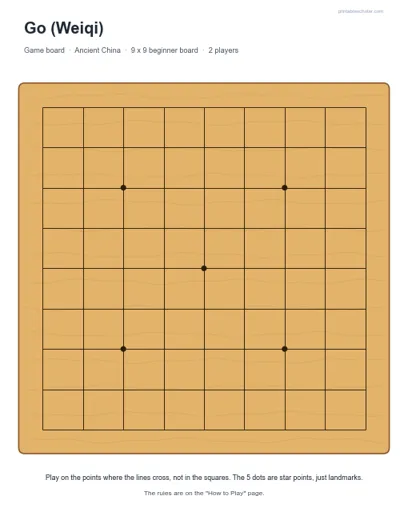 Go (Weiqi)Ancient China, first written mention 548 BC · 2 players
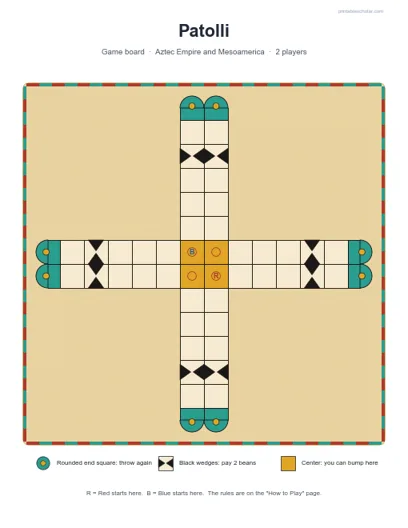 PatolliAztec Empire, played for over 1,000 years, to the 1500s · 2 players
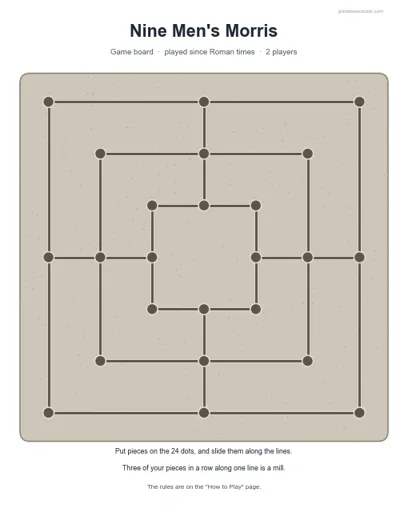 Nine Men's MorrisAncient Rome, about 2,000 years old · 2 players
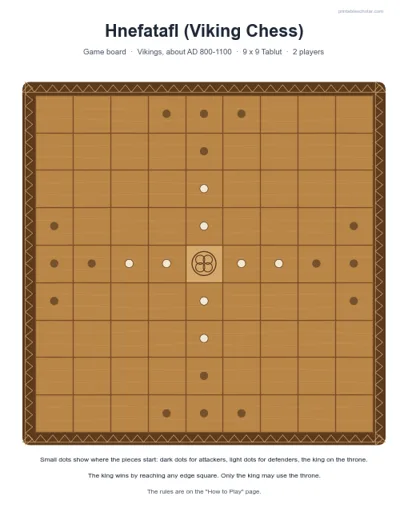 Hnefatafl (Viking Chess)Vikings, about AD 800-1100 · 2 players
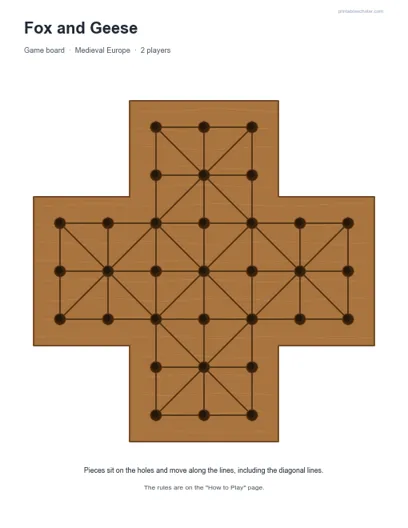 Fox and GeeseMedieval Europe, known from the 1300s · 2 players