Rules of Nine Men's Morris
2 players · about 15-20 minutes · ages 7 and up. Ancient Rome, about 2,000 years old.
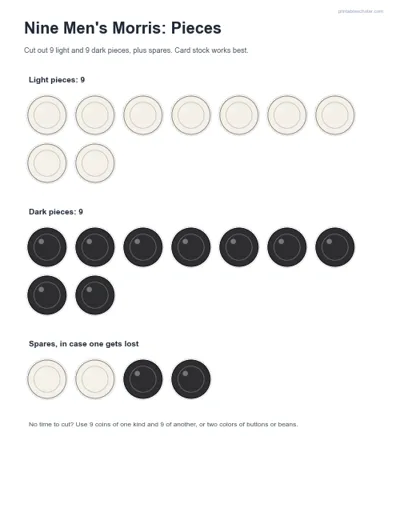
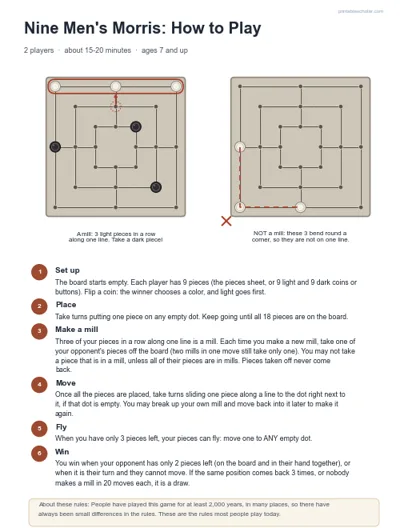
- Set up. The board starts empty. Each player has 9 pieces (the pieces sheet, or 9 light and 9 dark coins or buttons). Flip a coin: the winner chooses a color, and light goes first.
- Place. Take turns putting one piece on any empty dot. Keep going until all 18 pieces are on the board.
- Make a mill. Three of your pieces in a row along one line is a mill. Each time you make a new mill, take one of your opponent's pieces off the board (two mills in one move still take only one). You may not take a piece that is in a mill, unless all of their pieces are in mills. Pieces taken off never come back.
- Move. Once all the pieces are placed, take turns sliding one piece along a line to the dot right next to it, if that dot is empty. You may break up your own mill and move back into it later to make it again.
- Fly. When you have only 3 pieces left, your pieces can fly: move one to ANY empty dot.
- Win. You win when your opponent has only 2 pieces left (on the board and in their hand together), or when it is their turn and they cannot move. If the same position comes back 3 times, or nobody makes a mill in 20 moves each, it is a draw.
About these rules: People have played this game for at least 2,000 years, in many places, so there have always been small differences in the rules. These are the rules most people play today.
The history of Nine Men's Morris
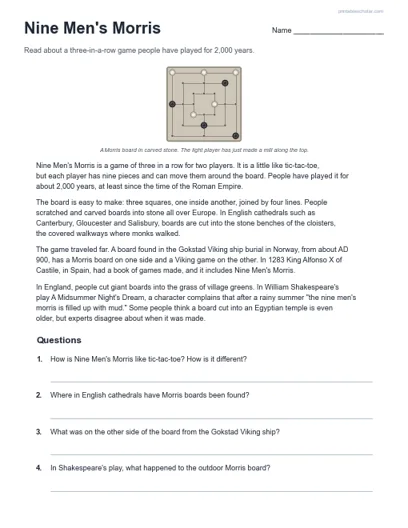
Nine Men's Morris is a game of three in a row for two players. It is a little like tic-tac-toe, but each player has nine pieces and can move them around the board. People have played it for about 2,000 years, at least since the time of the Roman Empire.
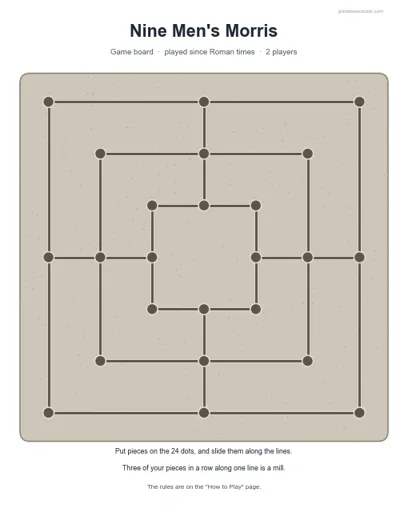
The board is easy to make: three squares, one inside another, joined by four lines. People scratched and carved boards into stone all over Europe. In English cathedrals such as Canterbury, Gloucester and Salisbury, boards are cut into the stone benches of the cloisters, the covered walkways where monks walked.
The game traveled far. A board found in the Gokstad Viking ship burial in Norway, from about AD 900, has a Morris board on one side and a Viking game on the other. In 1283 King Alfonso X of Castile, in Spain, had a book of games made, and it includes Nine Men's Morris.
In England, people cut giant boards into the grass of village greens. In William Shakespeare's play A Midsummer Night's Dream, a character complains that after a rainy summer "the nine men's morris is filled up with mud." Some people think a board cut into an Egyptian temple is even older, but experts disagree about when it was made.
Teaching Ancient Rome? The game fits right into a history unit: play it on the day you teach the civilization, then hand out the reading.
 Printable Scholar
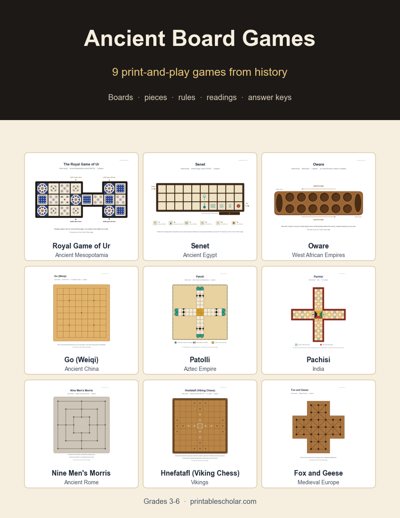
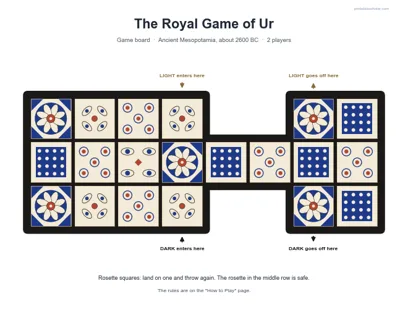 Royal Game of Ur
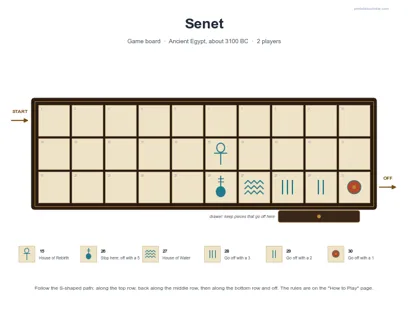 Senet
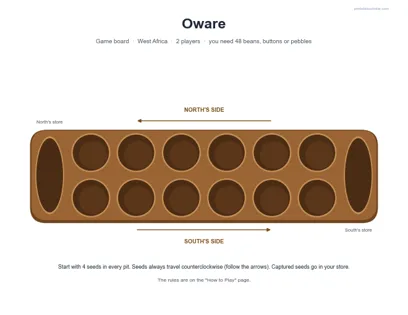 Oware
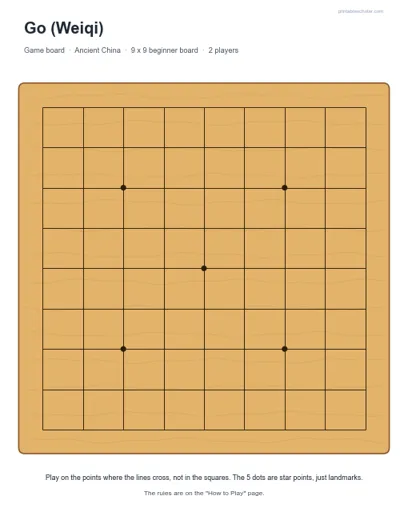 Go (Weiqi)
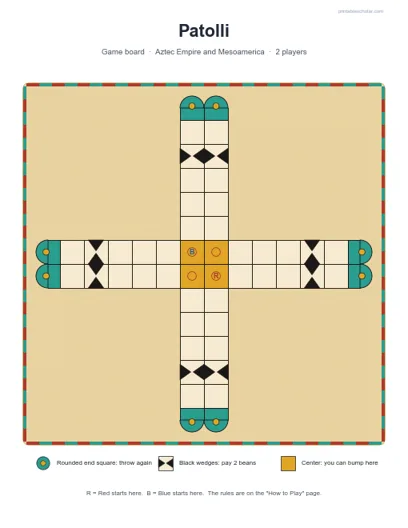 Patolli
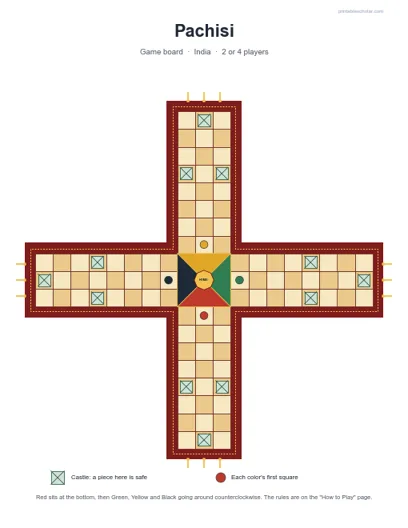 Pachisi
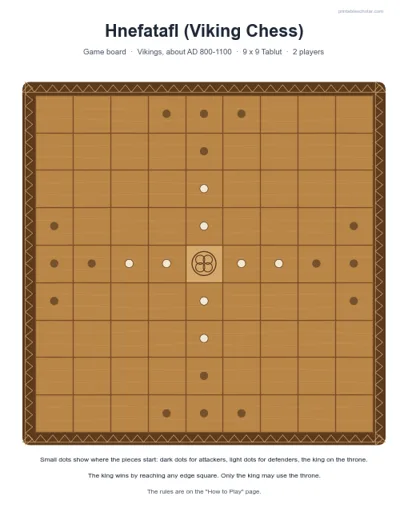 Hnefatafl (Viking Chess)
 Fox and Geese