 Printable Scholar
Oracle Bone Script
More than 3,000 years ago, Shang kings asked their ancestors questions about rain, harvests, wars and illness. Priests heated turtle shells and ox shoulder blades until they cracked, read the cracks as answers, and carved the questions into the bone. This oracle bone script is the oldest large body of Chinese writing. Many of its signs began as pictures, and you can still see them in the characters people in China read today.
Free to print
From oracle bones to today’s characters, and a real oracle bone to read
PDFs sized for US Letter paper, in color and black and white.
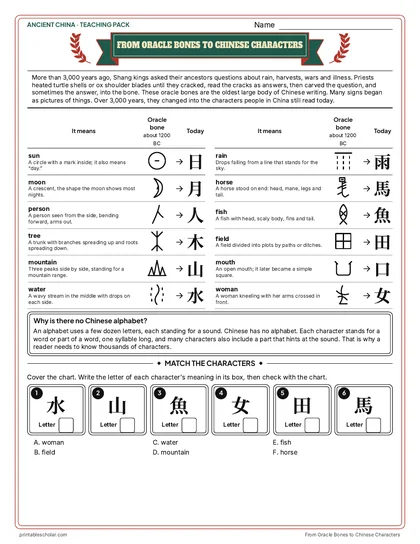
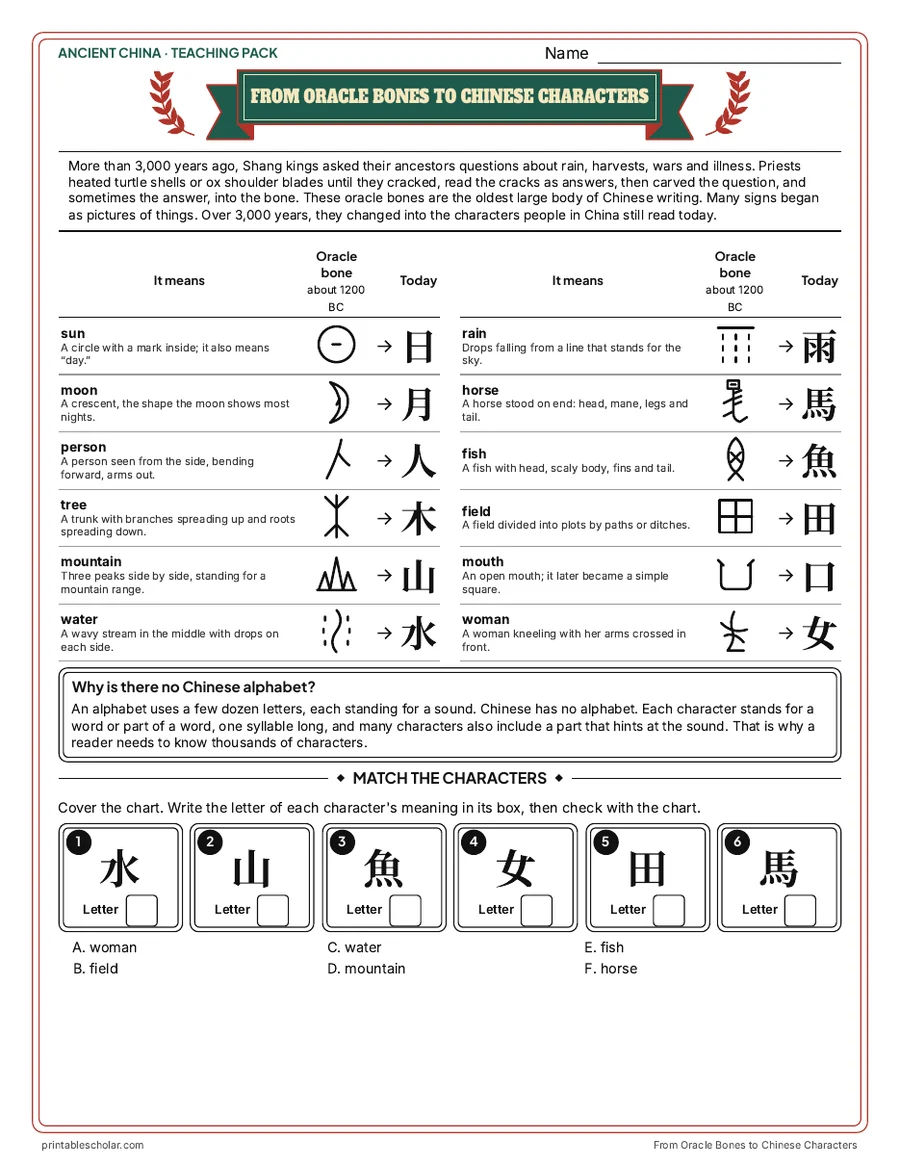
From Oracle Bones to Chinese Characters
Twelve oracle-bone signs beside the characters they became (sun, moon, person, tree, rain, horse, fish and more), why Chinese has no alphabet, and a matching activity.
Download PDF Black and white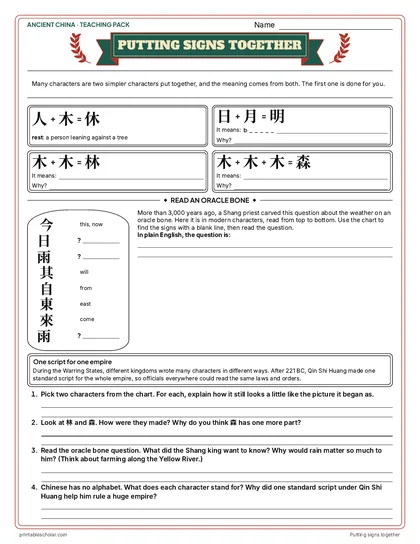
Putting Signs Together
How two simple characters make a new one (a person beside a tree means rest), a Shang question about rain to read, and questions. The answers are in the teaching pack’s key.
Download PDF Black and white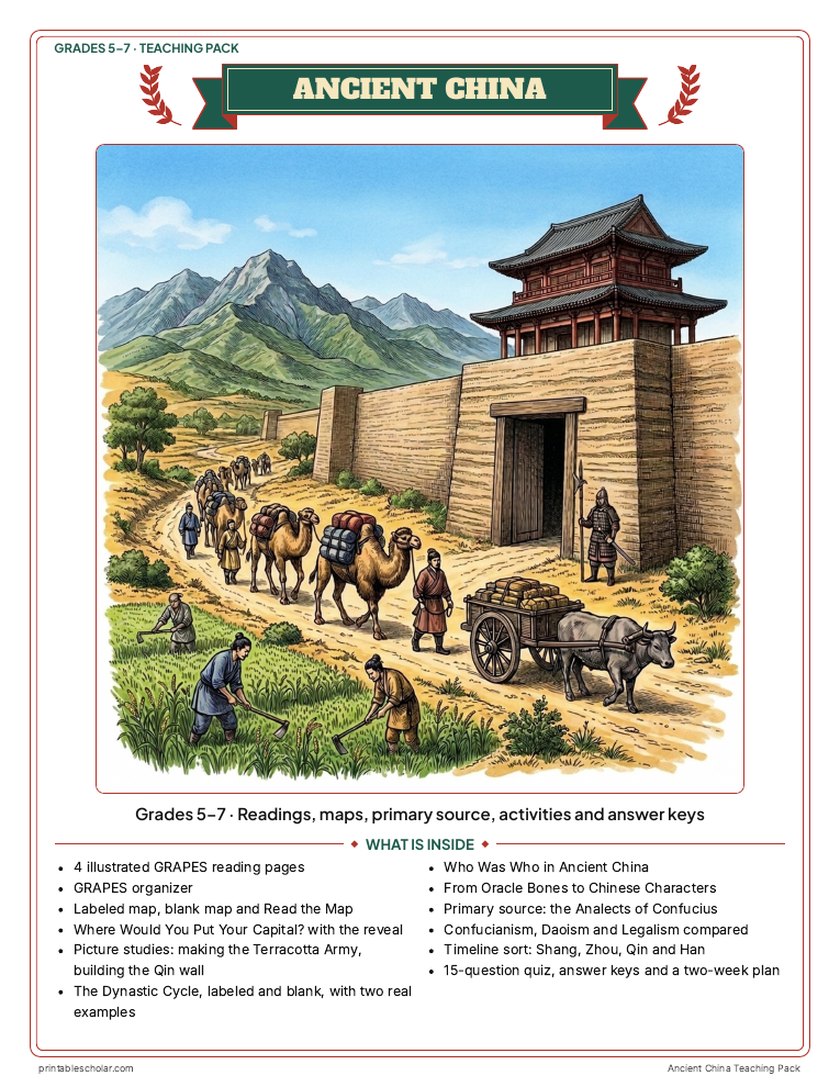
Teaching pack · Grades 5–7
Teaching Ancient China? The whole unit, ready to teach.
Two weeks of lessons in one download: slides to present, notes for students to fill in, and printable pages that use these maps and pictures.
Every slide comes with teacher notes: what to say, what to ask, and sample answers.
- 33 lesson slides (PowerPoint you can edit) and 2 pages of guided notes
- 4 illustrated reading pages and a GRAPES organizer
- Maps: labeled, blank, Read and Measure the Map, and a "Where would you put your capital?" decision with the reveal
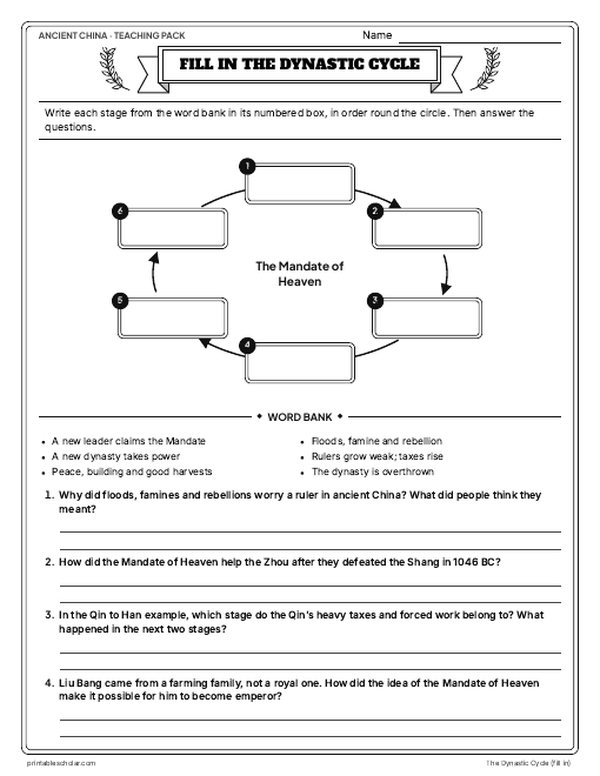
- Activities: picture studies of the Terracotta Army workshops and the building of the Qin wall, the dynastic cycle (labeled and fill-in), who was who, oracle bones to Chinese characters, the Analects of Confucius, Confucianism, Daoism and Legalism compared, and a timeline sort
- A 15-question quiz, a teacher guide with a two-week plan, and answer keys for everything
Every answer is in the pack. The readings, slides, maps and pictures teach everything the sheets and quiz ask, so no textbook is needed.
Get the Ancient China pack for $7Teaching more than one? Get all eight ancient history packs (Early Humans, Egypt, Mesopotamia, the Persian Empire, Greece, Rome, China and India) for $39: about sixteen weeks of lessons.
Get all 8 packs for $39See all eight packsOr get every history pack (27) in one download:Get all 27 for $49
One-time purchase. Instant download. Color and ink-saving black-and-white editions. Secure checkout by Stripe.
The 10-day plan
10 lessons, each planned for one class period of about 45 to 50 minutes, straight from the teacher guide. Some days are fuller than others; the note below shows how to even them out.
- Day 1Hook: Where would you put your capital?
- Day 2Geography and economy, with guided notes
- Day 3Religion and achievements, with guided notes
- Day 4Politics, social structure and the dynasties
- Day 5The map and measuring the Silk Road
- Day 6From oracle bones to Chinese characters
- Day 7The dynastic cycle, labeled and blank
- Day 8Three ways of thinking and the Analects
- Day 9Terracotta Army, Qin Wall and Who Was Who
- Day 10Timeline sort, then review and the 15-question quiz
Fitting it to your schedule: Day 4 is the fullest (14 slides and two readings), then Days 8 and 9, and Day 1 the lightest. With 10 periods, move Reading 4: The Dynasties from Day 4 to Day 5, before the dynastic cycle. With 8 periods, teach slides 1-9 on Day 1 after the reveal, move Reading 1 and its G and E boxes to Day 5 with Read and Measure the Map as homework, then show the labeled dynastic cycle at the end of Day 6 in place of making new characters, give the blank diagram and its questions as homework and skip the human dynastic cycle.
See the full day-by-day plan
- Day 1
- Before any reading (the readings and slides give the answer away): Where Would You Put Your Capital? Students choose and argue in pairs. Then read What Really Happened together.
- Day 2
- Lesson slides 1-9 with guided notes page 1. Reading 1: Geography and Economy. Fill the G and E boxes of the GRAPES organizer.
- Day 3
- Lesson slides 10-16 (guided notes page 1, continued). Reading 2: Religion and Achievements. Fill the R and A boxes.
- Day 4
- Lesson slides 17-30 with guided notes page 2 (two turn and talks, Weird but True, Myth vs. Fact). Reading 3: Politics and Social Structure, and Reading 4: The Dynasties of Ancient China. Fill the P and S boxes.
- Day 5
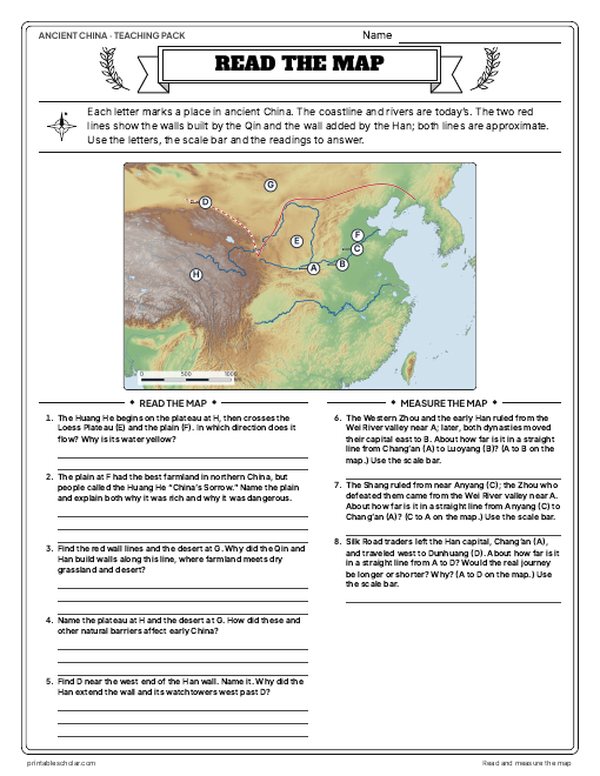
- Labeled map with the What Happened strip; students fill in the blank map with the word bank. Read and Measure the Map, including the Silk Road distance to Dunhuang.
- Day 6
- From Oracle Bones to Chinese Characters: the picture-to-character chart, the matching, putting signs together and reading the oracle bone question. Make new characters.
- Day 7
- The Dynastic Cycle: labeled diagram, then the blank diagram with the word bank, the Shang to Zhou and Qin to Han examples and the questions. Try the human dynastic cycle.
- Day 8
- Three Ways of Thinking compare sheet, then the primary source: the Analects, read aloud with the plain-English column and gloss, and the document questions. Three rulers, one problem.
- Day 9
- Picture studies: Making the Terracotta Army and Building the Qin Wall, Look Closely questions. Then Who Was Who in Ancient China. Try rammed earth.
- Day 10
- Slides 31-33: the Who am I? riddle and the exit question at the bottom of notes page 2. Timeline sort with the BC box, check the GRAPES organizer, then the 15-question quiz.
What oracle bones are, and how their signs became characters
Asking the ancestors
Shang kings ruled in northern China from about 1600 to 1046 BC, and the oracle bones come from the last part of their rule, about 1250 to 1050 BC. A king would ask a question such as "Will it rain today?" Priests drilled small hollows into a turtle shell or an ox shoulder blade, pressed a hot rod against it until it cracked, and read the cracks as a yes or no from the ancestors. Then they carved the question, and sometimes the answer, into the bone.
Found as dragon bones
For centuries farmers near the city of Anyang dug up the old bones and sold them to medicine shops as "dragon bones" to be ground into cures. In 1899 a scholar named Wang Yirong noticed writing on them. Since then, well over 100,000 pieces have been found, most near Anyang, where the last Shang capital stood.
Pictures that turned into characters
Many oracle-bone signs are simple pictures: a circle with a dot for the sun, three peaks for a mountain, a person bending forward. Over 3,000 years, as scribes wrote more with brushes on bamboo, silk and later paper, the signs became squarer and simpler. You can still see the pictures in many characters today, such as 山 (mountain), 木 (tree) and 雨 (rain).
Putting signs together
Chinese builds new characters from old ones. A person beside a tree, 休, means rest. Two trees, 林, are a small woods, and three trees, 森, are a forest. Most characters also include a part that hints at how the word is said.
Why there is no Chinese alphabet
An alphabet uses a few dozen letters for sounds. Chinese has no alphabet: each character stands for a word or part of a word, one syllable long. That is why a reader needs to know thousands of characters. After 221 BC, the first emperor, Qin Shi Huang, made one standard way of writing for his whole empire.
Frequently asked questions
What is oracle bone script?
The oldest large body of Chinese writing: questions carved into turtle shells and ox shoulder blades by priests of the Shang dynasty, about 1250 to 1050 BC, when they asked the ancestors about the future.
How were oracle bones used?
Priests drilled hollows into a bone or shell, heated it until it cracked, and read the cracks as the ancestors’ answer to the king’s question. Then they carved the question into the bone.
Can we still read oracle bone script?
Partly. Scholars have found thousands of different oracle-bone signs and can read many of them, because they are early forms of Chinese characters still used today. Many others are still not understood.
Where were oracle bones found?
Most come from near Anyang, in Henan province, where the last Shang capital stood. Scholars first noticed the writing on them in 1899.
Is oracle bone script the same as Chinese characters today?
It is their ancestor. Many oracle-bone pictures, like the sun, moon, tree and mountain, became characters people still read, though the shapes changed a great deal over 3,000 years.