About the Picture Addition Worksheets
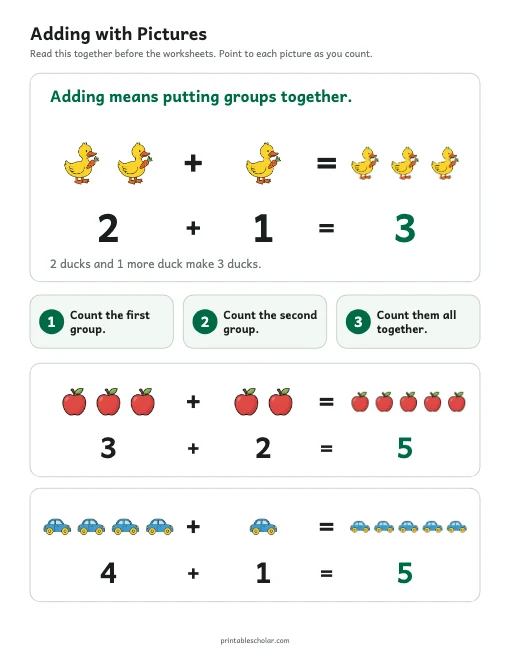
Children understand addition as "putting together" long before a row of bare equations means anything to them. Two ducks and one more duck is something a five-year-old can see and count. The number sentence 2 + 1 = 3 is a way of writing down what they just did.
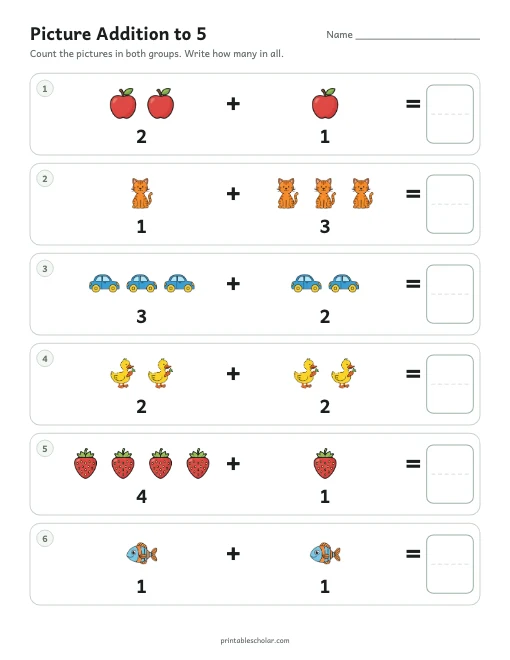
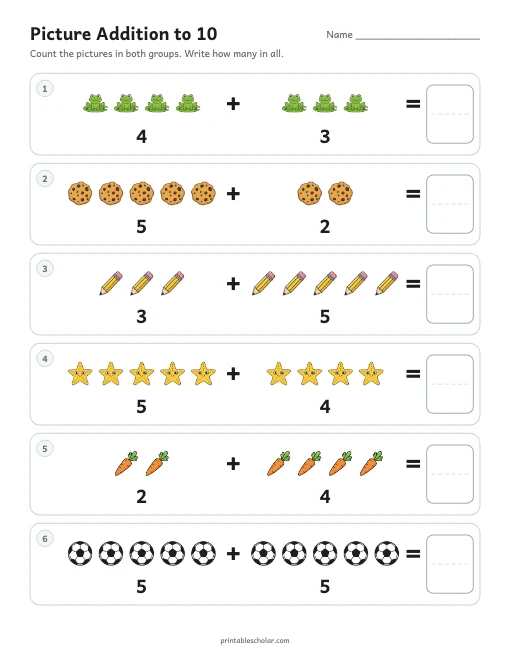
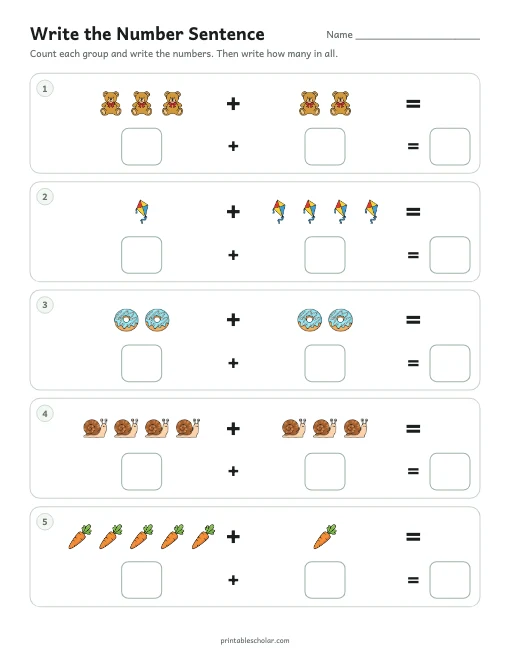
These sheets keep the pictures and the numbers side by side so that link gets made. On the first two worksheets the numbers are already printed under each group, and the child only writes the total. On Write the Number Sentence they write all three numbers themselves.
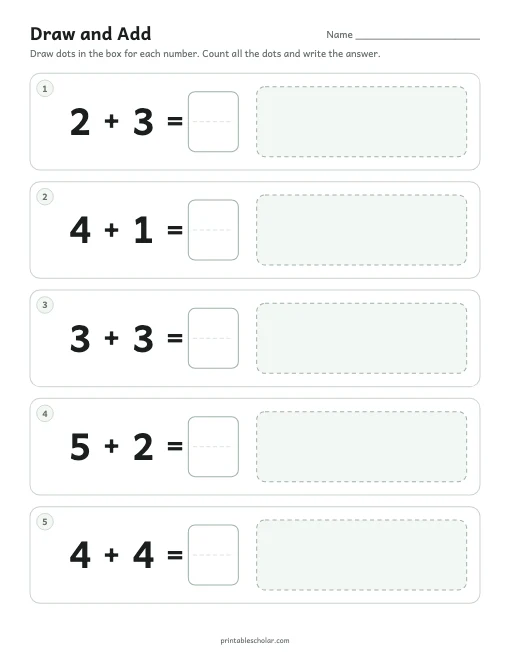
Draw and Add turns it around. It gives the numbers and an empty box, and the child draws dots to work out the answer. That is the bridge to plain addition problems, because drawing dots is a strategy they can use on any worksheet.
Every worksheet has an answer key on its second page. Children should be able to count to ten first, which the counting to 10 worksheets cover. When pictures are no longer needed, the addition worksheets page has practice without them.
Frequently Asked Questions
What is picture addition?
Picture addition shows each number as a group of objects. The child counts the first group, counts the second group, then counts them all together to find the total.
What age is picture addition for?
Ages 5 to 7, which is kindergarten and the start of 1st grade. Sums to 5 come first, and sums to 10 follow once those feel easy.
Should my child count all the pictures, or count on?
Counting all of them is the right place to start. Later, children learn to count on: say the first number and keep counting through the second group. Do not rush it. Counting on usually appears during 1st grade.
When should we stop using pictures?
When your child answers sums to 5 quickly and can draw their own dots for larger sums. The Draw and Add sheet checks this. Many children still like pictures or fingers for sums to 10 well into 1st grade, and that is normal.
What comes after picture addition?
Picture subtraction, then addition and subtraction facts within 10 without pictures. Ten frames and number bonds are useful tools at that stage.