 Printable Scholar
Triangular Trade Map
A free printable map of the triangular trade drawn on real terrain, with Britain’s triangle, New England’s triangle and the goods carried on every leg. It comes labeled, in black and white, and blank with lines to write the goods.

Choose your version
Black and white, color or blank.
All three are free PDFs sized for US Letter paper.

Black and white
Everything named on a plain map with no terrain. No color ink needed.
downloadBlack and white PDF
Color
Both triangles and the goods on every leg, on shaded relief.
downloadColor PDF
Blank
The routes with no names, and lines to write the goods carried on each leg.
downloadBlank PDF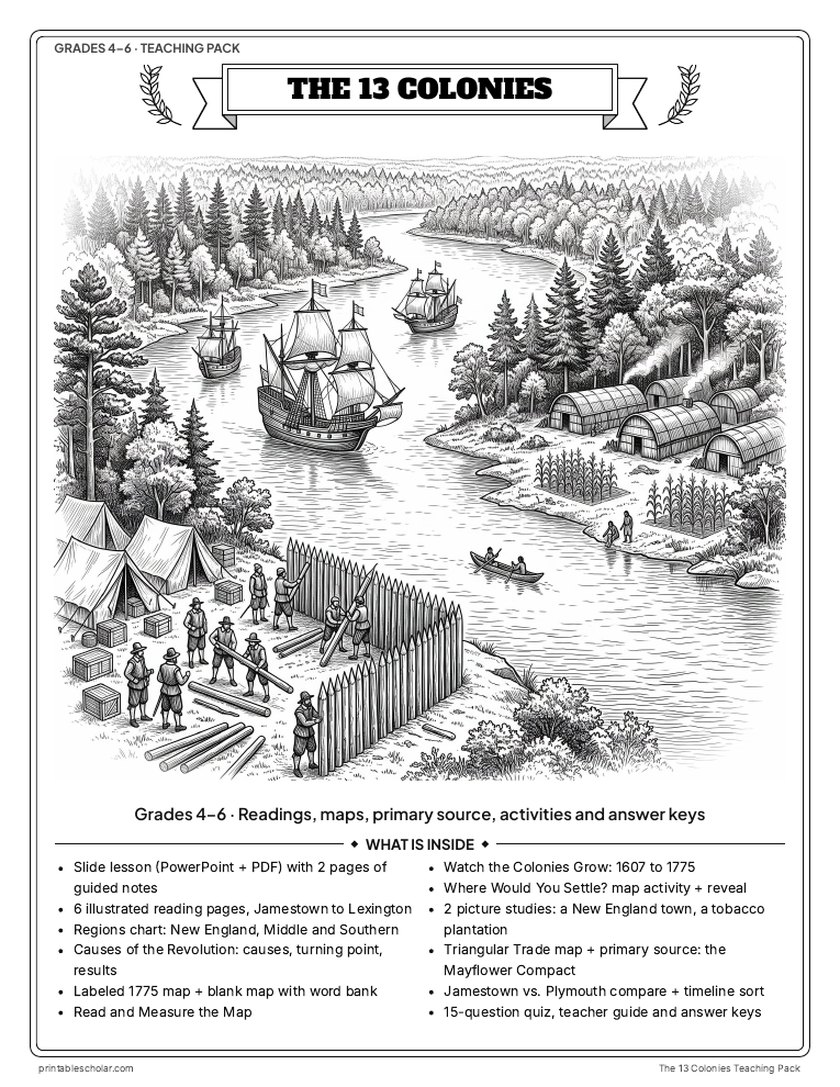
Teaching pack · Grades 4–6
Teaching the 13 Colonies? The whole unit, ready to teach.
Two weeks of lessons in one download: slides to present, notes for students to fill in, and printable pages that use these maps and pictures.
- 27 lesson slides (PowerPoint you can edit, teacher notes on every slide) and 2 pages of guided notes
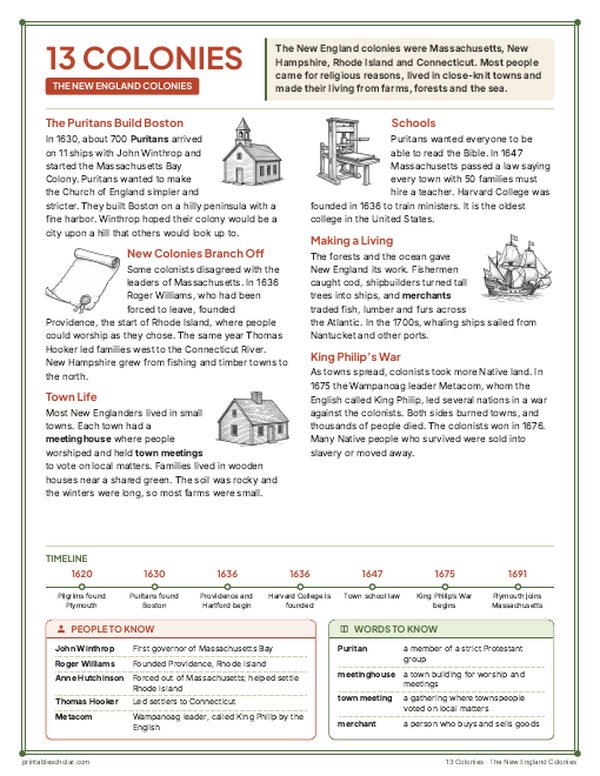
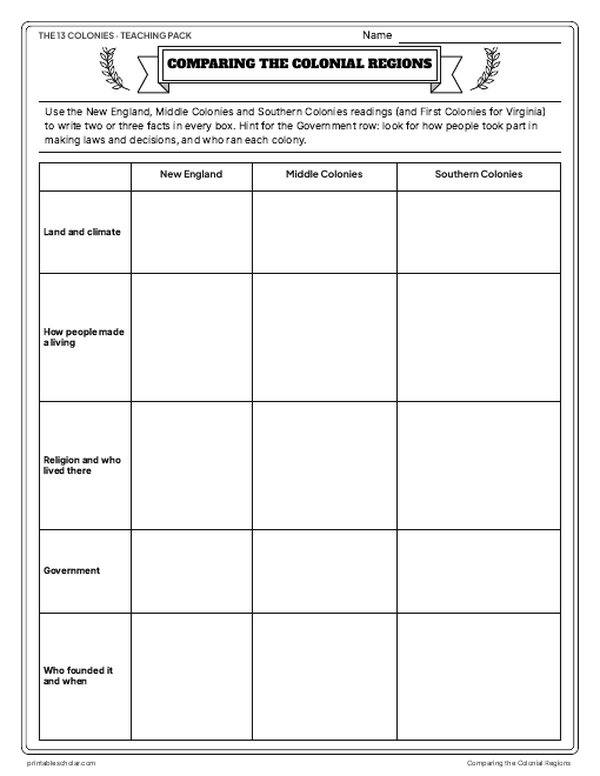
- 6 illustrated reading pages, from Jamestown to Lexington and Concord, with the Comparing the Colonial Regions chart and a Causes of the Revolution sheet
- Maps: the colonies in 1775, a blank map, Read and Measure the Map, Watch the Colonies Grow (1607 to 1775), and Where Would You Settle? with the reveal
- Activities: two picture studies, the Triangular Trade map, the Mayflower Compact as a primary source, Jamestown vs. Plymouth and a timeline sort
- A 15-question quiz, a teacher guide with a two-week plan, and answer keys for everything
Every answer is in the pack. The readings, slides, maps and pictures teach everything the sheets and quiz ask, so no textbook is needed.
Get the 13 Colonies pack for $7One-time purchase. Instant download. Color and ink-saving black-and-white editions. Secure checkout by Stripe.
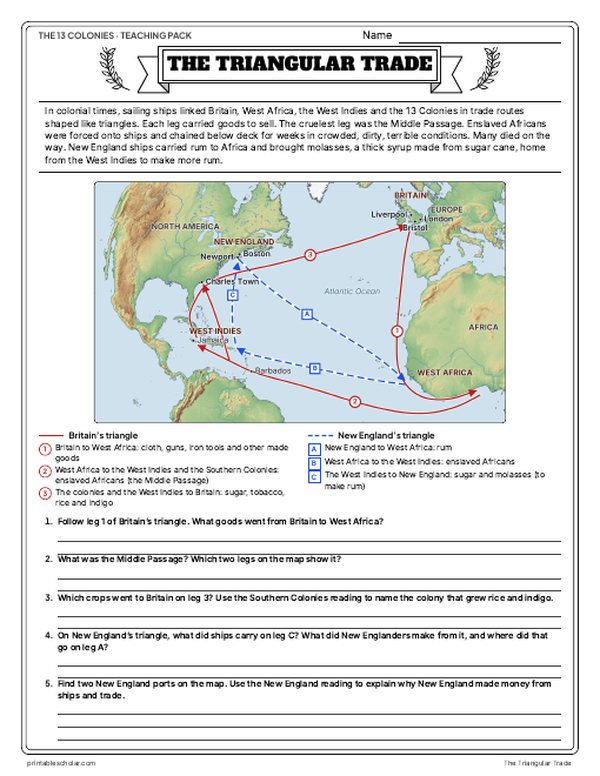
The triangular trade
In colonial times, sailing ships linked Britain, West Africa, the West Indies and the 13 Colonies in trade routes shaped like triangles. Each leg carried goods to sell. On Britain’s triangle, ships took cloth, guns, iron tools and other made goods to West Africa, carried enslaved Africans to the West Indies and the Southern Colonies, and brought sugar, tobacco, rice and indigo back to Britain. The cruelest leg was the Middle Passage. Enslaved Africans were forced onto ships and chained below deck for weeks in crowded, dirty, terrible conditions, and many died on the way. New England ships ran a triangle of their own: rum to West Africa, enslaved Africans to the West Indies, and sugar and molasses, a thick syrup made from sugar cane, home to New England to make more rum.
The goods on each leg
- Leg 1, Britain to West Africa: cloth, guns, iron tools and other made goods
- Leg 2, West Africa to the West Indies and the Southern Colonies: enslaved Africans (the Middle Passage)
- Leg 3, the colonies and the West Indies to Britain: sugar, tobacco, rice and indigo
- Leg A, New England to West Africa: rum
- Leg B, West Africa to the West Indies: enslaved Africans
- Leg C, the West Indies to New England: sugar and molasses
Find it on the map
- Britain’s triangle (solid lines) and New England’s (dashed)
- Legs 2 and B, the Middle Passage
- The ports: Liverpool, Bristol and London; Boston, Newport and Charles Town
Routes are approximate. Coastlines and rivers are shown as they are today.
Frequently asked questions
What was the triangular trade?
Trade routes across the Atlantic, shaped like triangles, that linked Britain, West Africa, the West Indies and the 13 Colonies in colonial times. Each leg carried goods to sell, and one leg carried enslaved Africans.
What was the Middle Passage?
The leg from West Africa to the West Indies and the colonies. Enslaved Africans were forced onto ships and chained below deck for weeks in crowded, dirty, terrible conditions, and many died on the way. On the map it is leg 2 and leg B.
What goods went to Britain?
Sugar, tobacco, rice and indigo, from the colonies and the West Indies (leg 3). South Carolina grew rice and indigo.
Why did New England ships bring molasses home?
To make rum. Molasses is a thick syrup made from sugar cane. Ships carried sugar and molasses from the West Indies to New England, and the rum made from it went to West Africa.