 Printable Scholar
Samurai Armor: The Parts of an O-yoroi
When the Mongols landed in Japan in 1274, samurai rode out in o-yoroi, "great armor." It was made for archers on horseback: hundreds of small scales of iron and leather, lacquered and laced together in rows with silk cords, so the armor bent as the rider twisted to shoot. These free pages show a mounted samurai about 1274, labeled, and the same picture blank with a word bank for students to label.
Free to print
A labeled samurai, and a blank one to label
PDFs sized for US Letter paper, in color and black and white.
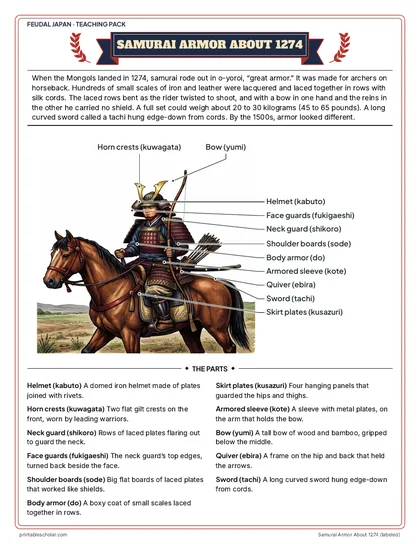
Samurai Armor About 1274, labeled
A mounted samurai archer in o-yoroi with eleven parts labeled and what each one was for.
Download PDF Black and white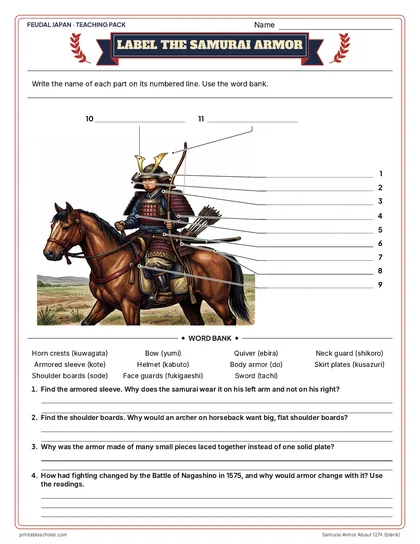
Label the Samurai Armor
The same picture with numbered lines, a word bank and four questions.
Download PDF Black and white
Teaching pack · Grades 6–8
Teaching Feudal Japan? The whole unit, ready to teach.
Two weeks of lessons in one download: slides to present, notes for students to fill in, and printable pages that use these maps and pictures.
Every slide comes with teacher notes: what to say, what to ask, and sample answers.
- 46 lesson slides (PowerPoint you can edit) and 2 pages of guided notes
- 4 illustrated reading pages and a GRAPES organizer
- Maps: feudal Japan labeled and blank, Read and Measure the Map, and "Where Would You Build the Shogun's Capital?" with the reveal
- Activities: the Heian court, the real Mongol invasion scroll (labeled), samurai armor about 1274 (labeled and blank), who was who in feudal Japan, from Chinese characters to kana, from Warring States to one Japan, the Seventeen-Article Constitution as a primary source, feudal Japan and feudal Europe compared, and a timeline sort
- A 15-question quiz, a teacher guide with a two-week plan, and answer keys for everything
Every answer is in the pack. The readings, slides, maps and pictures teach everything the sheets and quiz ask, so no textbook is needed.
Get the Feudal Japan pack for $7Teaching more than one? Get all six medieval world packs (West Africa, the Silk Road, the Byzantines, Medieval Europe, Feudal Japan and the Ottomans) for $29, with a bonus chart comparing all six: about twelve weeks of lessons.
Get all 6 packs for $29See all six packsOr get every history pack (23) in one download:Get all 23 for $49
One-time purchase. Instant download. Color and ink-saving black-and-white editions. Secure checkout by Stripe.
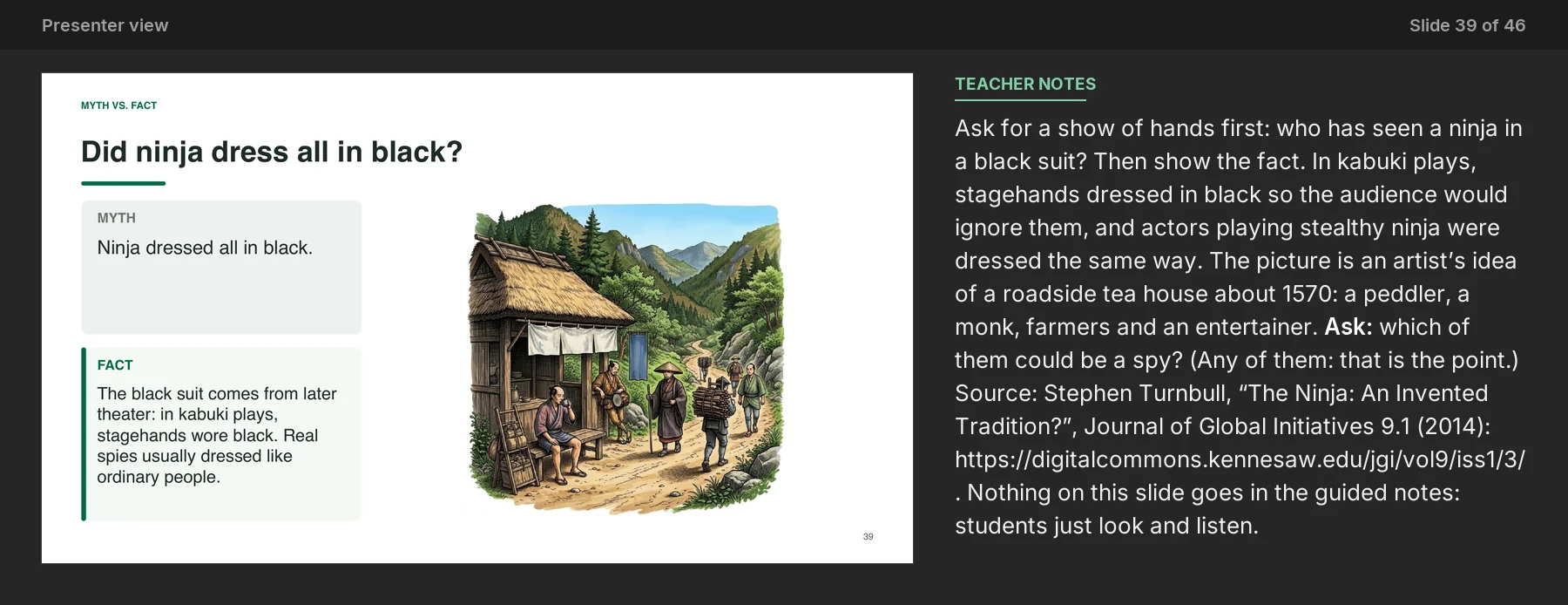
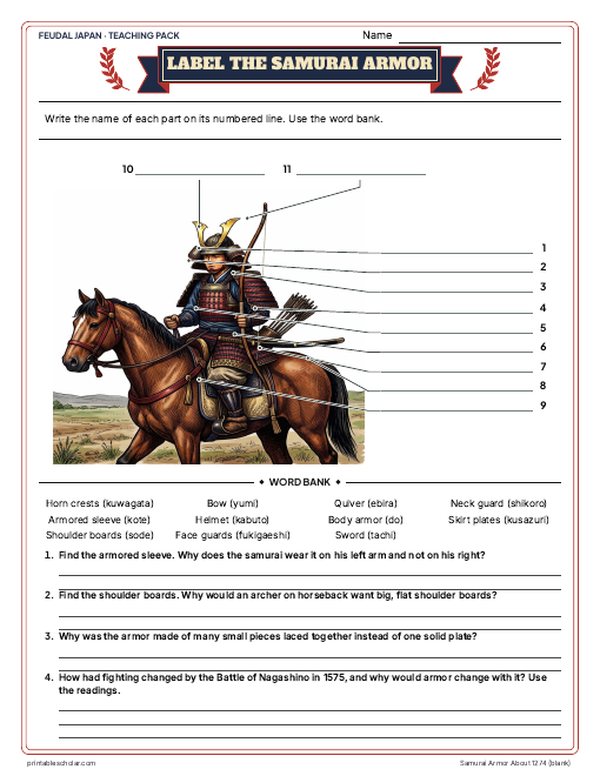
The parts of samurai armor about 1274
Helmet and horn crests
A domed iron helmet (kabuto) of riveted plates, with two flat gilt horn crests (kuwagata) worn by leading warriors.
Neck guard and face guards
Rows of laced plates (shikoro) flared out to guard the neck; their top edges turned back beside the face (fukigaeshi).
Shoulder boards
Big flat boards of laced plates (sode) that worked like shields, since an archer with a bow and reins in his hands carried no shield.
Body armor and skirt plates
A boxy coat of small laced scales (do), with four hanging panels (kusazuri) that guarded the hips and thighs.
Armored sleeve
A sleeve with metal plates (kote) on the arm that held the bow.
Bow, quiver and sword
A tall bow of wood and bamboo (yumi) gripped below the middle, a quiver (ebira) at the hip and back, and a long curved sword (tachi) hung edge-down from cords.
How armor changed
By the 1500s, with foot soldiers carrying long spears and, after 1543, guns, armor became plainer and closer-fitting.
Frequently asked questions
What is samurai armor called?
The great armor of the Kamakura period is called o-yoroi, "great armor." Later armor of the 1500s is called tosei gusoku, "modern armor."
What was samurai armor made of?
Hundreds of small scales of iron and leather, lacquered and laced together in rows with silk cords. A full set could weigh about 20 to 30 kilograms.
Did samurai fight with swords or bows?
The first samurai were archers on horseback, "the way of the bow and horse." Swords mattered more later, and guns arrived in 1543.
Why is there armor on only one arm?
The armored sleeve was on the arm that held the bow; the other arm drew the bowstring and needed to move freely.