Printable Scholar
Feudal Japan Map
A free printable map of Japan in the age of the samurai, about 1185 to 1603, drawn on real terrain: the capitals of the emperor and the shoguns, the main castle towns and ports, three famous battles and the routes of the Mongol fleets of 1274 and 1281. It comes in color, in black and white, and blank.

Choose your version
Black and white, color or blank.
All three are free PDFs sized for US Letter paper.

Black and white
Everything named on a plain outline map with no terrain, Ezo hatched and each Mongol fleet in its own line pattern. No color ink needed.
downloadBlack and white PDF
Color
Medieval Japan on shaded relief, Ezo shaded, with the capitals, battles, seas and Mongol fleet routes named.
downloadColor PDF
Blank
The black-and-white map with its markers and fleet routes but no names, for labeling practice.
downloadBlank PDF
Teaching pack · Grades 6–8
Teaching Feudal Japan? The whole unit, ready to teach.
Two weeks of lessons in one download: slides to present, notes for students to fill in, and printable pages that use these maps and pictures.
Every slide comes with teacher notes: what to say, what to ask, and sample answers.
- 46 lesson slides (PowerPoint you can edit) and 2 pages of guided notes
- 4 illustrated reading pages and a GRAPES organizer
- Maps: feudal Japan labeled and blank, Read and Measure the Map, and "Where Would You Build the Shogun's Capital?" with the reveal
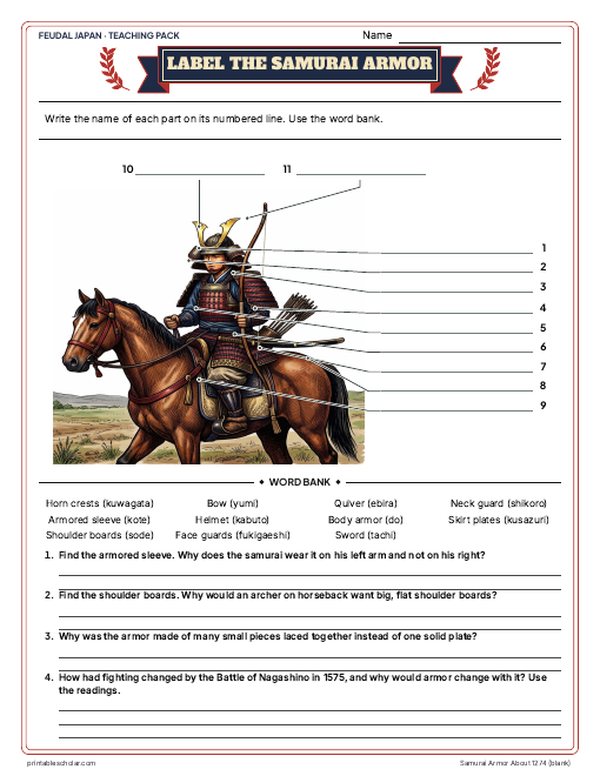
- Activities: the Heian court, the real Mongol invasion scroll (labeled), samurai armor about 1274 (labeled and blank), who was who in feudal Japan, from Chinese characters to kana, from Warring States to one Japan, the Seventeen-Article Constitution as a primary source, feudal Japan and feudal Europe compared, and a timeline sort
- A 15-question quiz, a teacher guide with a two-week plan, and answer keys for everything
Every answer is in the pack. The readings, slides, maps and pictures teach everything the sheets and quiz ask, so no textbook is needed.
Get the Feudal Japan pack for $7Teaching more than one? Get all six medieval world packs (West Africa, the Silk Road, the Byzantines, Medieval Europe, Feudal Japan and the Ottomans) for $29, with a bonus chart comparing all six: about twelve weeks of lessons.
Get all 6 packs for $29See all six packsOr get every history pack (23) in one download:Get all 23 for $49
One-time purchase. Instant download. Color and ink-saving black-and-white editions. Secure checkout by Stripe.
Japan in the age of the samurai
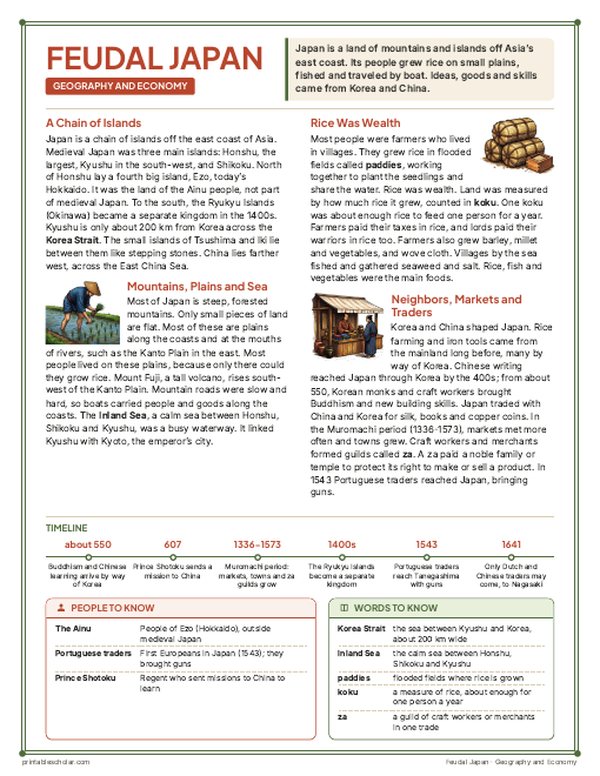
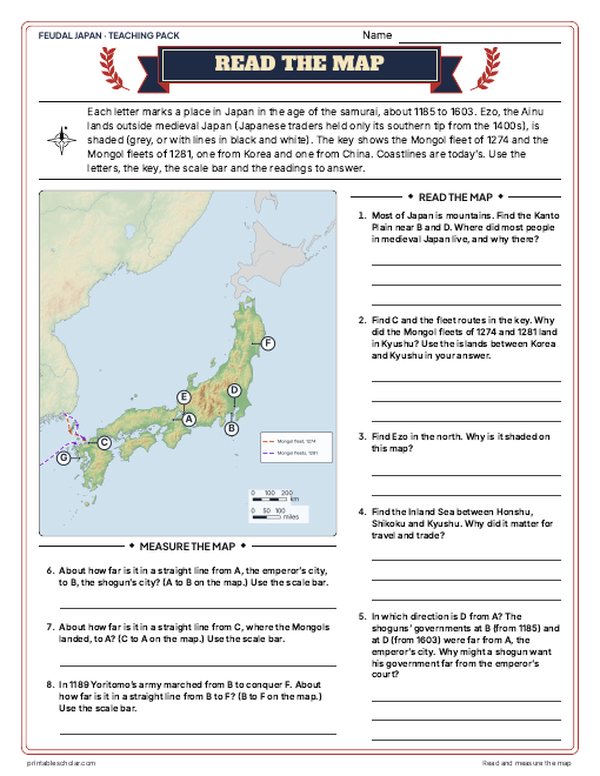
In 1185 the Minamoto clan destroyed the rival Taira clan in a sea battle at Dan-no-ura, and Minamoto no Yoritomo became Japan’s first lasting shogun, a military ruler who governed in the emperor’s name. The emperor and his court stayed in Kyoto, but Yoritomo ruled from his own headquarters at Kamakura, in the east. Warrior families called samurai served lords in return for land, much like the knights of medieval Europe. In 1274 and 1281 the Mongol ruler Kublai Khan, who ruled northern China and had made Korea his vassal, sent fleets across the Korea Strait to Kyushu; both invasions failed, storms wrecked many of the ships, and the Japanese later called those storms kamikaze, divine winds. From the 1330s the Ashikaga shoguns ruled from Kyoto, but after 1467 their power collapsed and Japan split into warring domains. Warlords such as Oda Nobunaga, whose guns won the Battle of Nagashino in 1575, and Toyotomi Hideyoshi reunited the country, and Tokugawa Ieyasu’s victory at Sekigahara in 1600 made him shogun in 1603, ruling from Edo, today’s Tokyo. The map shades Ezo, today’s Hokkaido, in gray: it was the land of the Ainu people, not part of medieval Japan. The Ryukyu Kingdom, on Okinawa and the islands to the south, was a separate kingdom with its own kings until the 1800s.
On the map
- Kyoto: the emperor’s capital, and the shoguns’ capital under the Ashikaga
- Kamakura: seat of the first shoguns, 1185 to 1333
- Edo (Tokyo): capital of the Tokugawa shoguns from 1603
- Nara: the old capital before Kyoto
- Osaka: castle town of Toyotomi Hideyoshi
- Hakata: the port where the Mongols landed in 1274
- Nagasaki: the port where Portuguese ships traded from 1571
- Hiraizumi: capital of the northern Fujiwara until 1189
- Dan-no-ura (1185), Nagashino (1575) and Sekigahara (1600): three battles that changed who ruled Japan
Find it on the map
- The Korea Strait, where Tsushima and Iki lie between Korea and Kyushu
- The Inland Sea between Honshu, Shikoku and Kyushu
- Mount Fuji and the Kanto Plain around Edo and Kamakura
Ezo (Hokkaido), southern Sakhalin and the Kuril Islands are shaded as the Ainu lands outside medieval Japan. The routes of the Mongol fleets are approximate, drawn through Tsushima, Iki, Hakata Bay and Takashima in Imari Bay, where a storm wrecked both fleets in 1281. Coastlines and rivers are shown as they are today, and no modern borders or cities are drawn.
Frequently asked questions
What were the main islands of feudal Japan?
Honshu, the largest, with Kyoto, Kamakura and Edo; Kyushu in the south-west, closest to Korea and China; and Shikoku across the Inland Sea, along with smaller islands such as Sado, Tsushima, Iki and Tanegashima. Hokkaido, then called Ezo, was not part of medieval Japan.
Why did the Mongols land in Kyushu?
Kyushu is the part of Japan closest to Korea, where the Mongol fleets set out. The ships crossed the Korea Strait by way of the islands of Tsushima and Iki and attacked Hakata Bay in 1274 and again in 1281, when a second fleet also came from China. Both times the samurai held them off, and in 1281 a storm wrecked both fleets.
Where were the shoguns’ capitals?
The first shoguns ruled from Kamakura, from 1185 to 1333. The Ashikaga shoguns ruled from Kyoto, the emperor’s capital, from 1336 to 1573. The Tokugawa shoguns ruled from Edo, today’s Tokyo, from 1603 to 1868. The emperor and his court stayed in Kyoto the whole time.
Was Hokkaido part of medieval Japan?
No. Hokkaido, then called Ezo, was the homeland of the Ainu people. Japanese traders and a few settlements held only the far southern tip in the 1400s and 1500s, and Japan did not take over the whole island until the late 1800s. That is why it is shaded gray on the map.