 Printable Scholar
Japanese Feudalism: Who Was Who in Feudal Japan
From about 1185 warrior rulers called shoguns governed Japan, while the emperor kept the highest rank but little real power. Great lords called daimyo ruled their own lands with their own samurai, who served them in return for land or rice. Historians call this system feudal because it is often compared to European feudalism, though it worked differently in places. The pyramid shows the Tokugawa ideal order of about 1600 to 1868: rank, not wealth, since merchants were ranked last but some grew rich.
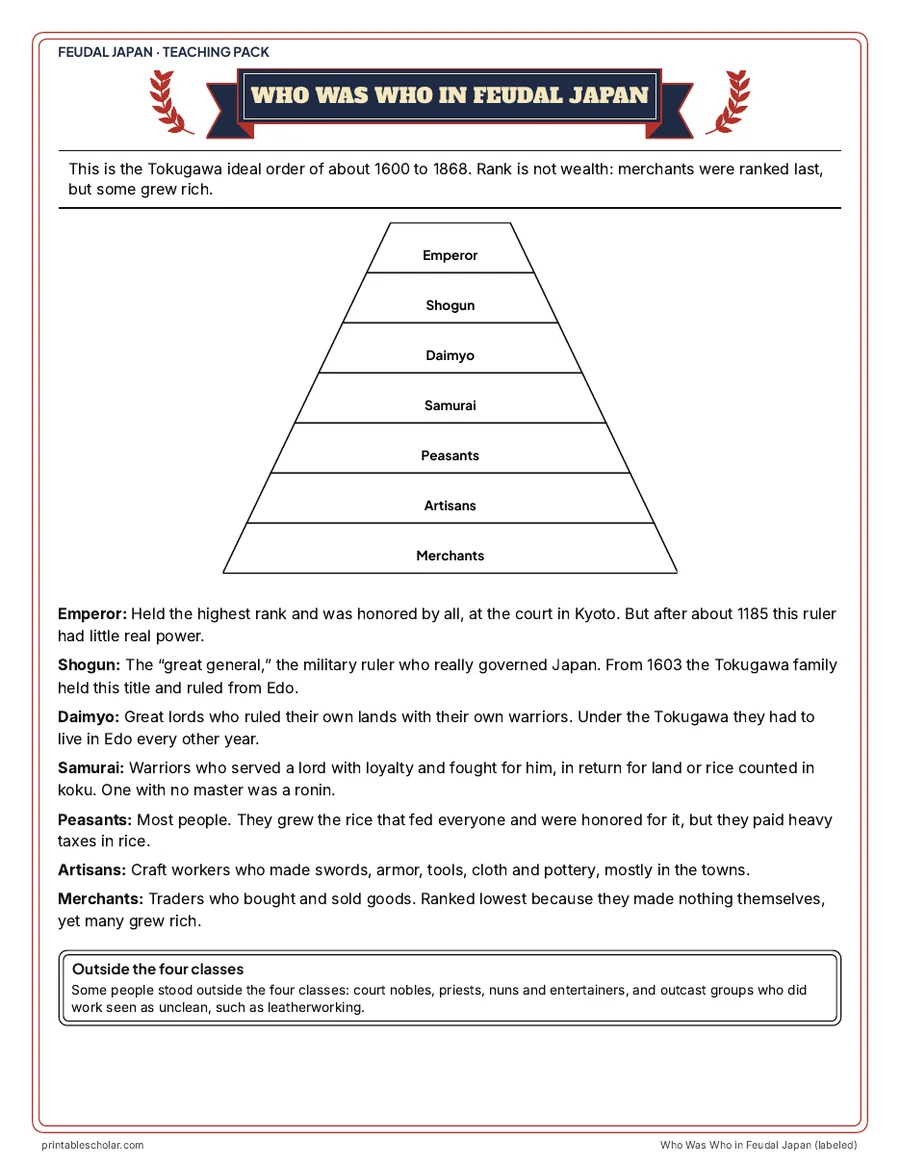
Free to print
A labeled feudal Japan pyramid, and a blank one to fill in
PDFs sized for US Letter paper, in color and black and white.
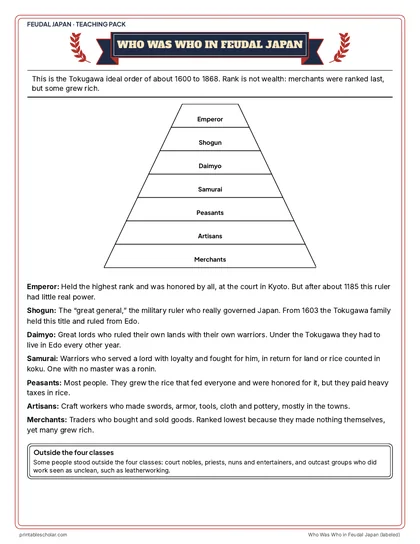
Who Was Who in Feudal Japan, labeled
Every group in its place, with what each one did.
Download PDF Black and white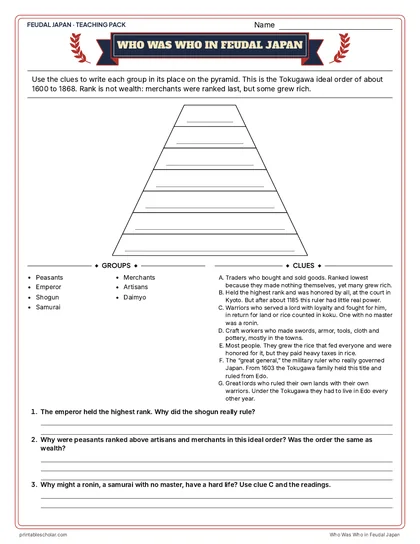
Who Was Who in Feudal Japan: fill it in
A blank pyramid with a word bank and clues, and three questions.
Download PDF Black and white
Teaching pack · Grades 6–8
Teaching Feudal Japan? The whole unit, ready to teach.
Two weeks of lessons in one download: slides to present, notes for students to fill in, and printable pages that use these maps and pictures.
Every slide comes with teacher notes: what to say, what to ask, and sample answers.
- 46 lesson slides (PowerPoint you can edit) and 2 pages of guided notes
- 4 illustrated reading pages and a GRAPES organizer
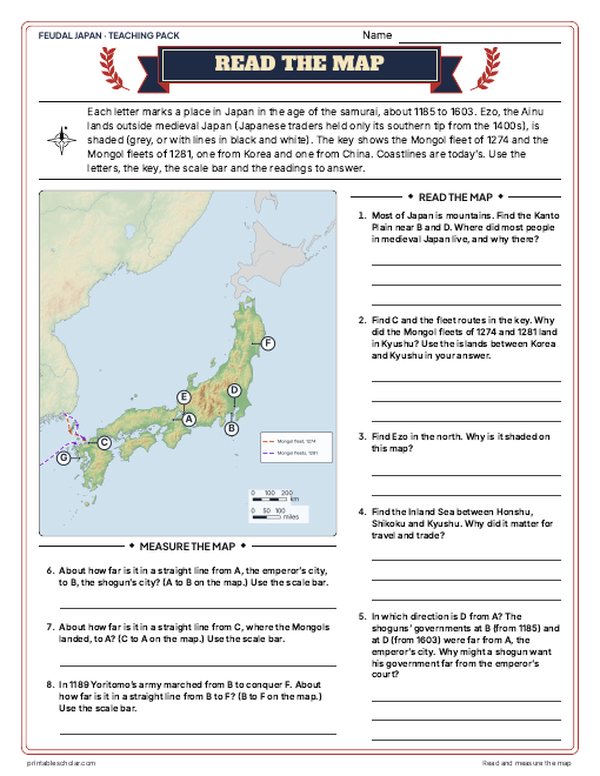
- Maps: feudal Japan labeled and blank, Read and Measure the Map, and "Where Would You Build the Shogun's Capital?" with the reveal
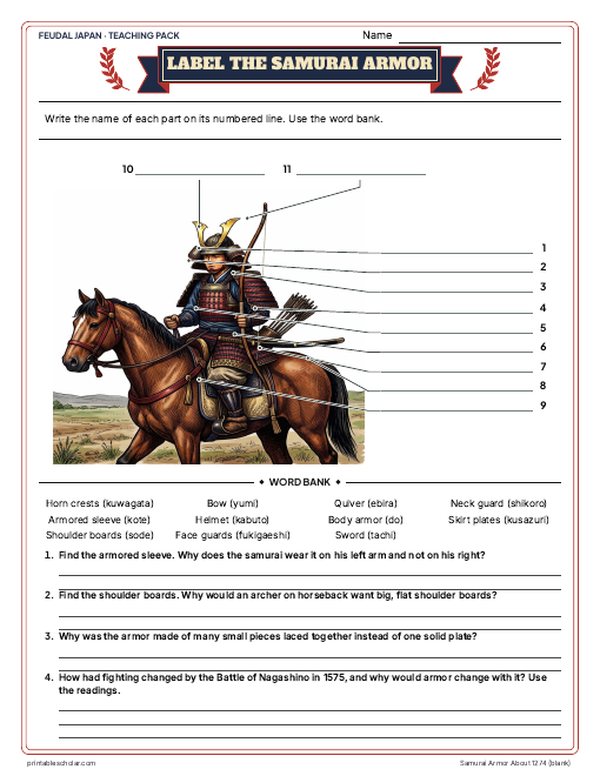
- Activities: the Heian court, the real Mongol invasion scroll (labeled), samurai armor about 1274 (labeled and blank), who was who in feudal Japan, from Chinese characters to kana, from Warring States to one Japan, the Seventeen-Article Constitution as a primary source, feudal Japan and feudal Europe compared, and a timeline sort
- A 15-question quiz, a teacher guide with a two-week plan, and answer keys for everything
Every answer is in the pack. The readings, slides, maps and pictures teach everything the sheets and quiz ask, so no textbook is needed.
Get the Feudal Japan pack for $7Teaching more than one? Get all six medieval world packs (West Africa, the Silk Road, the Byzantines, Medieval Europe, Feudal Japan and the Ottomans) for $29, with a bonus chart comparing all six: about twelve weeks of lessons.
Get all 6 packs for $29See all six packsOr get every history pack (23) in one download:Get all 23 for $49
One-time purchase. Instant download. Color and ink-saving black-and-white editions. Secure checkout by Stripe.
Who was who in feudal Japan
Emperor
Held the highest rank and was honored by all at the court in Kyoto, but after about 1185 had little real power.
Shogun
The "great general," the military ruler who really governed. From 1603 the Tokugawa family held the title and ruled from Edo.
Daimyo
Great lords with their own lands and warriors. Under the Tokugawa they had to live in Edo every other year (alternate attendance).
Samurai
Warriors who served a lord with loyalty, in return for land or a yearly income of rice counted in koku. A samurai with no master was a ronin.
Peasants
Most people. They grew the rice that fed everyone and were honored for it in the ideal order, but they paid heavy taxes in rice.
Artisans and merchants
Craft workers made swords, armor, tools and cloth. Merchants were ranked lowest because they made nothing themselves, yet many grew rich.
Outside the four classes
Court nobles, priests, nuns and entertainers stood outside the order, and so did outcast groups who did work seen as unclean.
Frequently asked questions
What was the social structure of feudal Japan?
At the top was the emperor, honored but with little power, then the shogun, who really ruled, the daimyo lords and their samurai. Below them, in the Tokugawa ideal order, came peasants, artisans and merchants.
Who had more power, the emperor or the shogun?
The shogun. After about 1185 the shogun led the government and the warriors, while the emperor kept the highest rank and took part in court ceremonies.
Why were merchants ranked lowest?
The Tokugawa order followed Confucian ideas: farmers grew food and artisans made things, but merchants were seen as making nothing. Many merchants still grew rich.
Was Japan’s system the same as European feudalism?
No. It is often compared to European feudalism because lords gave land or income for loyal service, but it worked differently: samurai were often paid in rice, and the emperor stayed above the shogun in rank.