 Printable Scholar
The Neolithic Revolution: Causes and Results
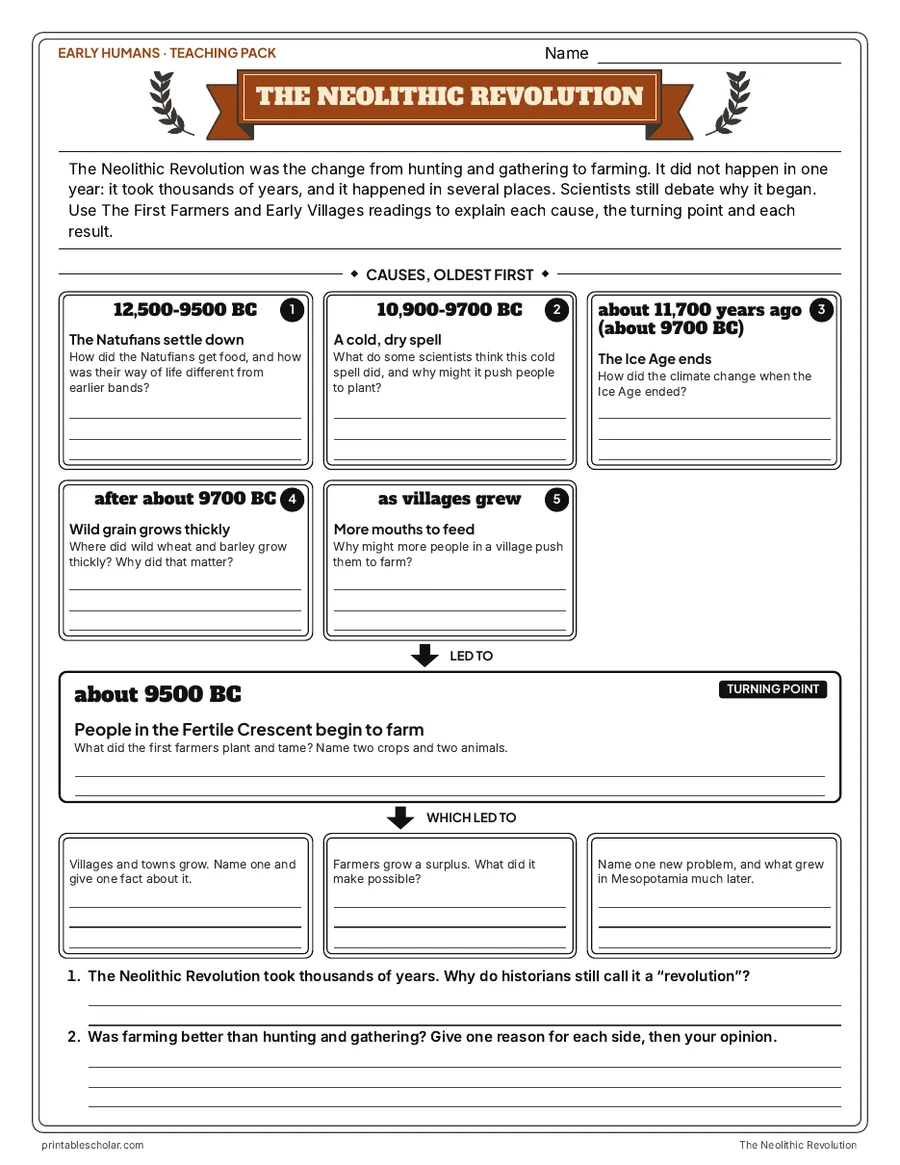
The Neolithic Revolution was the change from hunting and gathering to farming. It began in the Fertile Crescent of Southwest Asia about 9500 BC and happened on its own in several other places, such as China, Mexico, New Guinea and the Andes. It took thousands of years, and scientists still debate why it began. This free sheet sets out five dated causes, the turning point and three results for students to explain, with two questions.
Free to print
The Neolithic Revolution: causes, turning point and results
PDFs sized for US Letter paper, in color and black and white.
The Neolithic Revolution
Five dated causes, the turning point about 9500 BC and three results to explain, with two questions.
Download PDF Black and white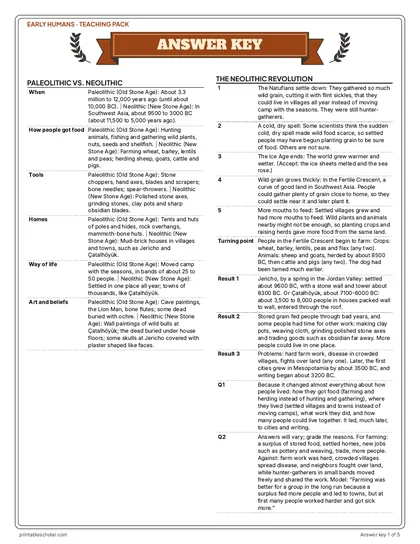
Answer key
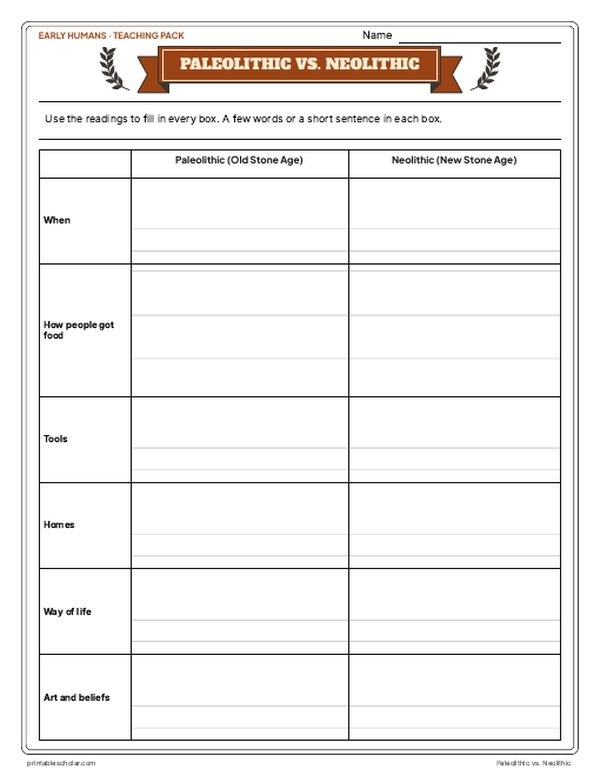
Model answers for every box and both questions (this key page also holds the Paleolithic vs. Neolithic key).
Download PDF Black and white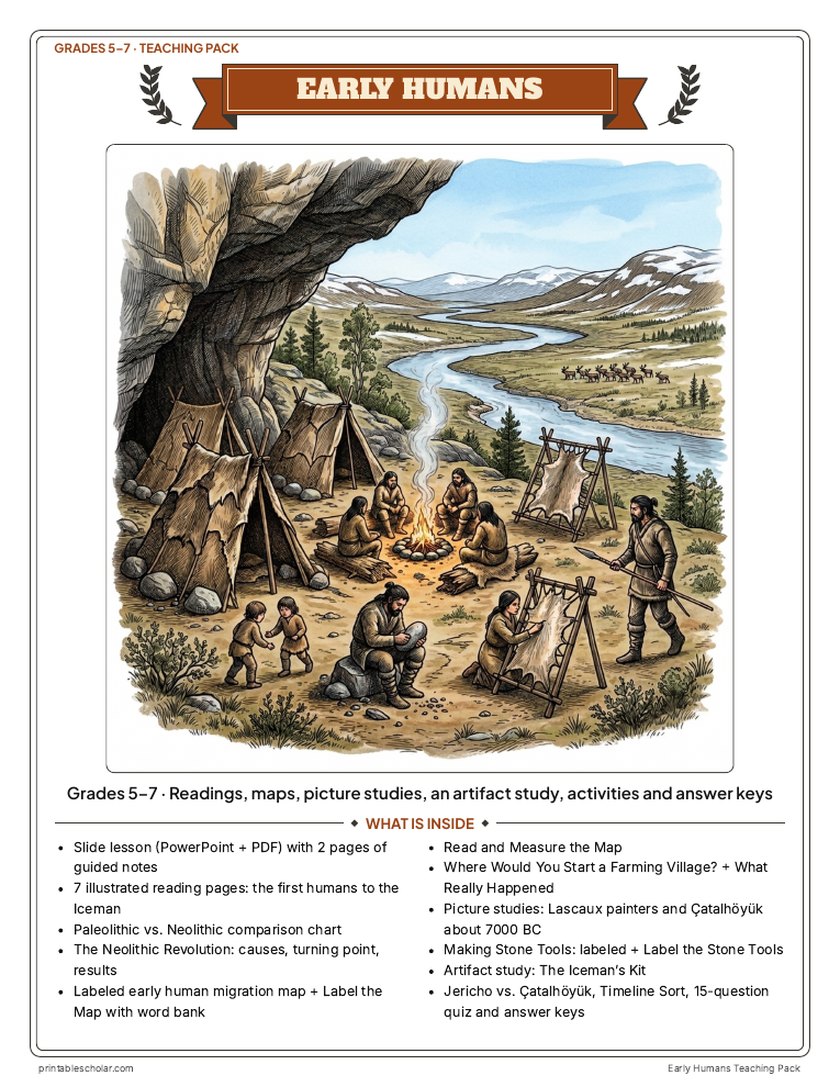
Teaching pack · Grades 5–7
Teaching Early Humans? The whole unit, ready to teach.
Two weeks of lessons in one download: slides to present, notes for students to fill in, and printable pages that use these maps and pictures.
Every slide comes with teacher notes: what to say, what to ask, and sample answers.
- 49 lesson slides (PowerPoint you can edit) and 2 pages of guided notes
- 7 illustrated reading pages: the first humans, out of Africa, life in the Old Stone Age, cave art and beliefs, the first farmers, early villages, and Ötzi the Iceman, plus a Paleolithic vs. Neolithic chart
- Maps: a labeled early human migration map with Ice Age coastlines, a blank map with word bank, Read and Measure the Map, and Where Would You Start a Farming Village? with What Really Happened
- Activities: picture studies of the Lascaux painters and Çatalhöyük, Making Stone Tools (labeled and blank), the Neolithic Revolution (causes and results), an artifact study of the Iceman's kit, Jericho vs. Çatalhöyük, and a timeline sort in years ago and BC
- A 15-question quiz, a teacher guide with a two-week plan, and answer keys for everything
Every answer is in the pack. The readings, slides, maps and pictures teach everything the sheets and quiz ask, so no textbook is needed.
Get the Early Humans pack for $7Teaching more than one? Get all seven ancient history packs (Early Humans, Egypt, Mesopotamia, Greece, Rome, China and India) for $34: about fourteen weeks of lessons.
Get all 7 packs for $34See all seven packsOr get every history pack (23) in one download:Get all 23 for $49
One-time purchase. Instant download. Color and ink-saving black-and-white editions. Secure checkout by Stripe.
Why farming began
The Ice Age ended
About 11,700 years ago the world grew warmer and wetter, and wild wheat and barley grew thickly in the Fertile Crescent.
People settled first
The Natufians gathered so much wild grain that they lived in villages all year, even before they farmed.
More mouths to feed
As villages grew, wild food nearby was not enough, so planting crops and herding animals gave more food from the same land.
Results
Villages and towns, stored surplus food, new jobs and trade, and new problems: harder work, crowding and disease. Later came the first cities and writing.
Frequently asked questions
Why is it called a revolution if it took thousands of years?
Because it changed almost everything about how people lived: what they ate, where they lived, how many people there were and what jobs they did.
Where did farming begin?
First in the Fertile Crescent of Southwest Asia, about 9500 BC. People also began farming on their own in China (rice and millet), Mexico (squash and maize), New Guinea, the Andes (potatoes) and Africa (sorghum).
Was farming better than hunting and gathering?
Both had good and bad sides. Farming fed more people and let them settle, but early farmers often worked harder and had more tooth decay and disease than hunter-gatherers.