About the Multiplication Chart 1-10
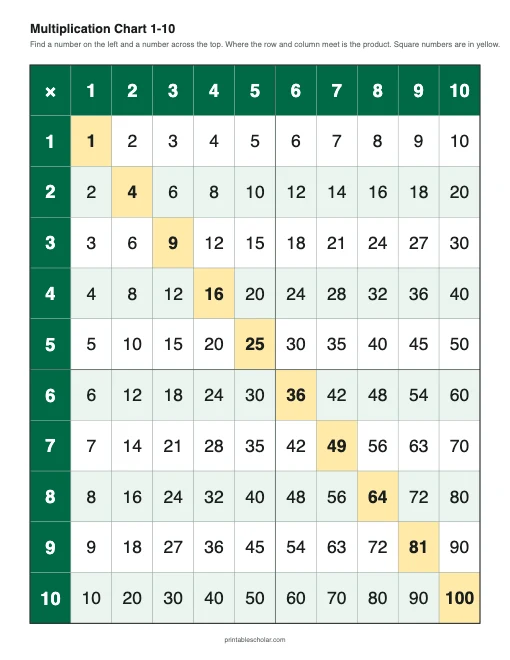
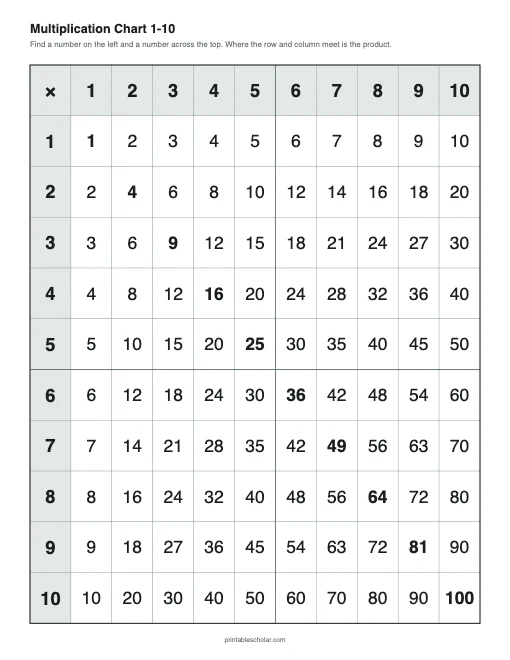
To read the chart, find one factor in the column on the left and the other in the row across the top. The cell where that row and column meet is the product. For 7 × 8, go to row 7 and move across to column 8: 56.
The 10 × 10 chart holds the facts most students learn in second and third grade. Many of them come free: the 1s row repeats the number, the 10s row adds a zero, and because 3 × 7 equals 7 × 3, every fact above the yellow diagonal is repeated below it. That leaves far fewer facts to memorize than 100.
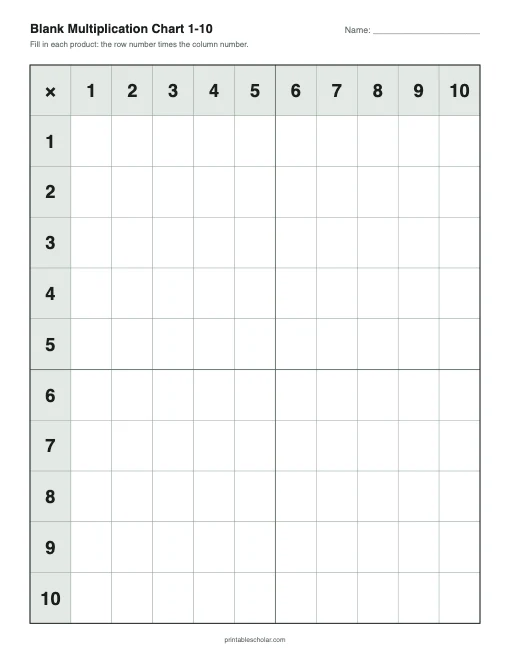
The blank chart works as a timed or untimed fill-in. Start with the 1s, 2s, 5s and 10s, then the square numbers, then the rest.
For 12 × 12 and other sizes, see the main multiplication chart page. Larger charts have their own pages: 1-25 and 1-30.
Frequently Asked Questions
What is a 1-10 multiplication chart?
It is a 10 by 10 grid that shows the product of every pair of numbers from 1 to 10, which is 100 facts in all. It is also called a 10 by 10 times table or a multiplication table to 10.
What grade uses a 10 by 10 multiplication chart?
Multiplication is introduced at the end of second grade and is a main topic of third grade, when students are expected to know the facts to 10 times 10. The chart is also used in fourth and fifth grade as a reference for multi-digit multiplication and division.
Should I print the 1-10 or the 1-12 chart?
Use 1-10 for students who are first learning their facts. It is less crowded and the print is larger. Move to 1-12 when the 11s and 12s are being taught.
How do I use the blank chart?
Have students fill in the rows they know first (1, 2, 5 and 10), then the square numbers down the diagonal, then the rest. Check it against the filled-in chart.