 Printable Scholar
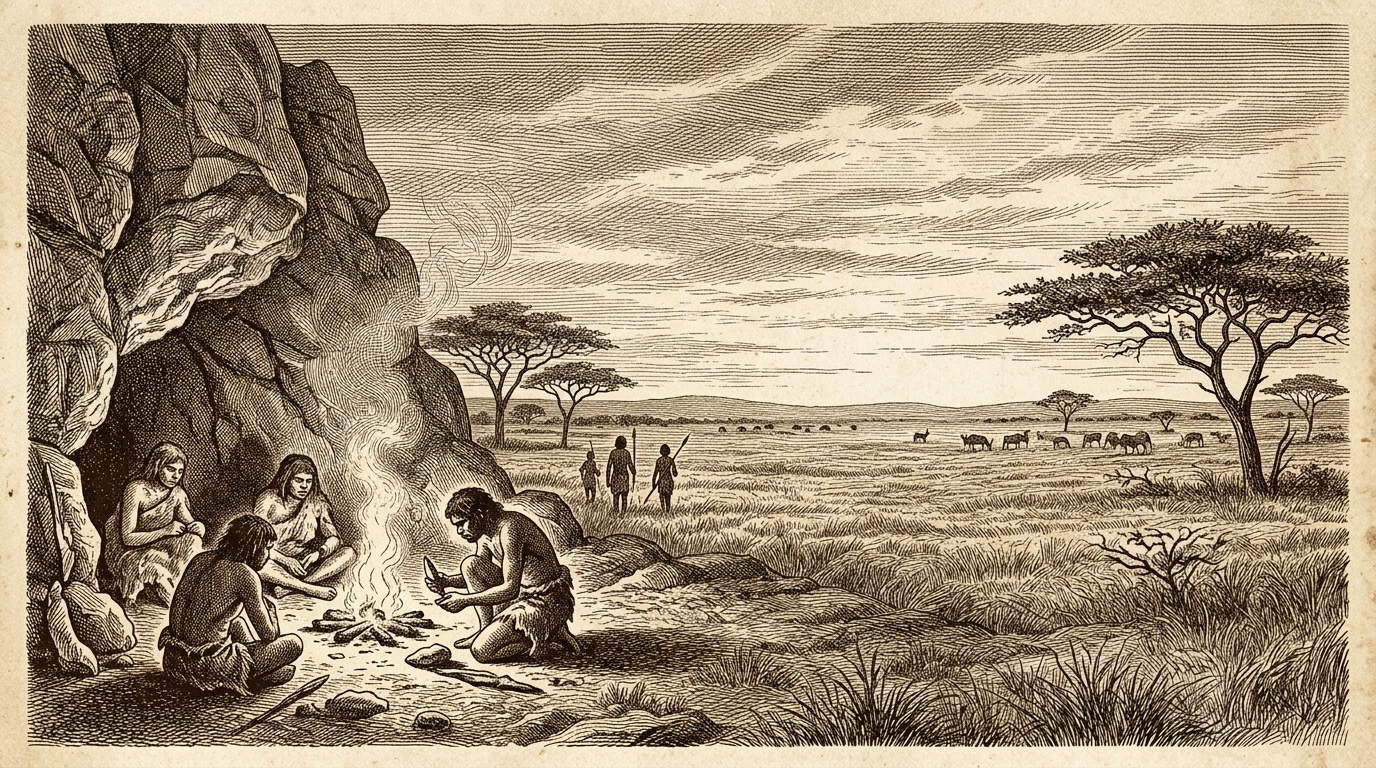
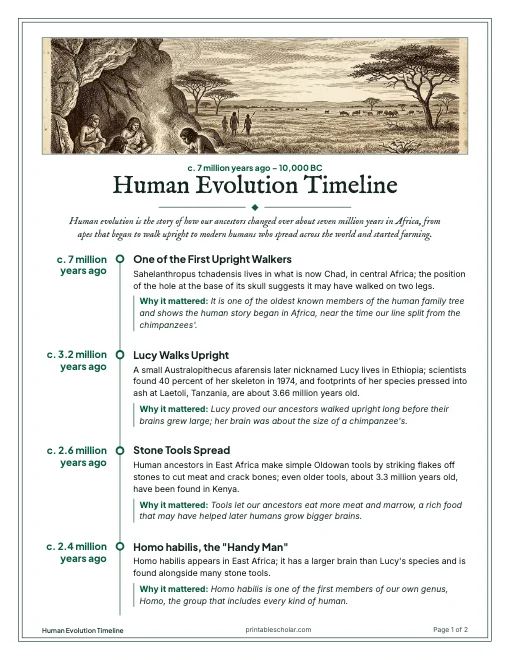
Human Evolution Timeline
Human evolution is the story of how our ancestors changed over about seven million years in Africa, from apes that began to walk upright to modern humans who spread across the world and started farming.
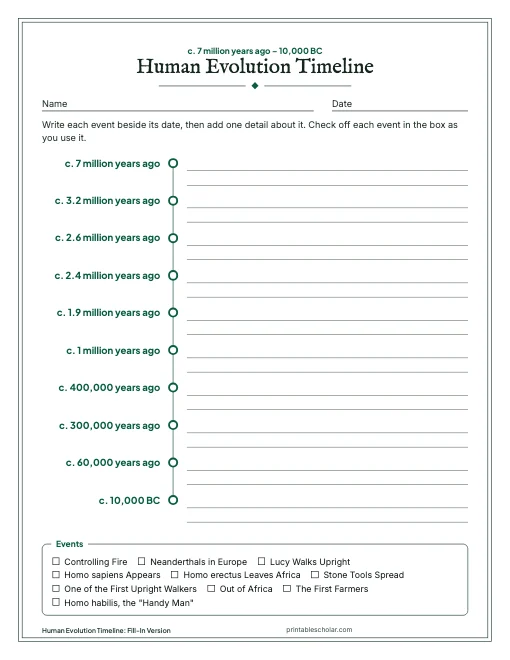
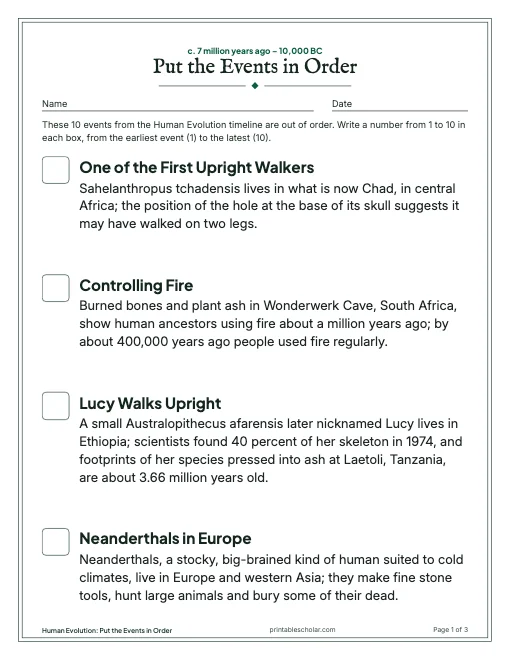
Put the Events in Order
The events shuffled, to number from first to last. With answer key.
Download PDF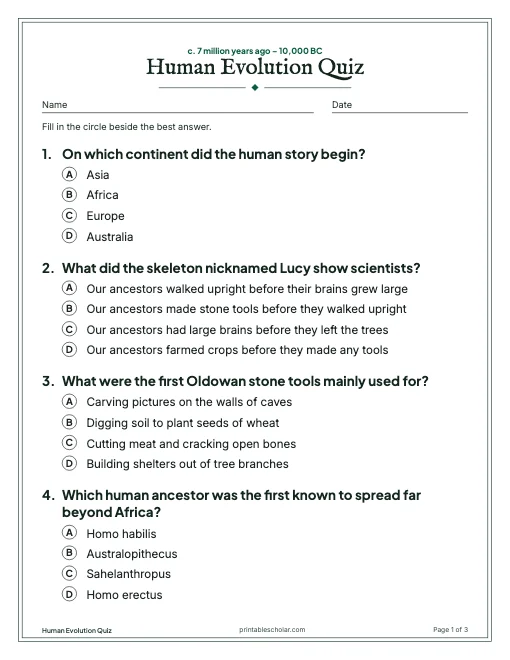
Scientists piece together the human story from fossils, stone tools, footprints, cave paintings and even ancient DNA. The evidence points to Africa as the place where it began. About seven million years ago, the line that led to us split from the line that led to chimpanzees, and over millions of years our ancestors came down from the trees, walked on two legs, and learned to make tools. There was never a single straight line from ape to human. For most of the past two million years, several kinds of humans lived on Earth at the same time: Homo erectus in Asia, Neanderthals in Europe, and others. Our own species, Homo sapiens, appeared in Africa about 300,000 years ago and is the only one left today. The last chapter of this timeline is the biggest change of all. Around 12,000 years ago, people in the Middle East began to plant crops and keep animals. Farming let them settle in villages, and villages grew into the first cities and civilizations.
- c. 7 million years ago
One of the First Upright Walkers
Sahelanthropus tchadensis lives in what is now Chad, in central Africa; the position of the hole at the base of its skull suggests it may have walked on two legs.
Why it mattered: It is one of the oldest known members of the human family tree and shows the human story began in Africa, near the time our line split from the chimpanzees'.
- c. 3.2 million years ago
Lucy Walks Upright
A small Australopithecus afarensis later nicknamed Lucy lives in Ethiopia; scientists found 40 percent of her skeleton in 1974, and footprints of her species pressed into ash at Laetoli, Tanzania, are about 3.66 million years old.
Why it mattered: Lucy proved our ancestors walked upright long before their brains grew large; her brain was about the size of a chimpanzee's.
- c. 2.6 million years ago
Stone Tools Spread
Human ancestors in East Africa make simple Oldowan tools by striking flakes off stones to cut meat and crack bones; even older tools, about 3.3 million years old, have been found in Kenya.
Why it mattered: Tools let our ancestors eat more meat and marrow, a rich food that may have helped later humans grow bigger brains.
- c. 2.4 million years ago
Homo habilis, the "Handy Man"
Homo habilis appears in East Africa; it has a larger brain than Lucy's species and is found alongside many stone tools.
Why it mattered: Homo habilis is one of the first members of our own genus, Homo, the group that includes every kind of human.
- c. 1.9 million years ago
Homo erectus Leaves Africa
Homo erectus, tall with long legs built for walking and running, appears in Africa; by about 1.8 million years ago its kind had reached Georgia in western Asia, and later China and Java.
Why it mattered: Homo erectus was the first human ancestor known to spread far beyond Africa, and it survived for more than a million years.
- c. 1 million years ago
Controlling Fire
Burned bones and plant ash in Wonderwerk Cave, South Africa, show human ancestors using fire about a million years ago; by about 400,000 years ago people used fire regularly.
Why it mattered: Fire gave warmth, light and protection from animals, and cooked food is easier to chew and digest.
- c. 400,000 years ago
Neanderthals in Europe
Neanderthals, a stocky, big-brained kind of human suited to cold climates, live in Europe and western Asia; they make fine stone tools, hunt large animals and bury some of their dead.
Why it mattered: Neanderthals were close relatives of ours: modern humans later met them and had children with them, and many people today still carry a little Neanderthal DNA.
- c. 300,000 years ago
Homo sapiens Appears
The oldest known fossils of our species, Homo sapiens, are found at Jebel Irhoud in Morocco and date to about 300,000 years ago.
Why it mattered: Every person alive today belongs to this one species, which began in Africa and is now the only kind of human left.
- c. 60,000 years ago
Out of Africa
Starting between about 70,000 and 50,000 years ago, groups of modern humans move out of Africa into Asia, reaching Australia by about 50,000 years ago and Europe by about 45,000 years ago; Neanderthals die out about 40,000 years ago.
Why it mattered: Within a few tens of thousands of years, Homo sapiens lived on every continent except Antarctica, reaching the Americas by at least 15,000 years ago.
- c. 10,000 BC
The First Farmers
About 12,000 years ago, at the end of the last Ice Age, people in the Fertile Crescent of the Middle East begin to plant wheat and barley and herd sheep and goats.
Why it mattered: Farming let people stay in one place, store food and grow in number, leading to villages, then cities, writing and the first civilizations.
Human Evolution Quiz
Check what you learned — read on screen, or download the Quiz with Answer Key above for a worksheet version.
On which continent did the human story begin?
- A) Asia
- B) Africa
- C) Europe
- D) Australia
What did the skeleton nicknamed Lucy show scientists?
- A) Our ancestors walked upright before their brains grew large
- B) Our ancestors made stone tools before they walked upright
- C) Our ancestors had large brains before they left the trees
- D) Our ancestors farmed crops before they made any tools
What were the first Oldowan stone tools mainly used for?
- A) Carving pictures on the walls of caves
- B) Digging soil to plant seeds of wheat
- C) Cutting meat and cracking open bones
- D) Building shelters out of tree branches
Which human ancestor was the first known to spread far beyond Africa?
- A) Homo habilis
- B) Australopithecus
- C) Sahelanthropus
- D) Homo erectus
Which of these was NOT a benefit of controlling fire?
- A) Warmth and light at night
- B) Protection from animals
- C) Food that is easier to chew
- D) Crops that grew faster
What do many people alive today carry from Neanderthals?
- A) A little of their DNA
- B) Their style of stone tools
- C) Their written language
- D) Their way of farming
Where were the oldest known fossils of Homo sapiens found?
- A) Laetoli in Tanzania
- B) Lascaux in France
- C) Jebel Irhoud in Morocco
- D) Hadar in Ethiopia
What change began in the Fertile Crescent about 12,000 years ago?
- A) People started to make stone tools
- B) People started to plant crops and herd animals
- C) People started to control fire
- D) People started to walk on two legs
Show answer key
1. B · 2. A · 3. C · 4. D · 5. D · 6. A · 7. C · 8. B
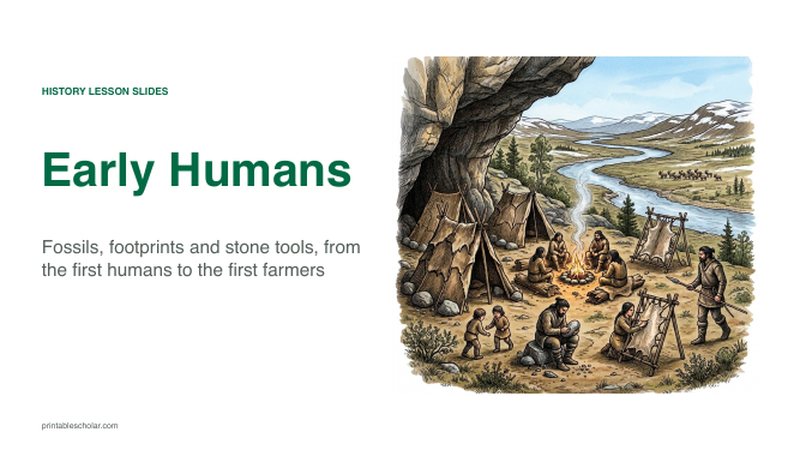 Teaching packThe Early Humans Teaching Pack, $7 — A two-week unit for grades 5 to 7: 49 lesson slides with guided notes, seven illustrated readings from the first humans to Ötzi the Iceman, a Paleolithic vs. Neolithic chart, an early human migration map with Ice Age coastlines, Where Would You Start a Farming Village?, the Lascaux painters and Çatalhöyük, making stone tools, the Neolithic Revolution, the Iceman's kit, a quiz and answer keys.
See the pack
See it on the map
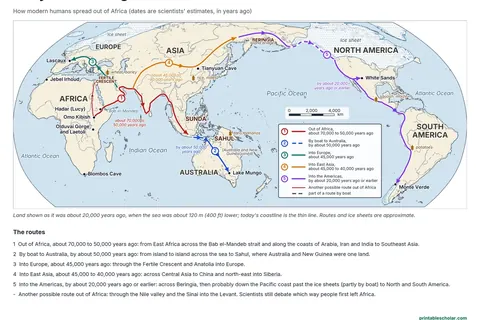 Pair this timeline with our printable Early Human Migration map — follow modern humans out of Africa, with the Ice Age coastlines. Open the map →
Related timelines
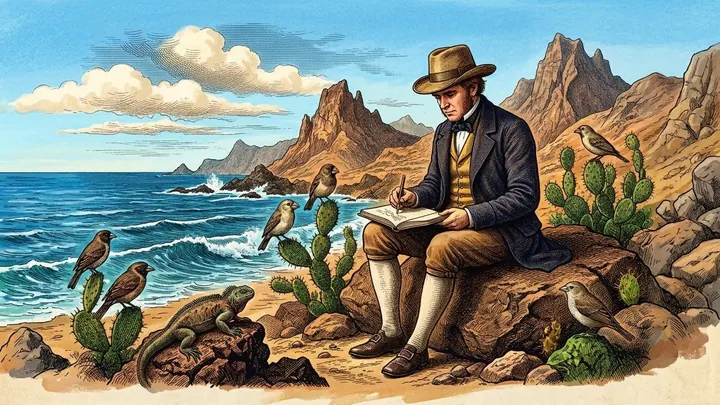 Evolution & Natural Selection Timeline — The theory of evolution by natural selection — developed by Charles Darwin in the 19th century and confirmed at the molecular level in the 20th — is the central organizing theory of all biology, explaining how all living things are related and how species change over time. Open →
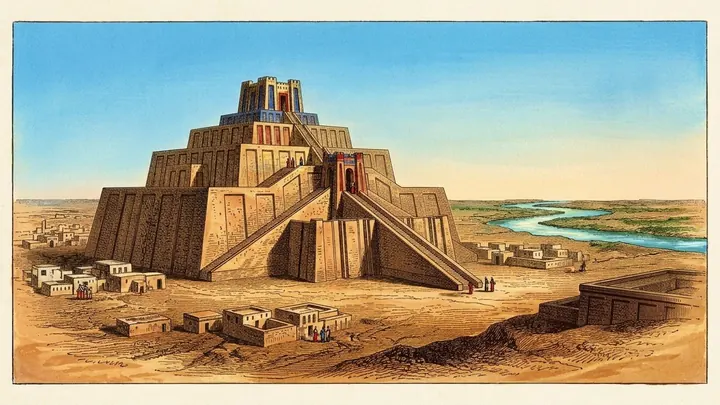 Ancient Mesopotamia Timeline — Ancient Mesopotamia — the land between the Tigris and Euphrates rivers in present-day Iraq — is called the cradle of civilization, home to the world's first cities, first writing, and first law codes. Open →
How to print
Every sheet above is a ready-to-print PDF sized for US Letter paper (8.5 × 11"). The fill-in version keeps the dates and gives students lines to write each event, with the events listed at the bottom to place — good for review. The ordering activity and the quiz each end with an answer key.
Frequently asked questions
Did humans evolve from chimpanzees?
No. Humans and chimpanzees share a common ancestor that lived about six to seven million years ago, and since then each line has kept changing in its own way. Chimpanzees are our closest living relatives, like cousins, not our ancestors. Fossils such as Sahelanthropus and Lucy show what some members of the human side of the family looked like after the split.
Why were there different kinds of humans at the same time?
Groups of early humans that lived far apart for hundreds of thousands of years slowly changed in different ways to suit their surroundings. Neanderthals in cold Ice Age Europe were stocky and strong, while Homo erectus lived on in parts of Asia. When modern humans spread out of Africa they met some of these other humans. Today Homo sapiens is the only kind of human left.
What paper size should I print this on?
The timeline is sized for standard US Letter paper (8.5 × 11 in.). The Download PDF button gives you a print-ready file that fits the page automatically.