 Printable Scholar
The Fall of Constantinople, 1453
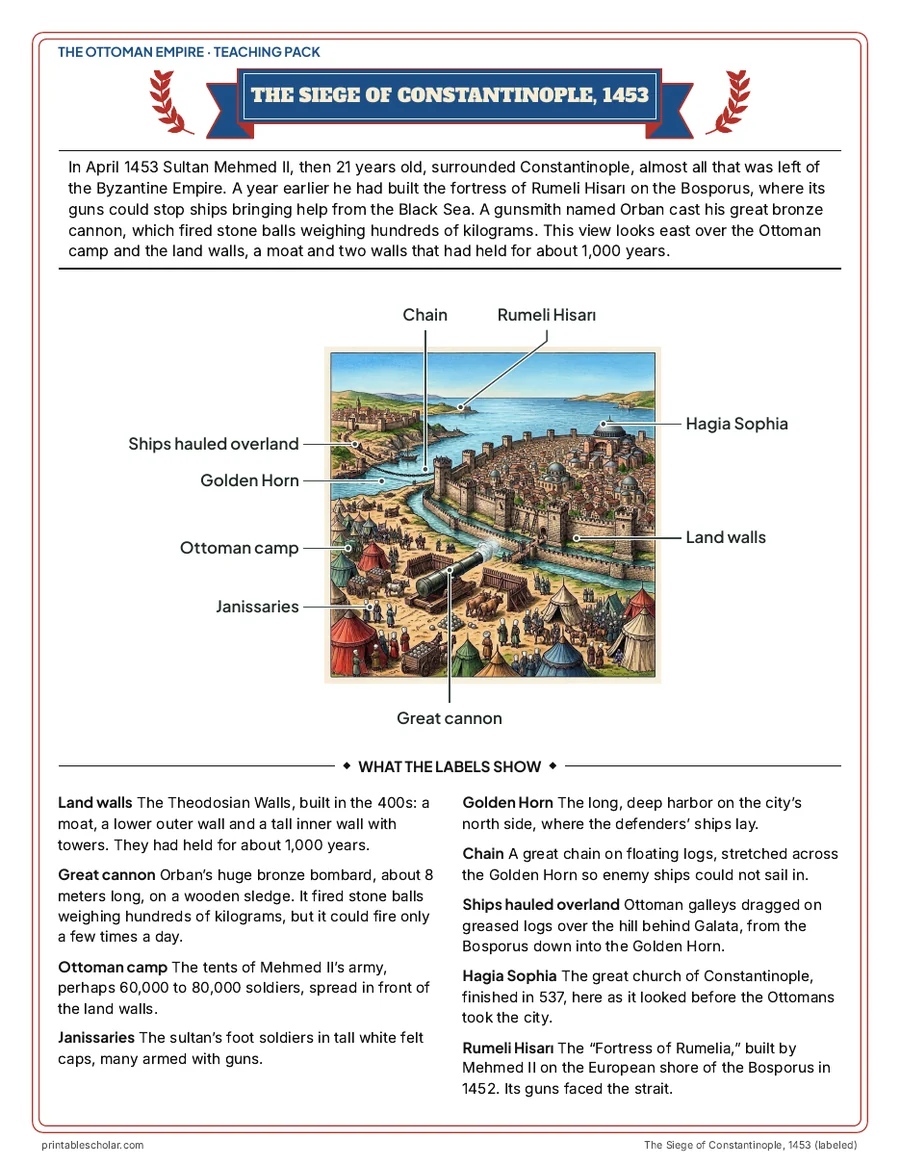
In April 1453 the Ottoman sultan Mehmed II, then 21 years old, surrounded Constantinople, almost all that was left of the Byzantine Empire. Its land walls had held for about 1,000 years. A year earlier he had built the fortress of Rumeli Hisarı on the Bosporus to stop help coming from the Black Sea; his great bronze cannon, cast by a gunsmith named Orban, fired stone balls weighing hundreds of kilograms; and when a chain kept his fleet out of the Golden Horn, his men hauled their ships over a hill on greased logs. On 29 May 1453, after 53 days, the city fell, and Mehmed made it his capital. These free pages show the siege in a labeled picture and walk through how his plan came together.
Free to print
The labeled siege picture and the causes worksheet
PDFs sized for US Letter paper, in color and black and white.
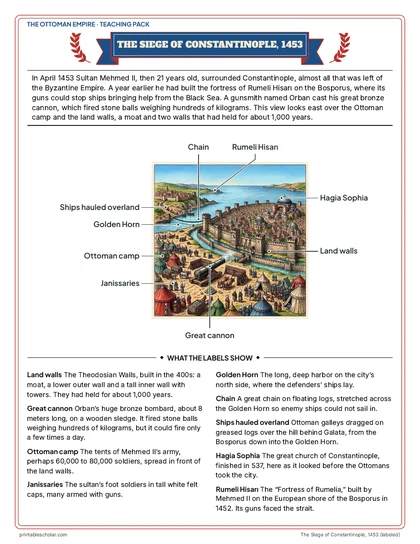
The Siege of Constantinople, 1453, labeled
The siege from above with nine parts labeled and what each one shows.
Download PDF Black and white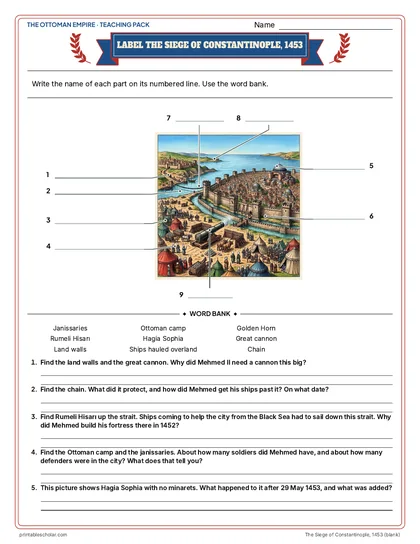
Label the Siege of Constantinople
The same picture with numbered blank labels, a word bank and five questions.
Download PDF Black and white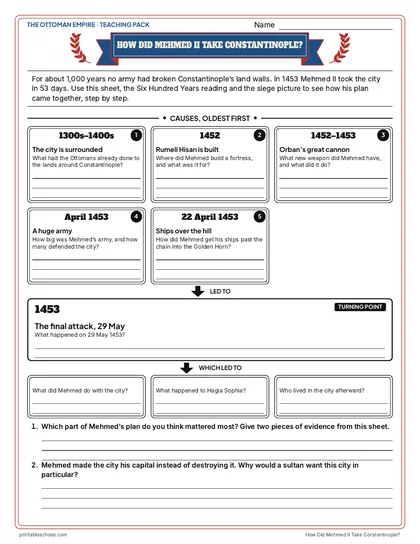
How Did Mehmed II Take Constantinople?
Dated causes, the turning point and the results, with two questions.
Download PDF Black and white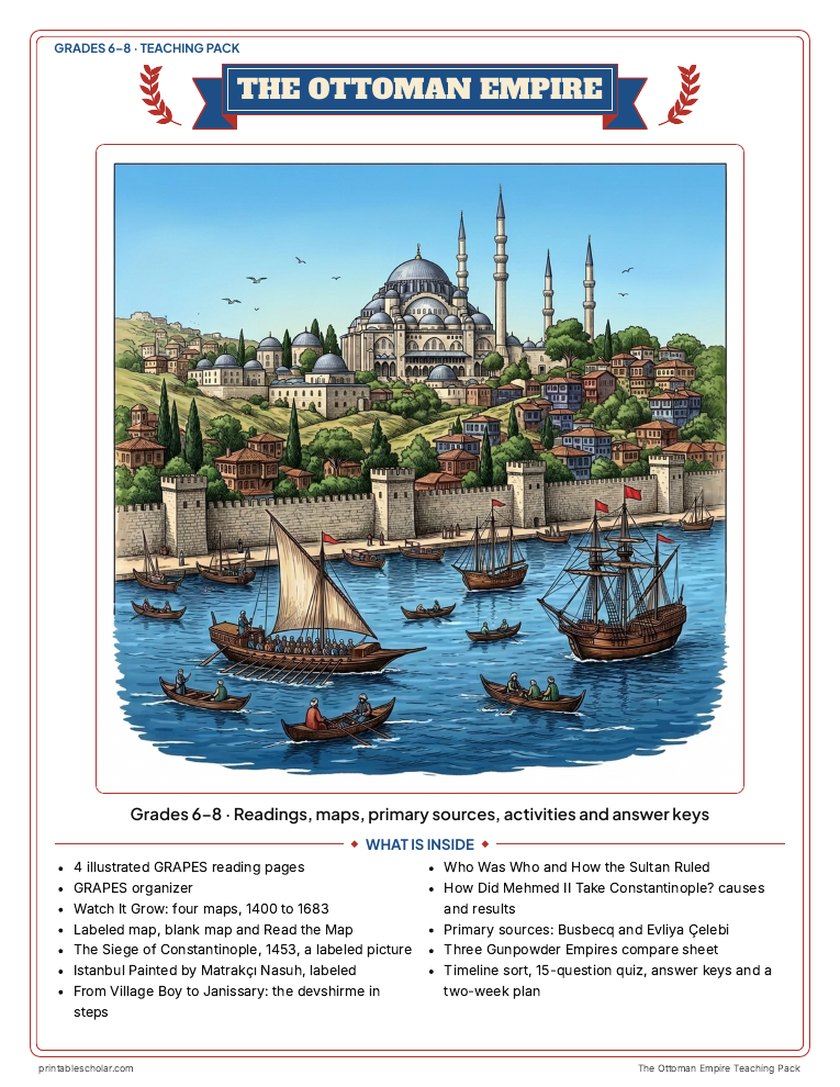
Teaching pack · Grades 6–8
Teaching the Ottoman Empire? The whole unit, ready to teach.
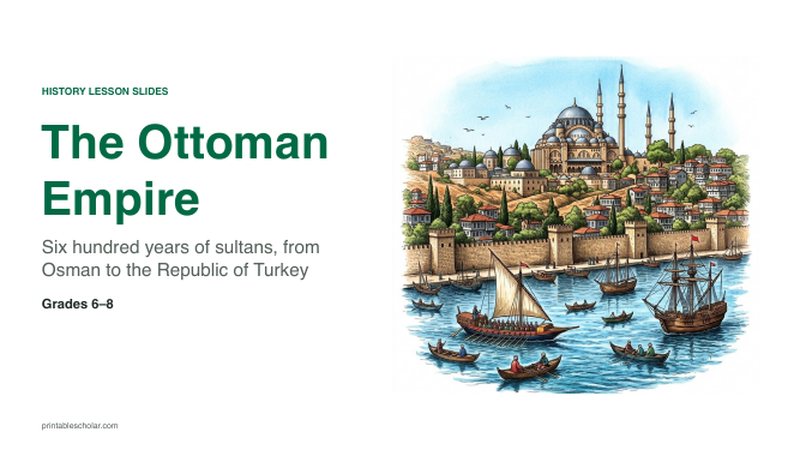
Two weeks of lessons in one download: slides to present, notes for students to fill in, and printable pages that use these maps and pictures.
- 43 lesson slides (PowerPoint you can edit, teacher notes on every slide) and 2 pages of guided notes
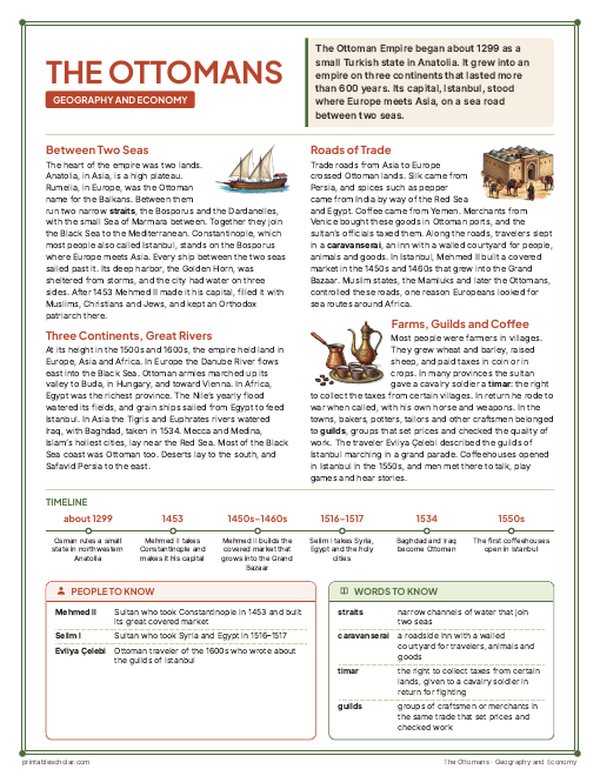
- 4 illustrated reading pages and a GRAPES organizer
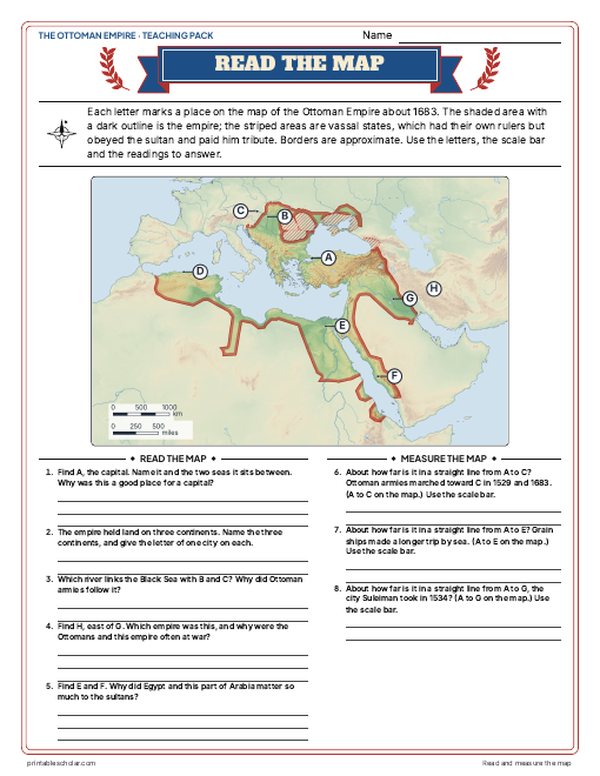
- Maps: labeled, blank, Read and Measure the Map, and Watch It Grow: the empire on four real maps, 1400, 1481, 1566 and 1683
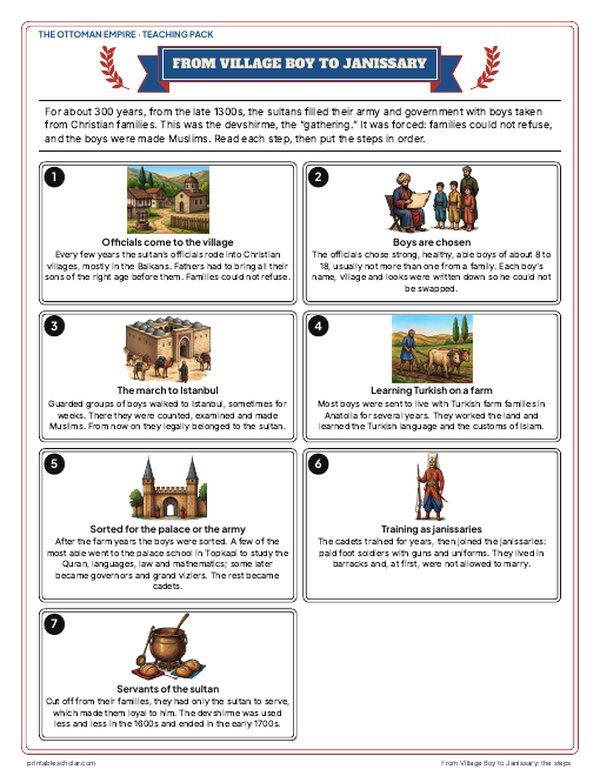
- Activities: the siege of Constantinople in 1453 (labeled), Istanbul in the real 1537 painting by Matrakçı Nasuh, From Village Boy to Janissary (the devshirme in steps), Who Was Who and how the sultan ruled, how Mehmed II took Constantinople, Busbecq and Evliya Çelebi as primary sources, three gunpowder empires compared, and a timeline sort
- A 15-question quiz, a teacher guide with a two-week plan, and answer keys for everything
Every answer is in the pack. The readings, slides, maps and pictures teach everything the sheets and quiz ask, so no textbook is needed.
Get the Ottoman Empire pack for $7Teaching more than one? Get all four medieval world packs (West Africa, the Silk Road, the Byzantines and the Ottomans) for $19, with a bonus chart comparing all four: about eight weeks of lessons.
Get all 4 packs for $19See all four packsOr get every history pack (18) in one download:Get all 18 for $49
One-time purchase. Instant download. Color and ink-saving black-and-white editions. Secure checkout by Stripe.
How Mehmed II took the city
Closing the strait
Rumeli Hisarı, built in about four months in 1452 on the European shore of the Bosporus, let Ottoman guns stop ships bringing help from the Black Sea.
A giant cannon
Orban’s bronze bombard, about 8 meters long, could fire only a few times a day, but with other cannons it pounded the land walls for weeks.
Ships over the hill
A great chain on floating logs closed the Golden Horn. On 22 April 1453 Mehmed’s men dragged ships on greased logs over the hill behind Galata and into the harbor.
Too few defenders
Perhaps 60,000 to 80,000 Ottoman soldiers faced about 7,000 defenders, far too few to guard the land walls and the harbor walls at once.
Frequently asked questions
When did Constantinople fall?
On 29 May 1453, after a siege that began in early April. Mehmed II made the city his capital.
Did Mehmed II rename Constantinople Istanbul?
No. Istanbul was a spoken name for the city, but Ottoman official papers kept calling it Kostantiniyye for centuries.
What happened to Hagia Sophia?
Mehmed II made the great church a mosque, and minarets were added beside it. In 1453 it had none.