 Printable Scholar
From Village Boy to Janissary: the Devshirme
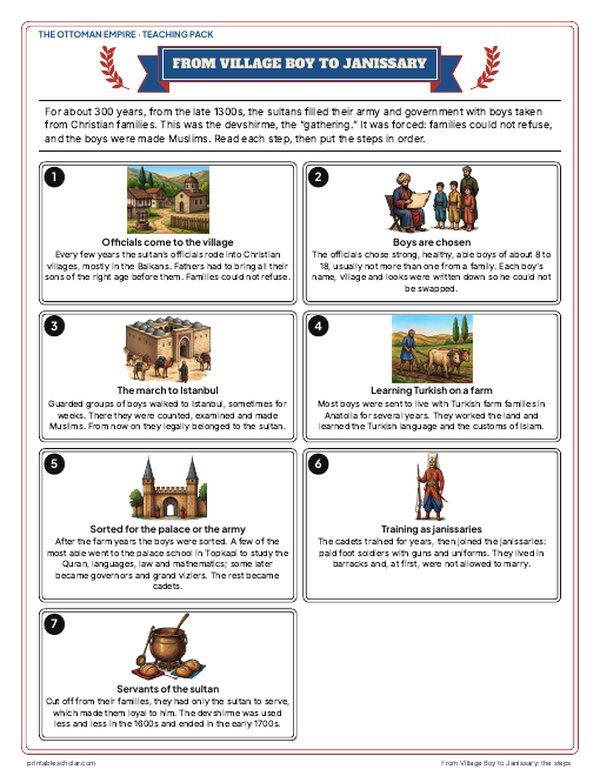
The janissaries were the Ottoman sultan’s paid foot soldiers, armed with guns, and among the most feared troops of their time. Most of them came through the devshirme, the "collection": every few years officials took Christian boys of about 8 to 18, mostly from villages in the Balkans, forced them to become Muslims and trained them to serve the sultan. For families it meant losing a son by force. For some boys it was also a road to power: the brightest went to the palace school, and some became governors and grand viziers. These free pages show the system in seven steps, then ask students to put the steps in order and weigh both sides.
Free to print
The devshirme steps and the put-in-order page
PDFs sized for US Letter paper, in color and black and white.
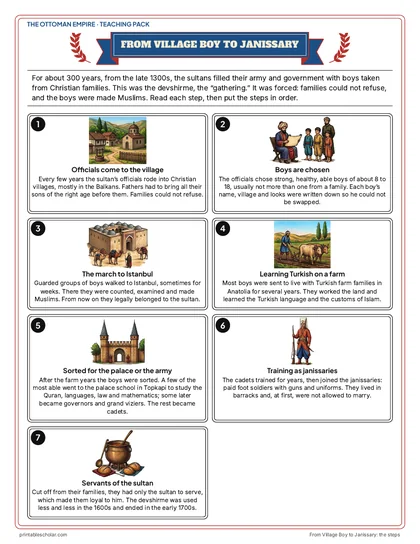
From Village Boy to Janissary: the steps
Seven illustrated steps, from the officials’ visit to the janissary barracks.
Download PDF Black and white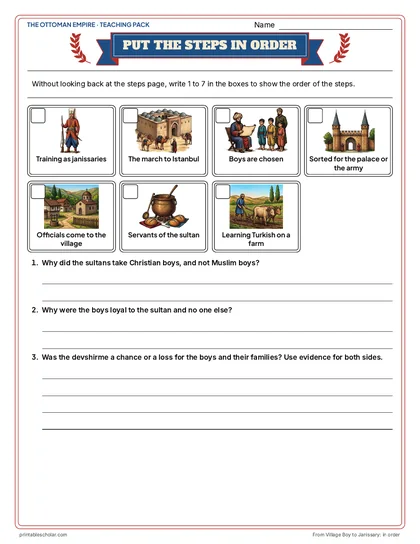
Put the steps in order
The same steps shuffled to number, with three questions (answers in the pack’s key).
Download PDF Black and white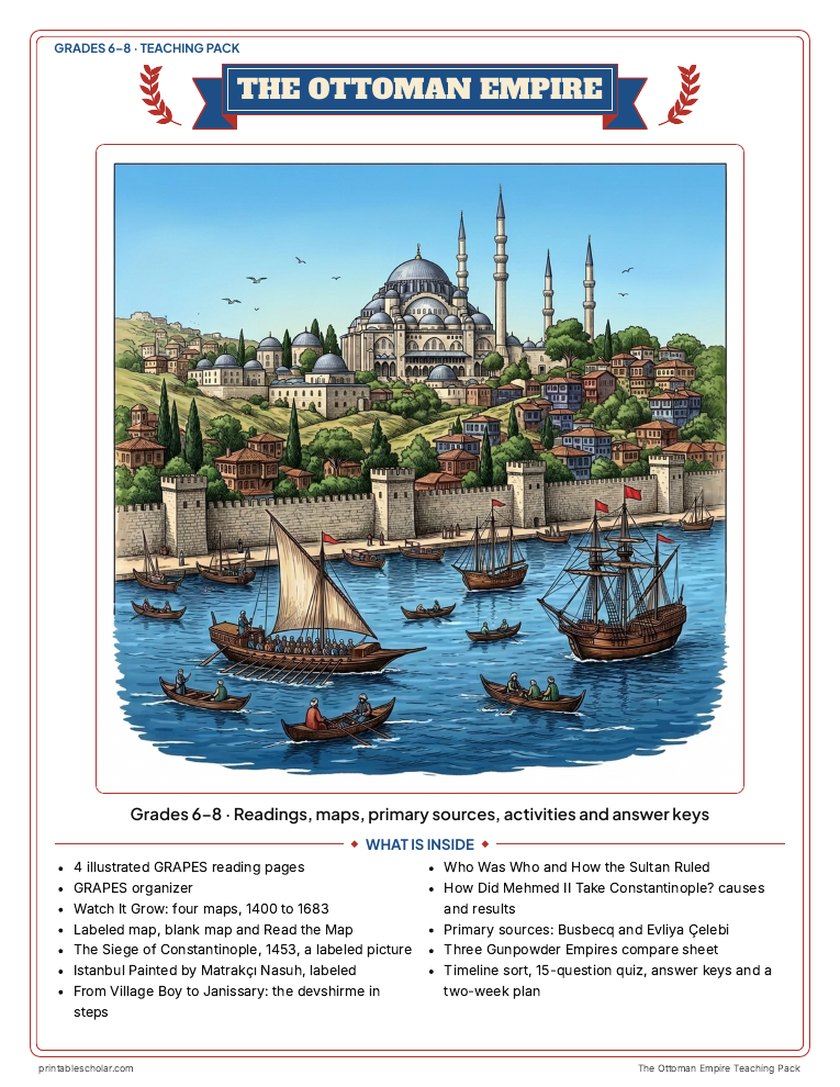
Teaching pack · Grades 6–8
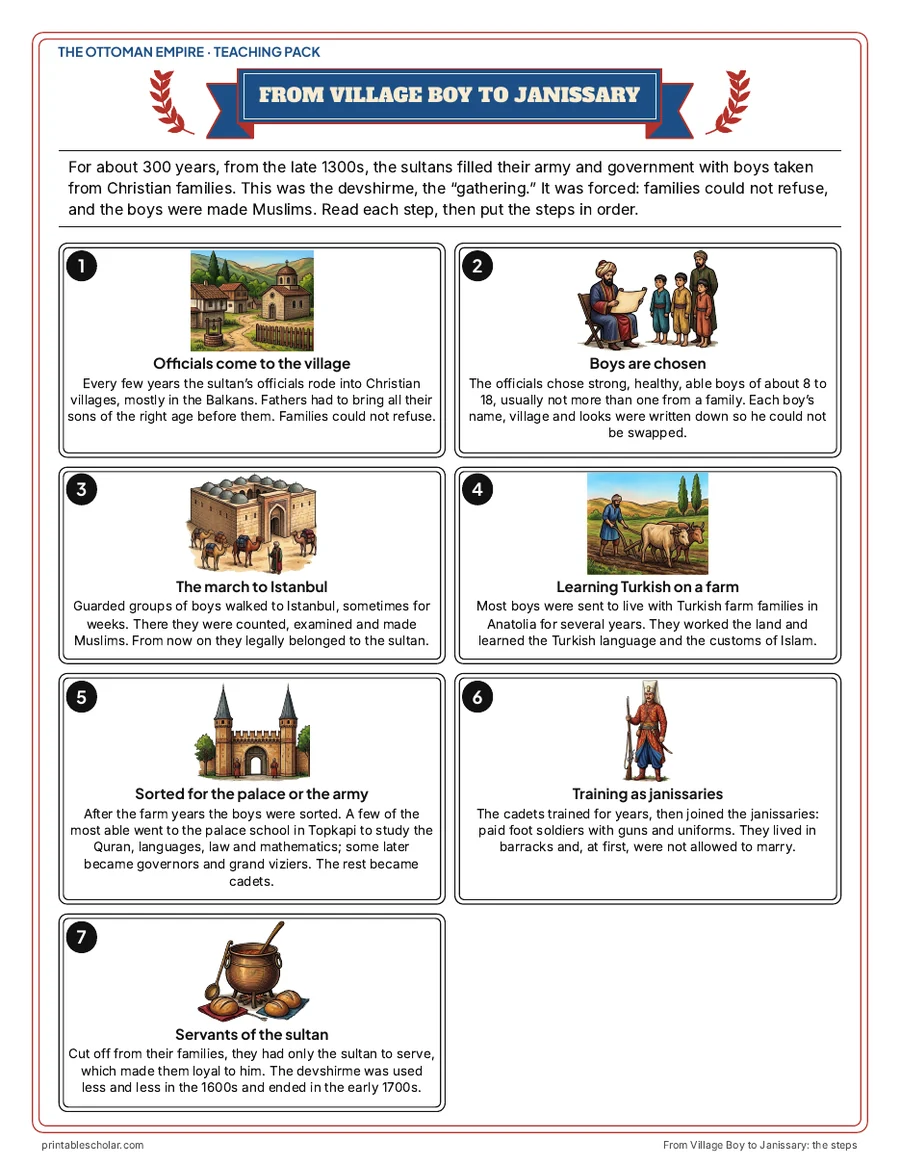
Teaching the Ottoman Empire? The whole unit, ready to teach.
Two weeks of lessons in one download: slides to present, notes for students to fill in, and printable pages that use these maps and pictures.
- 43 lesson slides (PowerPoint you can edit, teacher notes on every slide) and 2 pages of guided notes
- 4 illustrated reading pages and a GRAPES organizer
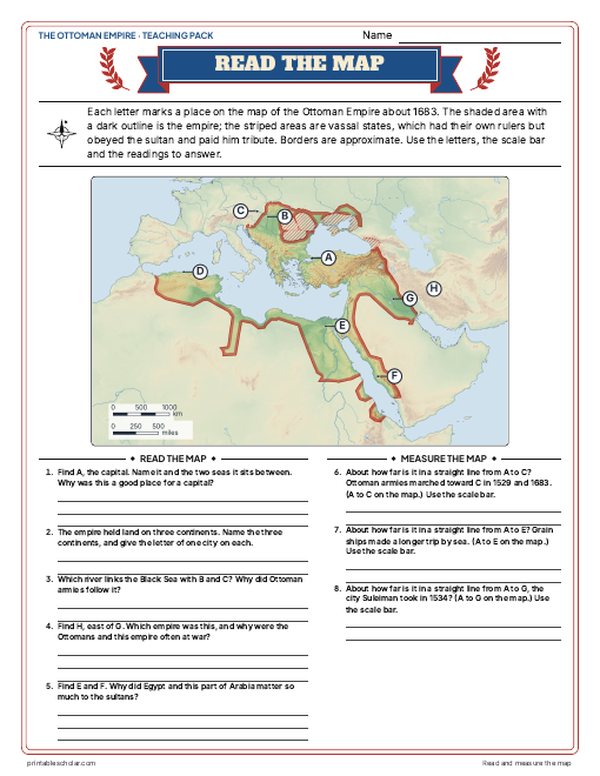
- Maps: labeled, blank, Read and Measure the Map, and Watch It Grow: the empire on four real maps, 1400, 1481, 1566 and 1683
- Activities: the siege of Constantinople in 1453 (labeled), Istanbul in the real 1537 painting by Matrakçı Nasuh, From Village Boy to Janissary (the devshirme in steps), Who Was Who and how the sultan ruled, how Mehmed II took Constantinople, Busbecq and Evliya Çelebi as primary sources, three gunpowder empires compared, and a timeline sort
- A 15-question quiz, a teacher guide with a two-week plan, and answer keys for everything
Every answer is in the pack. The readings, slides, maps and pictures teach everything the sheets and quiz ask, so no textbook is needed.
Get the Ottoman Empire pack for $7Teaching more than one? Get all four medieval world packs (West Africa, the Silk Road, the Byzantines and the Ottomans) for $19, with a bonus chart comparing all four: about eight weeks of lessons.
Get all 4 packs for $19See all four packsOr get every history pack (18) in one download:Get all 18 for $49
One-time purchase. Instant download. Color and ink-saving black-and-white editions. Secure checkout by Stripe.
How the devshirme worked
Why Christian boys
Islamic law did not allow free Muslims to be enslaved, and the sultans wanted servants with no family ties, so they took Christian boys who would be loyal only to the sultan.
Sorted by ability
After years learning Turkish on farms, a few of the most able boys went to the palace school in Topkapi; the rest trained as cadets and became janissaries.
A road to power
Sokollu Mehmed Pasha, taken as a boy from Bosnia, became grand vizier. A boy from a village could end up running the empire.
A loss as well
Families could not refuse, and the boys were forced to change their religion and belonged to the sultan. Historians call it enslavement by the state.
Frequently asked questions
What were janissaries?
The Ottoman sultan’s paid foot soldiers, armed with guns and dressed in uniforms. They lived in barracks and at first were not allowed to marry. Their tall white felt cap is called a börk.
What was the devshirme?
The Ottoman system of taking Christian boys of about 8 to 18, mostly from the Balkans, converting them to Islam and training them as janissaries or palace officials.
Was the devshirme slavery?
The boys were taken by force and legally belonged to the sultan, so historians call it enslavement by the state. But they were paid, trained and could rise to the highest offices, which ordinary enslaved people could not.