Picture pattern worksheets for preschool and kindergarten. Children say a pattern out loud, find what comes next, and pick out the part that repeats. Start with the chart, then the two-picture patterns, then the harder ones. The two Copy the Pattern sheets end with a pencil: trace a pattern on a dot grid, then keep it going.
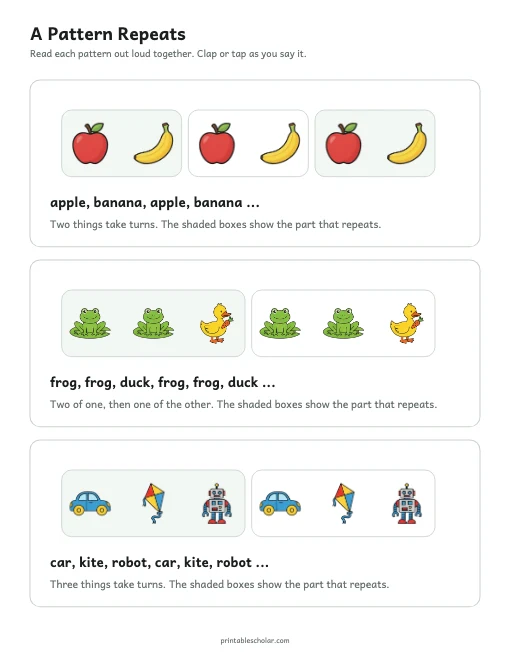
Three patterns with the repeating part boxed, to read out loud together.
Download PDF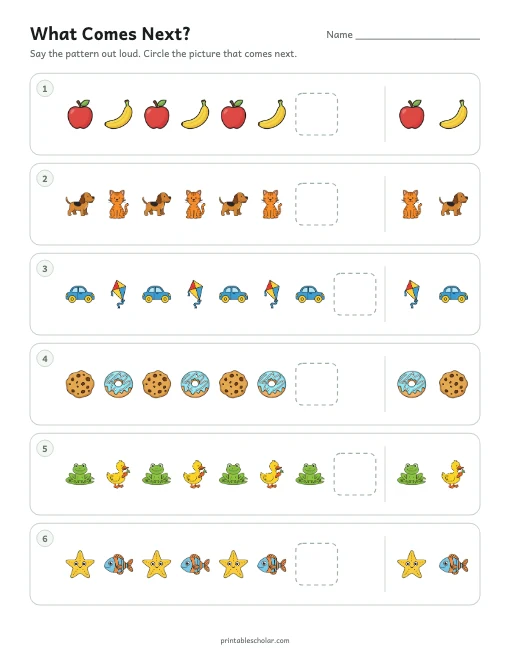
Six patterns where two pictures take turns. Circle the one that comes next.
Download PDF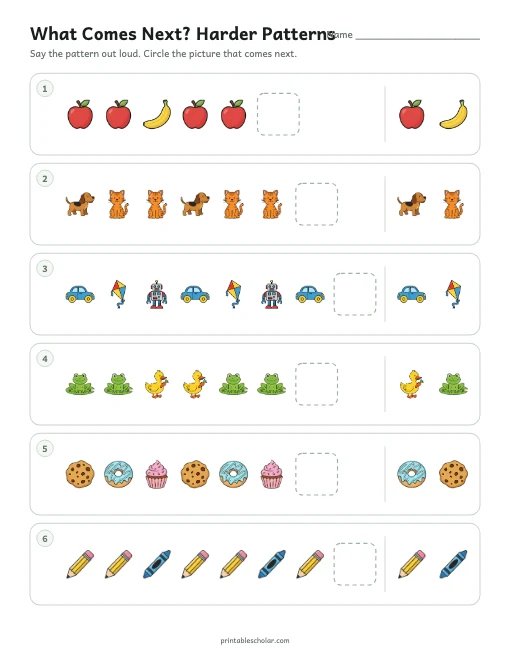
Six patterns with doubles and three-part repeats.
Download PDF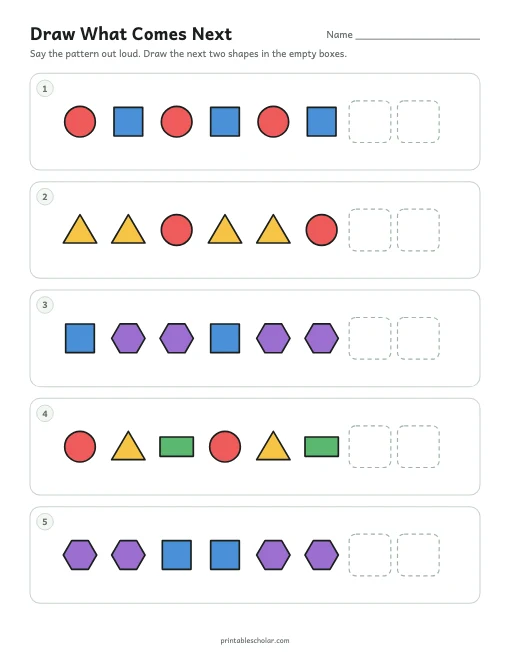
Colored shape patterns with two empty boxes to fill in.
Download PDF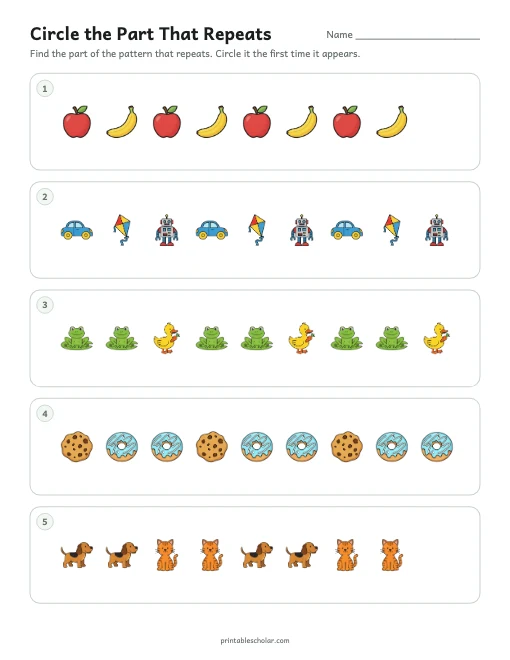
Find the piece of each pattern that repeats and circle it.
Download PDF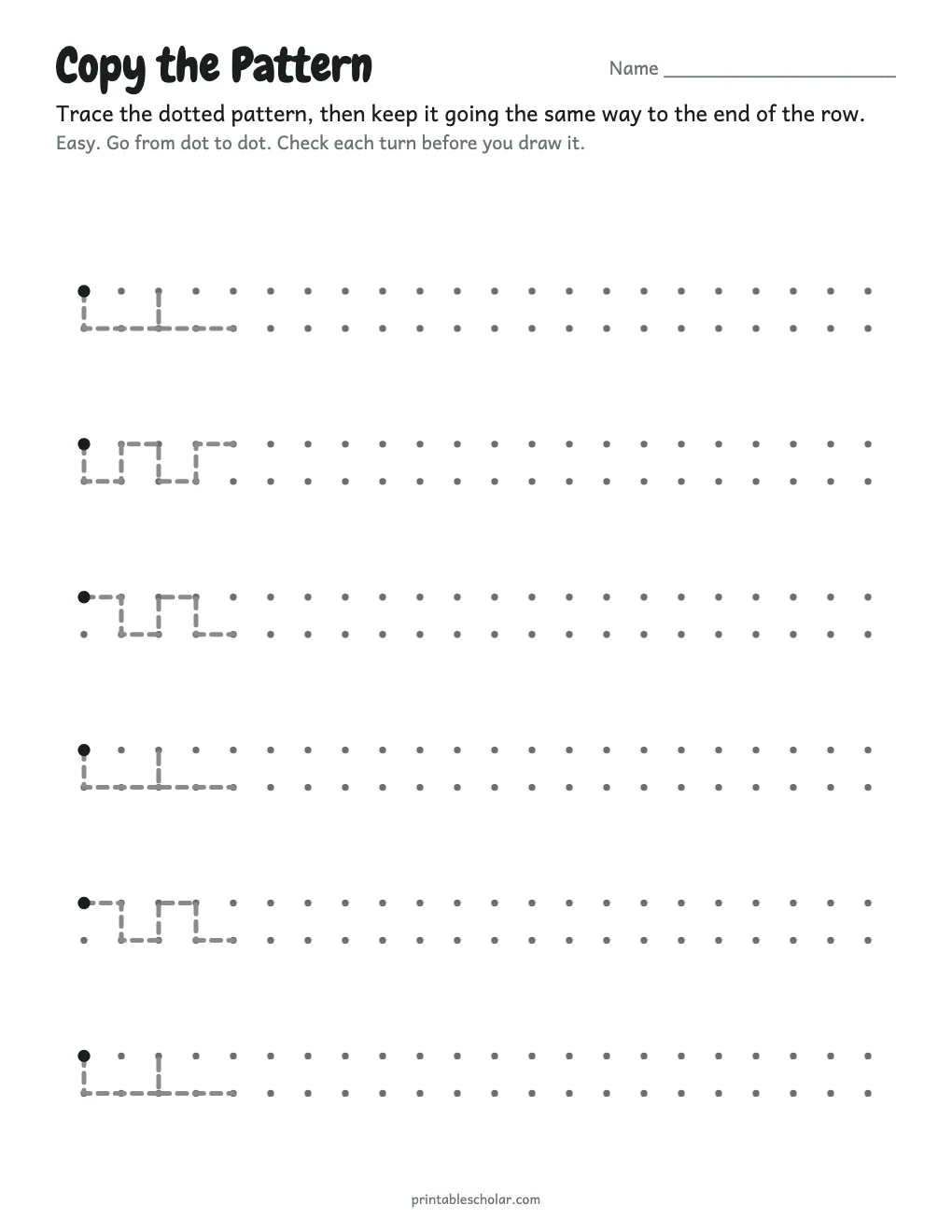
Trace a short line pattern on the dots, then keep it going to the end of each row. Includes answer key.
Download PDF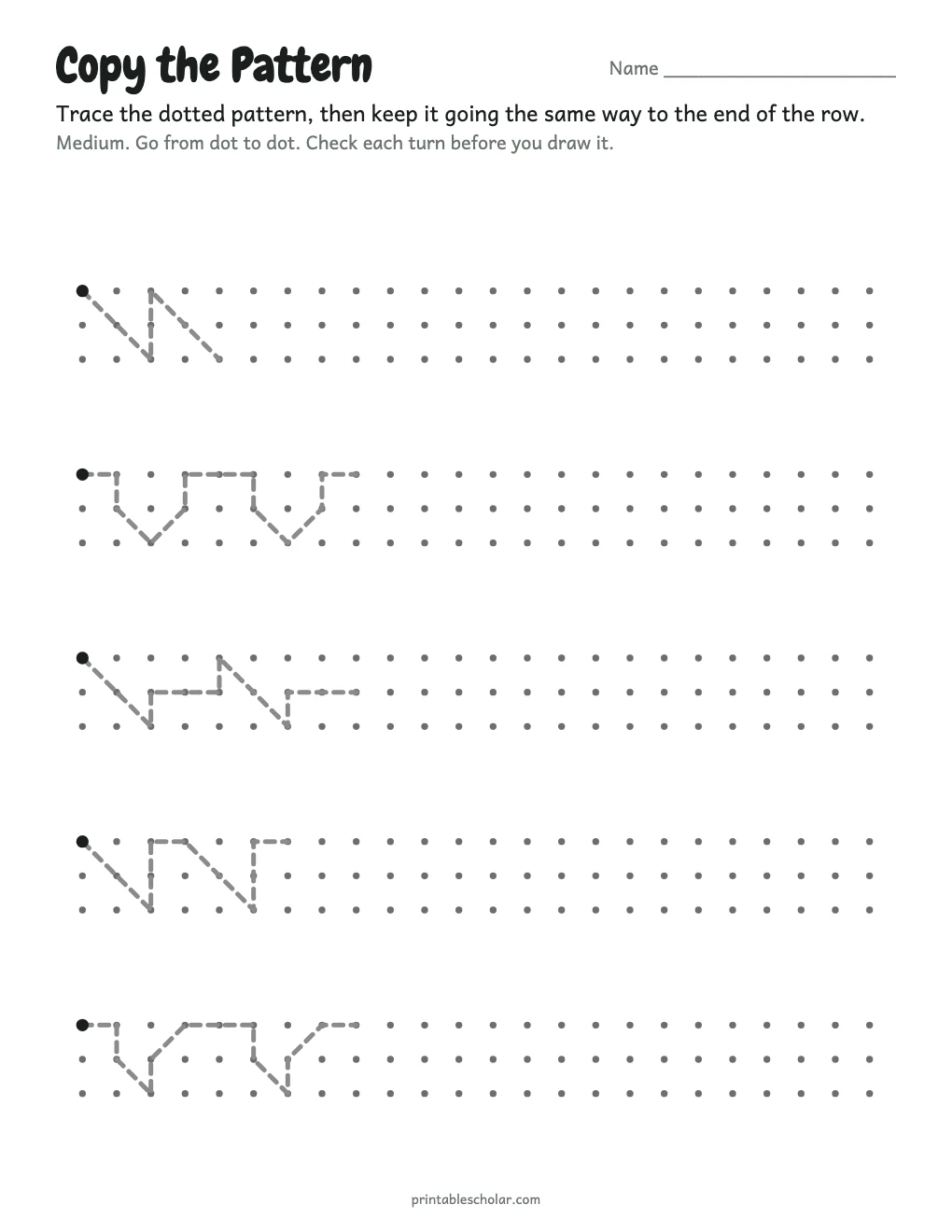
Longer, trickier line patterns to trace and continue dot by dot. Includes answer key.
Download PDFA pattern is something that repeats in a way you can predict. Apple, banana, apple, banana: once a child sees the rule, they know what comes next without being told. Spotting rules like that is the beginning of mathematical thinking, and it shows up later in skip counting, times tables and algebra.
The simplest patterns have two parts taking turns. Teachers call these AB patterns. The first What Comes Next? sheet uses only those. The harder sheet adds doubles, such as frog, frog, duck, and three-part repeats, such as car, kite, robot.
The most useful habit is saying the pattern out loud. Children hear the rhythm before they can explain the rule, so every sheet asks for that first. Circle the Part That Repeats then asks them to find the repeating piece itself, which is the step from following a pattern to understanding it.
Copy the Pattern moves from pictures to lines. The child traces the start of a pattern on a dot grid, then continues it to the end of the row, counting dots to keep each turn the same size. It is the same skill as what comes next, done with a pencil, and good practice for the straight and slanted strokes of handwriting. More puzzles for the same age, with mazes, dot-to-dots and harder picture patterns, are in the activity sheets.
Every worksheet has an answer key on its second page. Patterns also make a good break between the counting and adding sets on the kindergarten math page.
 Printable Scholar