 Printable Scholar
Manifest Destiny
In 1845 a New York editor, John L. O’Sullivan, wrote that it was America’s "manifest destiny" to spread across the whole continent. Manifest Destiny was a belief many Americans held at the time: that God meant the United States to grow from the Atlantic to the Pacific. It helped people argue for adding Texas, for taking the Oregon Country, and for the war with Mexico. Not everyone agreed, even then. And the land was not empty: Native nations, Mexicans and Tejanos already lived on much of it. These free sheets let students read the painting most linked to the idea and O’Sullivan’s own words.
Free to print
The picture study and the primary source
PDFs sized for US Letter paper, in color and black and white.
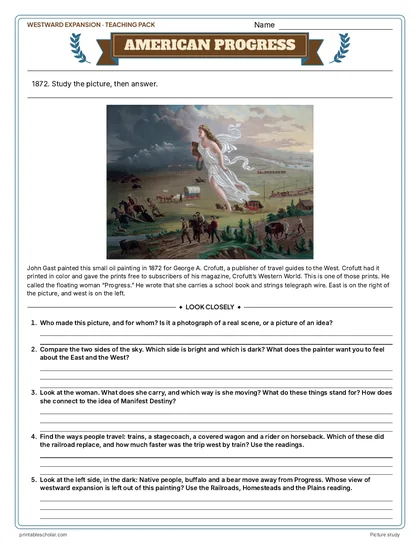
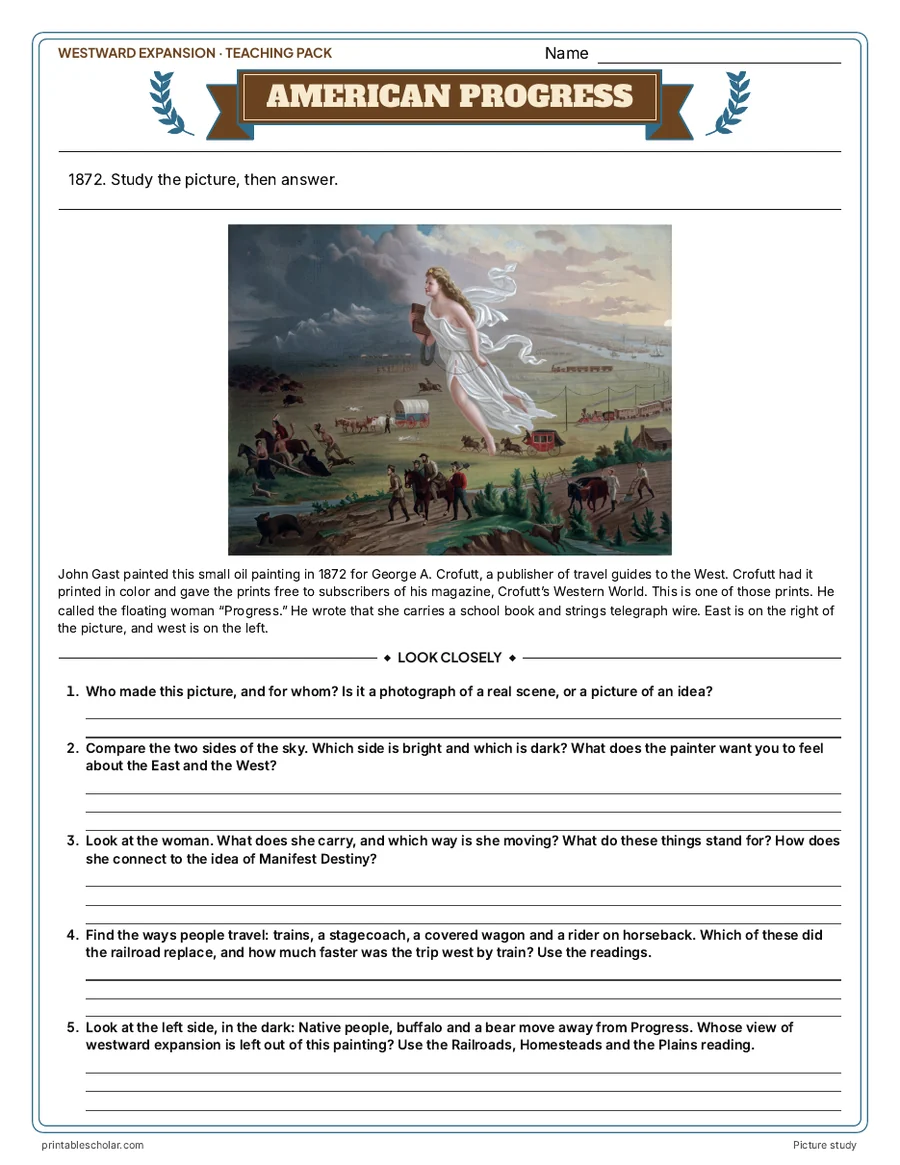
Picture study: American Progress (1872)
John Gast’s painting of westward expansion, with five Look Closely questions.
Download PDF Black and white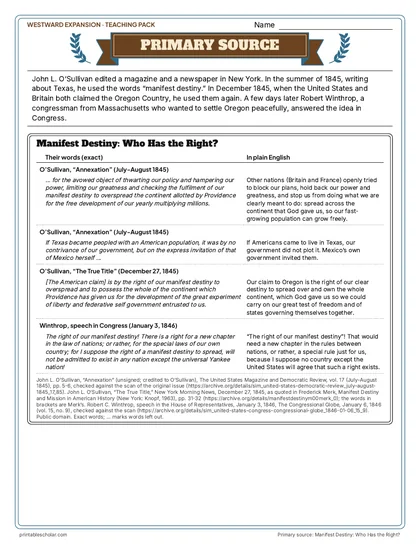
Manifest Destiny: Who Has the Right?
O’Sullivan’s words from 1845 and a congressman’s answer in 1846, each beside a plain-English version.
Download PDF Black and white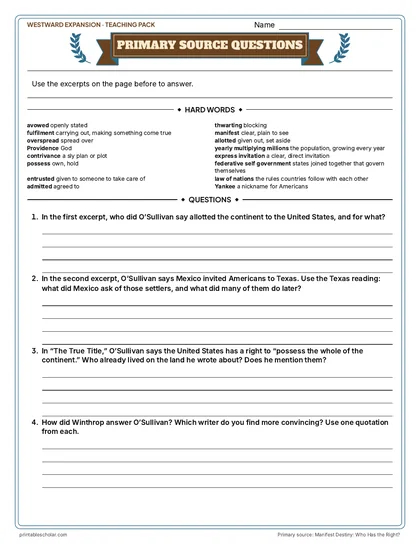
Hard words and questions
The hard words explained, and four questions about the documents.
Download PDF Black and white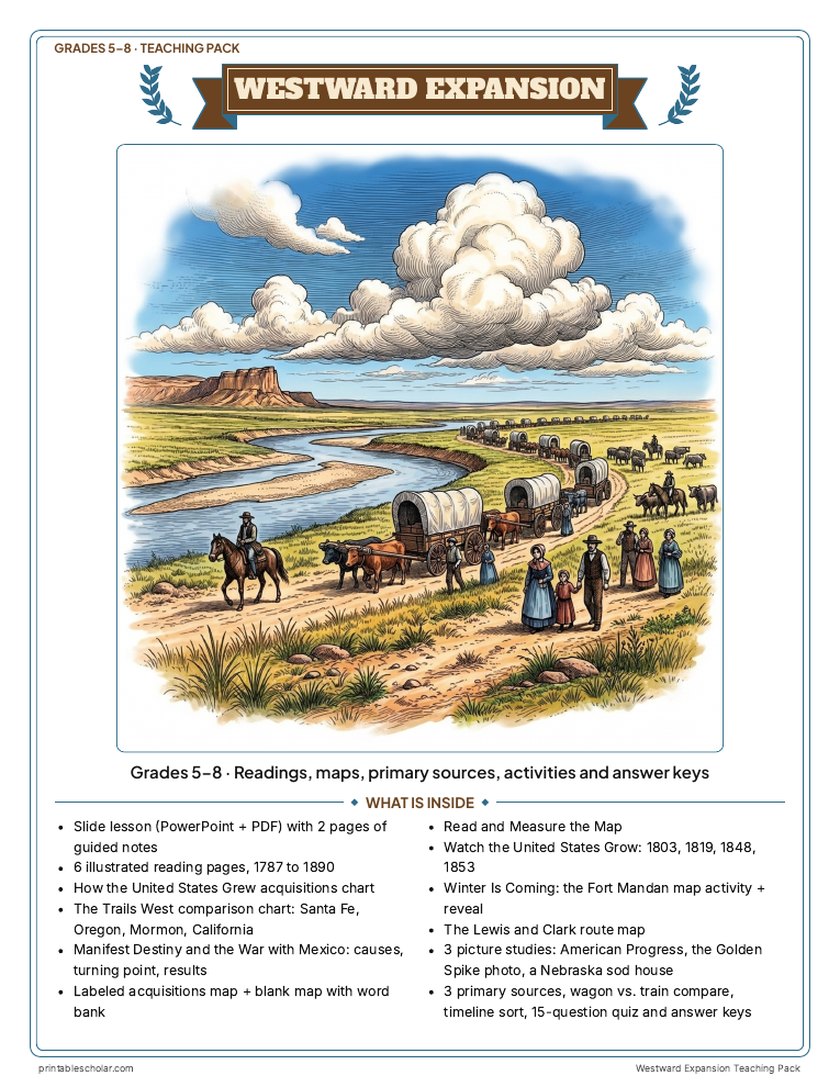
Teaching pack · Grades 5–8
Teaching Westward Expansion? The whole unit, ready to teach.
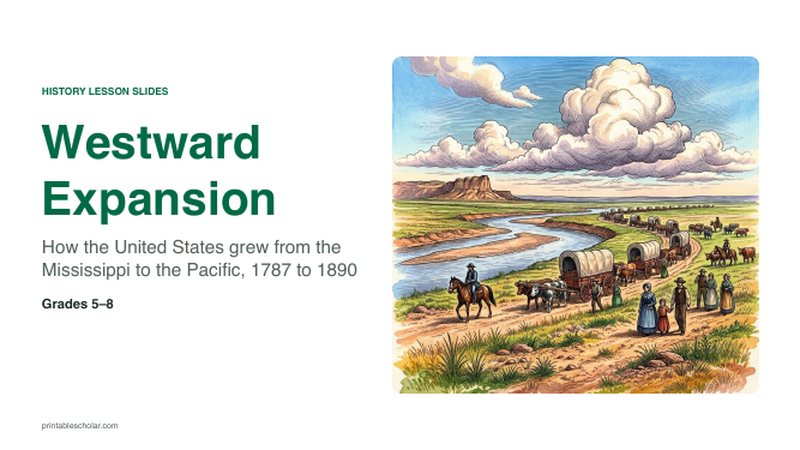
Two weeks of lessons in one download: slides to present, notes for students to fill in, and printable pages that use these maps and pictures.
- 39 lesson slides (PowerPoint you can edit, teacher notes on every slide) and 2 pages of guided notes
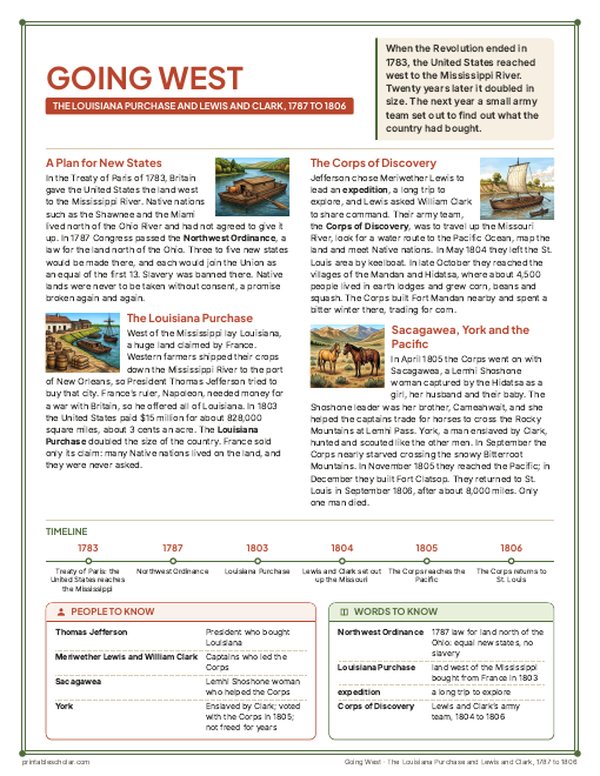
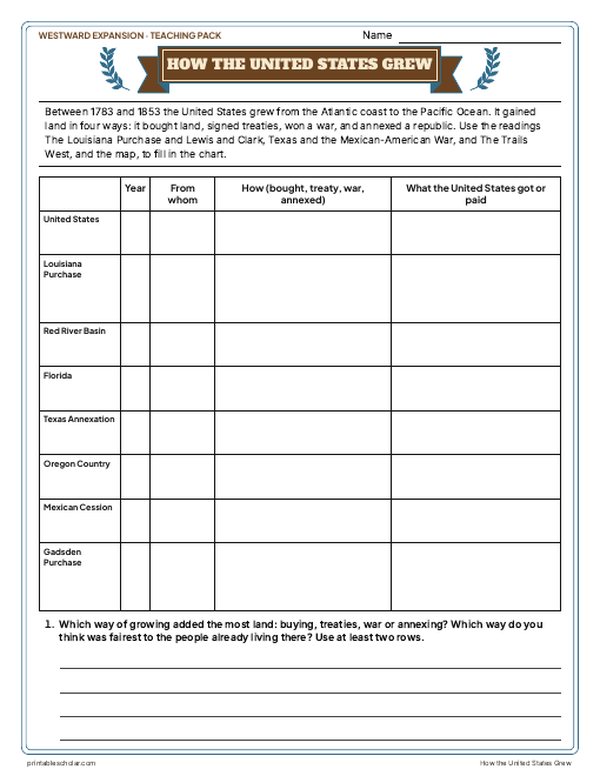
- 6 illustrated reading pages, 1787 to 1890, a How the United States Grew chart, a Trails West chart and a Manifest Destiny and the War with Mexico sheet
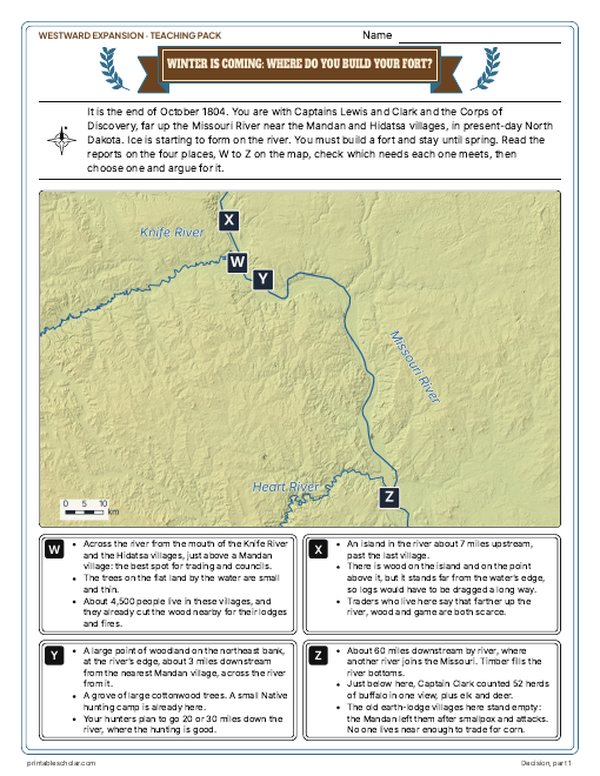
- Maps: labeled, blank, Read and Measure the Map, the United States in 1803, 1819, 1848 and 1853, the Lewis and Clark route, and a Fort Mandan decision with the reveal
- Primary sources: Clark's journal in the Bitterroots, O'Sullivan's Manifest Destiny beside a reply in Congress, and the Indian Removal Act beside John Ross's answer, each with plain English beside it; picture studies of Gast's American Progress, the 1869 Golden Spike photo and an 1886 sod house photo
- Wagon vs. train, a timeline sort, a 15-question quiz, a teacher guide with a two-week plan, and answer keys for everything
Every answer is in the pack. The readings, slides, maps and pictures teach everything the sheets and quiz ask, so no textbook is needed.
Get the Westward Expansion pack for $7Teaching more than one? Get all four US history packs (the 13 Colonies, the American Revolution, Westward Expansion and the Civil War) for $19: about eight weeks of lessons.
Get all 4 packs for $19One-time purchase. Instant download. Color and ink-saving black-and-white editions. Secure checkout by Stripe.
Manifest Destiny, step by step
What it was
Manifest means clear or plain to see, and destiny means fate. People who believed in Manifest Destiny thought it was plain that God meant the United States to spread across the continent, so its growing population could have new land. It was a belief people held at the time, not a law or a plan written by the government.
Who named it
John L. O’Sullivan, who edited a magazine and a newspaper in New York. In the summer of 1845, writing about Texas, he wrote of "our manifest destiny to overspread the continent allotted by Providence for the free development of our yearly multiplying millions." In December 1845, when the United States and Britain both claimed the Oregon Country, he used the words again.
How it was used
In 1845 Texas, which had broken away from Mexico in 1836, was annexed as the 28th state. In 1846 the Oregon Treaty split the Oregon Country with Britain at the 49th parallel. Mexico still claimed Texas and its border, and in 1846 the two countries went to war. In the Treaty of Guadalupe Hidalgo (1848), Mexico gave up about 525,000 square miles for $15 million; counting Texas, it lost about 55 percent of its land.
Who disagreed
Robert Winthrop, a congressman from Massachusetts who wanted to settle Oregon peacefully, made fun of the idea in Congress in January 1846. He said no nation except "the universal Yankee nation" would agree such a right existed. Congressman Abraham Lincoln and others said the war with Mexico was wrong, and many Northerners worried that new land would mean more slave states.
Who it hurt
Native nations lived on almost all of the land the United States added, and they were not asked. Mexico lost more than half of its land. In California, many Californios lost their land after 1851, and the Native population fell from about 150,000 in 1846 to about 30,000 by 1873.
American Progress: what’s in it
John Gast painted American Progress in 1872 for George A. Crofutt, a publisher of travel guides to the West, who gave color prints of it free to subscribers of his magazine. A huge woman Crofutt called "Progress" floats west, carrying a school book and stringing telegraph wire. Below her come trains, a stagecoach, a covered wagon and a rider on horseback, with farmers and miners.
Reading the painting
The right side (east) is bright and sunny; the left side (west) is dark and stormy. Native people, buffalo and a bear move away from Progress into the dark. Ask students how the light, the dark and the things she carries try to persuade the viewer, and whose view of westward expansion is left out.
Frequently asked questions
What was Manifest Destiny?
The belief, held by many Americans in the 1840s, that God meant the United States to spread across the whole continent, from the Atlantic to the Pacific.
Who coined the phrase Manifest Destiny?
John L. O’Sullivan, a New York editor, in 1845, first about Texas and then, in December 1845, about the Oregon Country.
Who was hurt by Manifest Destiny?
Native nations, who lived on the land and were not asked; Mexico, which lost more than half of its land after the war of 1846 to 1848; and Mexicans and Californios in the new territories, many of whom later lost their land.
What is the Manifest Destiny painting?
American Progress, painted by John Gast in 1872 for the publisher George A. Crofutt. It shows a floating woman, Progress, leading settlers, trains and telegraph wires west while Native people and buffalo move away into the dark.
Did everyone agree with Manifest Destiny at the time?
No. Congressman Robert Winthrop mocked the idea in 1846, and Congressman Abraham Lincoln and others said the war with Mexico was wrong.