 Printable Scholar
The Indian Removal Act of 1830
In the Southeast lived the Cherokee, Choctaw, Chickasaw, Creek and Seminole nations. Settlers wanted their land for cotton, and in 1829 gold was found on Cherokee land in Georgia. In 1830 President Andrew Jackson signed the Indian Removal Act. It let the president trade land west of the Mississippi River for the lands of Native nations in the East that agreed to move. Over the next ten years almost all of these nations were forced west, and the Cherokee’s removal became known as the Trail of Tears. These free sheets put the words of the law beside the Cherokee answer.
Free to print
The law and the Cherokee answer, with questions
PDFs sized for US Letter paper, in color and black and white.
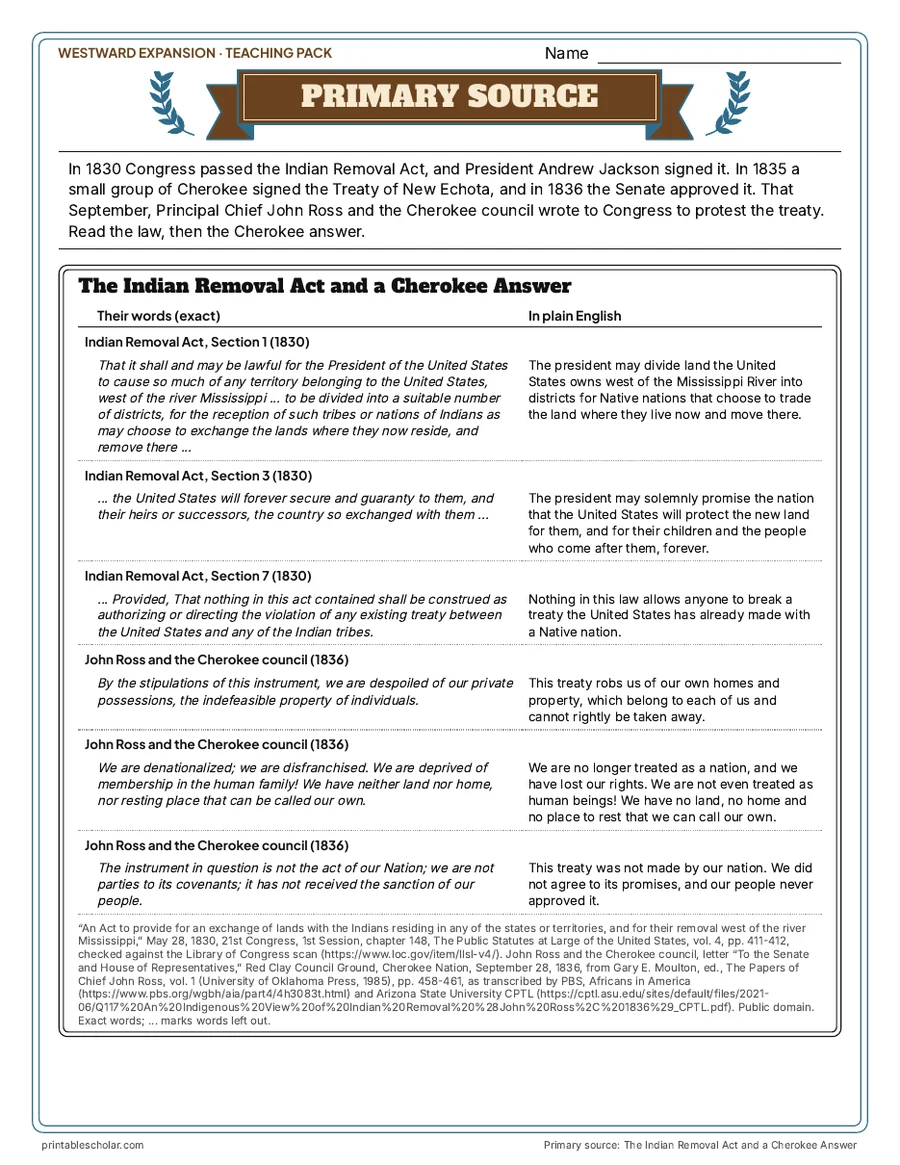
The Indian Removal Act and a Cherokee Answer
Three parts of the 1830 law and three parts of John Ross’s 1836 letter to Congress, each beside a plain-English version.
Download PDF Black and white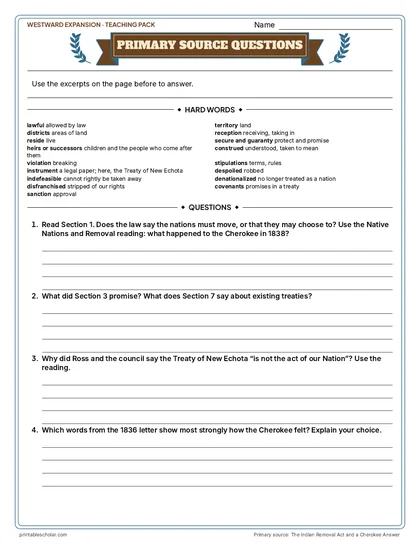
Hard words and questions
The hard words explained, and four questions about the two documents.
Download PDF Black and white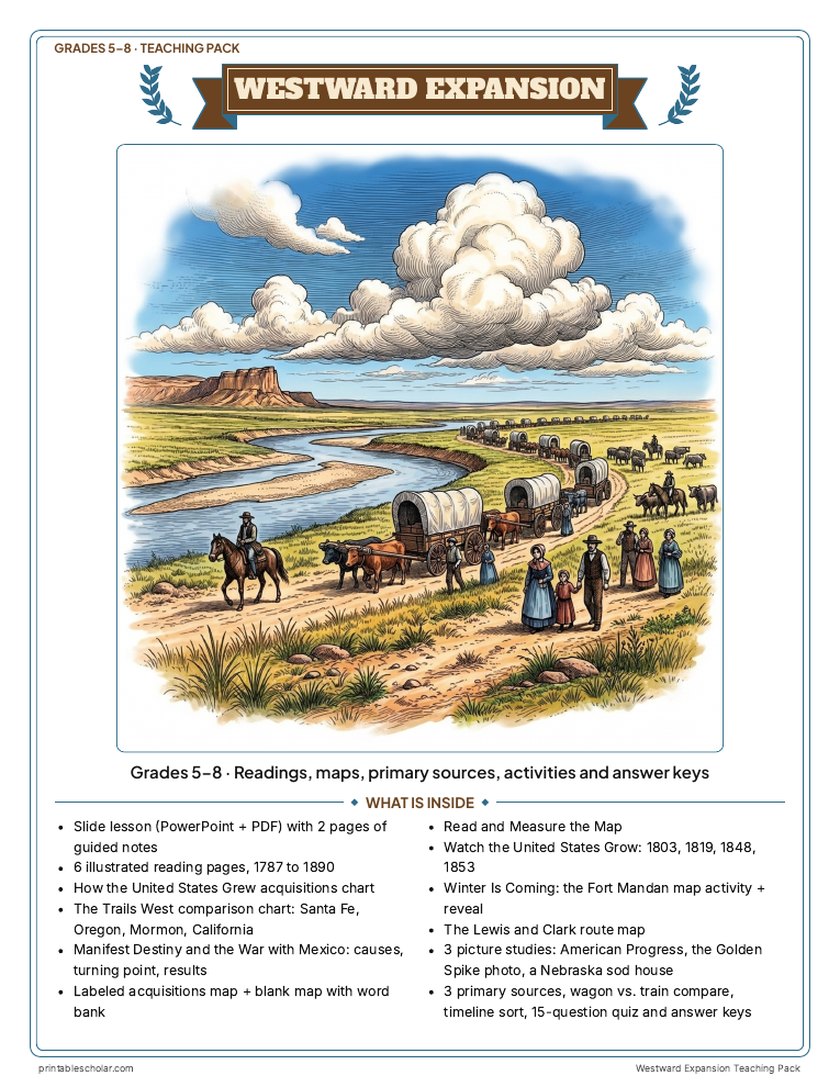
Teaching pack · Grades 5–8
Teaching Westward Expansion? The whole unit, ready to teach.
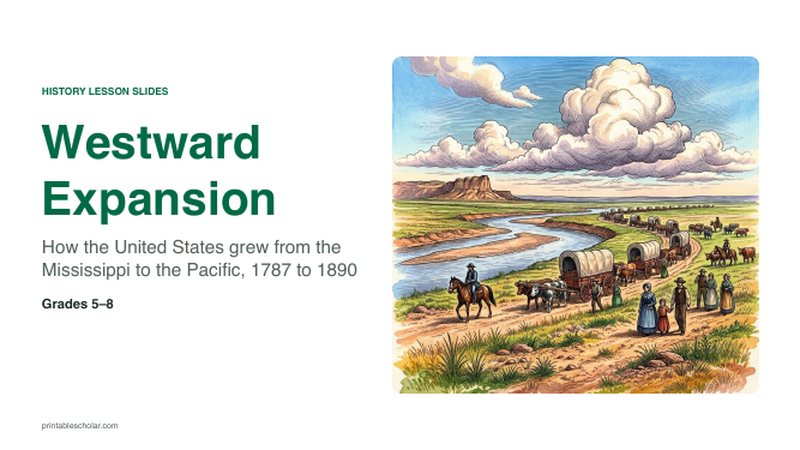
Two weeks of lessons in one download: slides to present, notes for students to fill in, and printable pages that use these maps and pictures.
- 39 lesson slides (PowerPoint you can edit, teacher notes on every slide) and 2 pages of guided notes
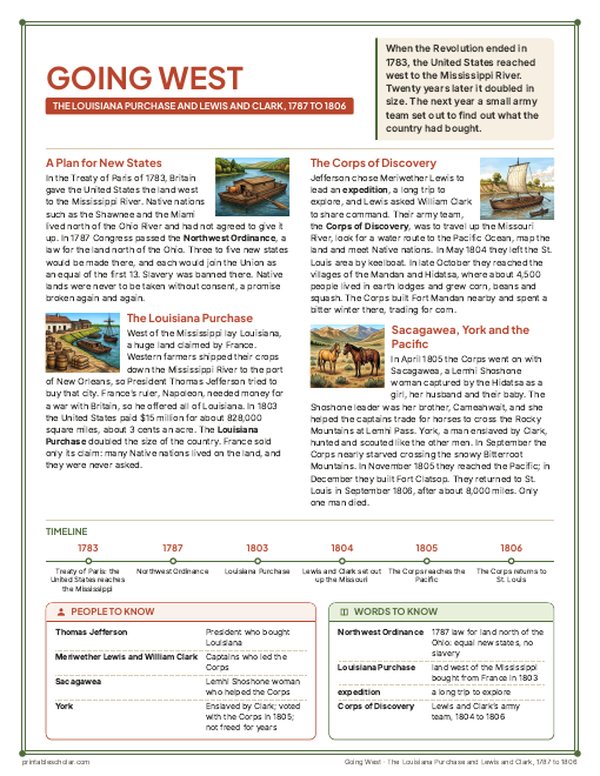
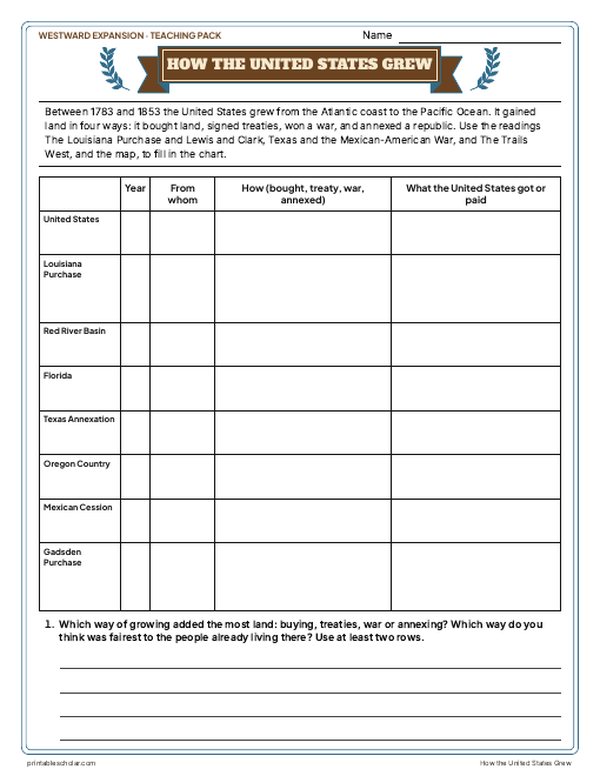
- 6 illustrated reading pages, 1787 to 1890, a How the United States Grew chart, a Trails West chart and a Manifest Destiny and the War with Mexico sheet
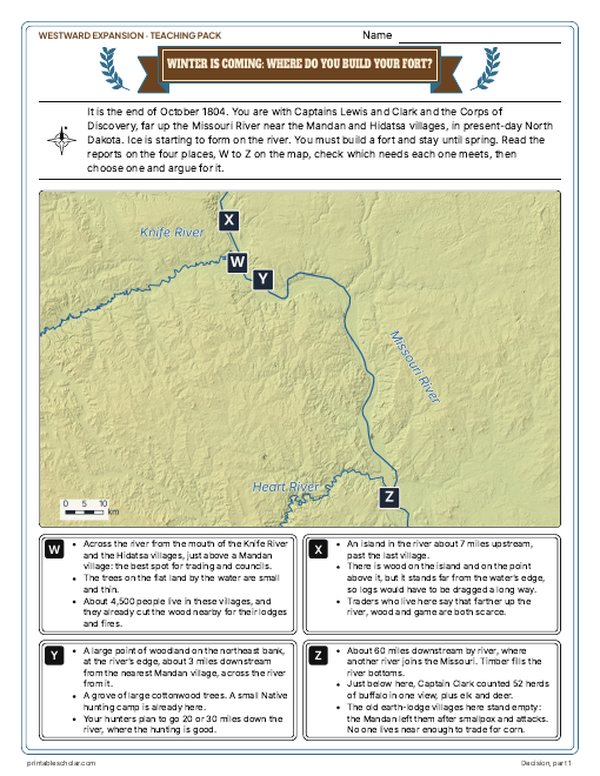
- Maps: labeled, blank, Read and Measure the Map, the United States in 1803, 1819, 1848 and 1853, the Lewis and Clark route, and a Fort Mandan decision with the reveal
- Primary sources: Clark's journal in the Bitterroots, O'Sullivan's Manifest Destiny beside a reply in Congress, and the Indian Removal Act beside John Ross's answer, each with plain English beside it; picture studies of Gast's American Progress, the 1869 Golden Spike photo and an 1886 sod house photo
- Wagon vs. train, a timeline sort, a 15-question quiz, a teacher guide with a two-week plan, and answer keys for everything
Every answer is in the pack. The readings, slides, maps and pictures teach everything the sheets and quiz ask, so no textbook is needed.
Get the Westward Expansion pack for $7Teaching more than one? Get all four US history packs (the 13 Colonies, the American Revolution, Westward Expansion and the Civil War) for $19: about eight weeks of lessons.
Get all 4 packs for $19One-time purchase. Instant download. Color and ink-saving black-and-white editions. Secure checkout by Stripe.
From the law to the Trail of Tears
What the Act said
The president could divide land the United States owned west of the Mississippi into districts "for the reception of such tribes or nations of Indians as may choose to exchange the lands where they now reside, and remove there." The president could promise that the new land would be theirs forever, and nothing in the Act allowed breaking an existing treaty.
The Choctaw go first
In 1831 the Choctaw became the first nation removed under the law. The Choctaw, Creek, Chickasaw and Seminole were all forced west in the years that followed.
The Cherokee go to court
Many Cherokee ran farms; in 1821 Sequoyah created a way to write the Cherokee language, and in 1827 the nation wrote its own constitution. The Cherokee sued Georgia, but in 1831 the Supreme Court said it could not hear their case. Then Georgia jailed Samuel Worcester, a missionary living on Cherokee land without a state license. In Worcester v. Georgia (1832), Chief Justice John Marshall ruled that Georgia’s laws had no force in the Cherokee Nation. President Jackson did not enforce the ruling.
The Treaty of New Echota
In 1835 a small group of Cherokee who were not the nation’s elected leaders signed the Treaty of New Echota, trading the Cherokee homeland for land in the West and $5 million. Principal Chief John Ross and thousands of Cherokee protested, but in 1836 the Senate approved the treaty.
John Ross’s answer
In September 1836 Ross and the Cherokee council wrote to Congress: "We are denationalized; we are disfranchised. We are deprived of membership in the human family! We have neither land nor home, nor resting place that can be called our own." They said the treaty "is not the act of our Nation" and that their people had never approved it.
The Trail of Tears
In 1838 U.S. Army soldiers and state militia forced more than 16,000 Cherokee from their homes into crowded camps. Group by group, they were sent more than 1,000 miles west to Indian Territory, in present-day Oklahoma, much of the way in winter. Disease, cold and hunger spread, and historians estimate that 4,000 to 8,000 Cherokee died. The Cherokee called the journey Nunna daul Tsuny, the trail where they cried. In Indian Territory they rebuilt their government, schools and newspaper.
Frequently asked questions
What was the Indian Removal Act?
A law of May 28, 1830, signed by President Andrew Jackson, that let the president trade land west of the Mississippi River for the lands of Native nations in the East that agreed to move.
Did the Indian Removal Act force Native nations to move?
The law spoke of nations that "may choose" to exchange their lands, and said no existing treaty could be broken. In practice, nations that refused were pushed out: in 1838 soldiers and militia forced the Cherokee west.
What was the Trail of Tears?
The forced removal of the Cherokee to Indian Territory in 1838 and 1839, more than 1,000 miles, much of it in winter. Historians estimate that 4,000 to 8,000 Cherokee died.
What did the Supreme Court decide in Worcester v. Georgia?
In 1832 Chief Justice John Marshall ruled that the Cherokee Nation was a separate nation and that Georgia’s laws had no force there. President Jackson did not enforce the ruling.
Who was John Ross?
The Principal Chief of the Cherokee, who fought removal. In 1836 he and the Cherokee council wrote to Congress to protest the Treaty of New Echota.