Homer's great adventure (the wooden horse, the Cyclops, the Sirens, the whirlpool and the long road home to Ithaca) told in short sentences and everyday words for readers who find chapter books too hard. Every chapter was checked to read at about a 2nd to 3rd grade level, and each one is a single sitting.
Good to know: the monsters are scary and some sailors die, each told in a line and never shown.
Long ago, the ancient Greeks lived in a land of rocky hills and blue seas. They were sailors and farmers. They built ships and cities, and they loved a good story. This story is one of the oldest of all. It is about 2,700 years old.
At first, no one wrote it down. People sang it aloud, at feasts and by the fire. A poet named Homer is said to have made it. The story is called The Odyssey, and it is an epic. An epic is a very long story about a hero. A hero is a brave person who does great things and faces great danger.
Our hero is Odysseus, king of a small island called Ithaca. Greek legend says that when his son Telemachus was a baby, Odysseus had to go to war. He kissed his wife Penelope goodbye and sailed across the sea to fight the city of Troy. The war went on and on. It lasted ten long years.
The Greeks believed in many gods. The gods lived high above the clouds, and they took sides in the lives of people. In this story, Athena, the goddess of wisdom, helps Odysseus. But Poseidon, the god of the sea, will come to hate him. And Odysseus has to cross a lot of sea to get home.
Want to know more about the Greek gods? Find a guide at printablescholar.com/greek-gods-family-tree.
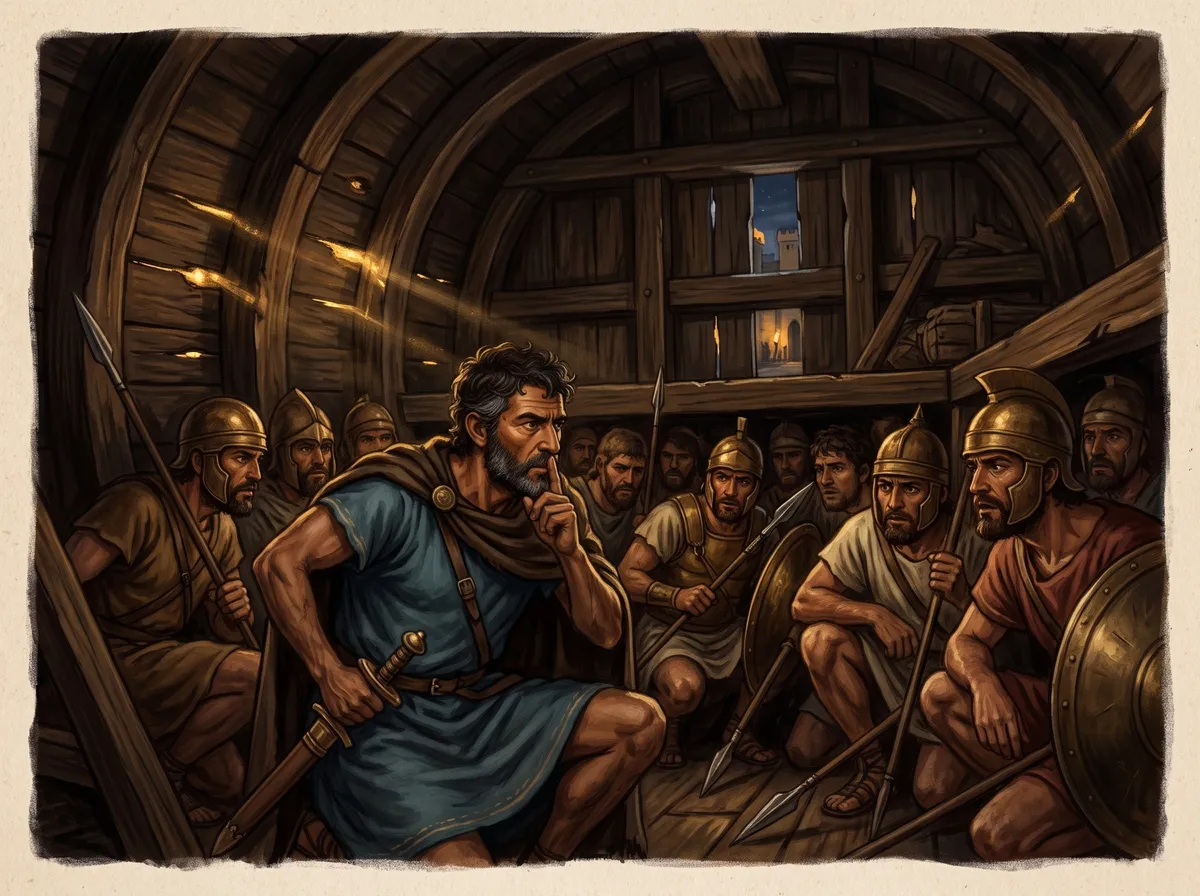
It was dark inside the horse. It was hot, too, and it smelled of sweat and fresh-cut wood. Thirty men sat pressed together in the belly of a wooden horse, and not one made a sound.
One of them was Odysseus (say oh-DISS-ee-us), king of a small, rocky island called Ithaca (say ITH-uh-kuh). The horse had been his idea. He was the most clever of all the Greek kings, and this was his best trick yet.
For ten long years, the Greeks had fought the city of Troy. Troy had huge stone walls, and the Greeks could not get past them. Thousands of men had died on the plain outside the walls, and both sides were sick of war.
So Odysseus made a plan. The Greeks built a huge horse out of wood and left it on the beach outside the city. Then the rest of the Greek army got into their ships and sailed away. Or so it seemed, because really they hid their ships behind an island close by.
Now Odysseus waited. Through a crack in the wood, he watched the people of Troy come out to stare.
"The Greeks have gone home," they shouted. "The war is over, and we have won!"
"This horse is a gift for the gods," someone said. "Let's pull it into the city."
The horse began to move. It rolled and rocked and creaked, and inside, the men held on tight. One young soldier was shaking, so Odysseus put a hand over his mouth. If anyone made one sound, they would all die.
The horse rolled through the great gates. That night, Troy held a huge feast, and people danced until they fell asleep in the streets.
At midnight, Odysseus opened a secret door in the horse's belly. The men slid down a rope, one by one, and ran to the gates and threw them open. Outside, the whole Greek army was waiting, because the ships had come back in the dark.
By morning, Troy had fallen. The ten-year war was over at last.
Odysseus stood on the beach and looked out at the sea. He had only one thought in his head, and that thought was home.
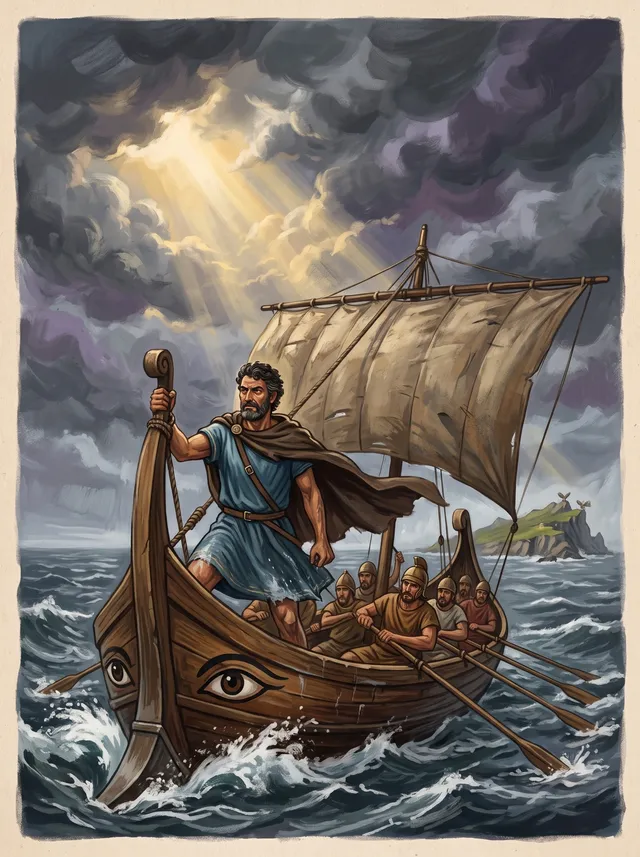
He had twelve ships, with about fifty men on each one. They were fine wooden ships with one square sail, and painted eyes on each prow watched the waves. His crew cheered as they pushed off from the sand.
"Ithaca," they shouted. "We are going home to Ithaca!"
Far away on Ithaca, a woman stood on a cliff and looked out to sea. Her name was Penelope (say peh-NEL-oh-pee), and she was the wife of Odysseus. Beside her stood a boy of ten named Telemachus (say teh-LEM-uh-kus).
"Is that his ship?" the boy asked. He asked it every time he saw a sail.
"Not yet," said Penelope. "But he will come home to us."
Telemachus had been a baby when his father left, so he did not know his father's face. He only knew the stories. His father was strong and clever, and he was the best man in all of Greece.
Penelope took her son's hand. "Troy is not so far," she said. "The trip home will take a few weeks, or a month at most."
She was wrong. It would take ten more years, and the trip home would be far harder than the war.
Chapter 1 as a print-ready PDF with its picture and questions, or get the whole printable book with the novel study below.
Chapter 1 PDF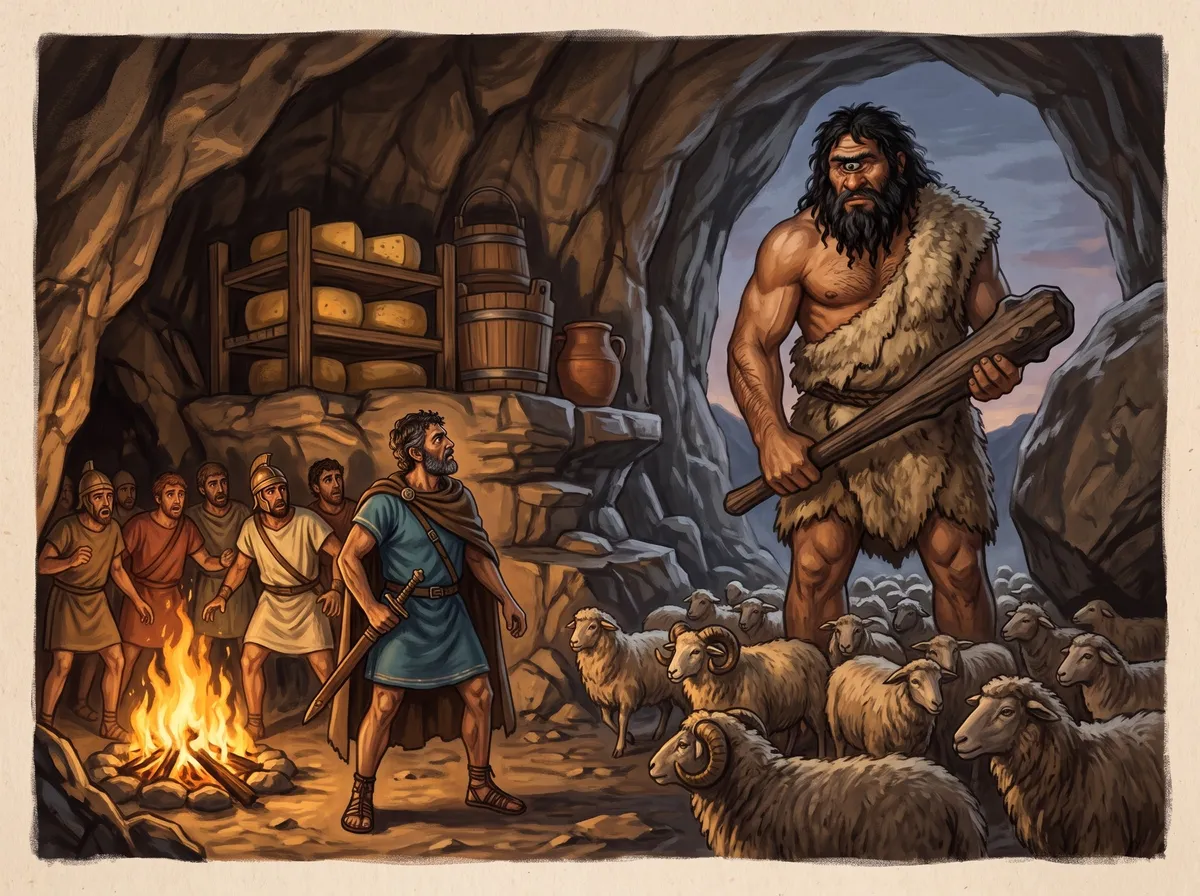
The ships had not gone far when a storm hit. For nine days, the wind pushed them across the sea, and on the tenth they reached land.
Odysseus sent three men to look for fresh water, but they did not come back. So he went to look for them himself.
He found them sitting under a tree with some smiling people. The people were eating a sweet, golden fruit called lotus, and they had shared it with the men.
"Come on, we have to get back to the ships," said Odysseus.
The men just smiled. "Why would we leave, when it is so nice here?" one asked.
"Because we are going home," said Odysseus.
The man looked puzzled. "Home?" he said. "Where is that?"
Odysseus felt a chill run down his back. The fruit had made them forget. They did not remember Ithaca, or their wives, or their children. All they wanted was more fruit.
So Odysseus dragged them back to the ships, kicking and crying, and tied them under the benches. Then he told the rest of the crew to row hard and never to eat that fruit.
Next they came to an island of wild goats and green hills. Across the water was a bigger island, where smoke rose up and sheep called to each other.
Odysseus had to know who lived there. He took one ship, twelve of his best men, and a jar of strong wine as a gift.
On the hill above the beach, they found a huge cave. Inside were pens of lambs and baby goats, racks of cheese and buckets of milk. Everything in the cave was giant-sized.
"Let's grab some cheese and go," his men begged. "Please, let's go now."
But Odysseus wanted to meet whoever lived here. A host should give gifts to a guest, and that was the law of the gods. So they waited, and they lit a fire and ate some cheese.
Then the ground began to shake, and a shadow filled the mouth of the cave.
It was a giant as tall as a tree, with one huge eye in his forehead. He was a Cyclops (say SY-klops), and his name was Polyphemus (say pol-ee-FEE-mus).
The giant drove his sheep into the cave. Then he rolled a rock bigger than a wagon across the door, so no one could get out.
He lit a fire, and in its light he saw the men. "Who are you?" he roared.
Odysseus stepped forward. His legs were shaking, but he kept his voice strong. "We are Greeks, on our way home from Troy," he said. "We ask you to treat us as guests. The great god Zeus (say ZOOS) wants every host to be kind."
The giant laughed. "I do not care about Zeus," he said. "My father is Poseidon (say puh-SY-dun), god of the sea, and I do what I want."
Then he grabbed two of the men and ate them for his supper.
The others cried out and held each other. Those two men had fought beside them for ten years, and now they were gone. No one could do a thing to save them.
The giant lay down by the fire and went to sleep. Odysseus pulled out his sword and crept up to the giant's chest. He could stab him right now, in the heart.
Then he stopped and looked at the door. Even if the giant died, they could never move that rock, so they would be trapped forever.
So Odysseus put his sword away. He sat in the dark and listened to the giant snore. He had to think of something clever, and he had to think of it fast.
In the morning, the giant drove his sheep out to the hills. He rolled the rock back over the door as he left, as easy as closing a lid.
Odysseus looked around the cave. In a corner lay a big olive-wood club as long as a mast, and he had a plan.
The men cut a piece off the club and made one end sharp. Then they hardened the point in the fire and hid the stake under a pile of straw.
That night, the giant came home. He milked his sheep and ate his supper, and then Odysseus walked up to him with the wine.
"Here, Cyclops, have a drink of this," he said, and he held out a bowl.
The giant drank it all in one gulp, and he had never tasted anything so good. "More," he roared. "And tell me your name, little man, so I can give you a gift."
Odysseus filled the bowl again and again. "My name is Nobody," he said. "My mother and father call me Nobody, and so do all my friends."
The giant laughed. "Then here is my gift, Nobody," he said. "I will eat you last."
He drank one more bowl. Then he fell back on the floor with a crash and began to snore.
"Now," Odysseus whispered to his men.
They heated the stake in the fire until its tip glowed red. They lifted it together, and then they drove it into the giant's one eye.
Polyphemus woke with a scream. He pulled the stake out and threw it, and then he stumbled around in the dark, howling.
The other giants on the island heard him and came running. "Polyphemus, what is wrong?" they called through the rock. "Is someone hurting you?"
"Nobody is hurting me!" he cried, over and over.
"Well, if nobody is hurting you, then be quiet and let us sleep," they said. And they went home.
Inside the cave, Odysseus smiled. His trick had worked, but they still had to get out.
In the morning, the blind giant rolled the rock away from the door. He sat in the doorway with his arms out wide, feeling every sheep as it went out. No man would slip past him.
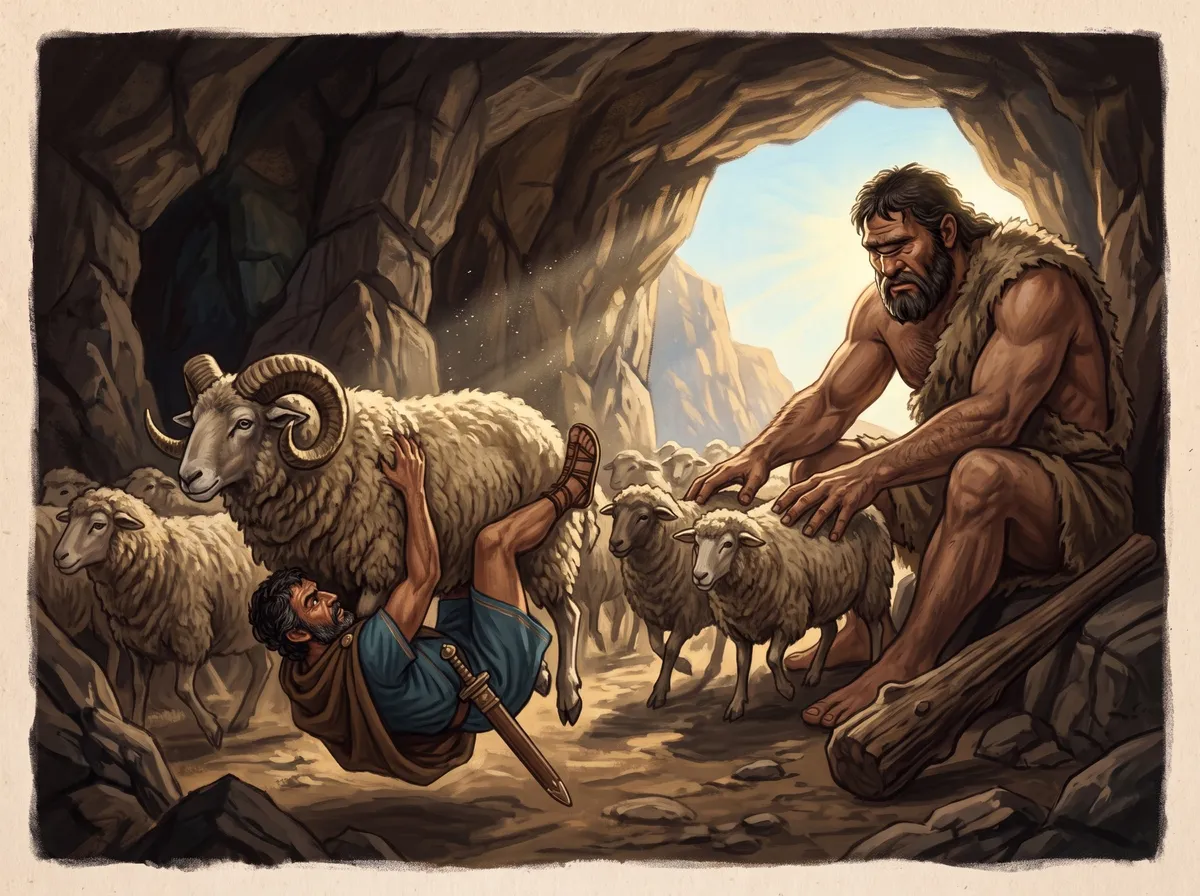
But Odysseus was ready. In the night, he had tied the rams in threes, and under each middle ram hung a man. Odysseus took the biggest ram of all, and he held on to its thick wool from below.
One by one, the sheep walked out. The giant's huge hands ran over their backs, but he never felt the men below.
The big ram came out last of all. "My poor ram, why are you so slow today?" said the giant. "Are you sad for your master?"
Then the ram walked out into the sun, and they were free.
The men ran to the ship and rowed hard. But when they were a little way out, Odysseus stood up. He could not help himself, because he wanted the giant to know who had beaten him.
"Listen, Cyclops," he shouted. "If anyone asks who took your eye, tell them it was not Nobody. It was Odysseus, king of Ithaca!"
His crew begged him to stop, because now the giant would know where they were.
The giant tore a huge rock off the hill and threw it. It crashed into the sea next to them, and a great wave pushed them back toward shore. They had to row with all their might to get away.
Then the giant lifted his arms to the sky. "Father Poseidon, hear me, and put a curse on Odysseus," he cried. "Let him lose all his men, and let it take him years to get home. And when he gets there, let him find trouble waiting."
Deep under the sea, Poseidon heard his son, and he was angry.
Odysseus sat down slowly, and the cheering on the ship stopped. He had been clever in the cave, but out here his pride had made him boast. Now the god of the sea knew his name. Odysseus had won, but he knew that someone would pay for that one shout.
The ships sailed on until they came to a floating island with a wall of bronze around it. There lived the Wind King, whom the gods had made the keeper of all the winds.
The Wind King was kind, and he let Odysseus and his men stay for a whole month. Every night there was a feast, and Odysseus told the king about the war and the wooden horse.
When it was time to go, the Wind King gave him a gift. It was a big leather bag, tied shut with a silver string.
"Inside this bag are all the storm winds," he said. "I have trapped them, and if you keep it shut, they cannot hurt you. I will send only the soft west wind to blow you home."
Odysseus tied the bag to the deck, but he did not tell the crew what was inside.
The west wind blew, soft and steady. For nine days and nine nights, the ships flew across the sea. Odysseus would not let anyone else steer, and he did not sleep at all.
On the tenth day, he saw it. There was a low green island with rocky cliffs and smoke rising from the cooking fires. It was Ithaca!
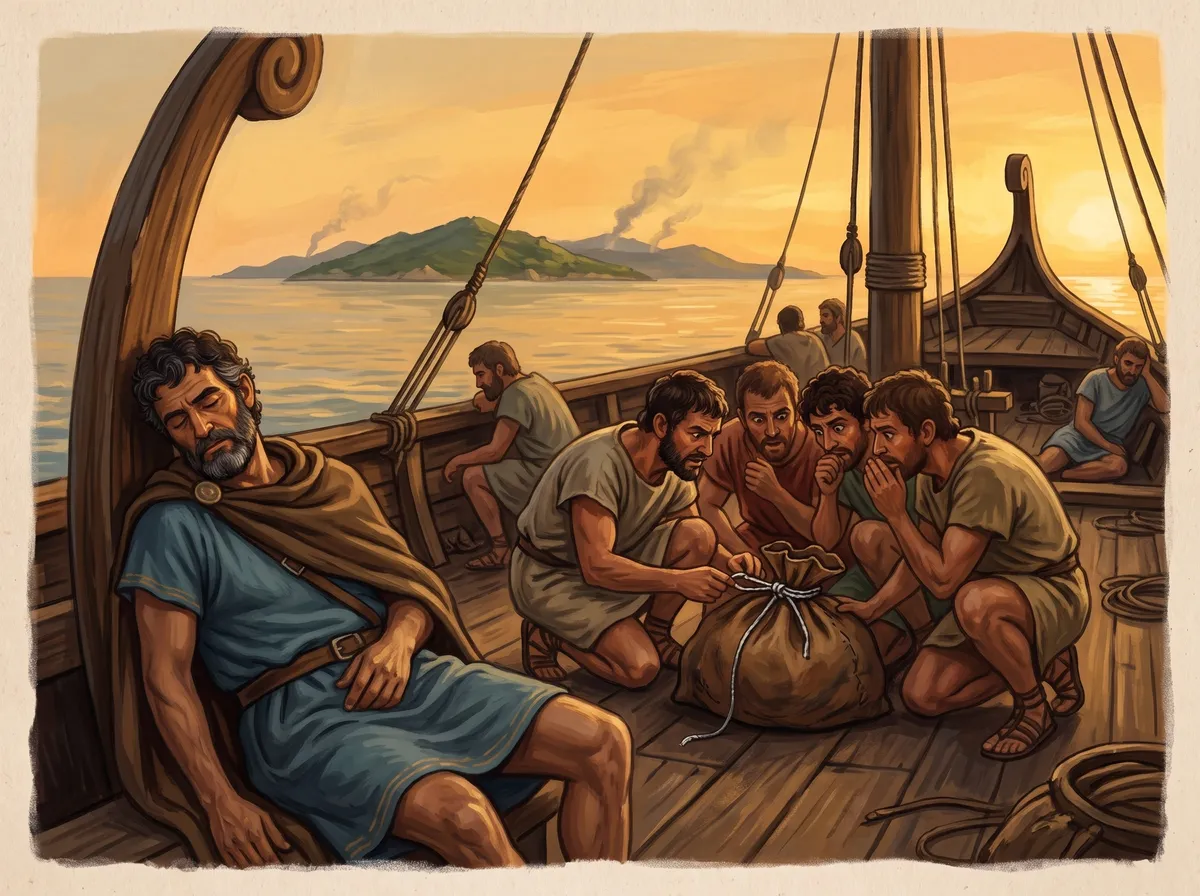
They were so close that he could see men on the hills with their sheep. He had not seen home in ten years, and he smiled. Then, at last, his eyes closed, and he fell asleep.
While he slept, the crew looked at the bag.
"What do you think is in there?" one man asked.
"Gold and silver," said another. "The Wind King gave him a treasure, and he will not share it with us."
"We fought at Troy too," said a third. "We should get our share, so let's just take a look."
So they untied the silver string.
With a howl, the storm winds burst out and roared across the sea. Black clouds filled the sky, and the waves rose up like mountains.
Odysseus woke to the sound of screams. He saw the open bag, and he saw Ithaca getting smaller and smaller until it was gone.
The winds blew them all the way back to the Wind King's island. Odysseus went to the king's hall and begged him for help.
But this time, the Wind King's face was cold. "Get out," he said. "The gods must hate you, and I will not help a man the gods hate."
So they rowed on with no wind at all. The men were tired and sad, and no one spoke.
After many days, they came to a harbor with high cliffs all around it. It looked safe, so eleven ships sailed into the harbor. But Odysseus tied his own ship to a rock outside.
This was a land of giants on a rocky coast, and the giants were huge and cruel. They came to the top of the cliffs and threw boulders down at the ships.
In a few minutes, all eleven ships in the harbor were smashed, and every man was lost.
Odysseus cut the rope with his sword. "Row!" he screamed. "Row for your lives!"
His men rowed harder than they ever had, and they got away. But when they looked back, there was nothing left in the harbor but broken wood.
That night, no one ate. The men sat at their oars and wept for their friends, their brothers and their cousins. Twelve ships had sailed from Troy, and now there was only one.
Odysseus held his head in his hands. He had been so close to home that he had seen the smoke from its fires. Now his ships were gone, and home was farther away than ever.
The last ship sailed on until it reached a quiet island with thick woods. The men were afraid to go far, because they had seen too much. But they needed food.
So Odysseus split the crew into two groups. Half of the men went to look around the island, and half stayed with him by the ship.
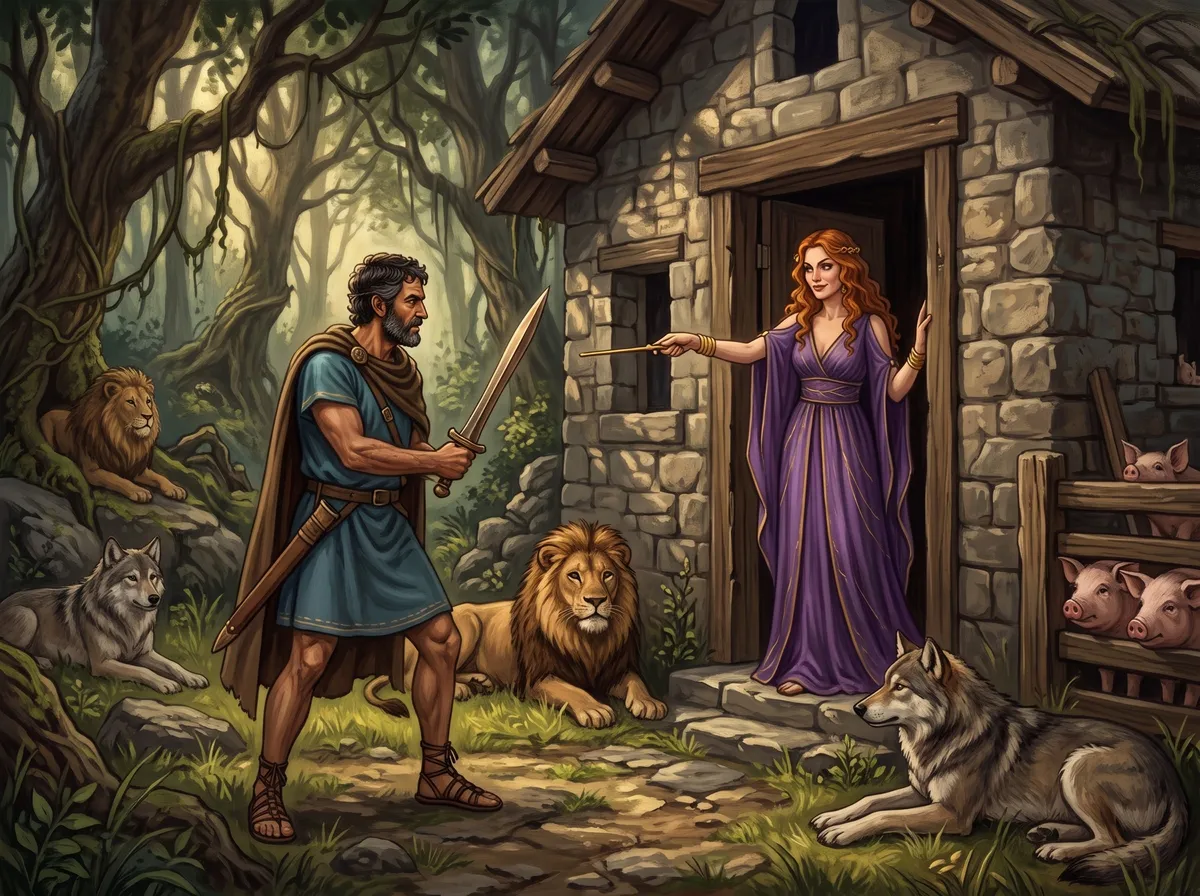
The first group found a stone house in the woods, with wolves and lions lying outside. The men froze, but the animals did not bite. They just wagged their tails like friendly dogs.
From inside came a lovely song, and the singer was Circe (say SUR-see), a witch with great magic. She came to the door and smiled at them. "Come in, for you must be hungry," she said.
The men all went in but one. He did not trust her, so he hid outside and watched.
Circe gave the men a feast of cheese, honey and wine, with a magic potion stirred in. Then she tapped each man with her wand.
At once, they began to change. Their noses grew long and flat, and their skin grew rough and hairy. They dropped to the floor on four legs, and they were pigs! Only their minds stayed the same. They knew who they were, but all they could do was squeal.
Circe laughed and drove them into a pen.
The man outside ran all the way back to the ship and told Odysseus what he had seen.
Odysseus grabbed his sword and went alone. On the path, he met a young man with a gold staff and a hat with little wings. It was Hermes (say HUR-meez), the messenger of the gods.
"The gods have seen your trouble, and I have come to help," said Hermes. "If you go in there like that, you will be a pig by supper."
Hermes pulled a plant from the ground. It had a black root and a milk-white flower. "Eat this, and her magic cannot hurt you," he said. "When she tries to change you, pull your sword and make her promise to free your men."
Odysseus ate the herb, and then he walked up to the house.
Circe met him with a smile and gave him a cup of wine. Then she tapped him with her wand. "Now go to the pen with your friends," she said.
But nothing happened.
Odysseus pulled his sword and held it high, and Circe gasped and fell to her knees. "No man has ever been able to resist my magic," she cried. "Who are you?"
"Free my men," said Odysseus. "And swear an oath that you will never harm us."
Circe swore the oath. She rubbed a new potion on each pig, and one by one, the pigs turned back into men. They looked younger and stronger than before, and they hugged Odysseus and wept.
After that, Circe was kind to them. She asked them to stay, and they did. Days became weeks, and weeks became months, until a whole year had gone by.
At last, the crew came to Odysseus and asked if he had forgotten Ithaca. "It is time to go home," they said.
Circe did not stop them. But before they left, she gave Odysseus three warnings.
"First, you will pass the Sirens," she said. "Their song is so lovely that sailors steer right to them and crash on the rocks. Put wax in your men's ears so they cannot hear it."
"Next comes a narrow strait. On one side lives Scylla (say SIL-uh), a monster with six heads. On the other side is Charybdis (say kuh-RIB-dis), a whirlpool that swallows ships. Stay close to Scylla, because it is better to lose six men than all of them."
"Last, you will reach the island of the Sun God, where his cattle graze. Whatever happens, do not eat them. If you do, you will lose your ship and all your men."
Odysseus listened to every word. Then he went down to the ship, and they set sail.
The wind died as they came near the island of the Sirens. The sea went flat and still, so the men took down the sail and picked up their oars.
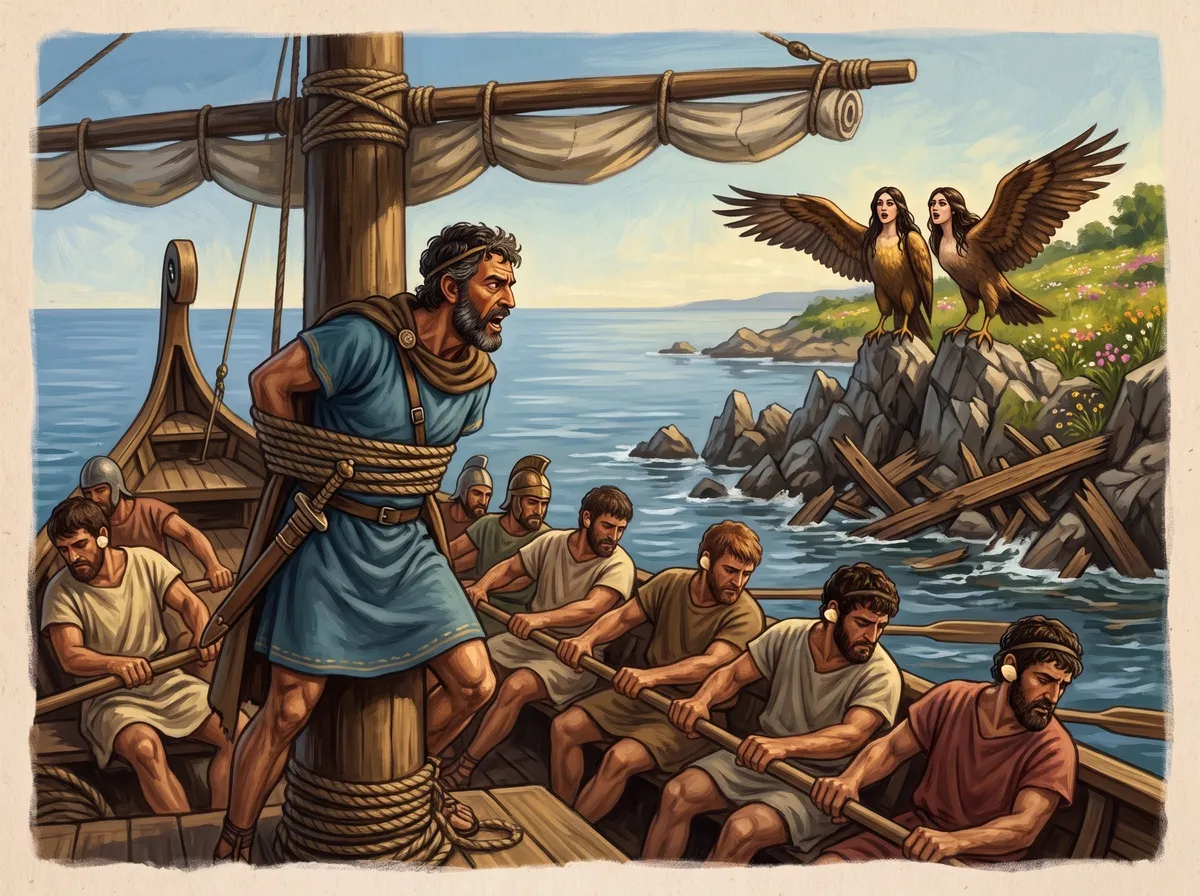
Odysseus called his crew together. "Circe warned me about the Sirens," he said. "You must not hear their song, but I want to hear it. So tie me to the mast, and tie me tight. If I beg you to let me go, tie me tighter."
He cut a block of wax into pieces and warmed them in his hands until they were soft. Then he pressed wax into each man's ears, so that they could not hear a thing.
The men tied Odysseus to the mast, and they rowed on. Soon they could see the island. It was a green meadow by the sea, with sharp rocks all around it. On the rocks sat the Sirens, with the bodies of great birds and the faces of women. Below them lay the broken wood of old ships.
Then the Sirens began to sing.
"Come here, Odysseus, great hero of Troy," they sang. "Stop your ship and listen to us. We know all that happened in the war, and we know all that will ever happen. Come, and we will tell you everything."
It was the most beautiful sound in the world. Odysseus forgot his home, and he forgot his wife and his son. All he wanted was to hear more. He pulled at the ropes and shouted at his men to let him go.
But his men could not hear him. Two of them got up and tied more ropes around him, just as he had told them to. Then they rowed on.
Slowly, the song grew softer, and then it was gone. The men took the wax out of their ears and untied him. Odysseus was shaking, because he knew he could never have resisted that song on his own.
But there was no time to rest. Ahead, the sea ran between two tall cliffs, and they could hear a roar like thunder.
On the left was Charybdis. Three times a day, the whirlpool sucked down the sea and then spat it all back up. The water spun and boiled, and any ship that came close would be pulled down to the bottom.
On the right was a high cliff with a dark cave near the top. That was where Scylla lived.
Odysseus did not tell his men about Scylla. If they knew, they might stop rowing and hide, and then the whirlpool would get them all. He just told them to steer close to the right-hand cliff, row hard, and not stop.
He put on his armor and picked up two spears. Then he stood at the prow and stared up at the cave, but he saw only darkness.
The ship crept along the cliff. Across the water, Charybdis opened wide, and the men could see right down to the sea floor. Their faces turned pale.
While they all stared at the whirlpool, Scylla struck. Six long necks shot out of the cave, and six men were snatched from the ship.
Odysseus heard them call his name one last time, and he could do nothing at all. It was the worst thing he saw in all his years at sea.
The rest of the men rowed on with tears on their faces. They rowed past the cliff and past the whirlpool, until at last the strait was behind them.
No one spoke. Circe had warned them, but knowing it would happen did not make it hurt any less.
Soon they saw a lovely island, where fat cattle grazed on the green hills. Their horns shone gold in the sun, because this was the island of the Sun God.
"We must not stop here," Odysseus told the crew. "Circe warned me, so let's keep going."
But the men were worn out. "We have rowed all day, and we have lost six friends," one of them said. "Let us sleep just one night on land. Please."
Odysseus looked at their tired faces, and he gave in. "All right," he said. "But first, you must swear an oath that no one will touch the cattle. We have food on the ship, and we will eat that."
Every man swore the oath.
That night, a storm blew in. In the morning, the wind was blowing hard against them, so they could not sail. The next day it still blew, and the next, and it kept on blowing for a whole month.
Soon the food on the ship ran out. The men fished and hunted birds, but it was never enough. Their bellies ached, and their arms grew thin.
One day, Odysseus walked off alone to pray to the gods for help. He sat down in a quiet spot, and the gods sent sleep over him until his eyes closed.
Back at the beach, one of the men stood up. "Starving is the worst way to die," he said. "Let's take the best cows and give some to the gods. Then the Sun God will not be angry with us."
The others were so hungry that they did not argue, and they broke their oath.
When Odysseus woke, he smelled meat cooking. He ran back to the beach, but he was too late. The cattle were gone, and the meat was already on the fire.
"What have you done?" he cried.
Then strange things began to happen. The meat on the fire mooed like a living cow. The men were scared, but they were so hungry that they ate it anyway. For six days, they feasted.
Far above, the Sun God went to Zeus. "The men of Odysseus have killed my cattle," he said. "Punish them, or I will stop shining on the world."
"Do not do that, for I will take care of it," said Zeus.
On the seventh day, the wind died down. The men cheered and set sail, and soon there was no land in sight, only sea and sky.
Then a black cloud rose over the ship, and the wind began to scream. It snapped the mast, and the mast fell onto the deck with a crash.
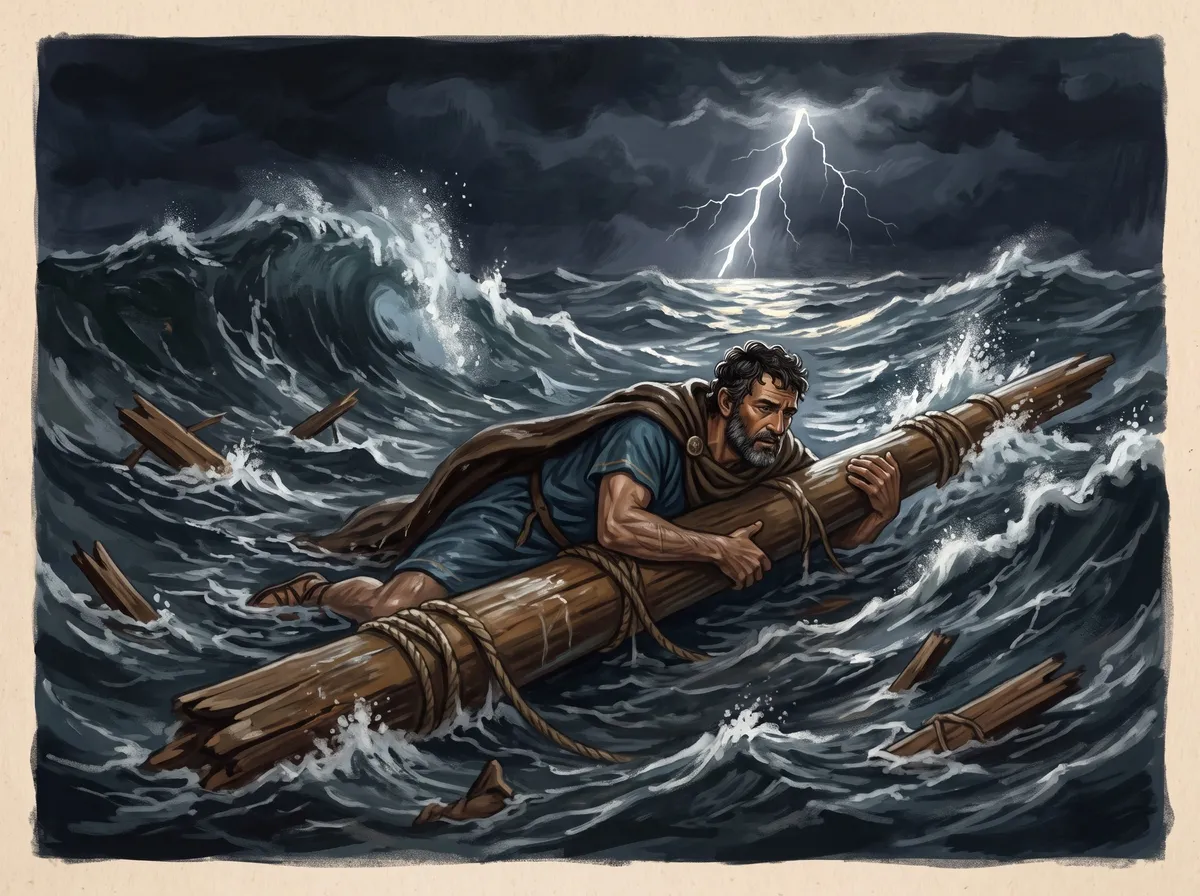
Zeus threw a bolt of lightning. It hit with a flash and a boom, and the whole ship spun and filled with smoke. The men were thrown into the sea.
Odysseus held on as the ship broke apart. He grabbed the broken mast and tied it to a long plank with a strip of leather. Then he climbed on and held on tight.
He looked around for his men and called out their names. No one answered, because the sea was empty. Every one of them was gone.
Odysseus lay on the wreck and cried. He had led hundreds of men to Troy, and he had tried so hard to bring them home. Now he was all alone.
For nine days, he floated on the sea while the waves rocked him up and down. He had no food and no fresh water, and all he could do was hold on.
On the tenth night, the waves washed him onto the shore of a strange island. He crawled up the sand, and then everything went black.
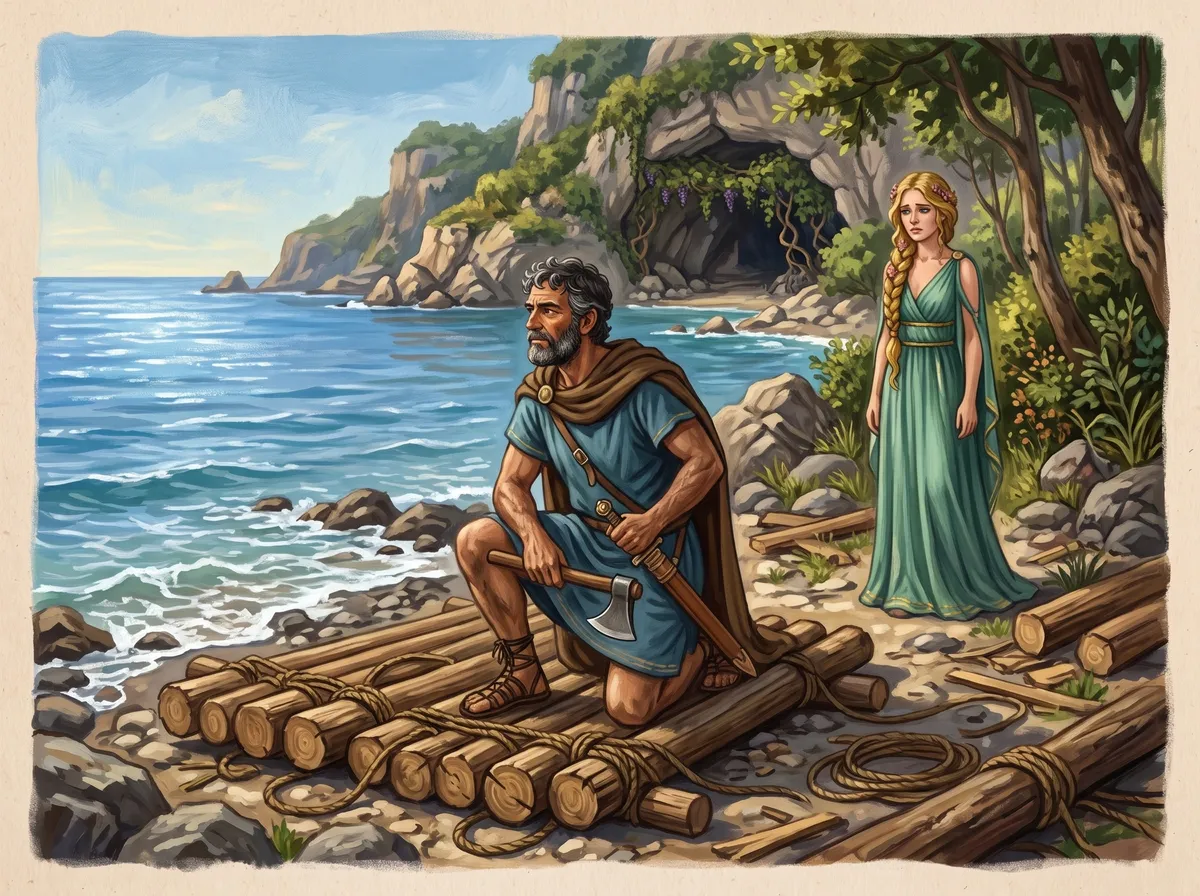
The island belonged to a goddess named Calypso (say kuh-LIP-so). She found Odysseus on the sand and took him to her cave, which was warm and sweet-smelling. Grape vines grew around the door, and birds sang in the trees.
Calypso nursed him back to health, and she fell in love with him.
"Stay with me and be my husband," she said. "I will make you a god, and you will never grow old or die."
But Odysseus did not want to be a god. He wanted to go home, because he was loyal to Penelope.
Calypso would not let him go. He had no ship and no crew, and there was no way off the island.
So every day, Odysseus sat on the rocks by the sea. He looked out over the water toward Ithaca, and he cried.
One year went by, and then two. Then five years went by, and then seven.
High above the clouds, where the gods lived, Athena (say uh-THEE-nuh) went to Zeus. She had always liked Odysseus best of all men, because he was clever, like her. And right now, Poseidon was far away at a feast.
"Father, it is time to help Odysseus," she said. "Look at what is happening in his home."
So Zeus looked down at Ithaca.
Odysseus had been gone almost twenty years, and most people thought he was dead. So more than a hundred young men had come to his house. Each one of them wanted to marry Penelope and become king.
They were called the suitors, and they were greedy and rude. Every day, they ate Odysseus's food and drank his wine and shouted at the servants. And every day, they told Penelope she had to pick one of them.
Penelope kept them waiting. She said she was weaving a great cloth, and she would pick a husband when it was done. She wove all day, but every night, in secret, she pulled the threads out again. For three years, the cloth was never done, until a maid told the suitors her secret. Then they made her finish it, and now she had no more ways to make them wait.
Telemachus was now a young man of twenty, and he hated the suitors. But there were so many of them, and he was only one. He could not make them leave.
Zeus nodded. "It is his fate to get home," he said. "Send Hermes to Calypso."
So Hermes flew down to Calypso's island. "Zeus orders you to let Odysseus go," he told her.
Calypso was sad and angry, but no one says no to Zeus. She went to Odysseus on the beach. "You may go," she said. "Build a raft."
She gave him a bronze axe. For four days, Odysseus cut down trees and tied them together, and he made a sail. On the fifth day, he set out on his raft, and Calypso sent a warm wind behind him.
For seventeen days he sailed, and on the eighteenth day he saw land.
But Poseidon was on his way home from his feast, and he spotted the little raft.
"So the gods have helped him while I was away," he growled. "Well, he is not home yet."
Poseidon struck the sea with his three-pointed spear, and a storm rose up out of nowhere. A huge wave crashed down on the raft and broke it into pieces.
Odysseus was pulled under, and he came up gasping. He grabbed one log and held on, and for two days and two nights he swam and floated.
Then Athena calmed the wind, and the waves rolled him onto a sandy shore. It was the land of a kind king who lived by the sea.
Odysseus told the king his whole story. "My sailors will take you home," the king said. He gave Odysseus a fast ship and many gifts.
Odysseus fell into a deep sleep on board, and the sailors rowed all night. When they reached Ithaca, they set him down on the sand, still asleep, with his gifts beside him. After twenty years, Odysseus was home.
Odysseus woke up on the sand, and he did not know where he was. A young shepherd stood over him, with bright grey eyes. It was Athena in disguise.
"Welcome home, Odysseus," she said. Then she showed him her true self, tall and shining, with a bronze helmet and a spear.
Odysseus fell to his knees and kissed the sand of Ithaca.
"Do not rush to your house," Athena warned. "More than a hundred suitors are there, and if they see you, they will kill you. You need a disguise."
She touched him with a golden wand. His skin grew wrinkled, his hair went thin and grey, and his clothes turned to dirty rags. Now he looked like a ragged old beggar, and not even his wife would know him.
Odysseus went first to the hut of his old pig-keeper. The pig-keeper was loyal, and though he did not know the beggar, he gave him food.
Then Telemachus came to the hut, and Odysseus's heart jumped. The baby he had left was now a tall young man.
When the pig-keeper went out, Athena touched Odysseus again. For a moment he was himself, strong and clean, a king.
Telemachus stepped back in fear. "Are you a god?" he asked.
"I am no god," said Odysseus. "I am your father."
They held each other and cried for a long time. Then they made a plan. Telemachus would take the swords and spears out of the hall and hide them. Odysseus would come as a beggar. Then he would wait for the right moment.
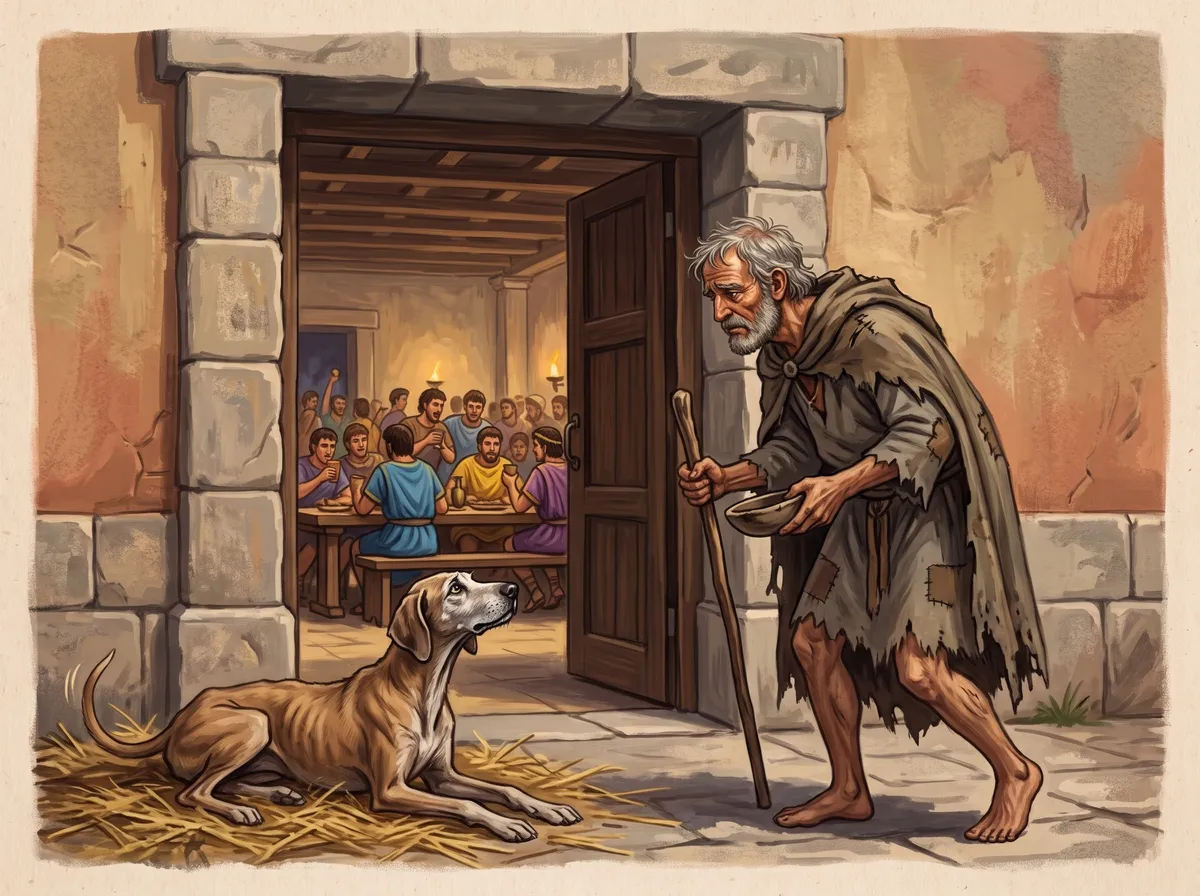
The next day, the beggar walked up the road to his own house. By the gate, on a pile of straw, lay an old dog, thin and covered in fleas. His name was Argos (say AR-gos).
Twenty years ago, Argos had been a puppy. Odysseus raised him, but he left for the war before they could hunt together. Later, Argos grew up to be the fastest hunting dog around.
Now the old dog lifted his head and sniffed. He knew that smell, even after twenty years and even under the rags.
Argos wagged his tail and laid his ears down, but he was too weak to get up.
Odysseus could not go to him, because someone might guess who he was. So he turned his face away and wiped a tear, and he walked into the hall.
Behind him, Argos laid his head down. He had seen his master come home at last. He closed his eyes, and he did not open them again.
Inside, the hall was loud. The suitors were having a feast, and the beggar went from table to table with his bowl out.
Some suitors gave him bread, and others laughed at him. The worst of them threw a footstool, and it hit the beggar hard in the back.
Odysseus did not fall, and he did not fight back. He just stood there, as still as a rock, and then he went and sat by the door. Telemachus watched with his face burning, but he kept quiet. It was all part of the plan.
That night, Penelope came down and spoke with the beggar, but she did not know him. He told her he had met Odysseus once, long ago, and Penelope cried.
"I am so tired of waiting," she said. "Tomorrow, I will end this."
The next day, she stood before the suitors with a great bow in her hands. It had belonged to Odysseus.
"Here is a contest," she said. "Whoever can string my husband's bow and shoot an arrow through twelve axe heads will be my husband."
The suitors cheered. The beggar by the door said nothing, but his eyes were sharp.
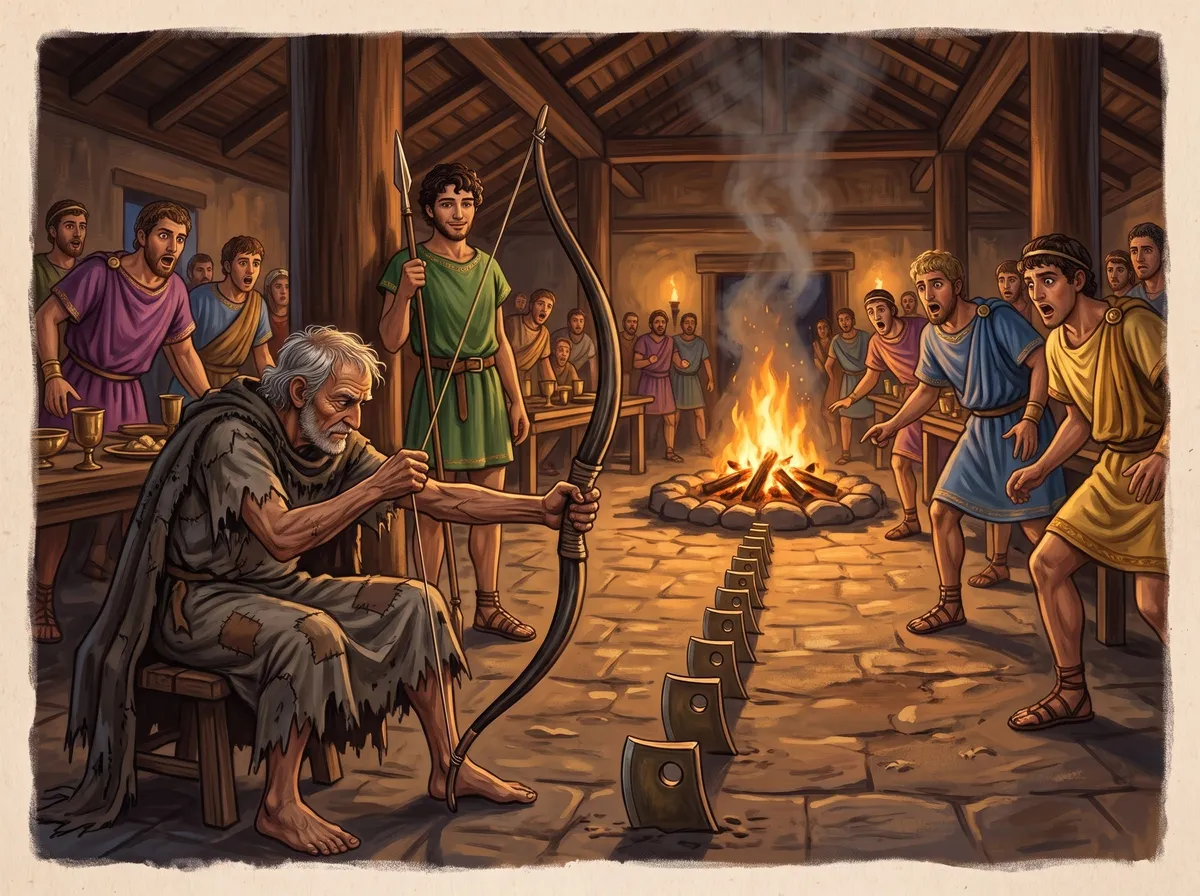
Telemachus set up twelve axe heads in a long, straight row. Each axe head had a hole at the top, and a great archer could shoot through all twelve.
But first, someone had to string the bow.
The bow was huge, and it was made of tough horn and wood. To string it, you had to bend it enough to hook the string on, which took great strength.
The first suitor tried. He pushed and pulled until his face turned red, but the bow would not bend.
"Rub it with fat and warm it by the fire," said another. They did, but it did not help.
One by one, the suitors tried, and one by one, they failed. Even the strongest of them could not bend it an inch.
"Let's try again tomorrow," one of them said. "Today is a feast day, so we should drink, not shoot."
Then the beggar stood up. "Let me try," he said. "I want to see if these old arms still have any strength in them."
The suitors jeered and told the old man to sit down.
But Telemachus said, "The bow is mine to give, so let him try."
The beggar picked up the bow and turned it over in his hands. He looked at it closely, like a man meeting an old friend.
Then, as easily as a singer strings a harp, he bent the bow and hooked the string on. He plucked it with one finger, and it sang like a bird.
The hall went silent, and high above, Zeus sent a crash of thunder.
The beggar picked up an arrow. He did not even stand up, but aimed from his stool and let go. The arrow flew through all twelve axe heads and out the other side.
Then he threw off his rags and stood up tall. "The contest is over," he said. "I am Odysseus, and I am home."
The suitors went pale. Odysseus and Telemachus fought the suitors in a fierce battle, and with Athena's help, they defeated them all. By nightfall, the hall was quiet, and the house was theirs again.
An old nurse ran up to Penelope's room. "Wake up!" she cried. "Odysseus is home!"
Penelope came down the stairs slowly and sat across from the man by the fire. Athena had made him look like himself again, and Penelope looked at him for a long time. But it had been twenty years. What if this was a god playing a trick on her?
"Mother, why don't you go to him?" asked Telemachus, puzzled.
"If he is really Odysseus," said Penelope, "then we have secrets that only the two of us know."
Then she turned to a servant. "Move our bed out of the bedroom," she said, "and make it up for him out here."
Odysseus jumped up. "No one can move that bed!" he cried. "I built it myself. An olive tree grew where our bedroom is, so I built the room around it. I cut off the top of the tree and made the trunk into a bedpost. That bed is part of a living tree!"
Penelope began to cry, because only her husband knew that secret. It was a test, and he had passed.
She ran and threw her arms around him, and they held each other for a long, long time.
That night, Athena held back the dawn so that the night would last longer. Odysseus told Penelope everything. He told her about the Cyclops, the bag of winds, Circe, the Sirens, and Calypso. Then Penelope told him about the suitors and her trick with the cloth.
Odysseus had been gone for twenty years. He had fought a war, and he had beaten giants and monsters. He had lived through the anger of the god of the sea. He had lost every ship and every man in his crew.
But now he was home in his own house, with his wife and his son. And this time, he was staying.
Everything on this page, ready to print, plus the worksheets to teach it.
Teaching the original novel? See the free Odyssey activities and vocabulary: a journey map, a monster guide and a word list.
 Printable Scholar