 Printable Scholar
The Greek Gods Family Tree
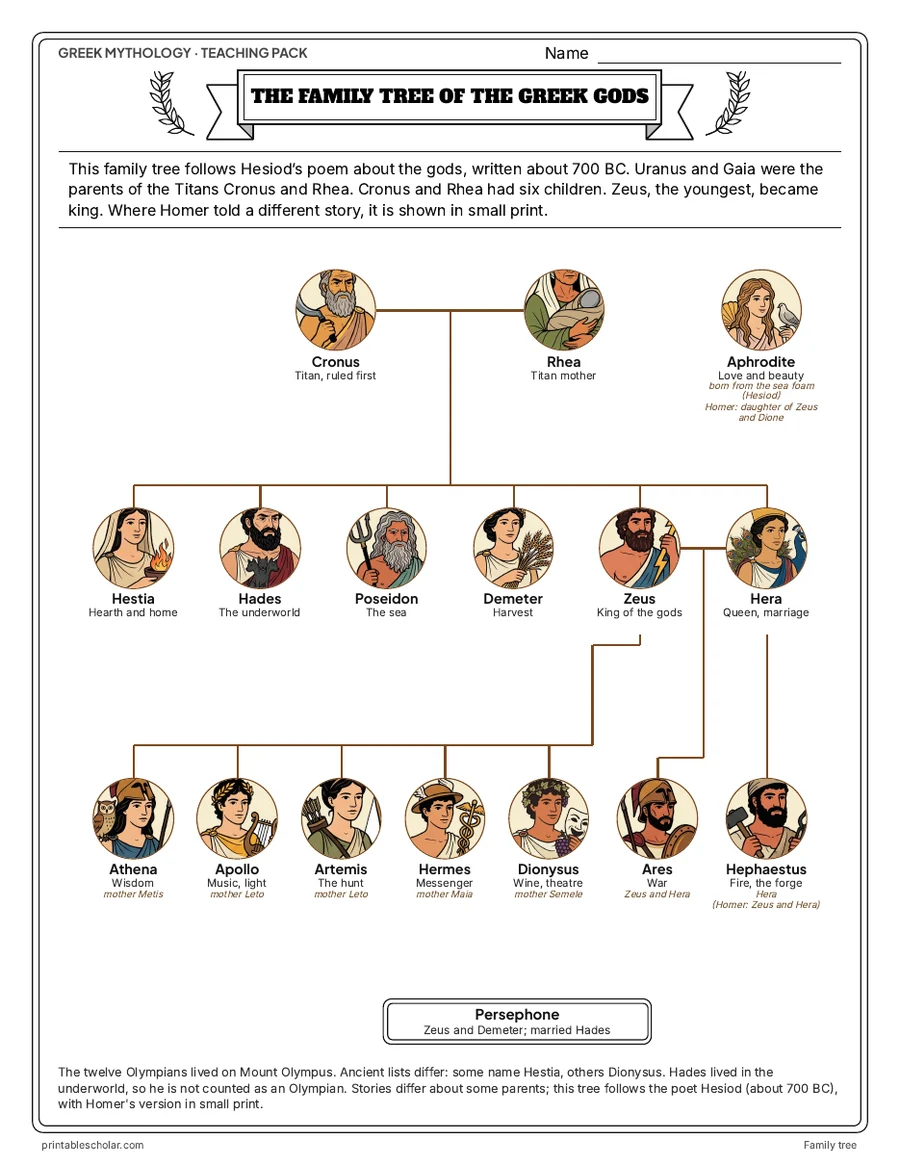
The ancient Greeks told stories about one big, quarrelsome family of gods. The Titans Cronus and Rhea had six children, and the youngest, Zeus, became king of the gods. This tree follows the poet Hesiod (about 700 BC); where Homer told it differently, the tree says so in small print.
Free to print
Free family tree printables
PDFs sized for US Letter paper, in color and black and white.
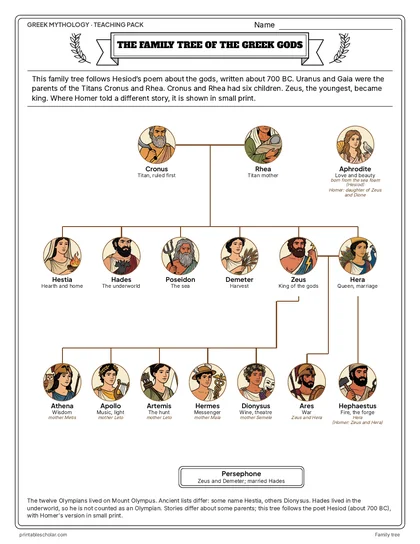
Greek gods family tree, labeled
Every god with a picture, what they ruled, and who their parents were.
Download PDF Black and white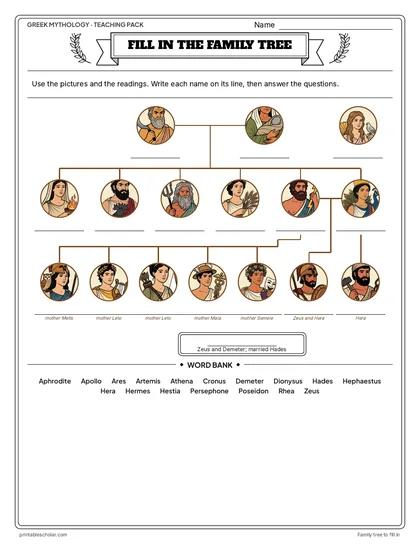
Blank family tree to fill in
The same pictures with blank lines and a word bank for students to label.
Download PDF Black and white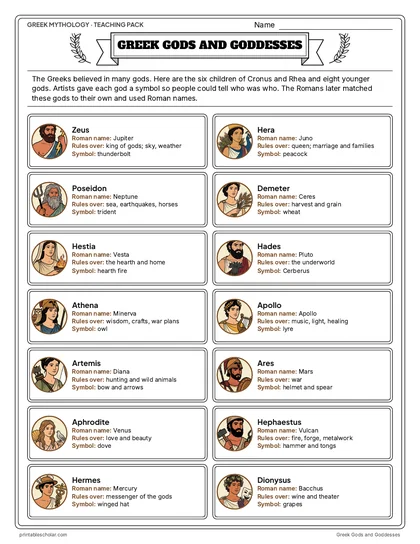
Greek gods and goddesses chart
Fourteen gods with their Roman names, what they ruled and their symbols.
Download PDF Black and white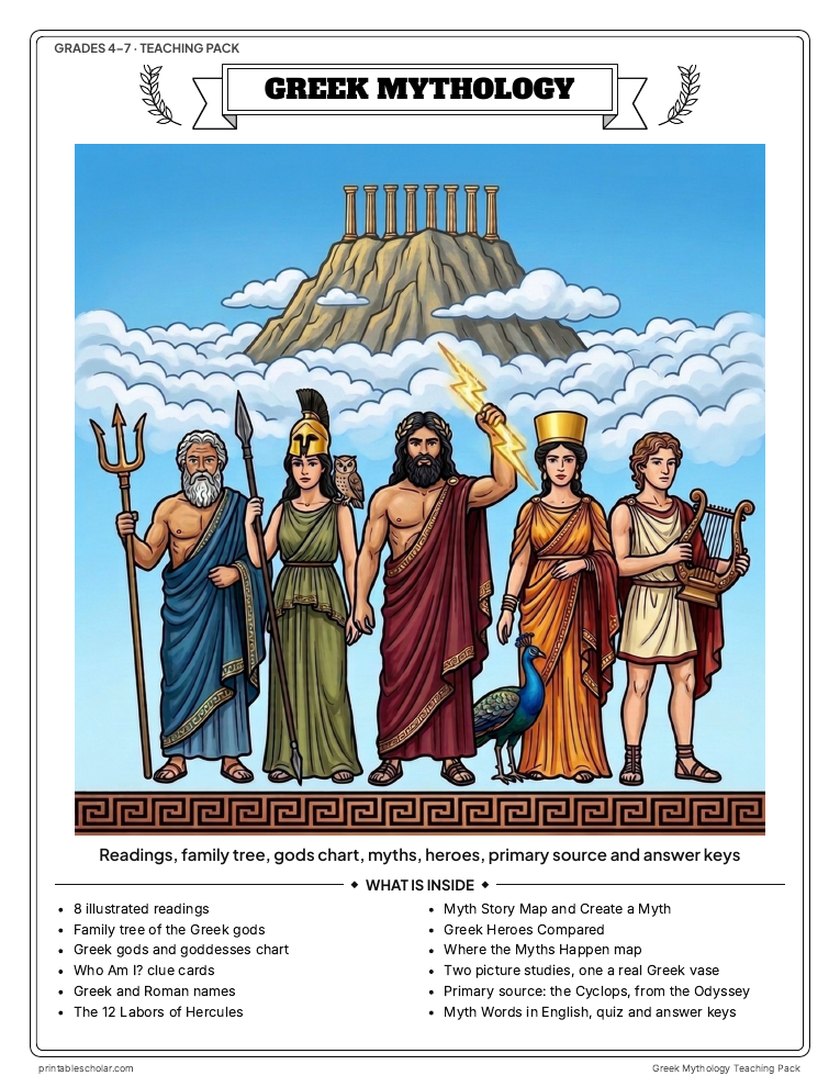
Teaching pack · Grades 4–7
Teaching Greek Mythology? The whole unit, ready to teach.
Two weeks of lessons in one download: slides to present, notes for students to fill in, and printable pages that use these maps and pictures.
Every slide comes with teacher notes: what to say, what to ask, and sample answers.
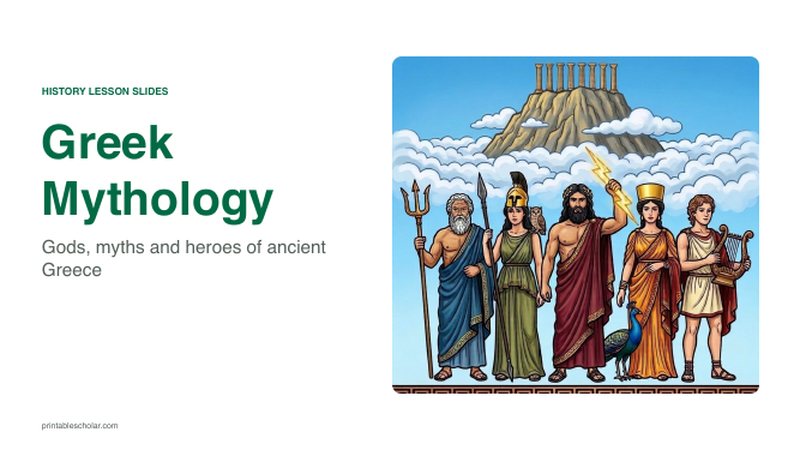
- 46 lesson slides (PowerPoint you can edit) and 2 pages of guided notes
- 8 illustrated reading pages: the Titans, the Olympians, myths that explain the world, myths with a lesson, Heracles, Perseus and Theseus, the Trojan War and Odysseus
- Activities: the family tree to fill in, a gods chart, Who Am I? clue cards, Greek and Roman names, the 12 labors in order, a myth story map, Greek heroes compared, myth words in English and Create a Myth
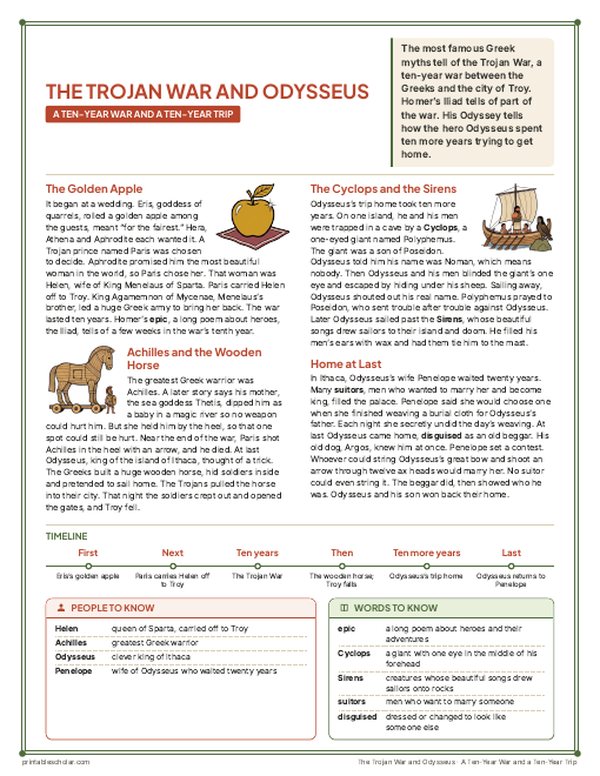
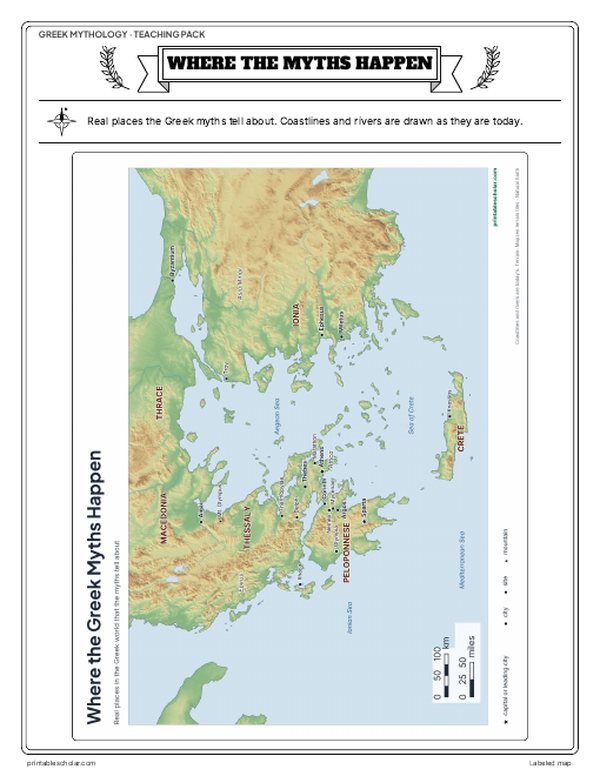
- Maps and sources: where the myths happen, a real Greek vase, and the Cyclops from the Odyssey
- A 15-question quiz, a teacher guide with a two-week plan, and answer keys for everything
Every answer is in the pack. The readings, slides, maps and pictures teach everything the sheets and quiz ask, so no textbook is needed.
Get the Greek Mythology pack for $7Teaching more than one? Get every history pack in one download, all 27 two-week units from Early Humans to World War II, for $49: about 54 weeks of lessons.
Get all 27 packs for $49See all 27 packsOne-time purchase. Instant download. Color and ink-saving black-and-white editions. Secure checkout by Stripe.
The 10-day plan
10 lessons, each planned for one class period of about 45 to 50 minutes, straight from the teacher guide. Some days are fuller than others; the note below shows how to even them out.
- Day 1Where Greek myths come from and the map
- Day 2The Titans and the family tree
- Day 3The Olympians and the gods chart
- Day 4Who Am I? and Greek and Roman names
- Day 5Myths that explain the world
- Day 6Myths with a lesson and a story map
- Day 7Heracles, the 12 labors and a real vase
- Day 8Perseus, Theseus and the map
- Day 9The Trojan War, the Cyclops and myth words
- Day 10Heroes compared, Create a Myth and the quiz
See the full day-by-day plan
- Day 1
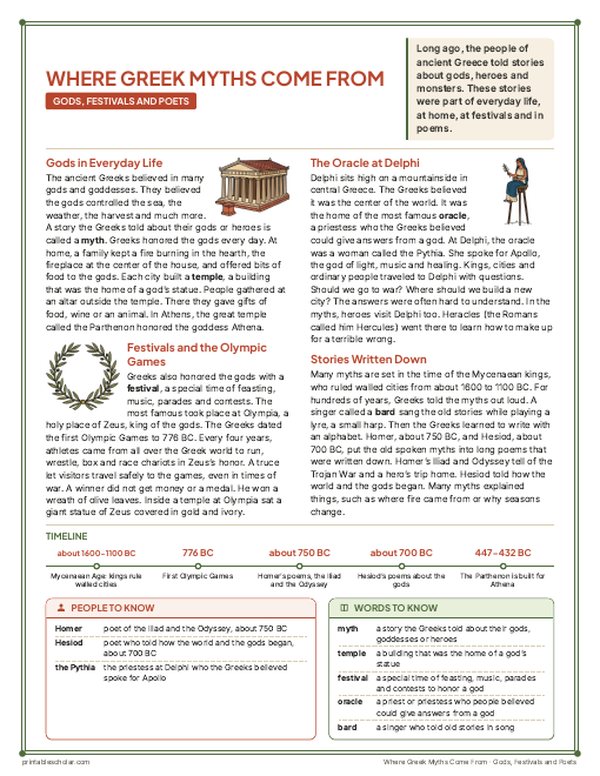
- Slides 1 to 6 and guided notes. Reading 1: Where Greek Myths Come From. Then the Where the Myths Happen map: find Delphi, Olympia and Mt. Olympus and do Label the Map with the places box.
- Day 2
- Slides 7 to 13. Reading 2: Titans and the Beginning. Then Fill In the Family Tree from the reading before handing out the labeled family tree to check.
- Day 3
- Slides 14 to 17. Reading 3: The Olympians. Study the Greek Gods and Goddesses chart, then the picture study The Gods on Mount Olympus.
- Day 4
- Slides 18 to 20. Who Am I? clue cards in pairs, then Greek and Roman Names (matching and questions).
- Day 5
- Slides 21 to 25. Reading 4: Myths That Explain the World. Model the Myth Story Map together on Persephone.
- Day 6
- Slides 26 to 30. Reading 5: Myths With a Lesson. Students fill in a second Myth Story Map on their own, on Arachne or King Midas.
- Day 7
- Slides 31 to 36. Reading 6: Heracles and the Twelve Labors. Put the Labors in Order from the reading first, then hand out The 12 Labors of Hercules cards to check. Then the vase picture study How Greek Painters Told Myths.
- Day 8
- Slides 37 to 39. Reading 7: Perseus and Theseus. Turn and talk: how did each hero get help from the gods or from a friend? Then Read the Map (Theseus's trip to Crete).
- Day 9
- Slides 40 to 43. Reading 8: The Trojan War and Odysseus. Primary source: The Cyclops (from the Odyssey). Then Myth Words in English and Use the Myth Words: every myth behind the words has now been read.
- Day 10
- Slides 44 to 46. The riddle and exit question, Greek Heroes Compared, then Create a Myth (or set it as homework) and the quiz.
Who is who in the family
The Titans
Gaia (the Earth) and Uranus (the Sky) had the Titans. Their son Cronus overthrew his father and ruled first. Cronus married his sister Rhea.
Cronus and Rhea’s six children
Hestia, Hades, Poseidon, Demeter, Hera and Zeus. Cronus swallowed the first five whole; Rhea hid baby Zeus and gave Cronus a stone wrapped in baby cloths. Zeus grew up, freed the others, and the three brothers drew lots: Zeus got the sky, Poseidon the sea and Hades the underworld.
Zeus and Hera’s children
Zeus married his sister Hera, queen of the gods. Their son was Ares, god of war. Hesiod said Hera had Hephaestus, god of the forge, by herself; Homer called him the son of Zeus and Hera.
Zeus’s other children
Athena (her mother was Metis; she sprang from Zeus’s head), the twins Apollo and Artemis (mother Leto), Hermes (mother Maia) and Dionysus (mother Semele, a mortal princess). Persephone was the daughter of Zeus and Demeter, and she married Hades.
Aphrodite’s two stories
Hesiod said Aphrodite was born from the sea foam before Zeus was king, so she sits apart on the tree. Homer called her the daughter of Zeus and the goddess Dione.
The twelve Olympians
The twelve most important gods lived on Mount Olympus. Ancient lists differ: some name Hestia, others Dionysus. Hades is not counted, because he lived in the underworld.
Frequently asked questions
Who is the father of the Greek gods?
Zeus was the king and father of many gods, but the oldest generation in the tree is the Titans. Cronus and Rhea were the parents of Zeus, Hera, Poseidon, Hades, Demeter and Hestia, and Gaia and Uranus were the parents of the Titans.
How many children did Zeus have?
Many. On this tree his children are Ares (with Hera), Athena, Apollo, Artemis, Hermes, Dionysus and Persephone. The Greeks told of many more, including heroes such as Heracles and Perseus, whose mothers were mortal women.
Is Hades one of the twelve Olympians?
No. Hades was Zeus’s brother, but he lived in the underworld, not on Mount Olympus, so he is not counted among the twelve.
Why do Greek family trees disagree?
The myths were told for hundreds of years by different poets. Hesiod and Homer, the two oldest, sometimes gave different parents, for example for Aphrodite and Hephaestus.