 Printable Scholar
Greek Columns: Doric, Ionic and Corinthian
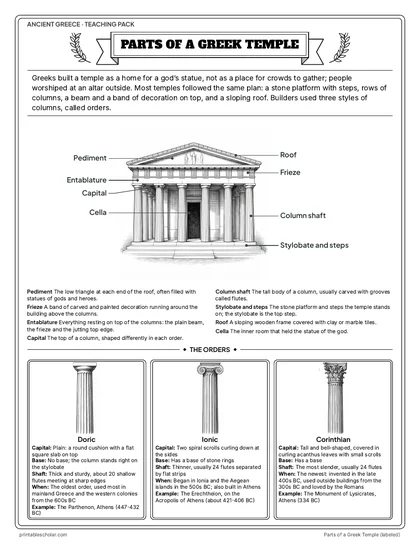
Greeks built a temple as a home for a god’s statue, not as a place for crowds to gather; people worshiped at an altar outside. Most temples followed the same plan: a stone platform with steps, rows of columns, a beam and a band of decoration on top, and a sloping roof. Builders used three styles of columns, called orders.
Free to print
A labeled temple, and a blank one to label
PDFs sized for US Letter paper, in color and black and white.
Parts of a Greek temple, labeled
The eight parts of a temple with leader lines, and the three column orders side by side.
Download PDF Black and white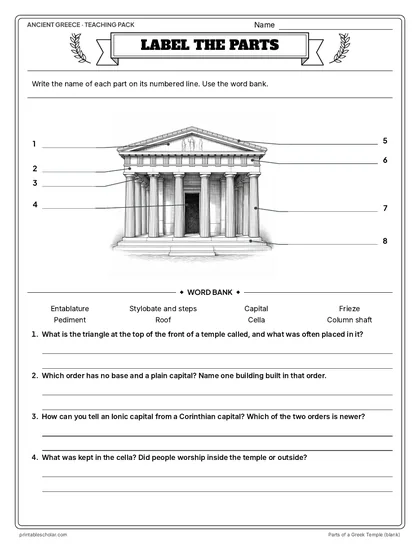
Label the parts
The same temple with numbered blanks, a word bank and four questions.
Download PDF Black and white
Teaching pack · Grades 5–7
Teaching Ancient Greece? The whole unit, ready to teach.
Two weeks of lessons in one download: slides to present, notes for students to fill in, and printable pages that use these maps and pictures.
- 29 lesson slides (PowerPoint you can edit, teacher notes on every slide) and 2 pages of guided notes
- 3 illustrated reading pages and a GRAPES organizer
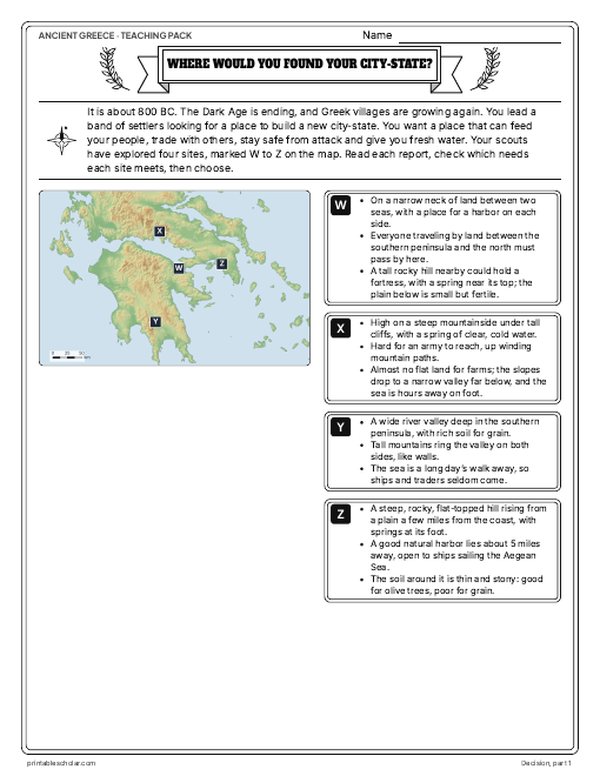
- Maps: labeled, blank, Read and Measure the Map, and a "Where would you found your city-state?" decision with the reveal
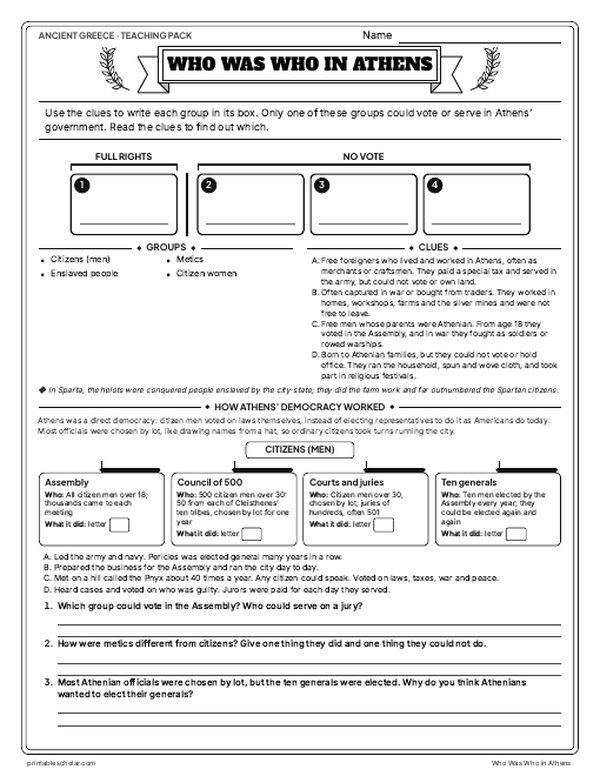
- Activities: picture studies of the agora and the Olympic Games, parts of a Greek temple and the three column orders, who was who in Athens and how its democracy worked, the Twelve Olympians, Pericles' Funeral Oration, a timeline sort and Athens vs. Sparta
- A 15-question quiz, a teacher guide with a two-week plan, and answer keys for everything
Every answer is in the pack. The readings, slides, maps and pictures teach everything the sheets and quiz ask, so no textbook is needed.
Get the Ancient Greece pack for $7One-time purchase. Instant download. Color and ink-saving black-and-white editions. Secure checkout by Stripe.
The three column orders
Doric
Capital: Plain: a round cushion with a flat square slab on top. Base: No base; the column stands right on the stylobate. Shaft: Thick and sturdy, about 20 shallow flutes meeting at sharp edges. When: The oldest order, used most in mainland Greece and the western colonies from the 600s BC. Example: The Parthenon, Athens (447-432 BC).
Ionic
Capital: Two spiral scrolls curling down at the sides. Base: Has a base of stone rings. Shaft: Thinner, usually 24 flutes separated by flat strips. When: Began in Ionia and the Aegean islands in the 500s BC; also built in Athens. Example: The Erechtheion, on the Acropolis of Athens (about 421-406 BC).
Corinthian
Capital: Tall and bell-shaped, covered in curling acanthus leaves with small scrolls. Base: Has a base. Shaft: The most slender, usually 24 flutes. When: The newest: invented in the late 400s BC, used outside buildings from the 300s BC and loved by the Romans. Example: The Monument of Lysicrates, Athens (334 BC).
Frequently asked questions
How can you tell Doric, Ionic and Corinthian columns apart?
Look at the top, the capital. Doric is plain: a round cushion with a flat slab. Ionic has two spiral scrolls. Corinthian is tall and bell-shaped, covered in leaves.
Which Greek column style is the oldest?
Doric, used from the 600s BC, mostly in mainland Greece. The Parthenon in Athens is Doric. Corinthian is the newest.
What were Greek temples for?
A Greek temple was a home for a god’s statue, kept in an inner room called the cella. People worshiped outside, at an altar in front of the temple.