 Printable Scholar
Athens vs. Sparta: How the Two City-States Compared
Athens and Sparta were the two most powerful city-states in ancient Greece. They fought side by side against Persia in 480 BC, then against each other in the Peloponnesian War (431-404 BC). They were run in very different ways: Athens was a democracy, Sparta an oligarchy built around its army.
Free to print
A compare chart to fill in
PDFs sized for US Letter paper, in color and black and white.
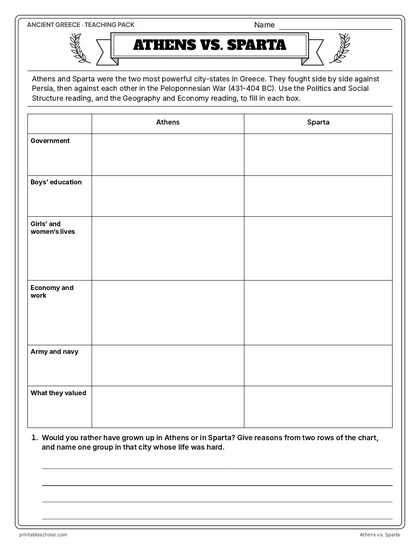
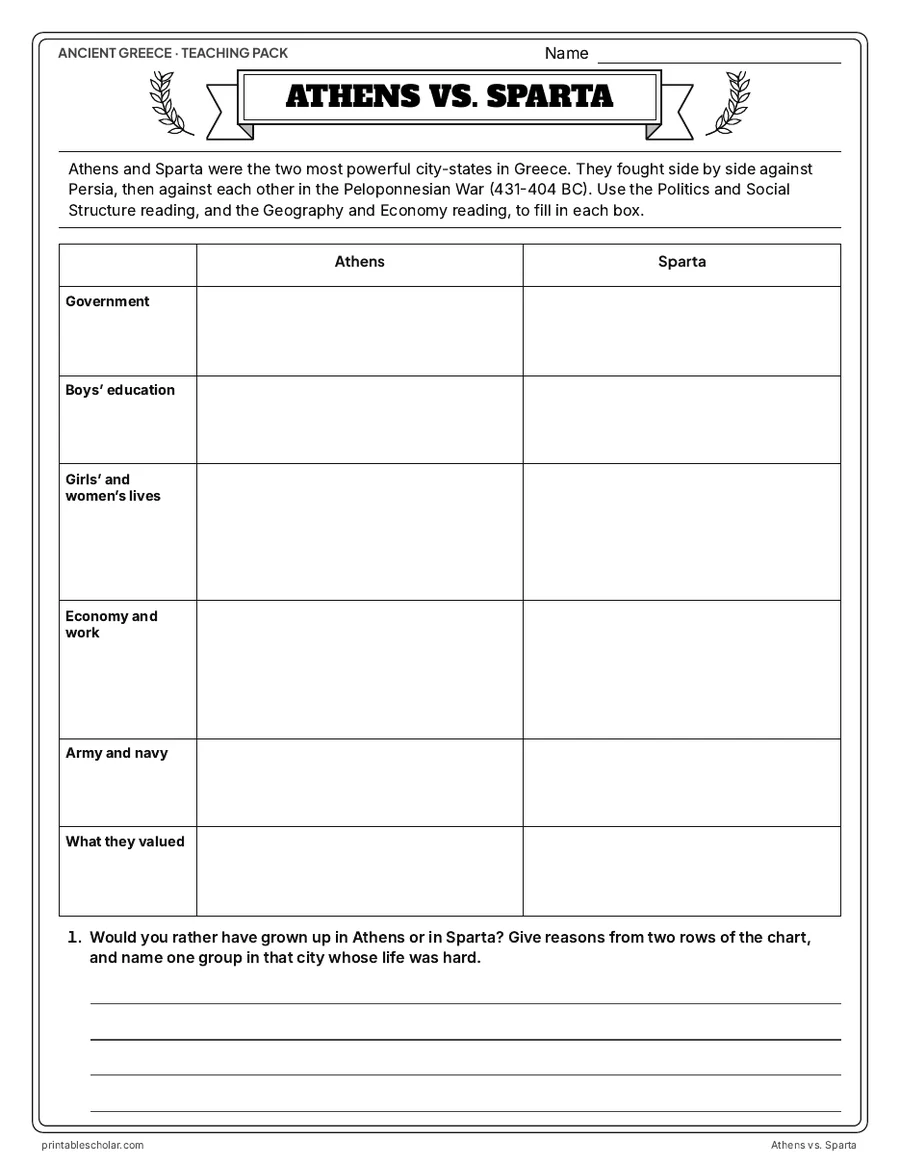
Athens vs. Sparta compare chart
Six rows to fill in, from government to what each city valued, and a question: would you rather have grown up in Athens or Sparta?
Download PDF Black and white
Teaching pack · Grades 5–7
Teaching Ancient Greece? The whole unit, ready to teach.
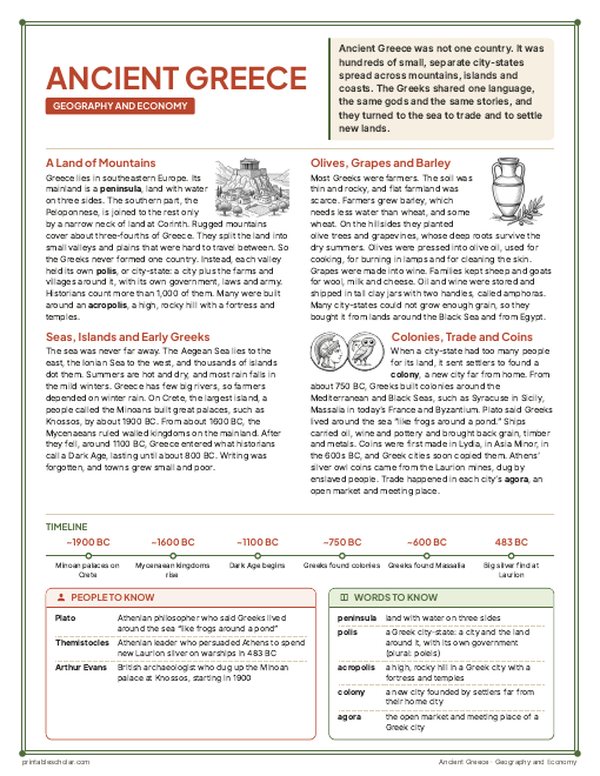
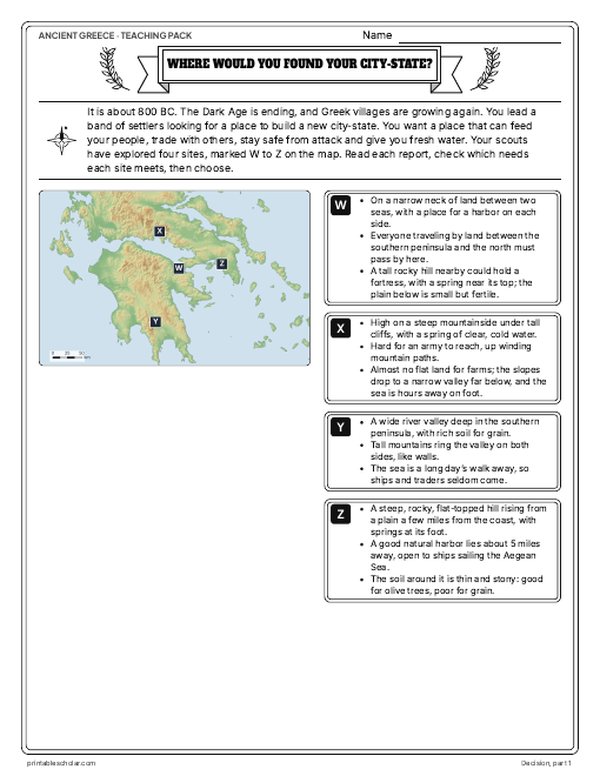
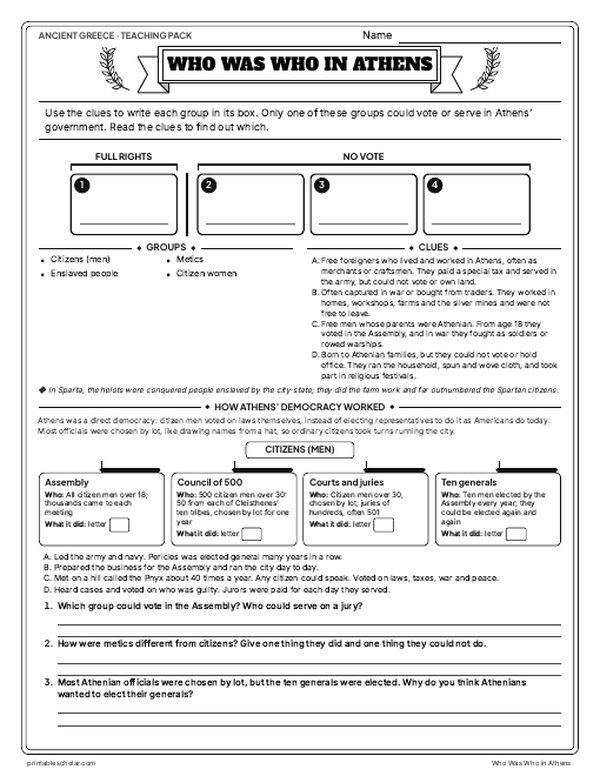
Two weeks of lessons in one download: slides to present, notes for students to fill in, and printable pages that use these maps and pictures.
- 29 lesson slides (PowerPoint you can edit, teacher notes on every slide) and 2 pages of guided notes
- 3 illustrated reading pages and a GRAPES organizer
- Maps: labeled, blank, Read and Measure the Map, and a "Where would you found your city-state?" decision with the reveal
- Activities: picture studies of the agora and the Olympic Games, parts of a Greek temple and the three column orders, who was who in Athens and how its democracy worked, the Twelve Olympians, Pericles' Funeral Oration, a timeline sort and Athens vs. Sparta
- A 15-question quiz, a teacher guide with a two-week plan, and answer keys for everything
Every answer is in the pack. The readings, slides, maps and pictures teach everything the sheets and quiz ask, so no textbook is needed.
Get the Ancient Greece pack for $7One-time purchase. Instant download. Color and ink-saving black-and-white editions. Secure checkout by Stripe.
Athens and Sparta, row by row
Government
Athens: A direct democracy from 507 BC (Cleisthenes): citizen men voted on laws themselves in the Assembly; a Council of 500 chosen by lot. Sparta: An oligarchy: two kings, a council of 28 elders over age 60 and five ephors elected each year.
Boys’ education
Athens: Boys whose families could pay went to school from about age 7: reading, writing, music, poetry and sports. Sparta: At age 7 boys left home to live in groups and train hard as soldiers, often cold and hungry.
Girls’ and women’s lives
Athens: Girls learned spinning, weaving and running a household at home and married at about 14 or 15; women could not vote or hold office. Sparta: Girls ran, wrestled and exercised to grow strong; women ran the households and could own land, more freedom than Athenian women had.
The chart, filled in
Every box of the chart, answered.
| Athens | Sparta | |
|---|---|---|
| Government | A direct democracy from 507 BC (Cleisthenes): citizen men voted on laws themselves in the Assembly; a Council of 500 chosen by lot. | An oligarchy: two kings, a council of 28 elders over age 60 and five ephors elected each year. |
| Boys’ education | Boys whose families could pay went to school from about age 7: reading, writing, music, poetry and sports. | At age 7 boys left home to live in groups and train hard as soldiers, often cold and hungry. |
| Girls’ and women’s lives | Girls learned spinning, weaving and running a household at home and married at about 14 or 15; women could not vote or hold office. | Girls ran, wrestled and exercised to grow strong; women ran the households and could own land, more freedom than Athenian women had. |
| Economy and work | Trade by sea (oil, wine and pottery for grain, timber and metals); silver owl coins from the Laurion mines; enslaved people worked in homes, workshops, farms and the silver mines. | Citizens did not farm or trade; helots, conquered people enslaved by Sparta, did the farm work. |
| Army and navy | A strong navy of triremes that won at Salamis in 480 BC; citizen men fought as foot soldiers or rowed warships. | The best army in Greece: citizen men were full-time hoplite soldiers. Sparta’s navy stayed weak until late in the Peloponnesian War, when it built a fleet with Persian money. |
| What they valued | Democracy, free debate and learning; theater, philosophy and the arts. | Discipline, obedience and courage; a strong army. |
Frequently asked questions
What was the main difference between Athens and Sparta?
Government and what each city valued. Athens was a direct democracy where citizen men voted on laws themselves, and it prized debate, learning and the arts. Sparta was an oligarchy with two kings and a council of elders, and it prized discipline and a strong army.
Who won the war between Athens and Sparta?
Sparta. The Peloponnesian War lasted from 431 to 404 BC, and Athens surrendered in 404 BC after a plague and a long war at sea.
Did women have more freedom in Athens or Sparta?
In Sparta. Spartan girls ran, wrestled and exercised, and Spartan women ran the households and could own land. Athenian women could not vote or hold office and mostly stayed at home.