 Printable Scholar
The 12 Labors of Hercules, in Order
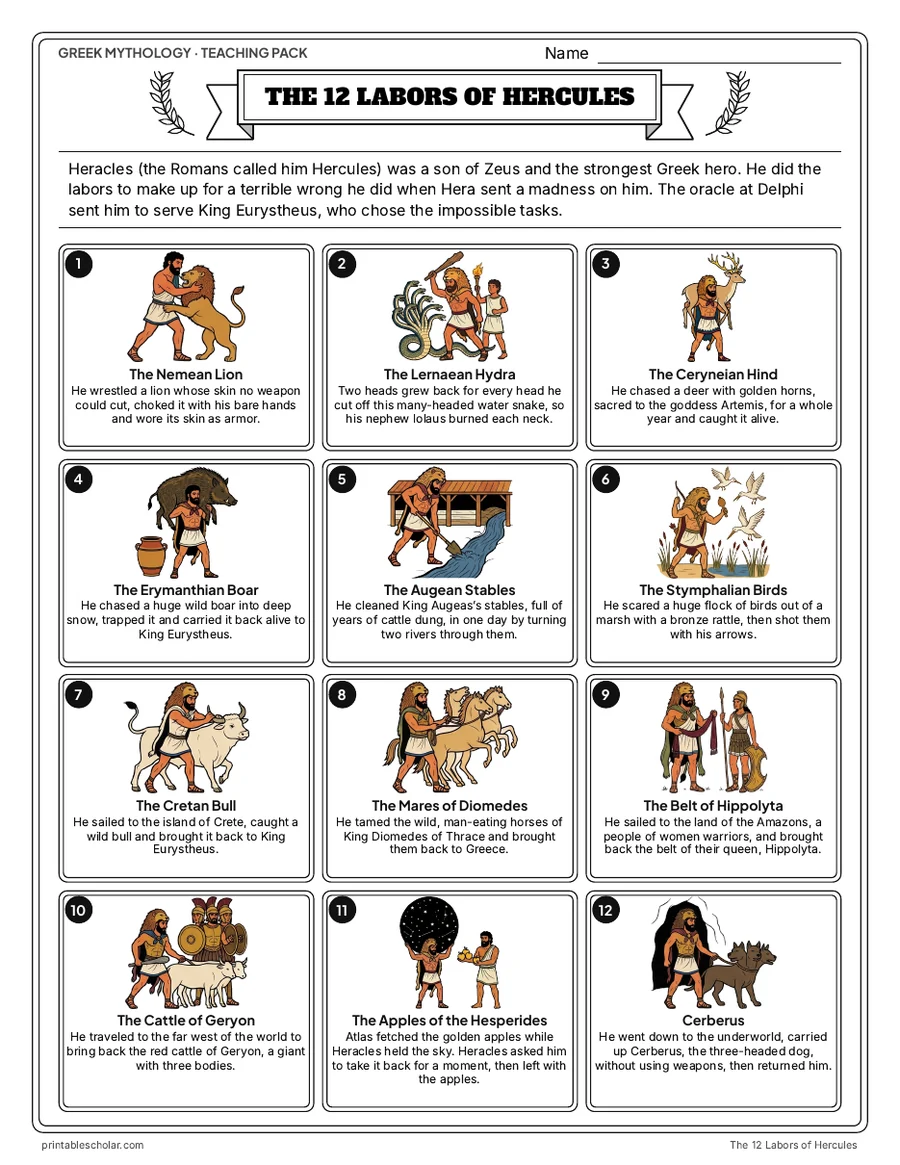
Heracles (the Romans called him Hercules) was a son of Zeus and the strongest Greek hero. He did the labors to make up for a terrible wrong he did when Hera sent a madness on him. The oracle at Delphi sent him to serve King Eurystheus, who chose the impossible tasks.
Free to print
Free 12 labors printables
PDFs sized for US Letter paper, in color and black and white.
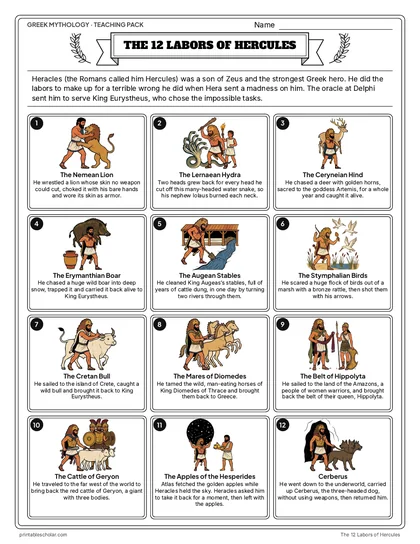
The 12 labors of Hercules, in order
All twelve labors with a picture and a one-line summary each.
Download PDF Black and white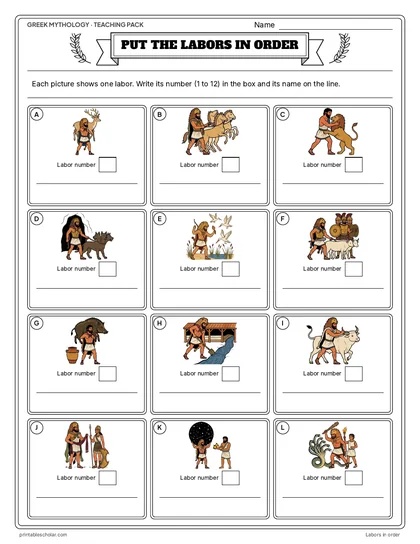
Put the labors in order
The twelve pictures mixed up: students number each labor and write its name.
Download PDF Black and white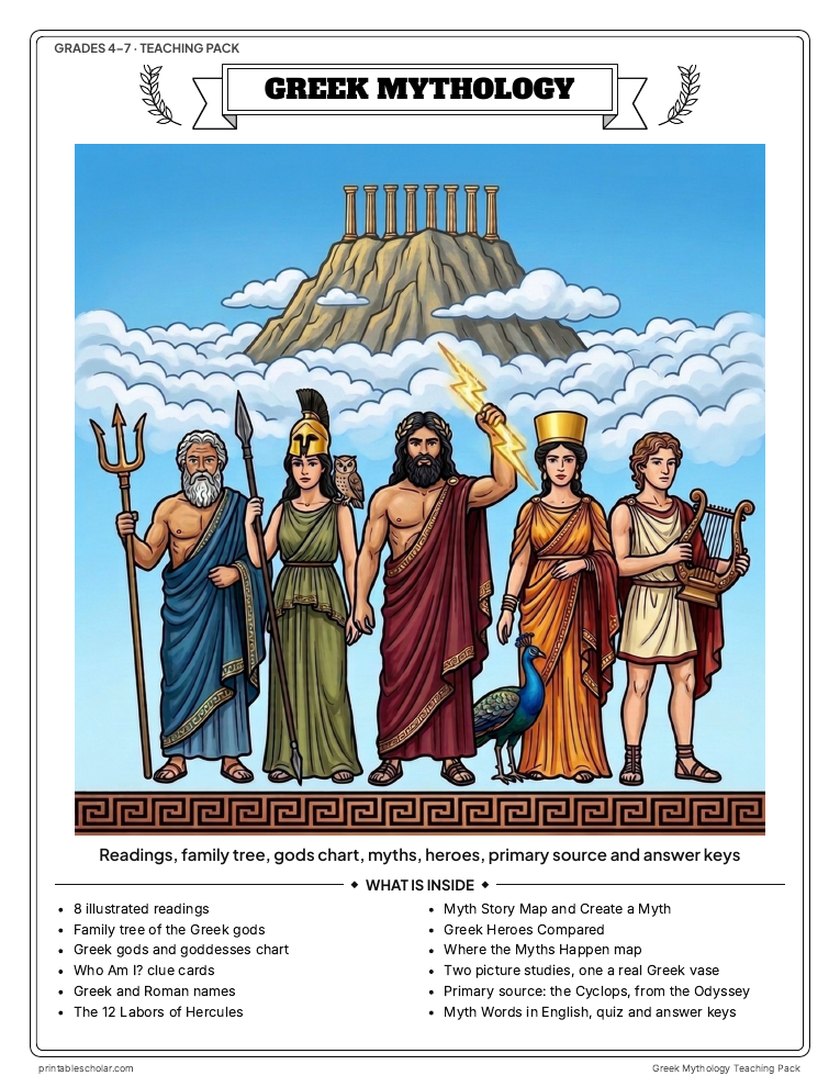
Teaching pack · Grades 4–7
Teaching Greek Mythology? The whole unit, ready to teach.
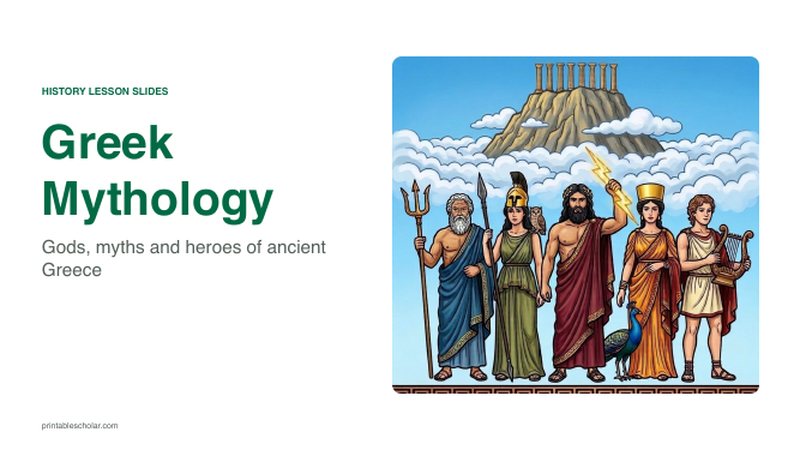
Two weeks of lessons in one download: slides to present, notes for students to fill in, and printable pages that use these maps and pictures.
Every slide comes with teacher notes: what to say, what to ask, and sample answers.
- 46 lesson slides (PowerPoint you can edit) and 2 pages of guided notes
- 8 illustrated reading pages: the Titans, the Olympians, myths that explain the world, myths with a lesson, Heracles, Perseus and Theseus, the Trojan War and Odysseus
- Activities: the family tree to fill in, a gods chart, Who Am I? clue cards, Greek and Roman names, the 12 labors in order, a myth story map, Greek heroes compared, myth words in English and Create a Myth
- Maps and sources: where the myths happen, a real Greek vase, and the Cyclops from the Odyssey
- A 15-question quiz, a teacher guide with a two-week plan, and answer keys for everything
Every answer is in the pack. The readings, slides, maps and pictures teach everything the sheets and quiz ask, so no textbook is needed.
Get the Greek Mythology pack for $7Teaching more than one? Get every history pack in one download, all 27 two-week units from Early Humans to World War II, for $49: about 54 weeks of lessons.
Get all 27 packs for $49See all 27 packsOne-time purchase. Instant download. Color and ink-saving black-and-white editions. Secure checkout by Stripe.
The 10-day plan
10 lessons, each planned for one class period of about 45 to 50 minutes, straight from the teacher guide. Some days are fuller than others; the note below shows how to even them out.
- Day 1Where Greek myths come from and the map
- Day 2The Titans and the family tree
- Day 3The Olympians and the gods chart
- Day 4Who Am I? and Greek and Roman names
- Day 5Myths that explain the world
- Day 6Myths with a lesson and a story map
- Day 7Heracles, the 12 labors and a real vase
- Day 8Perseus, Theseus and the map
- Day 9The Trojan War, the Cyclops and myth words
- Day 10Heroes compared, Create a Myth and the quiz
See the full day-by-day plan
- Day 1
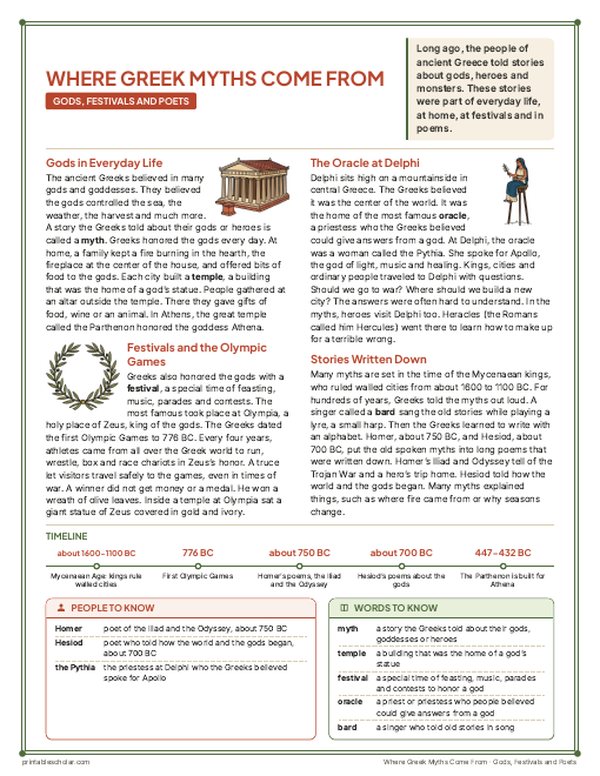
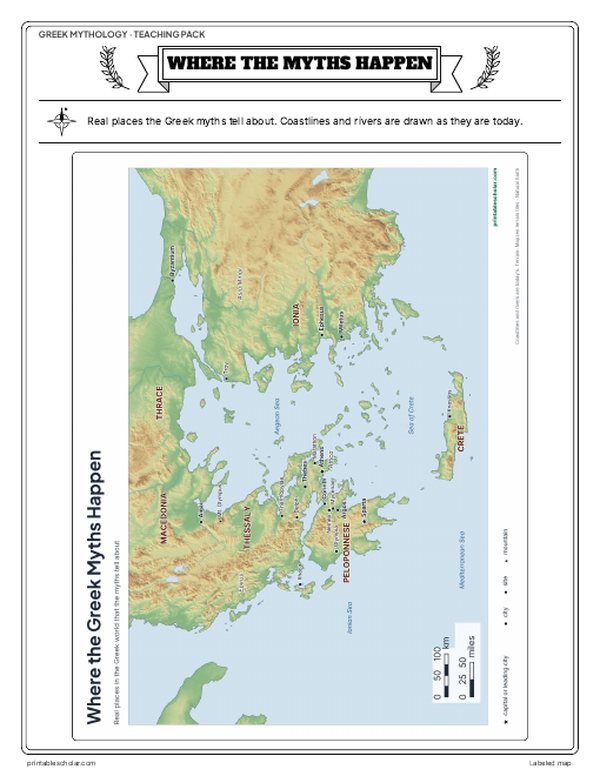
- Slides 1 to 6 and guided notes. Reading 1: Where Greek Myths Come From. Then the Where the Myths Happen map: find Delphi, Olympia and Mt. Olympus and do Label the Map with the places box.
- Day 2
- Slides 7 to 13. Reading 2: Titans and the Beginning. Then Fill In the Family Tree from the reading before handing out the labeled family tree to check.
- Day 3
- Slides 14 to 17. Reading 3: The Olympians. Study the Greek Gods and Goddesses chart, then the picture study The Gods on Mount Olympus.
- Day 4
- Slides 18 to 20. Who Am I? clue cards in pairs, then Greek and Roman Names (matching and questions).
- Day 5
- Slides 21 to 25. Reading 4: Myths That Explain the World. Model the Myth Story Map together on Persephone.
- Day 6
- Slides 26 to 30. Reading 5: Myths With a Lesson. Students fill in a second Myth Story Map on their own, on Arachne or King Midas.
- Day 7
- Slides 31 to 36. Reading 6: Heracles and the Twelve Labors. Put the Labors in Order from the reading first, then hand out The 12 Labors of Hercules cards to check. Then the vase picture study How Greek Painters Told Myths.
- Day 8
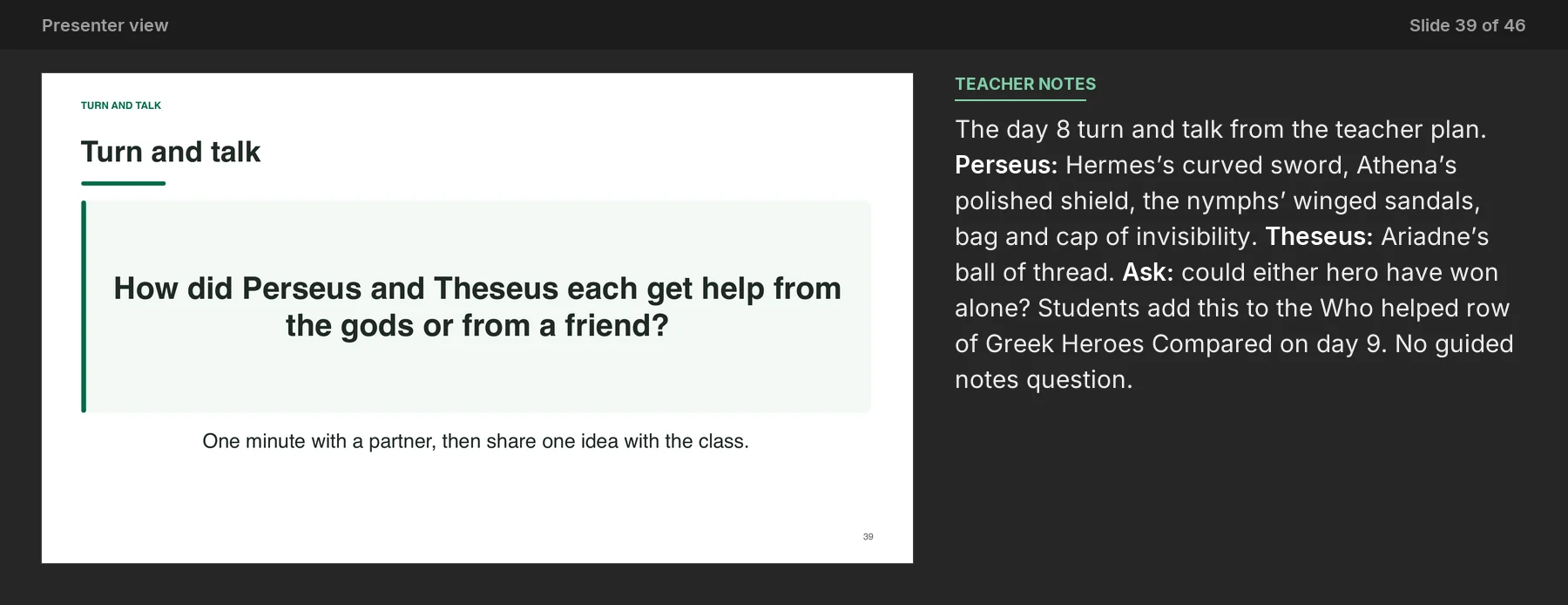
- Slides 37 to 39. Reading 7: Perseus and Theseus. Turn and talk: how did each hero get help from the gods or from a friend? Then Read the Map (Theseus's trip to Crete).
- Day 9
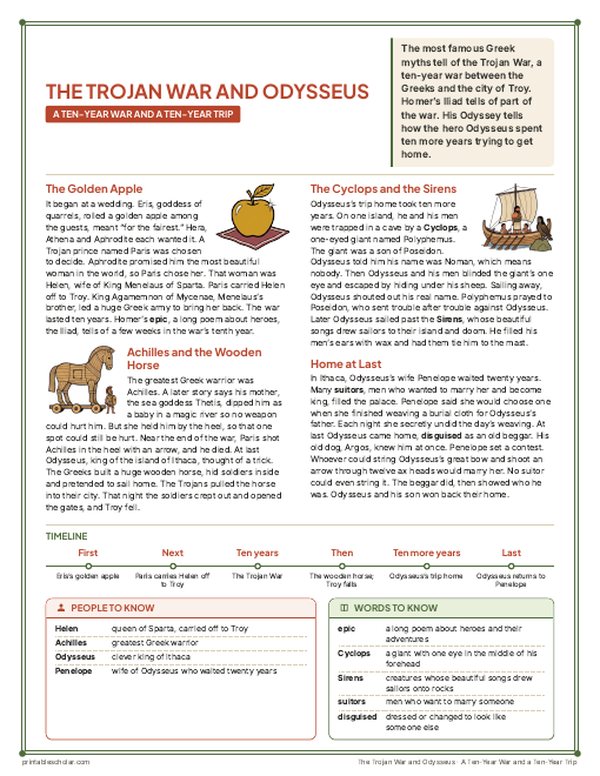
- Slides 40 to 43. Reading 8: The Trojan War and Odysseus. Primary source: The Cyclops (from the Odyssey). Then Myth Words in English and Use the Myth Words: every myth behind the words has now been read.
- Day 10
- Slides 44 to 46. The riddle and exit question, Greek Heroes Compared, then Create a Myth (or set it as homework) and the quiz.
The twelve labors, one by one
1. The Nemean Lion
He wrestled a lion whose skin no weapon could cut, choked it with his bare hands and wore its skin as armor.
2. The Lernaean Hydra
Two heads grew back for every head he cut off this many-headed water snake, so his nephew Iolaus burned each neck.
3. The Ceryneian Hind
He chased a deer with golden horns, sacred to the goddess Artemis, for a whole year and caught it alive.
4. The Erymanthian Boar
He chased a huge wild boar into deep snow, trapped it and carried it back alive to King Eurystheus.
5. The Augean Stables
He cleaned King Augeas’s stables, full of years of cattle dung, in one day by turning two rivers through them.
6. The Stymphalian Birds
He scared a huge flock of birds out of a marsh with a bronze rattle, then shot them with his arrows.
7. The Cretan Bull
He sailed to the island of Crete, caught a wild bull and brought it back to King Eurystheus.
8. The Mares of Diomedes
He tamed the wild, man-eating horses of King Diomedes of Thrace and brought them back to Greece.
9. The Belt of Hippolyta
He sailed to the land of the Amazons, a people of women warriors, and brought back the belt of their queen, Hippolyta.
10. The Cattle of Geryon
He traveled to the far west of the world to bring back the red cattle of Geryon, a giant with three bodies.
11. The Apples of the Hesperides
Atlas fetched the golden apples while Heracles held the sky. Heracles asked him to take it back for a moment, then left with the apples.
12. Cerberus
He went down to the underworld, carried up Cerberus, the three-headed dog, without using weapons, then returned him.
Frequently asked questions
Is it Hercules or Heracles?
Both. Heracles is his Greek name; the Romans spelled it Hercules, and that is the name most people know today.
Why did Hercules do the 12 labors?
He did the labors to make up for a terrible wrong he did when Hera sent a madness on him. The oracle at Delphi sent him to serve King Eurystheus, who chose the impossible tasks.
Why were there twelve labors and not ten?
At first there were to be ten. King Eurystheus said two did not count: the Hydra, because Heracles had help from his nephew Iolaus, and the Augean stables, because Heracles asked for pay.
What was the last labor of Hercules?
Bringing up Cerberus, the three-headed dog that guarded the underworld. Heracles carried him up without using weapons, then returned him.