How to do the gingerbread man glyph
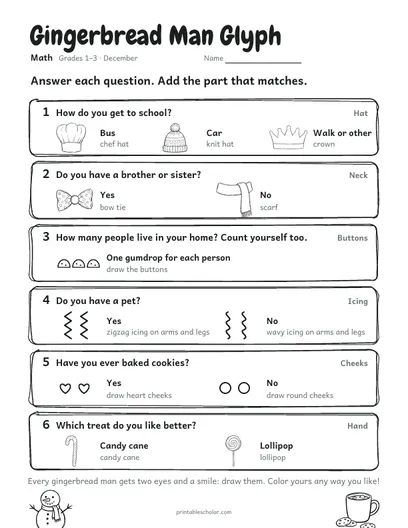
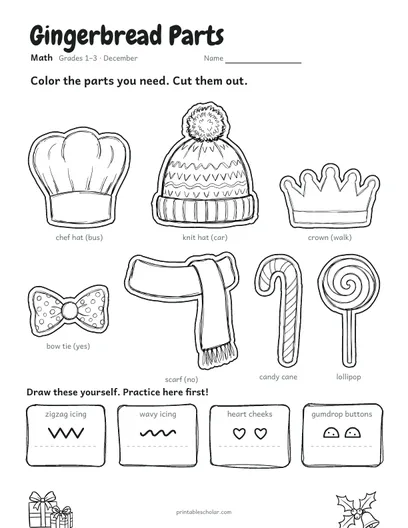
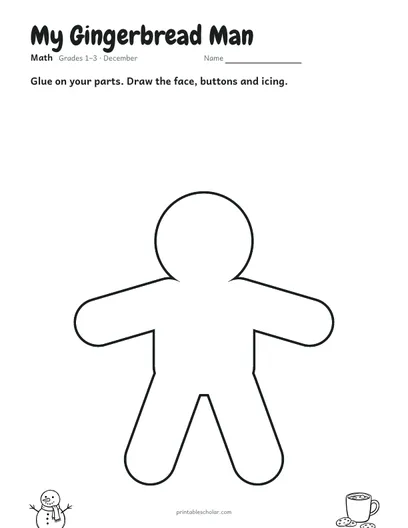
Print the legend, the parts and the gingerbread man body for each child. Read each question on the legend together. The child finds the part that matches their answer, colors it, cuts it out and glues it on. The eyes, smile, cheeks, gumdrop buttons and icing are drawn straight on, and the parts page has a strip for practising them first. When every gingerbread man is done, hang them up and read them: a crown means walking to school, a bow tie means a brother or sister, the gumdrops count the people at home, and zigzag icing means a pet.
The legend
- Hat: How do you get to school? Bus = chef hat, Car = knit hat, Walk or other = crown.
- Neck: Do you have a brother or sister? Yes = bow tie, No = scarf.
- Buttons: How many people live in your home? Count yourself too. One gumdrop for each person = draw the buttons.
- Icing: Do you have a pet? Yes = zigzag icing on arms and legs, No = wavy icing on arms and legs.
- Cheeks: Have you ever baked cookies? Yes = draw heart cheeks, No = draw round cheeks.
- Hand: Which treat do you like better? Candy cane = candy cane, Lollipop = lollipop.
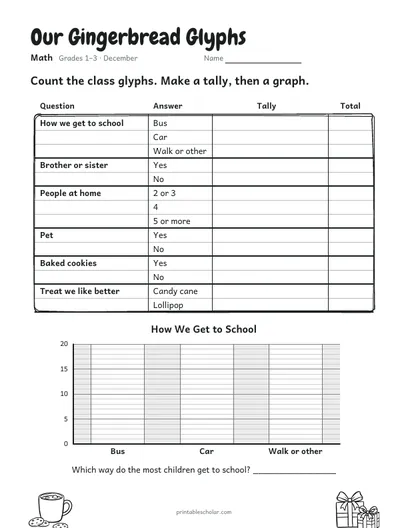
Then use the class tally sheet to count the answers and graph how everyone gets to school. It is a data lesson that feels like a craft: children collect the data from themselves, show it in a picture, and read it back. For more graphing practice, see the graphing worksheets, or try the probability experiments with older children. Read or watch The Gingerbread Man story first, and for January try the snowman glyph.
Printing tip: print at 100 percent (actual size) on US Letter paper. The parts are sized to fit the gingerbread man body.
Questions
What is a glyph?
A glyph is a picture that shows information. Each part of the picture stands for an answer to a question, the way a symbol on a graph stands for a number. Here every child builds a gingerbread man from their own answers, so the finished gingerbread men can be read, sorted, tallied and graphed.
What grades is the gingerbread man glyph for?
Grades 1 to 3. First graders can do it with an adult reading the questions aloud. Second and third graders can read the legend themselves and do the tally and graph on their own.
Do I need colored paper or a color printer?
No. Every answer shows in the shape of a part (which hat, a bow tie or a scarf, zigzag or wavy icing, how many gumdrops), not its color, so the glyphs can be read when printed in black and white. Children color their gingerbread man any way they like, or cut the body from brown paper.
Can I do this with one child at home?
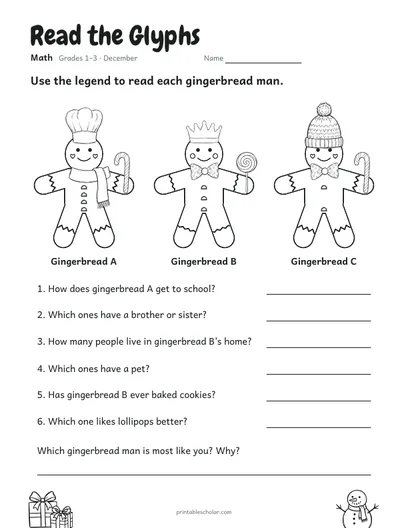
Yes. The Read the Glyphs sheet has three finished gingerbread men to read with the legend, so a single child can practise reading glyphs without a class. The class tally works with a family, too.
How long does it take?
About 30 to 45 minutes for the gingerbread man, and 15 to 20 minutes for the tally and graph. It pairs well with reading The Gingerbread Man the same week.
 Printable Scholar