 Printable Scholar
The Declaration of Independence
On July 4, 1776, Congress approved the Declaration of Independence. Thomas Jefferson wrote the first draft, and Congress made changes. It has three main parts: a statement of ideas about rights and government, a list of 27 complaints (grievances) against King George III, and the declaration that the colonies are free. Here are the opening, the ideas, some grievances and the ending. The printable below sets the exact words beside a plain-English version, explains the hard words and asks four questions.
Free to print
The Declaration with plain English, and the questions
PDFs sized for US Letter paper, in color and black and white.
The Declaration of Independence, with plain English
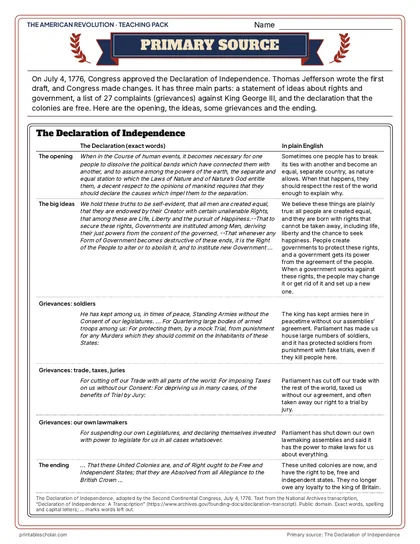
The opening, the big ideas, six grievances and the ending, each beside a plain-English version (National Archives text).
Download PDF Black and white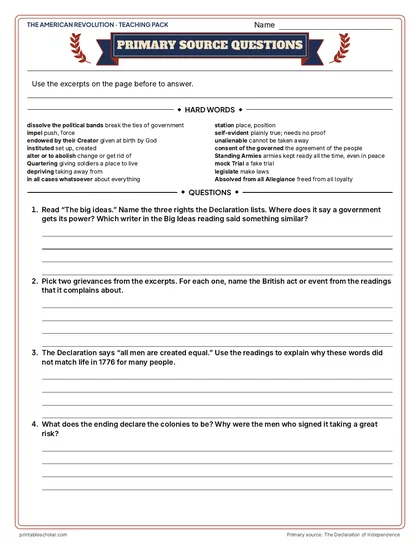
Hard words and questions
The hard words explained, and four questions about the Declaration.
Download PDF Black and white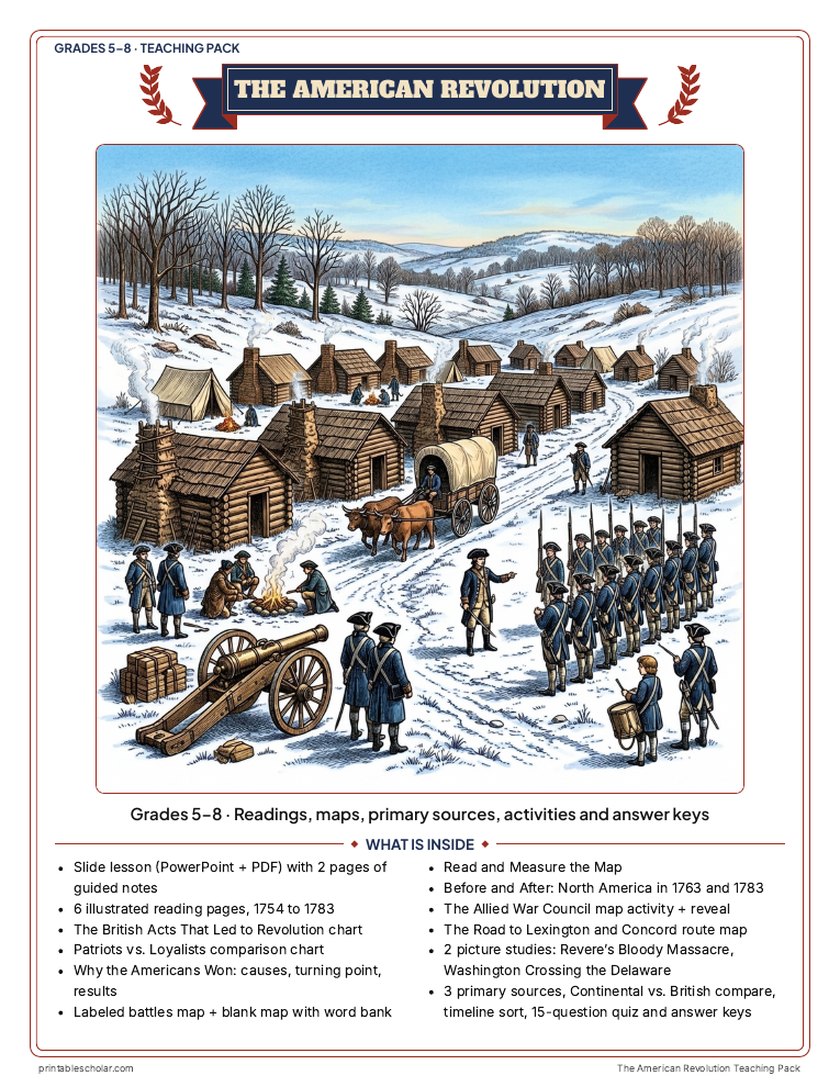
Teaching pack · Grades 5–8
Teaching the American Revolution? The whole unit, ready to teach.
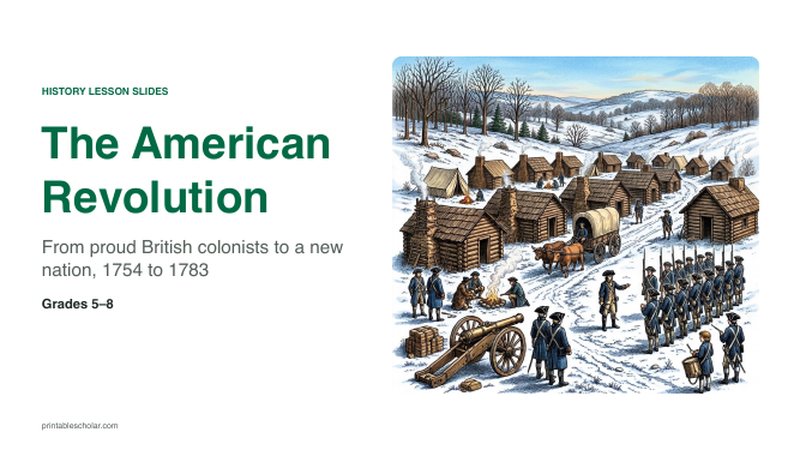
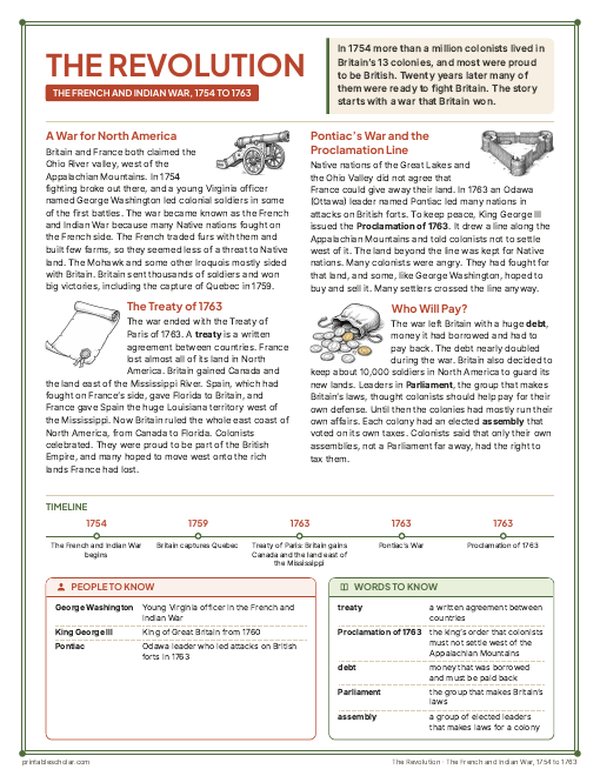
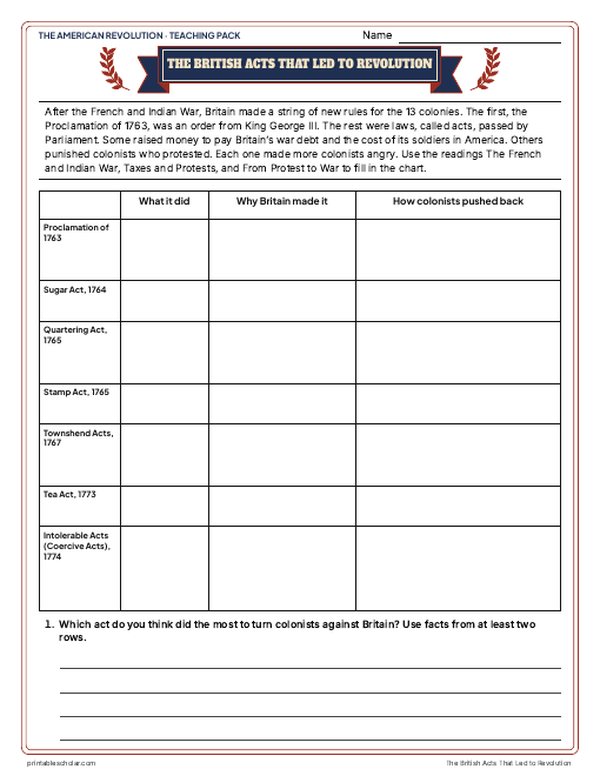
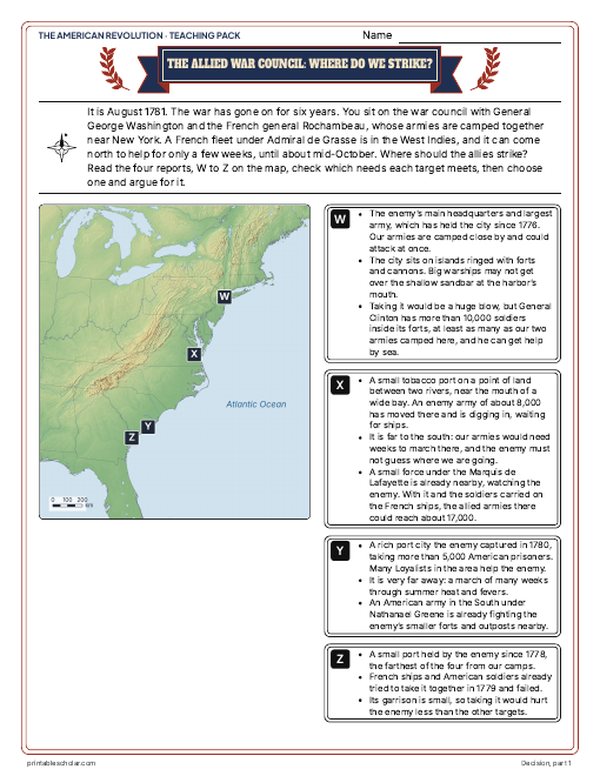
Two weeks of lessons in one download: slides to present, notes for students to fill in, and printable pages that use these maps and pictures.
- 41 lesson slides (PowerPoint you can edit, teacher notes on every slide) and 2 pages of guided notes
- 6 illustrated reading pages, 1754 to 1783, a British Acts chart, a Patriots vs. Loyalists chart and a Why the Americans Won sheet
- Maps: labeled, blank, Read and Measure the Map, North America in 1763 and 1783, the Road to Lexington and Concord, and a 1781 war council decision with the reveal
- Primary sources: the Declaration of Independence, Common Sense beside a Loyalist reply, and Abigail Adams's "Remember the Ladies", each with plain English beside it; picture studies of Revere's 1770 engraving and Leutze's 1851 painting
- Continental Army vs. British Army, a timeline sort, a 15-question quiz, a teacher guide with a two-week plan, and answer keys for everything
Every answer is in the pack. The readings, slides, maps and pictures teach everything the sheets and quiz ask, so no textbook is needed.
Get the American Revolution pack for $7One-time purchase. Instant download. Color and ink-saving black-and-white editions. Secure checkout by Stripe.
The Declaration, part by part
The opening
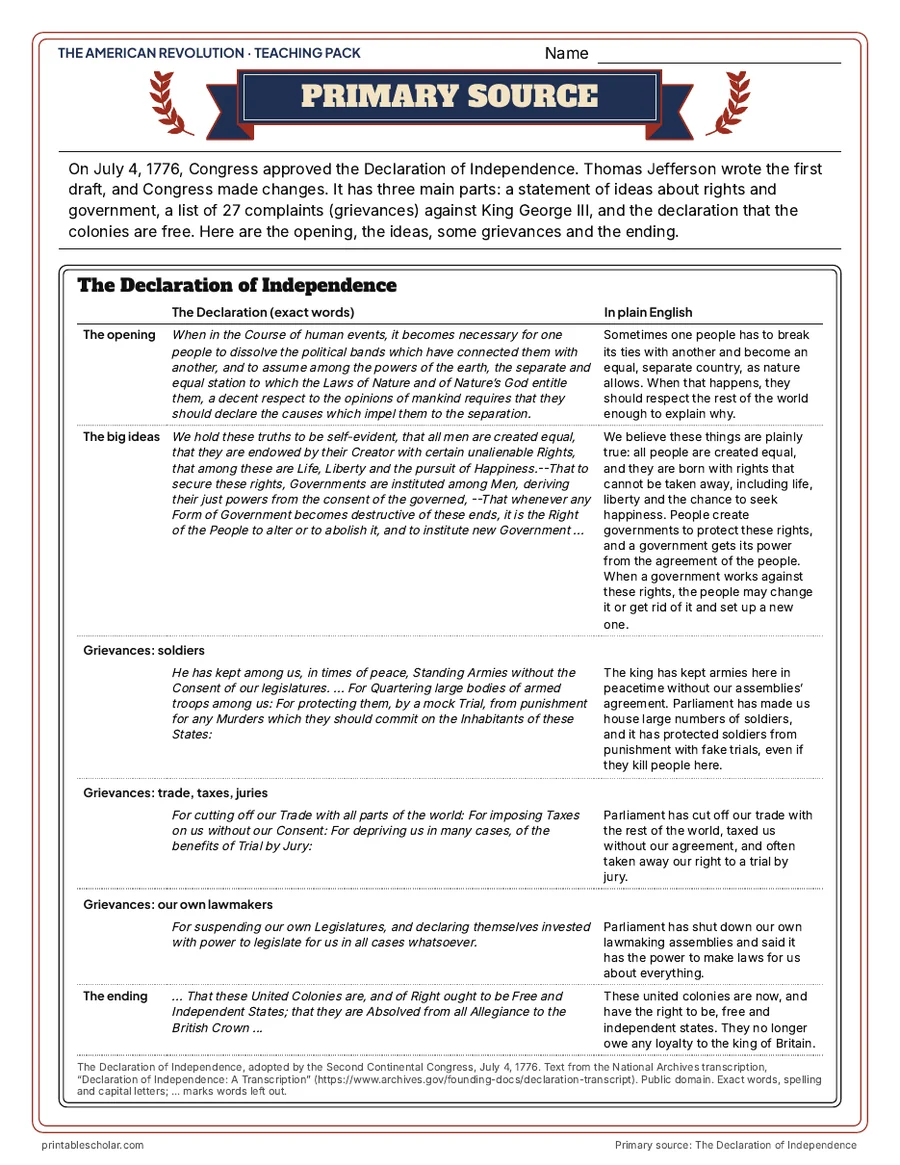
When in the Course of human events, it becomes necessary for one people to dissolve the political bands which have connected them with another, and to assume among the powers of the earth, the separate and equal station to which the Laws of Nature and of Nature’s God entitle them, a decent respect to the opinions of mankind requires that they should declare the causes which impel them to the separation. In plain English: Sometimes one people has to break its ties with another and become an equal, separate country, as nature allows. When that happens, they should respect the rest of the world enough to explain why.
The big ideas
We hold these truths to be self-evident, that all men are created equal, that they are endowed by their Creator with certain unalienable Rights, that among these are Life, Liberty and the pursuit of Happiness. — That to secure these rights, Governments are instituted among Men, deriving their just powers from the consent of the governed, — That whenever any Form of Government becomes destructive of these ends, it is the Right of the People to alter or to abolish it, and to institute new Government ... In plain English: We believe these things are plainly true: all people are created equal, and they are born with rights that cannot be taken away, including life, liberty and the chance to seek happiness. People create governments to protect these rights, and a government gets its power from the agreement of the people. When a government works against these rights, the people may change it or get rid of it and set up a new one.
Grievances: soldiers
He has kept among us, in times of peace, Standing Armies without the Consent of our legislatures. ... For Quartering large bodies of armed troops among us: For protecting them, by a mock Trial, from punishment for any Murders which they should commit on the Inhabitants of these States: In plain English: The king has kept armies here in peacetime without our assemblies’ agreement. Parliament has made us house large numbers of soldiers, and it has protected soldiers from punishment with fake trials, even if they kill people here.
Grievances: trade, taxes, juries
For cutting off our Trade with all parts of the world: For imposing Taxes on us without our Consent: For depriving us in many cases, of the benefits of Trial by Jury: In plain English: Parliament has cut off our trade with the rest of the world, taxed us without our agreement, and often taken away our right to a trial by jury.
Grievances: our own lawmakers
For suspending our own Legislatures, and declaring themselves invested with power to legislate for us in all cases whatsoever. In plain English: Parliament has shut down our own lawmaking assemblies and said it has the power to make laws for us about everything.
The ending
... That these United Colonies are, and of Right ought to be Free and Independent States; that they are Absolved from all Allegiance to the British Crown ... In plain English: These united colonies are now, and have the right to be, free and independent states. They no longer owe any loyalty to the king of Britain.
Frequently asked questions
Who wrote the Declaration of Independence?
Thomas Jefferson wrote the first draft in June 1776, working with a committee that included John Adams and Benjamin Franklin. Congress made changes and approved it on July 4, 1776.
What are the three main parts of the Declaration?
A statement of ideas about rights and government, a list of 27 complaints (grievances) against King George III, and the declaration that the colonies are free and independent states.
What does "consent of the governed" mean?
A government gets its power from the agreement of the people it governs. The idea comes from the English writer John Locke.
Did "all men are created equal" include everyone in 1776?
No. About one in five people in the colonies was enslaved, and many signers, including Jefferson, held people in slavery. Women could not vote. The words were later used by people working to end slavery and win equal rights.