 Printable Scholar
Causes of the American Revolution: The British Acts
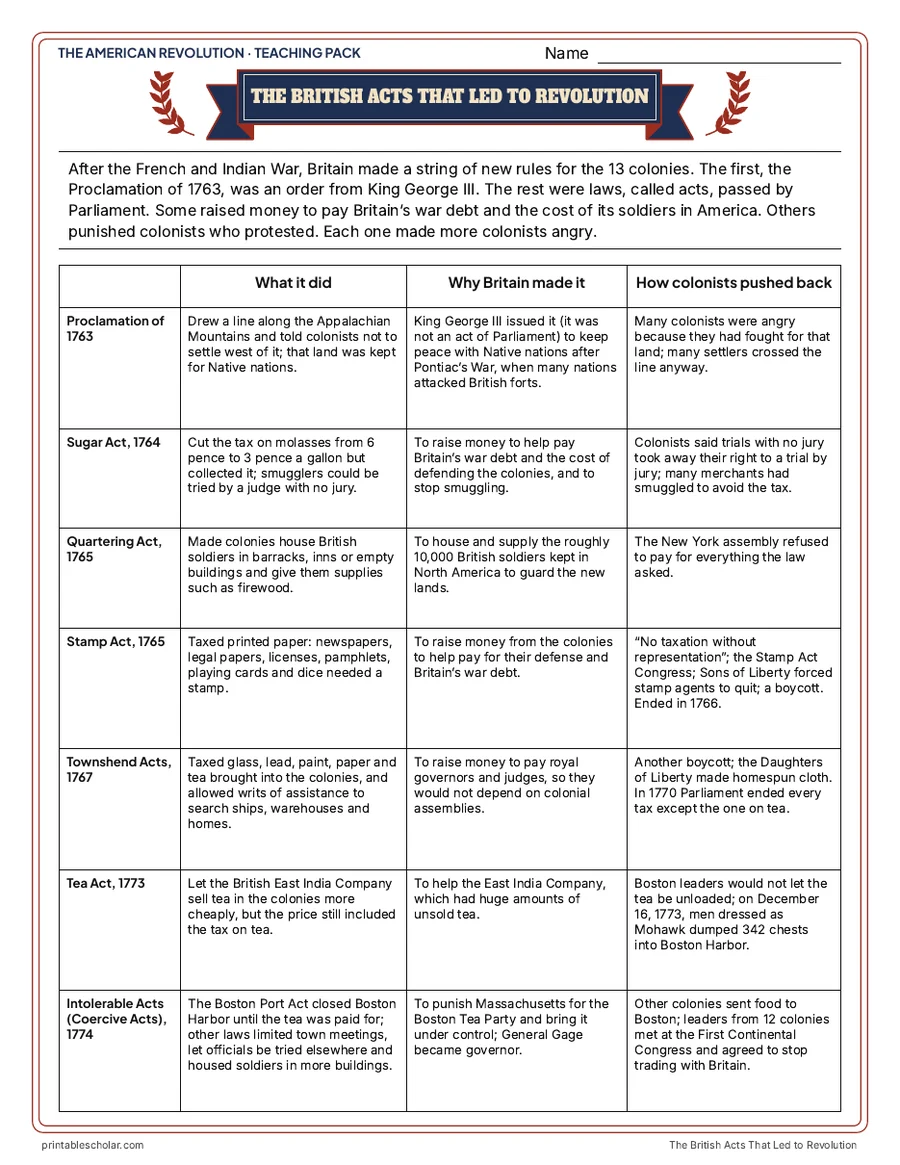
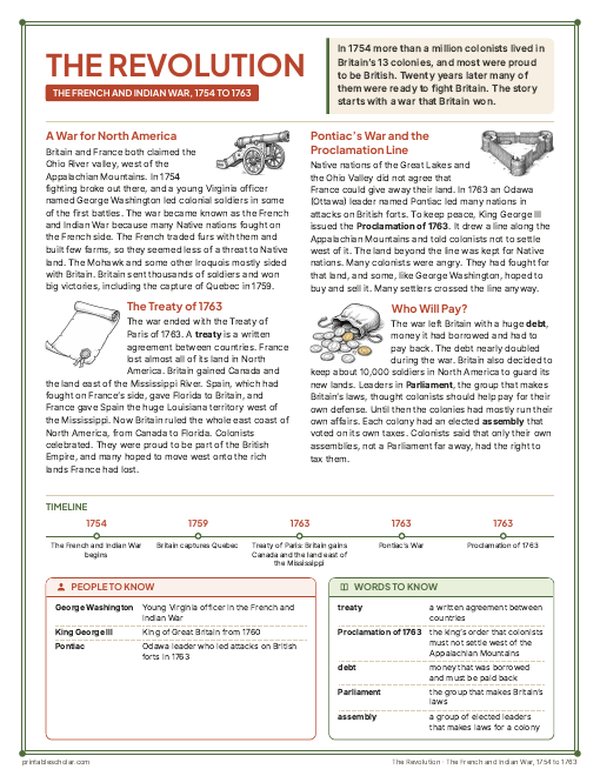
In 1763 most colonists were proud to be British. Twelve years later many of them were ready to fight Britain. What changed? After the French and Indian War, Britain was deep in debt and kept about 10,000 soldiers in North America. King George III closed the land west of the Appalachian Mountains to settlers, and Parliament passed a string of laws, called acts, to raise money from the colonies and to punish colonists who protested. Colonists had no members in Parliament, and many said Parliament had no right to tax them: no taxation without representation. Each act below pushed the colonies a little closer to revolution.
Free to print
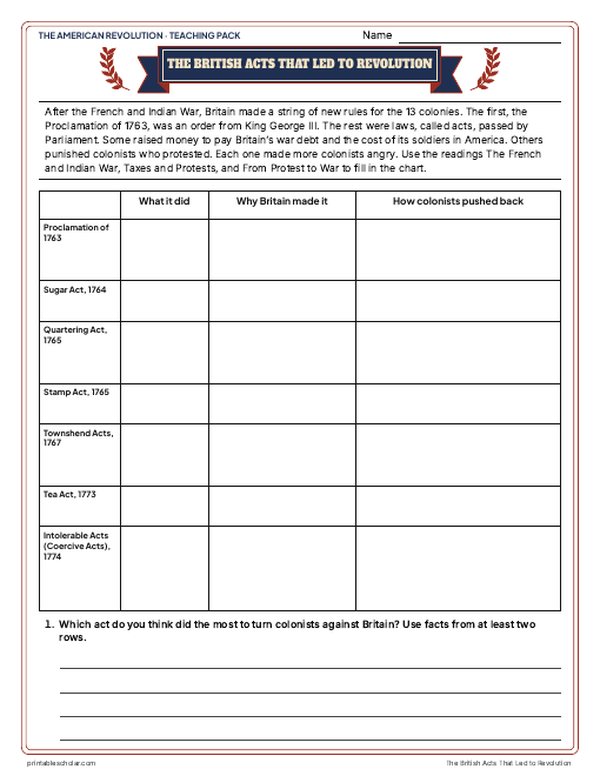
The British acts chart, filled in and blank
PDFs sized for US Letter paper, in color and black and white.
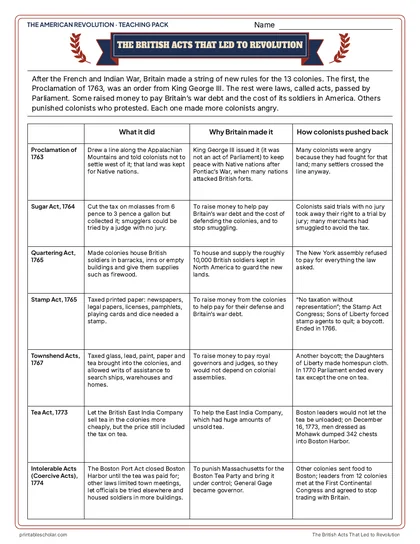
The British Acts That Led to Revolution (filled in)
Seven rules from the Proclamation of 1763 to the Intolerable Acts: what each did, why Britain made it and how colonists pushed back.
Download PDF Black and white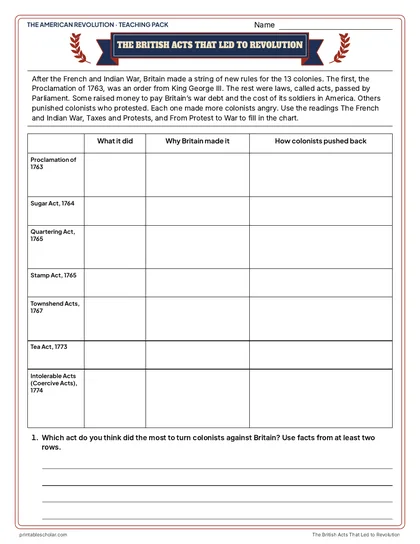
The British Acts chart (blank)
The same chart with empty boxes for students to fill in, and one question.
Download PDF Black and white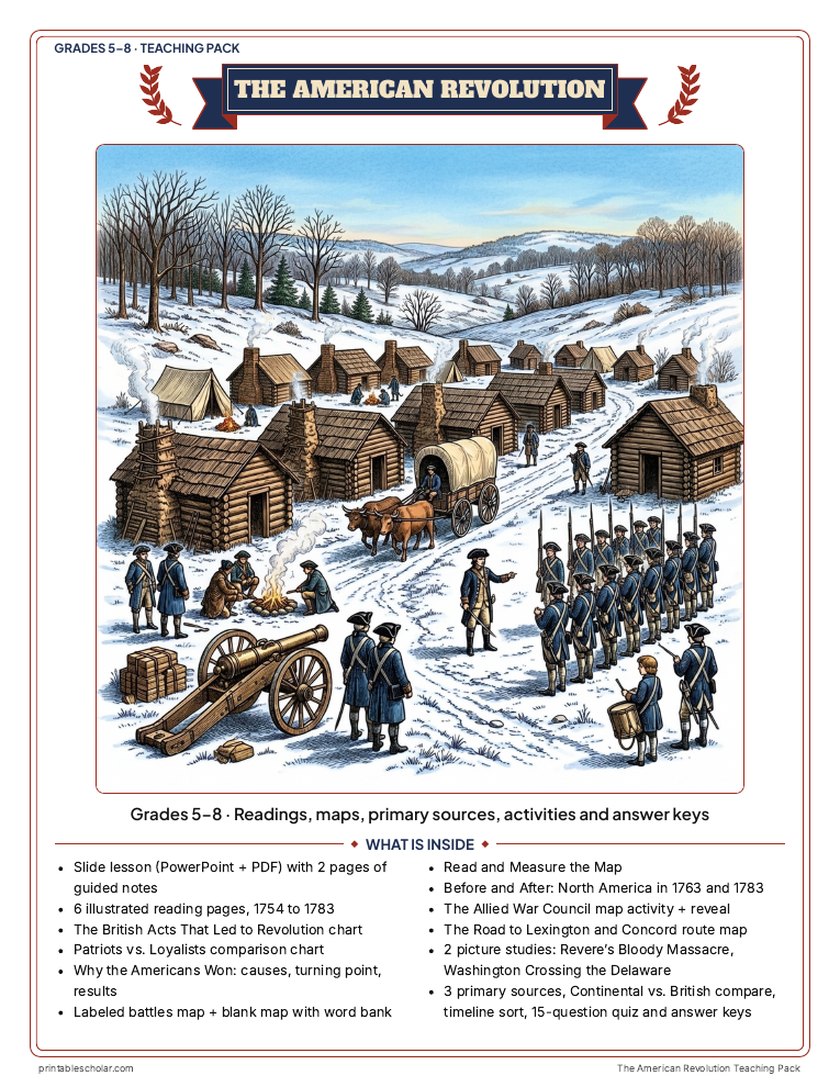
Teaching pack · Grades 5–8
Teaching the American Revolution? The whole unit, ready to teach.
Two weeks of lessons in one download: slides to present, notes for students to fill in, and printable pages that use these maps and pictures.
- 41 lesson slides (PowerPoint you can edit, teacher notes on every slide) and 2 pages of guided notes
- 6 illustrated reading pages, 1754 to 1783, a British Acts chart, a Patriots vs. Loyalists chart and a Why the Americans Won sheet
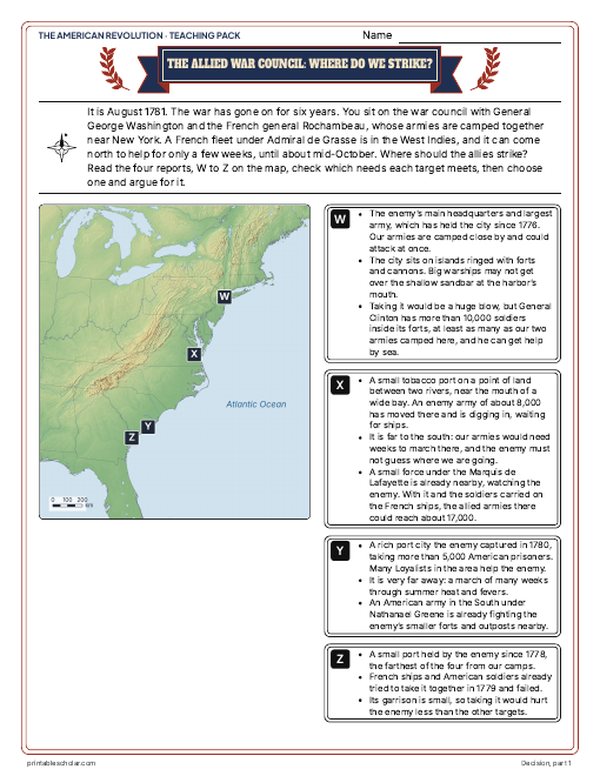
- Maps: labeled, blank, Read and Measure the Map, North America in 1763 and 1783, the Road to Lexington and Concord, and a 1781 war council decision with the reveal
- Primary sources: the Declaration of Independence, Common Sense beside a Loyalist reply, and Abigail Adams's "Remember the Ladies", each with plain English beside it; picture studies of Revere's 1770 engraving and Leutze's 1851 painting
- Continental Army vs. British Army, a timeline sort, a 15-question quiz, a teacher guide with a two-week plan, and answer keys for everything
Every answer is in the pack. The readings, slides, maps and pictures teach everything the sheets and quiz ask, so no textbook is needed.
Get the American Revolution pack for $7One-time purchase. Instant download. Color and ink-saving black-and-white editions. Secure checkout by Stripe.
The acts, one by one
Proclamation of 1763
What it did: Drew a line along the Appalachian Mountains and told colonists not to settle west of it; that land was kept for Native nations. Why Britain made it: King George III issued it (it was not an act of Parliament) to keep peace with Native nations after Pontiac’s War, when many nations attacked British forts. How colonists pushed back: Many colonists were angry because they had fought for that land; many settlers crossed the line anyway.
Sugar Act, 1764
What it did: Cut the tax on molasses from 6 pence to 3 pence a gallon but collected it; smugglers could be tried by a judge with no jury. Why Britain made it: To raise money to help pay Britain’s war debt and the cost of defending the colonies, and to stop smuggling. How colonists pushed back: Colonists said trials with no jury took away their right to a trial by jury; many merchants had smuggled to avoid the tax.
Quartering Act, 1765
What it did: Made colonies house British soldiers in barracks, inns or empty buildings and give them supplies such as firewood. Why Britain made it: To house and supply the roughly 10,000 British soldiers kept in North America to guard the new lands. How colonists pushed back: The New York assembly refused to pay for everything the law asked.
Stamp Act, 1765
What it did: Taxed printed paper: newspapers, legal papers, licenses, pamphlets, playing cards and dice needed a stamp. Why Britain made it: To raise money from the colonies to help pay for their defense and Britain’s war debt. How colonists pushed back: "No taxation without representation"; the Stamp Act Congress; Sons of Liberty forced stamp agents to quit; a boycott. Ended in 1766.
Townshend Acts, 1767
What it did: Taxed glass, lead, paint, paper and tea brought into the colonies, and allowed writs of assistance to search ships, warehouses and homes. Why Britain made it: To raise money to pay royal governors and judges, so they would not depend on colonial assemblies. How colonists pushed back: Another boycott; the Daughters of Liberty made homespun cloth. In 1770 Parliament ended every tax except the one on tea.
Tea Act, 1773
What it did: Let the British East India Company sell tea in the colonies more cheaply, but the price still included the tax on tea. Why Britain made it: To help the East India Company, which had huge amounts of unsold tea. How colonists pushed back: Boston leaders would not let the tea be unloaded; on December 16, 1773, men dressed as Mohawk dumped 342 chests into Boston Harbor.
Intolerable Acts (Coercive Acts), 1774
What it did: The Boston Port Act closed Boston Harbor until the tea was paid for; other laws limited town meetings, let officials be tried elsewhere and housed soldiers in more buildings. Why Britain made it: To punish Massachusetts for the Boston Tea Party and bring it under control; General Gage became governor. How colonists pushed back: Other colonies sent food to Boston; leaders from 12 colonies met at the First Continental Congress and agreed to stop trading with Britain.
Frequently asked questions
What were the main causes of the American Revolution?
Britain’s new taxes and laws after the French and Indian War (the Sugar Act, Stamp Act, Townshend Acts, Tea Act and Intolerable Acts), passed by a Parliament in which the colonists had no members, and the colonists’ belief that only their own elected assemblies could tax them.
What does "no taxation without representation" mean?
Colonists said Parliament had no right to tax them because they did not elect any of its members. Only their own colonial assemblies, which they elected, should tax them.
Was the Proclamation of 1763 a law passed by Parliament?
No. It was an order from King George III. It told colonists not to settle west of the Appalachian Mountains, to keep peace with Native nations after Pontiac’s War.
Which act led straight to the war?
The Intolerable Acts of 1774 closed Boston Harbor and limited town meetings in Massachusetts. Twelve colonies met at the First Continental Congress, and in April 1775 the fighting began at Lexington and Concord.