 Printable Scholar
The Treaty of Versailles: A Primary Source Worksheet
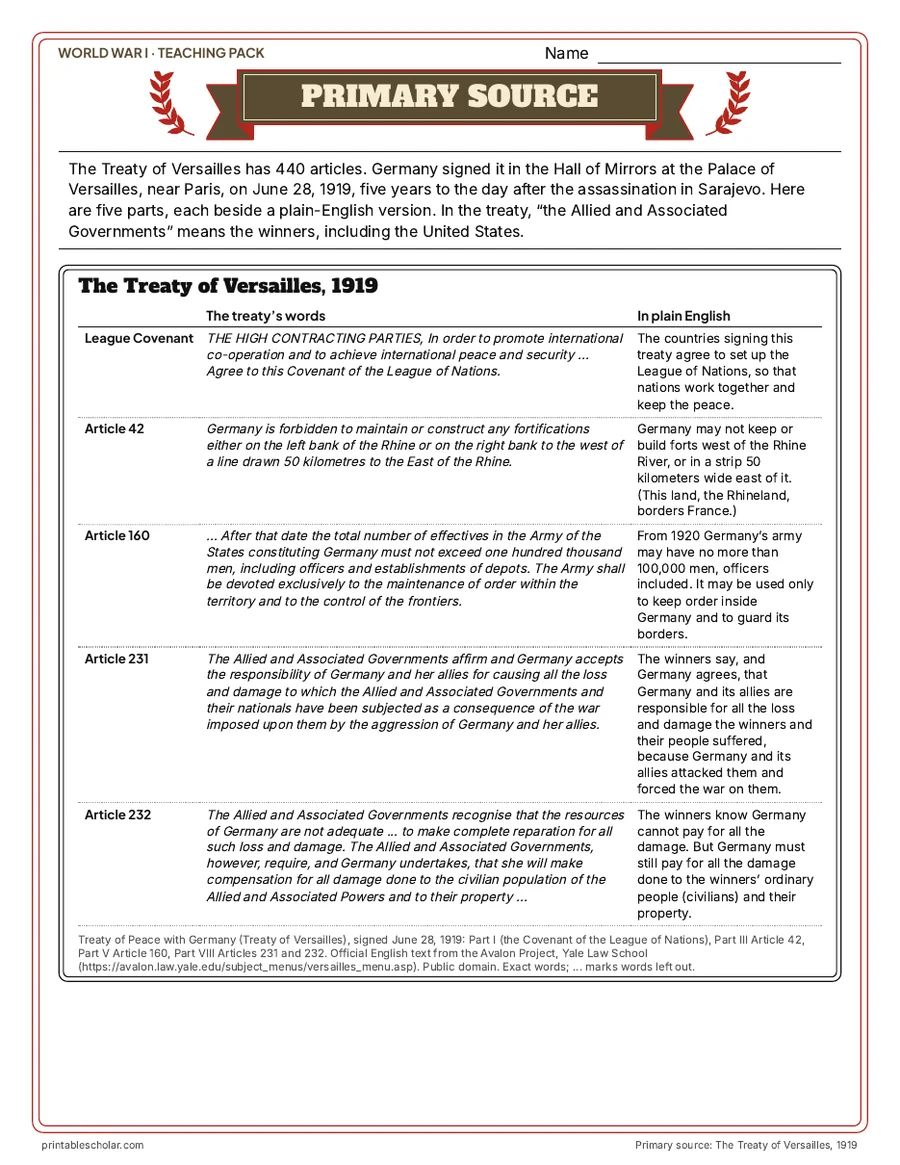
Germany signed the Treaty of Versailles in the Hall of Mirrors near Paris on June 28, 1919, five years to the day after the shots in Sarajevo. The treaty has 440 articles. These free pages print five of them in the treaty’s own words beside plain English: the League of Nations, the Rhineland, the limit on Germany’s army, the war guilt clause and reparations, with document questions. Versailles dealt only with Germany; other treaties from 1919 to 1923 made the new borders for the rest of Europe, shown here on two maps.
Free to print
The Versailles worksheet and the two maps
PDFs sized for US Letter paper, in color and black and white.
The Treaty of Versailles, 1919: the articles
Five parts of the treaty in its own words beside plain English.
Download PDF Black and white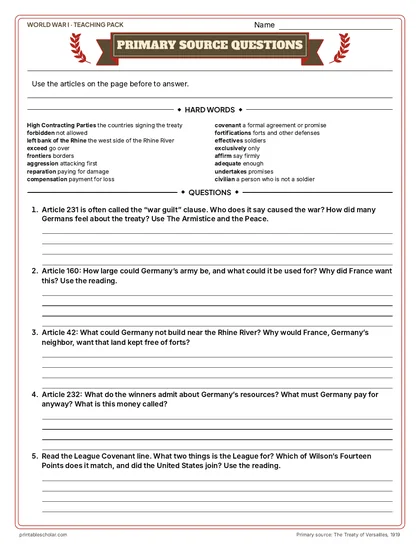
The Treaty of Versailles: questions
Hard words explained and five document questions.
Download PDF Black and white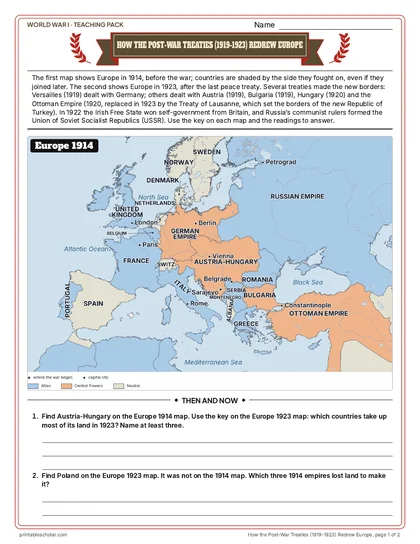
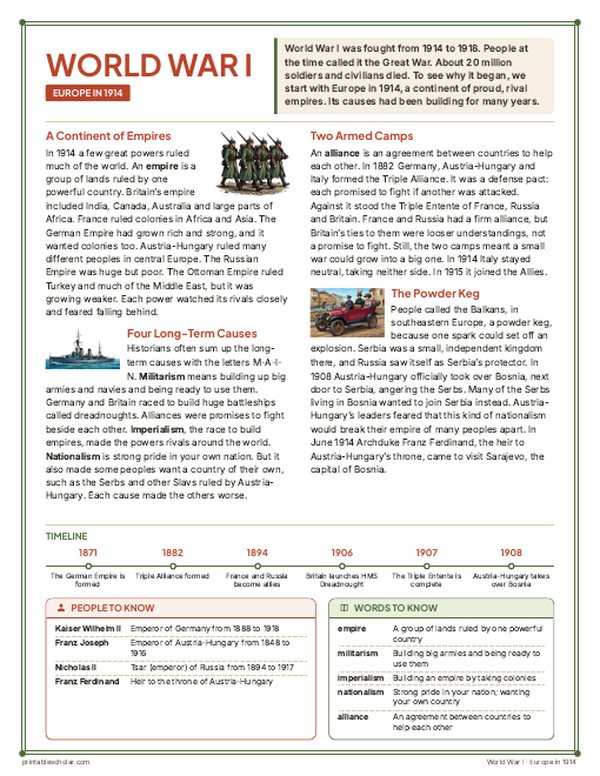
How the Post-War Treaties (1919-1923) Redrew Europe: Europe 1914
Europe in 1914, coloured by side, with two Then and Now questions.
Download PDF Black and white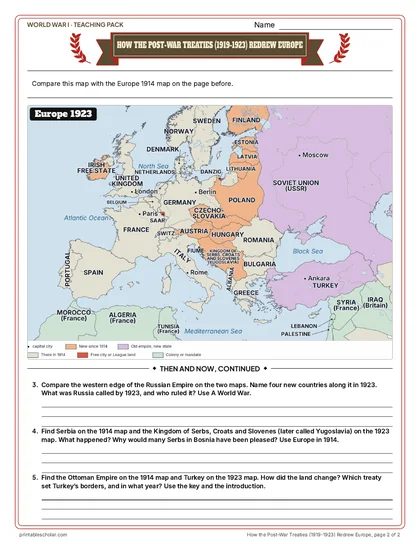
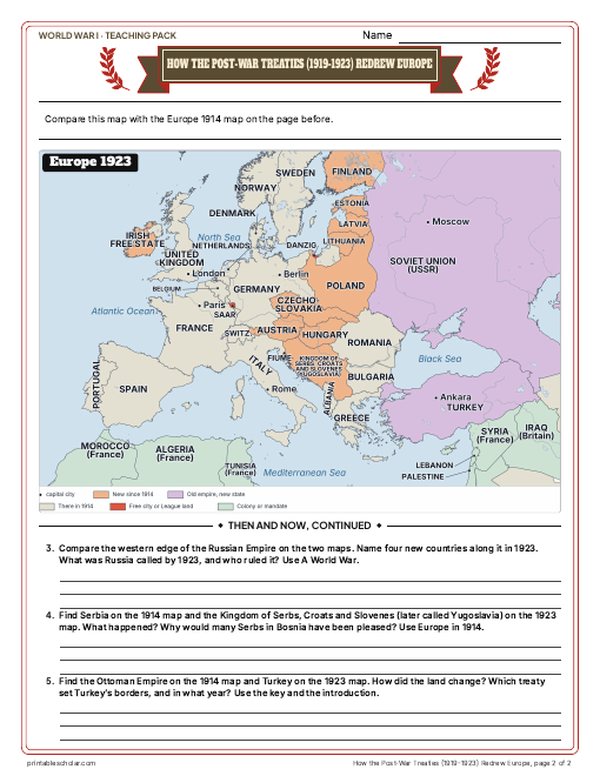
How the Post-War Treaties (1919-1923) Redrew Europe: Europe 1923
Europe in 1923 with the new countries, and three more questions.
Download PDF Black and white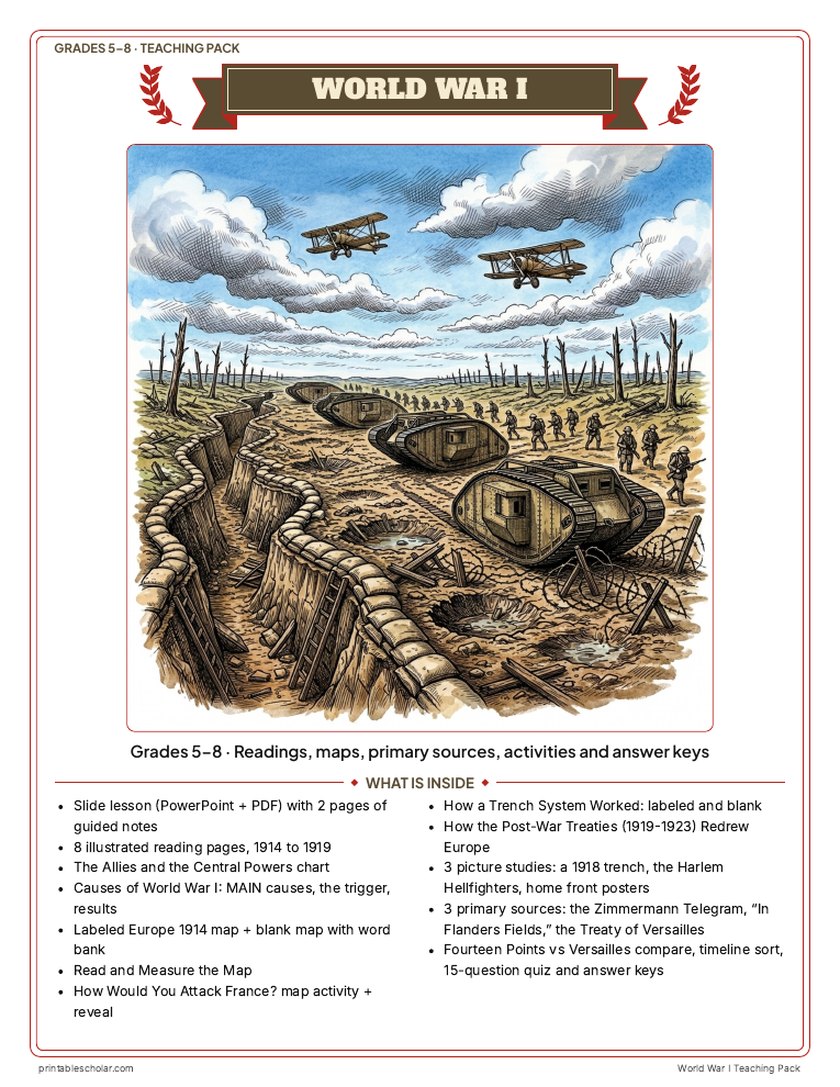
Teaching pack · Grades 5–8
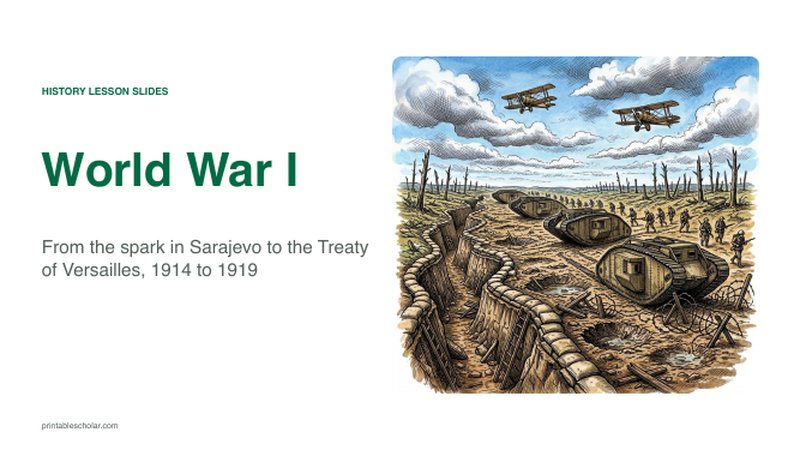
Teaching World War I? The whole unit, ready to teach.
Two weeks of lessons in one download: slides to present, notes for students to fill in, and printable pages that use these maps and pictures.
Every slide comes with teacher notes: what to say, what to ask, and sample answers.
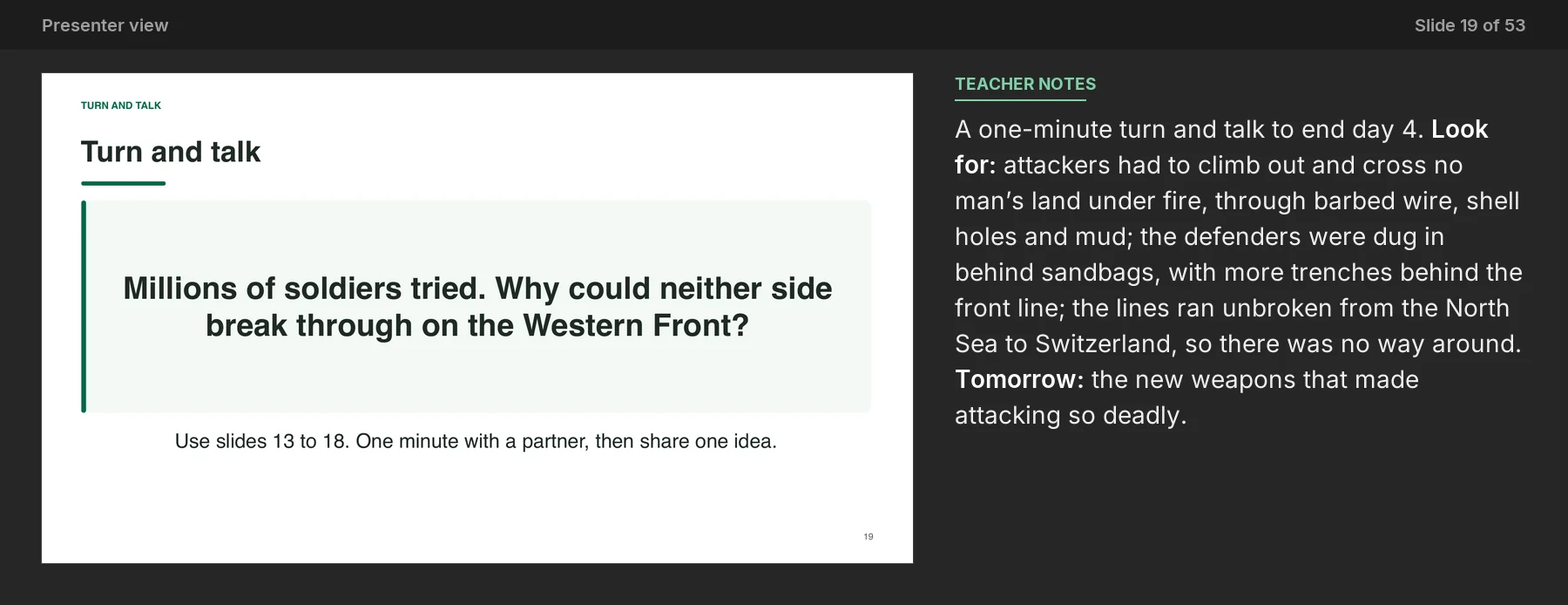
- 53 lesson slides (PowerPoint you can edit) and 2 pages of guided notes
- 8 illustrated reading pages with real photographs, from Europe in 1914 to the Treaty of Versailles, including America's home front and the Harlem Hellfighters
- Maps: labeled and blank Europe 1914, Read and Measure the Map, Europe 1914 and 1923 (how the post-war treaties redrew Europe), and a "How would you attack France?" decision with the reveal
- Primary sources and picture studies: the Zimmermann Telegram, "In Flanders Fields" and Treaty of Versailles articles with plain English beside them, a 1918 trench photo, the Harlem Hellfighters, four home front posters, and a labeled trench system
- The Allies and the Central Powers chart, causes of World War I, the Fourteen Points vs. the treaty, a timeline sort, a 15-question quiz, a teacher guide with a two-week plan, and answer keys for everything
Every answer is in the pack. The readings, slides, maps and pictures teach everything the sheets and quiz ask, so no textbook is needed.
Get the World War I pack for $7Teaching more than one? Get both world war packs (World War I and World War II) for $12, with a bonus chart comparing the two wars: about four weeks of lessons.
Get both packs for $12See both packsOr get every history pack (26) in one download:Get all 26 for $49
One-time purchase. Instant download. Color and ink-saving black-and-white editions. Secure checkout by Stripe.
The 10-day plan
10 lessons, each planned for one class period of about 45 to 50 minutes, straight from the teacher guide. Some days are fuller than others; the note below shows how to even them out.
- Day 1Europe in 1914 and the two armed camps
- Day 2How would you attack France?
- Day 3The spark in Sarajevo and what really happened
- Day 4Life in the trenches and the trench system
- Day 5A new kind of war and "In Flanders Fields"
- Day 6A world war, from Gallipoli to Russia's exit
- Day 7America enters and the Zimmermann Telegram
- Day 8Americans at home and over there, posters
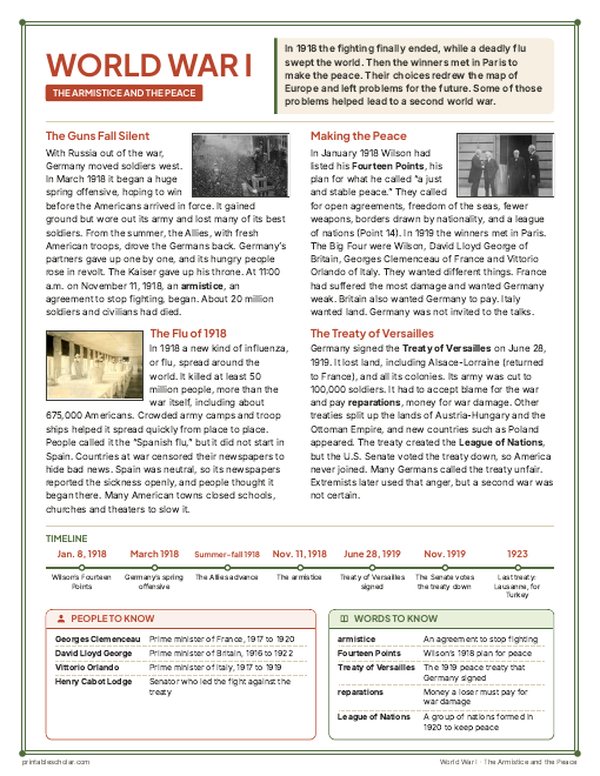
- Day 9The armistice, the treaty and the new map
- Day 10Fourteen Points vs. the treaty, sort and quiz
Fitting it to your schedule: Days 6 and 9 are the fullest: day 6 holds the Armenian genocide sentence, so leave time for questions, and day 9 has the treaty and both maps. Day 2 is one activity on purpose: it must come before Reading 2, which gives the answer away. With 8 periods, give Read and Measure the Map and the causes sheet as homework, and fold the day 10 compare sheet into day 9's treaty work, keeping the quiz on its own day; every cut part is still taught by a reading and its slides.
See the full day-by-day plan
- Day 1
- Core: Reading 1, Europe in 1914. Labeled Europe 1914 map. Start The Allies and the Central Powers chart (members). Optional: MAIN cause cards (see the ideas). Slides 3-6.
- Day 2
- Core: How Would You Attack France? Students read the three route reports, fill the needs chart and argue for a route. Keep What Really Happened for Day 3: Reading 2, Read the Map question 2 and the Schlieffen Plan cause card give the answer away. Optional: Label the Map (blank map with word bank). Slide 7.
- Day 3
- Core: Reading 2, The Spark. What Really Happened; students compare it with their Day 2 choice. Causes of World War I sheet. Optional: falling dominoes (see the ideas); Read and Measure the Map (Berlin to Paris, Berlin to Petrograd), after the reveal. Slides 8-12.
- Day 4
- Core: Reading 3, Life in the Trenches. How a Trench System Worked (labeled), then Label the Trench System. Optional: picture study Americans in the Trenches; trench model. Slides 13-19.
- Day 5
- Core: Reading 4, A New Kind of War. Primary source: "In Flanders Fields." Add strengths to the chart. Optional: Myth vs Fact on artillery (slides). Slides 20-26.
- Day 6
- Core: Reading 5, A World War. Read the Gallipoli section slowly and plainly, including the sentence on the Armenian genocide, with time for questions. Finish the members, strengths and key wins rows of the chart. Optional: Read the Map questions 4 and 5. Slides 27-32.
- Day 7
- Core: Reading 6, America Enters. Primary source: The Zimmermann Telegram. Optional: Weird but True on dazzle ships (slides). Slides 33-38.
- Day 8
- Core: Reading 7, Americans at Home and Over There. Picture study: Posters on the Home Front. Optional: picture study The Harlem Hellfighters Come Home; poster gallery walk. Slides 39-45.
- Day 9
- Core: Reading 8, The Armistice and the Peace. Primary source: The Treaty of Versailles, 1919. How the Post-War Treaties (1919-1923) Redrew Europe. Optional: treaty table (see the ideas). Slides 46-50.
- Day 10
- Core: The Fourteen Points and the Treaty of Versailles compare sheet. Timeline sort. 15-question quiz. Use the answer keys to check every sheet. Optional: riddle (slides). Slides 51-53.
What the treaty said
The League of Nations
Part I set up the League of Nations, a group of countries meant to keep the peace. The United States Senate voted against the treaty, so the U.S. never joined.
The Rhineland and the army
Article 42 forbade Germany to build forts in the Rhineland, its land along the Rhine River. Article 160 limited Germany’s army to 100,000 men.
Blame and payment
Article 231, often called the war guilt clause, made Germany accept responsibility for the losses and damage of the war. Article 232 made it pay reparations for the damage done to the Allies’ civilians.
A new map
Other treaties from 1919 to 1923 split up the lands of Austria-Hungary and the Ottoman Empire. New countries appeared: Poland, Czechoslovakia, Austria, Hungary, the Kingdom of Serbs, Croats and Slovenes (Yugoslavia), Finland, Estonia, Latvia and Lithuania.
Frequently asked questions
When was the Treaty of Versailles signed?
On June 28, 1919, in the Hall of Mirrors at the Palace of Versailles, near Paris.
What did the Treaty of Versailles do to Germany?
Germany gave up land, including Alsace-Lorraine to France, kept an army of only 100,000 men, could not build forts in the Rhineland, accepted responsibility for the war’s losses (Article 231) and had to pay reparations.
Did the Treaty of Versailles cause World War II?
Not by itself. It left grievances in Germany that later extremists used, but many other events came between 1919 and 1939.