 Printable Scholar
The Trans-Saharan Trade: Salt for Gold
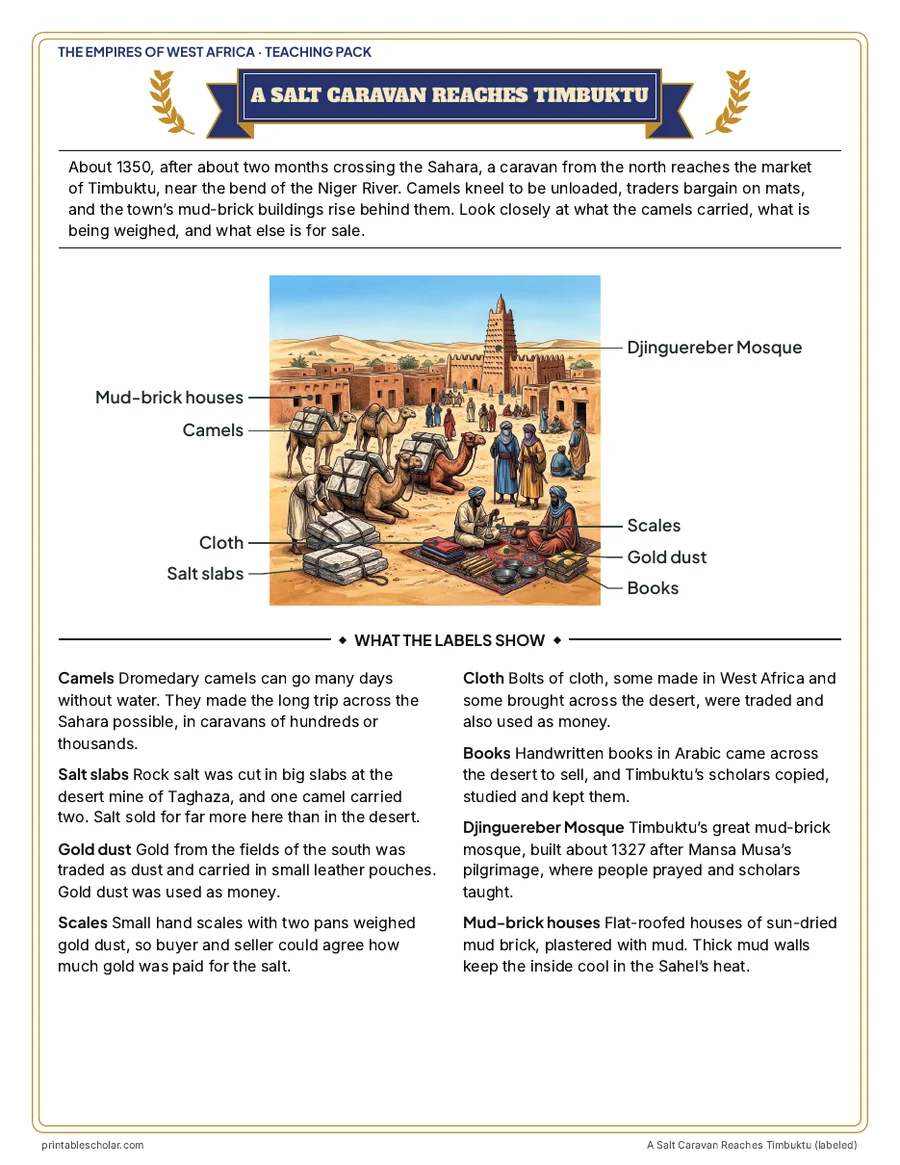
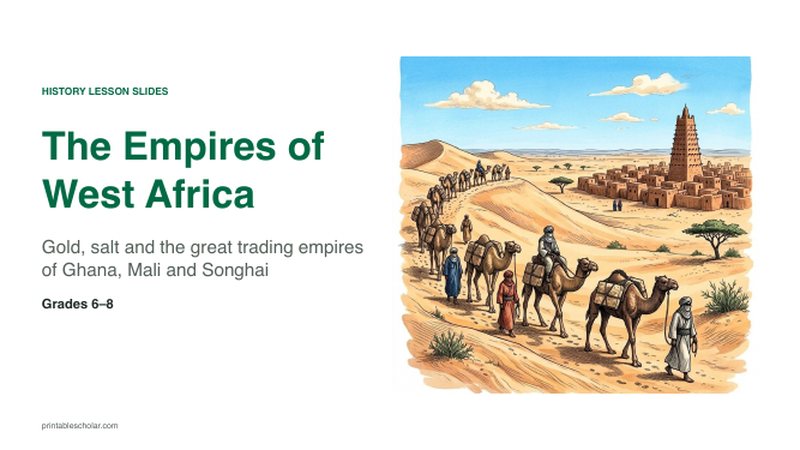
For hundreds of years, camel caravans crossed the Sahara Desert between North Africa and West Africa. West Africa had gold, dug in the Bambuk and Bure gold fields, but little salt. The Sahara had salt, cut in big slabs at mines such as Taghaza, but no gold. So salt went south and gold went north, along with cloth, copper, horses, books and enslaved people. The empires of Ghana, Mali and Songhai grew rich by taxing the goods that passed through their trading towns. This free labeled picture shows a salt caravan reaching the market at Timbuktu about 1350.
Free to print
Labeled and blank salt caravan picture
PDFs sized for US Letter paper, in color and black and white.
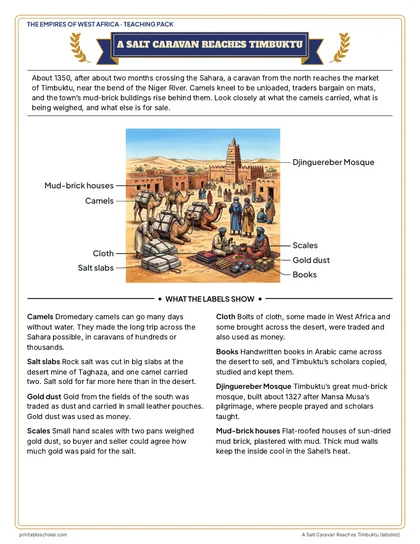
A Salt Caravan Reaches Timbuktu, labeled
A picture of Timbuktu’s market about 1350 with eight things labeled and what each one was.
Download PDF Black and white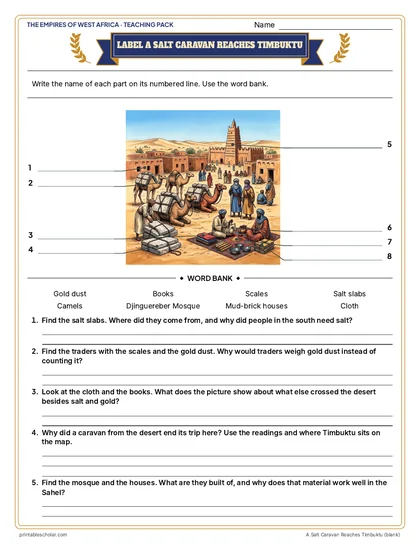
Label the Salt Caravan
The same picture with numbered blank labels, a word bank and questions.
Download PDF Black and white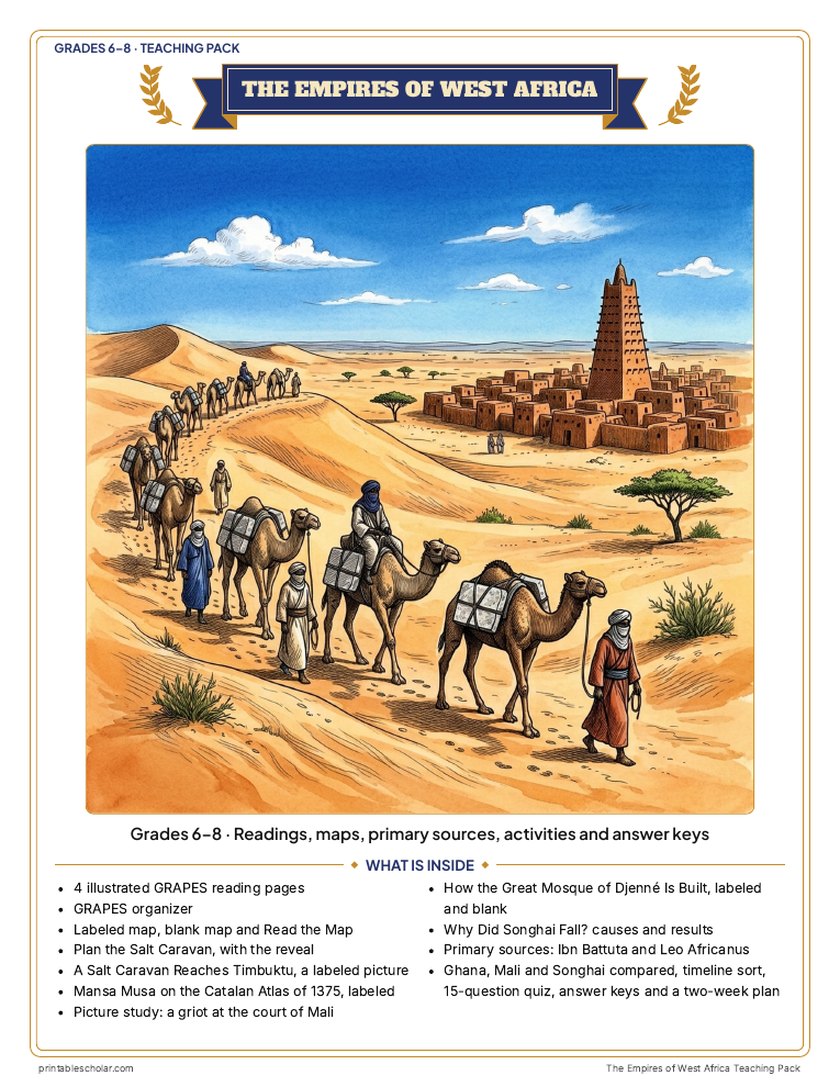
Teaching pack · Grades 6–8
Teaching the Empires of West Africa? The whole unit, ready to teach.
Two weeks of lessons in one download: slides to present, notes for students to fill in, and printable pages that use these maps and pictures.
- 41 lesson slides (PowerPoint you can edit, teacher notes on every slide) and 2 pages of guided notes
- 4 illustrated reading pages and a GRAPES organizer
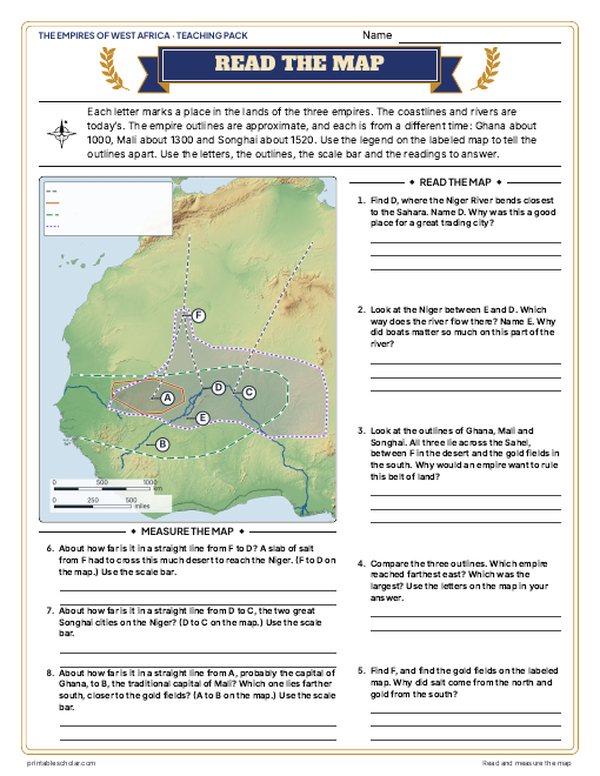
- Maps: labeled, blank, Read and Measure the Map, and "Plan the Salt Caravan": choose a route across the Sahara on a real relief map, then the reveal
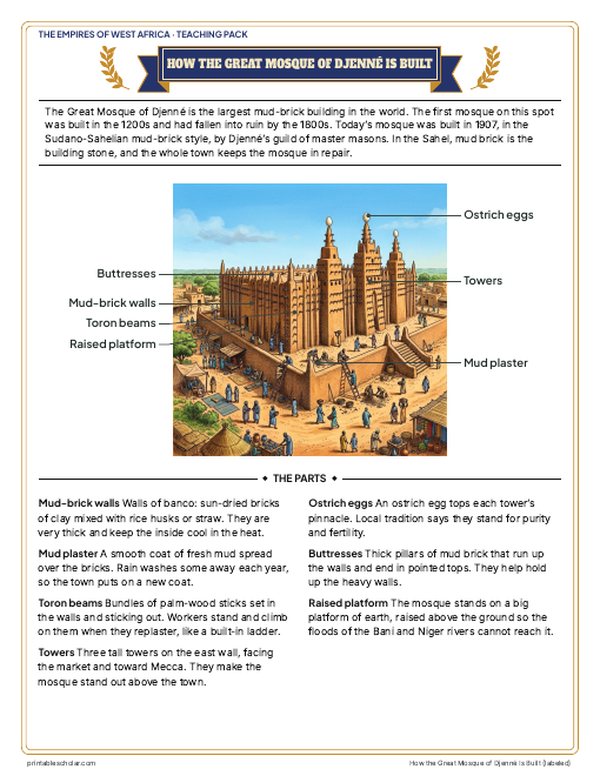
- Activities: a labeled salt caravan at Timbuktu, Mansa Musa on the real Catalan Atlas of 1375, a griot at the court of Mali, how the Great Mosque of Djenné is built (labeled and blank), why Songhai fell, Ibn Battuta and Leo Africanus, Ghana, Mali and Songhai compared, and a timeline sort
- A 15-question quiz, a teacher guide with a two-week plan, and answer keys for everything
Every answer is in the pack. The readings, slides, maps and pictures teach everything the sheets and quiz ask, so no textbook is needed.
Get the Empires of West Africa pack for $7Teaching more than one? Get all four medieval world packs (West Africa, the Silk Road, the Byzantines and the Ottomans) for $19, with a bonus chart comparing all four: about eight weeks of lessons.
Get all 4 packs for $19See all four packsOne-time purchase. Instant download. Color and ink-saving black-and-white editions. Secure checkout by Stripe.
How the trade worked
Salt from the north
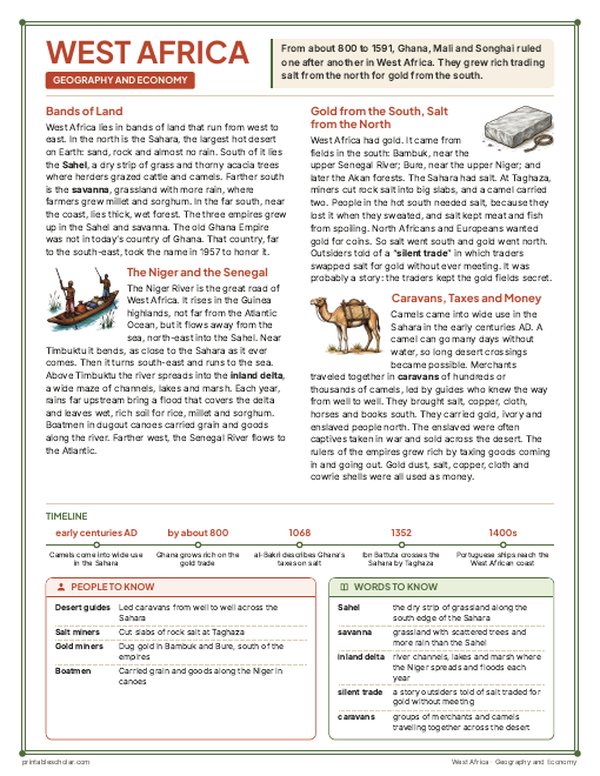
Miners at Taghaza, in the middle of the Sahara, cut rock salt into big slabs; a camel carried two. People in the hot south needed salt because they lost it when they sweated, and to keep meat and fish from spoiling.
Gold from the south
Gold came from fields near the upper Senegal and Niger rivers. Traders kept the gold fields secret, and outsiders told a story of a “silent trade” in which nobody ever met. It was probably a story.
Camels and guides
Camels can go many days without water. Caravans of hundreds or thousands of camels crossed the desert from well to well, led by guides who knew the way. The trip from Sijilmasa to Walata took about two months.
Taxes made empires
The rulers of Ghana, Mali and Songhai taxed the goods coming in and going out of their towns. Gold dust, salt, copper, cloth and cowrie shells were all used as money.
Frequently asked questions
What was traded on the trans-Saharan trade routes?
Mostly gold from West Africa and salt from the Sahara, plus cloth, copper, horses and books going south, and ivory and enslaved people sent north.
Why was salt so valuable in West Africa?
People need salt to stay healthy, they lose it by sweating in the heat, and it kept food from spoiling. West Africa had little of it, so it came from desert mines like Taghaza.
Why did the trans-Saharan trade decline?
From the 1400s Portuguese ships traded along the West African coast, and over time more gold went to the sea. After Morocco defeated Songhai in 1591, the desert trade shrank.