 Printable Scholar
Mansa Musa: The King of Mali on a Map of 1375
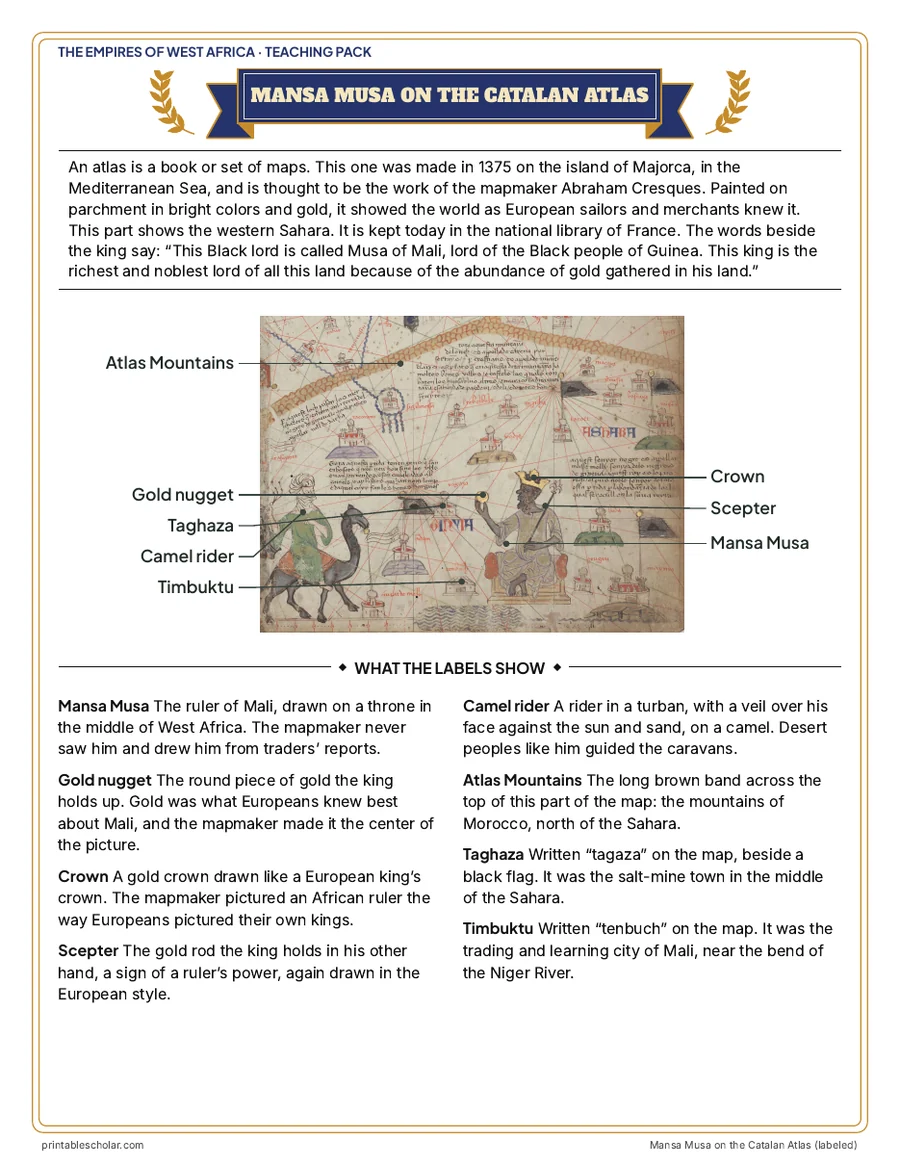
Mansa Musa ruled the Mali Empire of West Africa from about 1312 to 1337. On his pilgrimage to Mecca in 1324-25 he passed through Cairo with so much gold, spent and given away, that people talked about it for generations; the Arab writer al-Umari reported that the price of gold in Cairo was still low about twelve years later. Fifty years after the journey, a mapmaker on the island of Majorca drew him on the Catalan Atlas: a king on a throne, holding up a piece of gold, beside the trading towns of the Sahara. These free pages label that real 1375 picture and ask what it shows about Mali, and about how Europeans saw it.
Free to print
Labeled and blank Catalan Atlas page
PDFs sized for US Letter paper, in color and black and white.
Mansa Musa on the Catalan Atlas, labeled
The real 1375 picture with eight things labeled and what each one shows, plus the words beside the king in Catalan and English.
Download PDF Black and white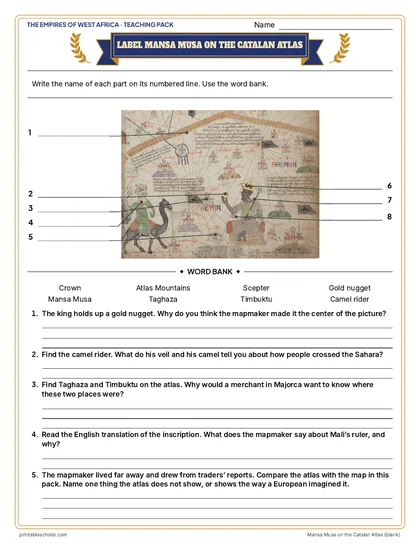
Label the Catalan Atlas
The same picture with numbered blank labels, a word bank and questions.
Download PDF Black and white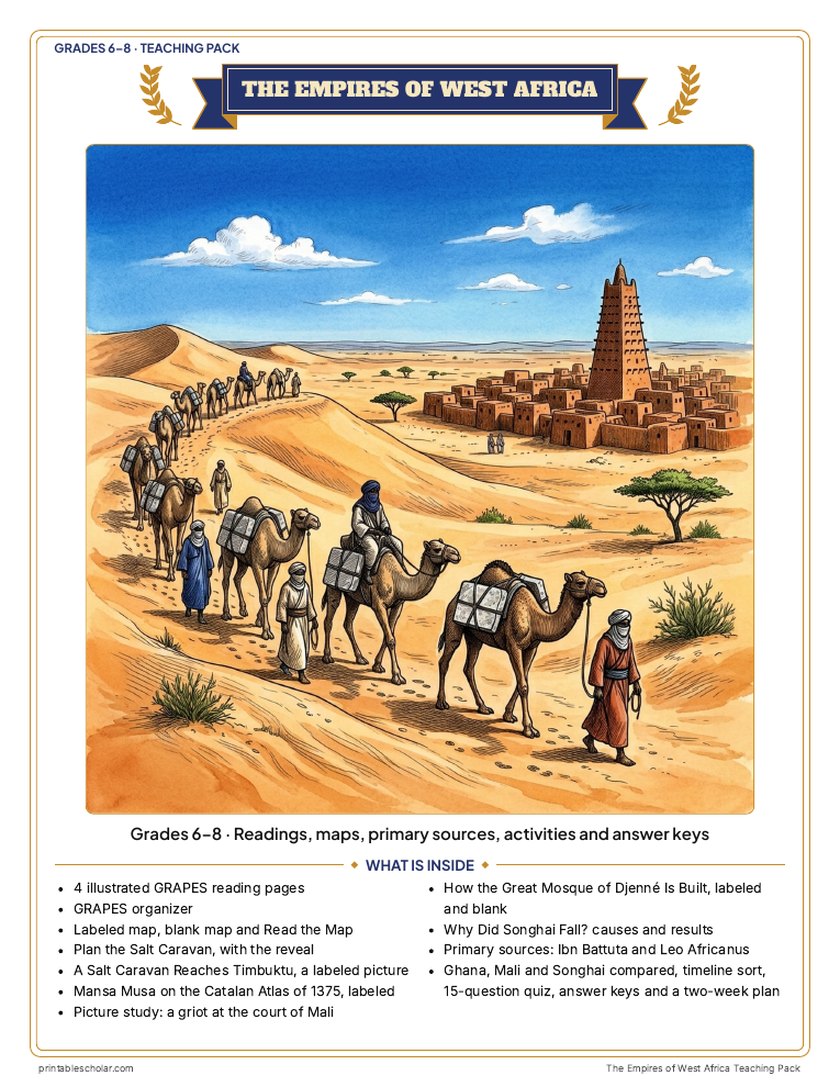
Teaching pack · Grades 6–8
Teaching the Empires of West Africa? The whole unit, ready to teach.
Two weeks of lessons in one download: slides to present, notes for students to fill in, and printable pages that use these maps and pictures.
- 41 lesson slides (PowerPoint you can edit, teacher notes on every slide) and 2 pages of guided notes
- 4 illustrated reading pages and a GRAPES organizer
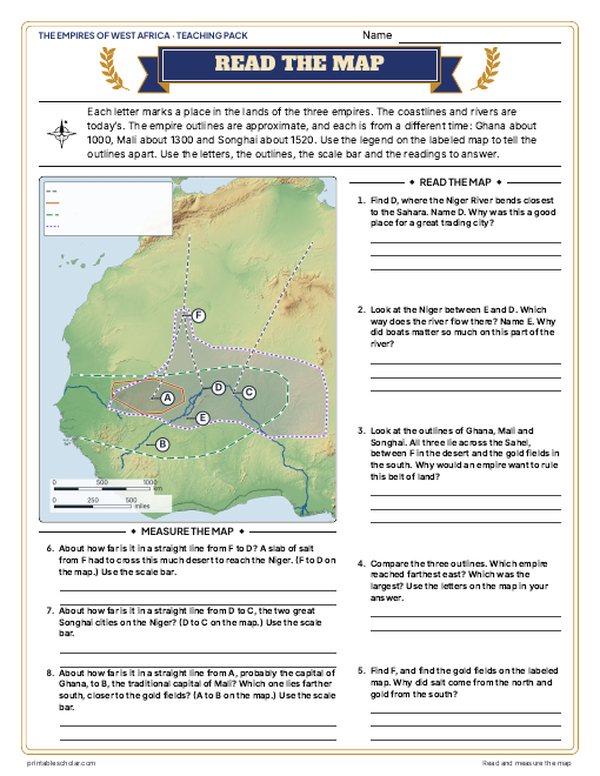
- Maps: labeled, blank, Read and Measure the Map, and "Plan the Salt Caravan": choose a route across the Sahara on a real relief map, then the reveal
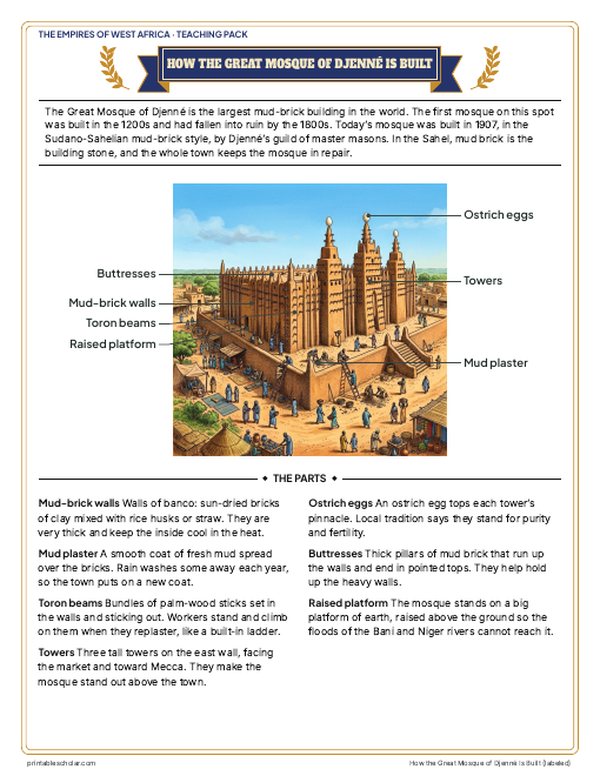
- Activities: a labeled salt caravan at Timbuktu, Mansa Musa on the real Catalan Atlas of 1375, a griot at the court of Mali, how the Great Mosque of Djenné is built (labeled and blank), why Songhai fell, Ibn Battuta and Leo Africanus, Ghana, Mali and Songhai compared, and a timeline sort
- A 15-question quiz, a teacher guide with a two-week plan, and answer keys for everything
Every answer is in the pack. The readings, slides, maps and pictures teach everything the sheets and quiz ask, so no textbook is needed.
Get the Empires of West Africa pack for $7Teaching more than one? Get all four medieval world packs (West Africa, the Silk Road, the Byzantines and the Ottomans) for $19, with a bonus chart comparing all four: about eight weeks of lessons.
Get all 4 packs for $19See all four packsOne-time purchase. Instant download. Color and ink-saving black-and-white editions. Secure checkout by Stripe.
Who Mansa Musa was
The ruler of Mali
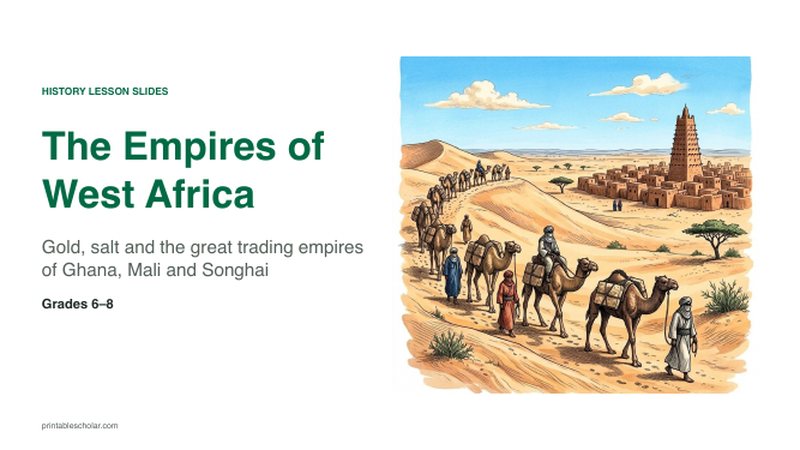
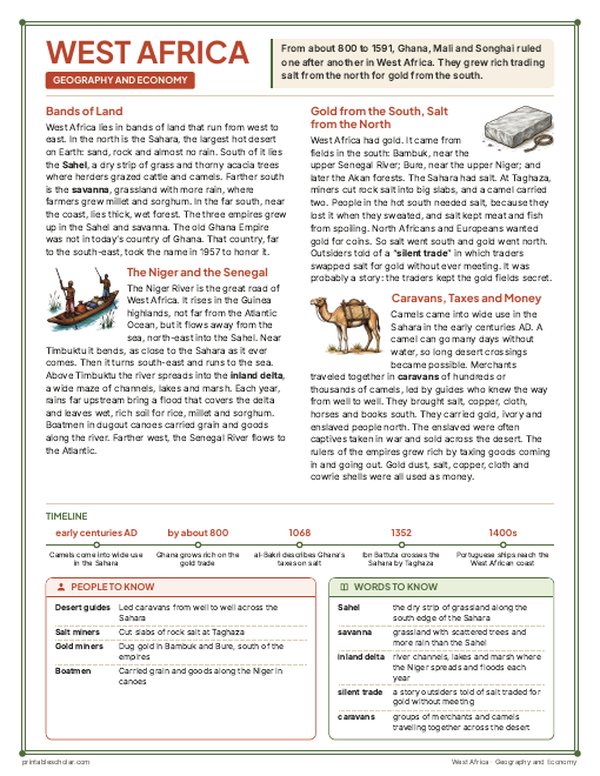
Mali was the second of the three great empires of West Africa, between Ghana and Songhai. At its height it reached from near the Atlantic coast east along the Niger River, and it held the gold fields of Bambuk and Bure.
The pilgrimage of 1324
As a Muslim, Mansa Musa made the journey to Mecca. His huge caravan carried gold, and he gave so much away in Cairo that Mali became famous across North Africa and Europe.
Scholars and builders
He brought scholars and builders home. Tradition says the poet as-Sahili, from Granada in Muslim Spain, designed the Djinguereber Mosque in Timbuktu, about 1327.
The Catalan Atlas
A set of maps made in 1375 on Majorca, thought to be the work of Abraham Cresques. Beside the king it says he is the richest and noblest lord of the land because of the gold gathered in his country. It is kept in the national library of France.
Frequently asked questions
Who was Mansa Musa?
The ruler (mansa) of the Mali Empire in West Africa from about 1312 to 1337, famous for his pilgrimage to Mecca in 1324-25 and the gold he carried and gave away.
Why is Mansa Musa on the Catalan Atlas?
News of his wealth reached Europe through North African traders after his pilgrimage. The mapmaker drew him holding gold to show that Mali was the source of the gold that crossed the Sahara.
Was Mansa Musa the richest person ever?
No one can measure his wealth in modern money, so that claim is a guess. What the sources show is that he controlled Mali’s gold trade and gave away enough gold in Cairo that its price there fell.