 Printable Scholar
The Three Branches of Government and Checks and Balances
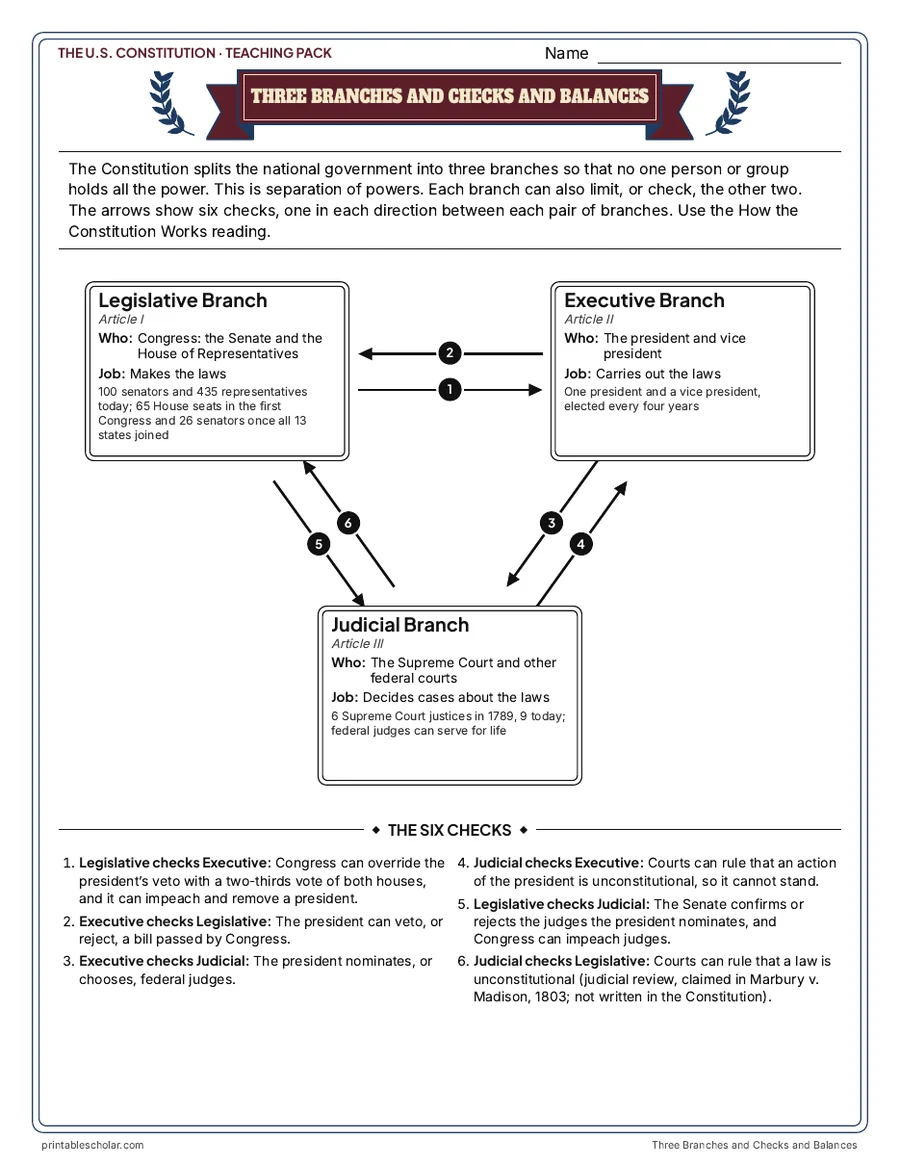
The Constitution, written in 1787, splits the national government into three branches so that no one person or group holds all the power. This is called separation of powers. Congress, the legislative branch, makes the laws. The president, the executive branch, carries out the laws. The Supreme Court and the other federal courts, the judicial branch, decide cases about the laws. Each branch can also limit, or check, the other two: the president can veto a bill, Congress can override a veto, the Senate confirms judges, and courts can rule that a law is unconstitutional. The chart below shows all six checks.
Free to print
The three branches chart, filled in and for practice
PDFs sized for US Letter paper, in color and black and white.
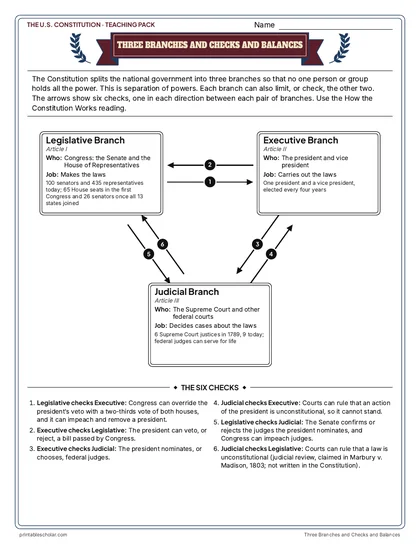
Three Branches and Checks and Balances (filled in)
Who is in each branch, its job and its Article of the Constitution, with the six checks numbered on the arrows and explained underneath.
Download PDF Black and white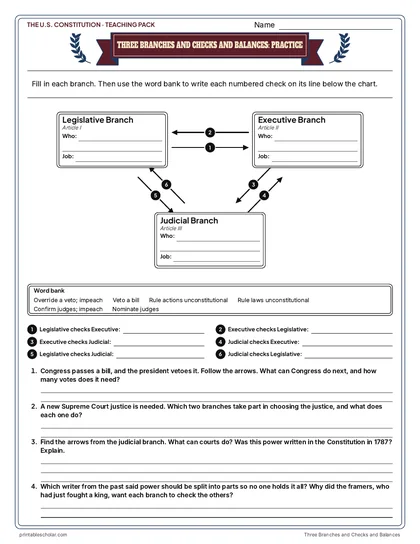
Three Branches practice (blank)
The same chart with lines to fill in each branch, a word bank of the six checks, and four questions.
Download PDF Black and white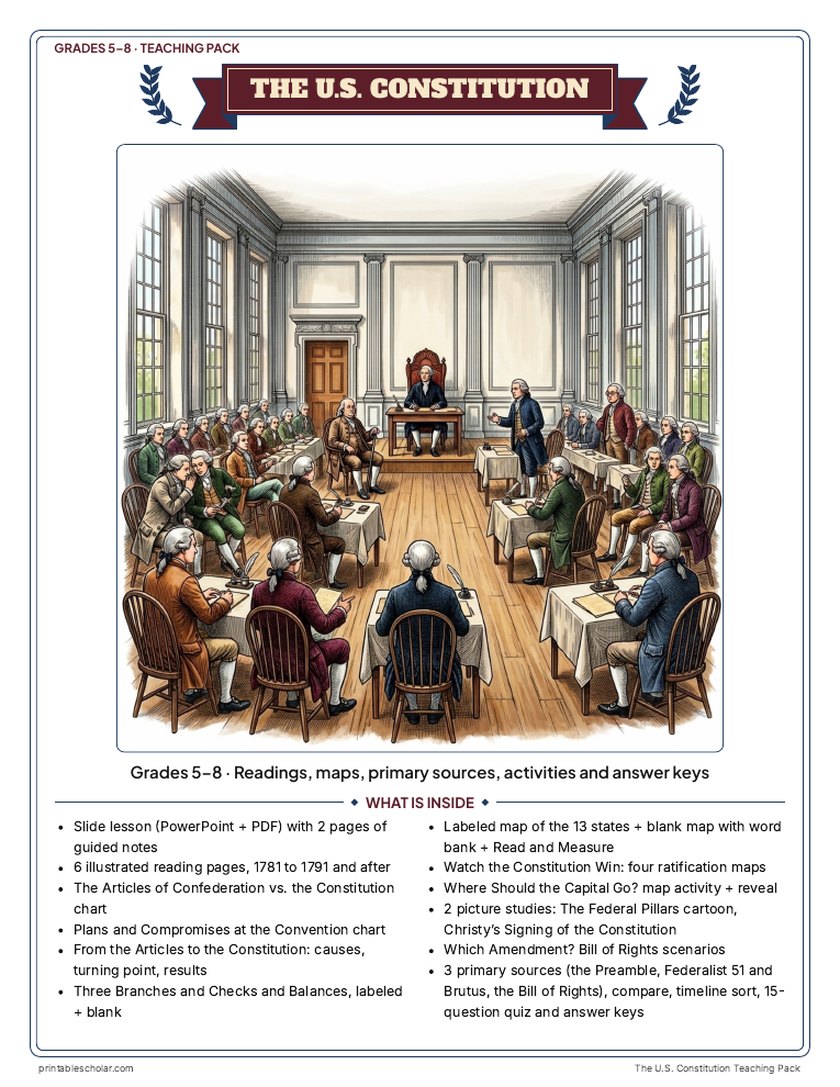
Teaching pack · Grades 5–8
Teaching the U.S. Constitution? The whole unit, ready to teach.
Two weeks of lessons in one download: slides to present, notes for students to fill in, and printable pages that use these maps and pictures.
- 38 lesson slides (PowerPoint you can edit, teacher notes on every slide) and 2 pages of guided notes
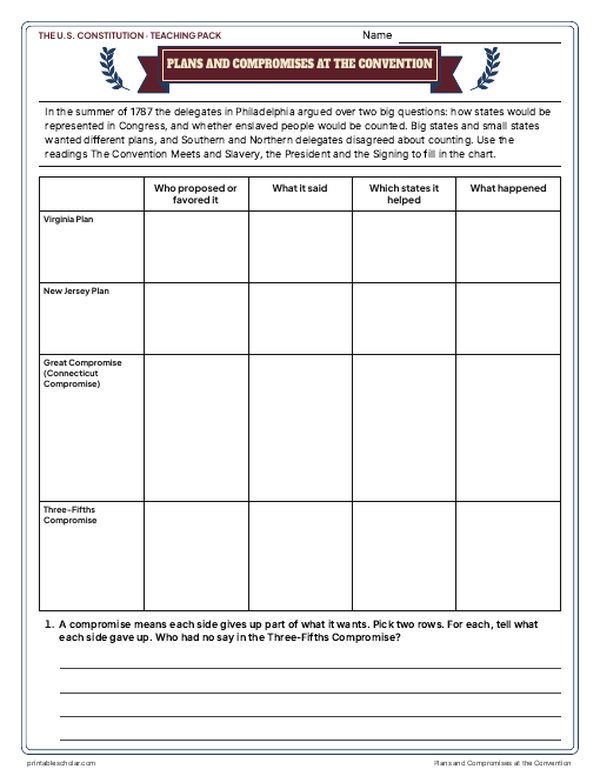
- 6 illustrated reading pages, 1781 to 1791, an Articles vs. Constitution chart, a Plans and Compromises chart and a causes sheet
- Three Branches and Checks and Balances (study page + practice), Which Amendment? Bill of Rights scenarios
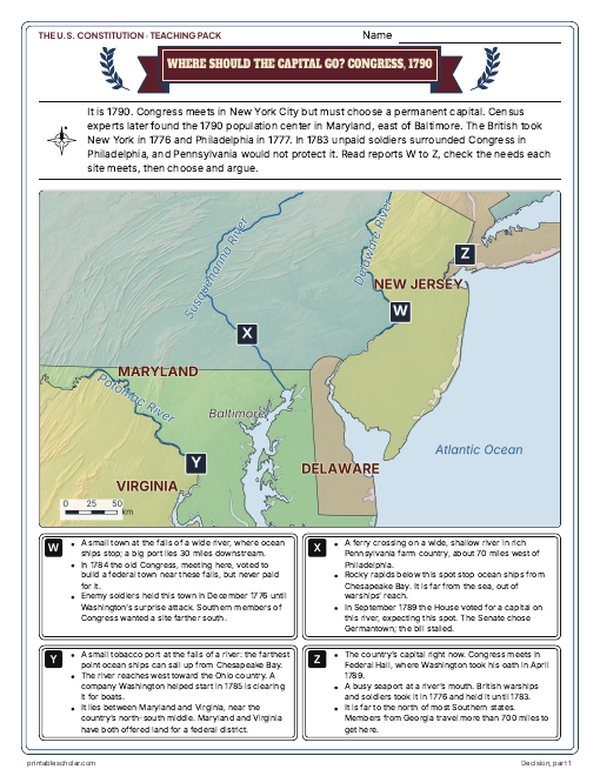
- Maps: the 13 states in 1790, labeled and blank, Read and Measure the Map, four ratification maps, and Where Should the Capital Go? with the reveal
- Primary sources: the Preamble, Federalist No. 51 beside Brutus No. 1, and the Bill of Rights, each with plain English beside it; picture studies of the 1788 Federal Pillars cartoon and Christy's Signing painting
- Federalists vs. Anti-Federalists, a timeline sort, a 15-question quiz, a teacher guide with a two-week plan, and answer keys for everything
Every answer is in the pack. The readings, slides, maps and pictures teach everything the sheets and quiz ask, so no textbook is needed.
Get the U.S. Constitution pack for $7Teaching more than one? Get all five US history packs (the 13 Colonies, the American Revolution, the Constitution, Westward Expansion and the Civil War) for $24: about ten weeks of lessons.
Get all 5 packs for $24One-time purchase. Instant download. Color and ink-saving black-and-white editions. Secure checkout by Stripe.
The branches and the checks, one by one
Legislative Branch
Article I. Who: Congress: the Senate and the House of Representatives. Job: Makes the laws. 100 senators and 435 representatives today; 65 House seats in the first Congress and 26 senators once all 13 states joined.
Executive Branch
Article II. Who: The president and vice president. Job: Carries out the laws. One president and a vice president, elected every four years.
Judicial Branch
Article III. Who: The Supreme Court and other federal courts. Job: Decides cases about the laws. 6 Supreme Court justices in 1789, 9 today; federal judges can serve for life.
Legislative checks Executive
Congress can override the president’s veto with a two-thirds vote of both houses, and it can impeach and remove a president.
Executive checks Legislative
The president can veto, or reject, a bill passed by Congress.
Executive checks Judicial
The president nominates, or chooses, federal judges.
Judicial checks Executive
Courts can rule that an action of the president is unconstitutional, so it cannot stand.
Legislative checks Judicial
The Senate confirms or rejects the judges the president nominates, and Congress can impeach judges.
Judicial checks Legislative
Courts can rule that a law is unconstitutional (judicial review, claimed in Marbury v. Madison, 1803; not written in the Constitution).
Frequently asked questions
What are the three branches of government?
The legislative branch (Congress: the Senate and the House of Representatives) makes the laws. The executive branch (the president and vice president) carries out the laws. The judicial branch (the Supreme Court and other federal courts) decides cases about the laws.
What are checks and balances?
Ways each branch can limit the other two, so no branch gets too much power. The president can veto a bill; Congress can override a veto with a two-thirds vote of both houses; the president nominates judges and the Senate confirms or rejects them; courts can rule a law or an action unconstitutional.
Where did the idea of separation of powers come from?
The framers drew on the French writer Montesquieu, who argued that power should be split into parts so that no one holds it all. They had just fought a war against a king and feared any one person or group having too much power.
Is judicial review written in the Constitution?
Not in so many words. The Supreme Court claimed the power to rule a law unconstitutional in Marbury v. Madison in 1803.