 Printable Scholar
Quipu: How the Inca Kept Records with Knotted Cords
A quipu (also spelled khipu) is a set of knotted cords the Inca used to keep records. Experts called quipucamayoc tied and read them: counts of people, llamas, storehouse goods and the work each family owed the state. The Inca had no alphabet, but their quipus stored numbers in base 10, just like ours. Each pendant cord holds one number, the knots nearest the main cord are the biggest place, an empty space means zero, and a top cord can add up a group of cords. Scholars can read the numbers; whether quipus also recorded words is still being studied.
Free to print
How to read a quipu, with a try-it row
PDFs sized for US Letter paper, in color and black and white.
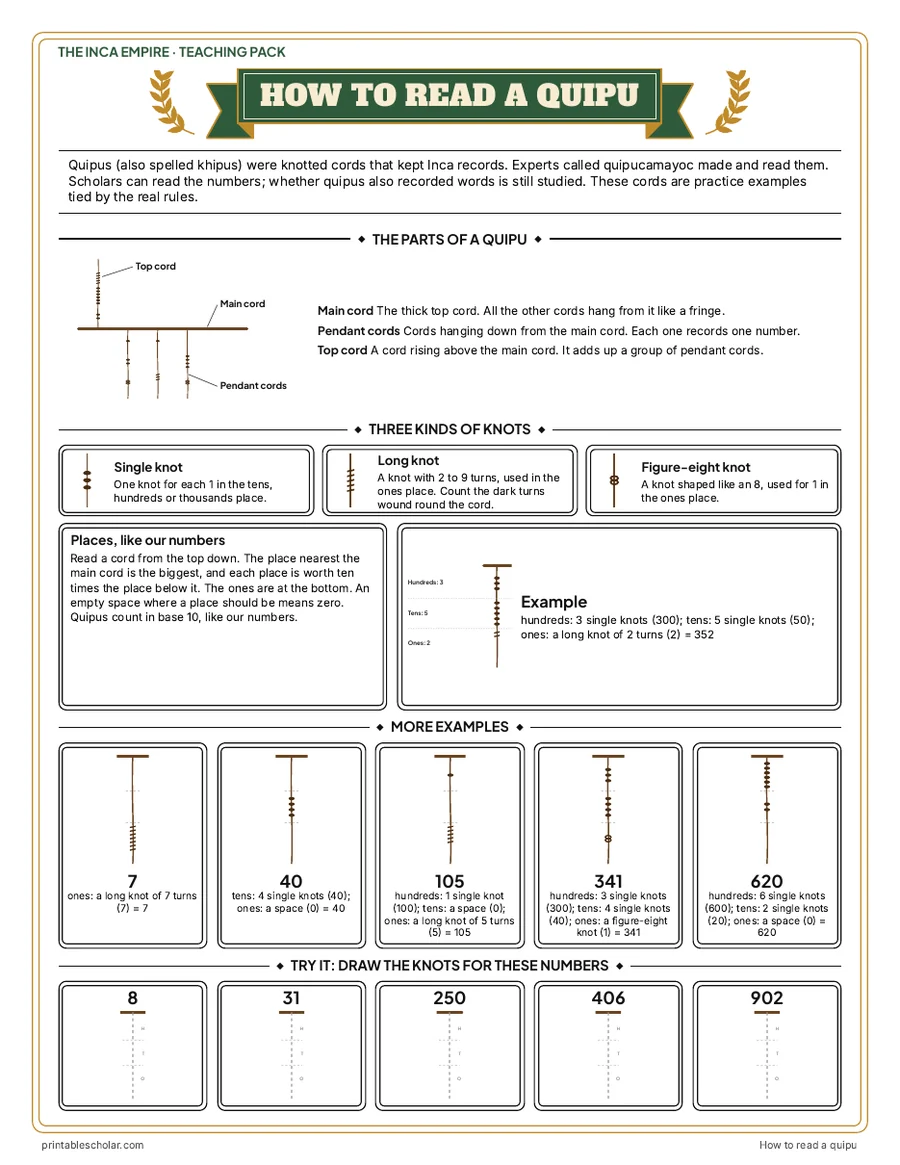
How to Read a Quipu
The parts of a quipu, the three kinds of knots, the place-value rule, worked examples and five numbers to tie yourself.
Download PDF Black and white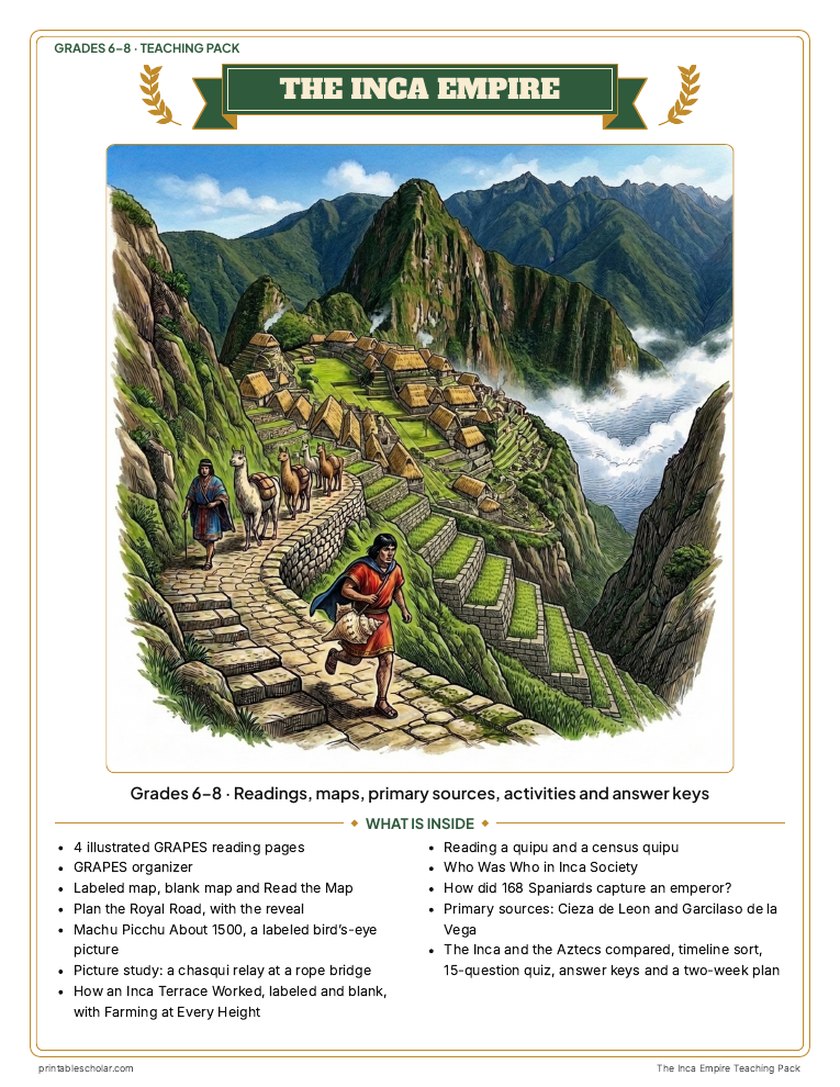
Teaching pack · Grades 6–8
Teaching the Inca Empire? The whole unit, ready to teach.
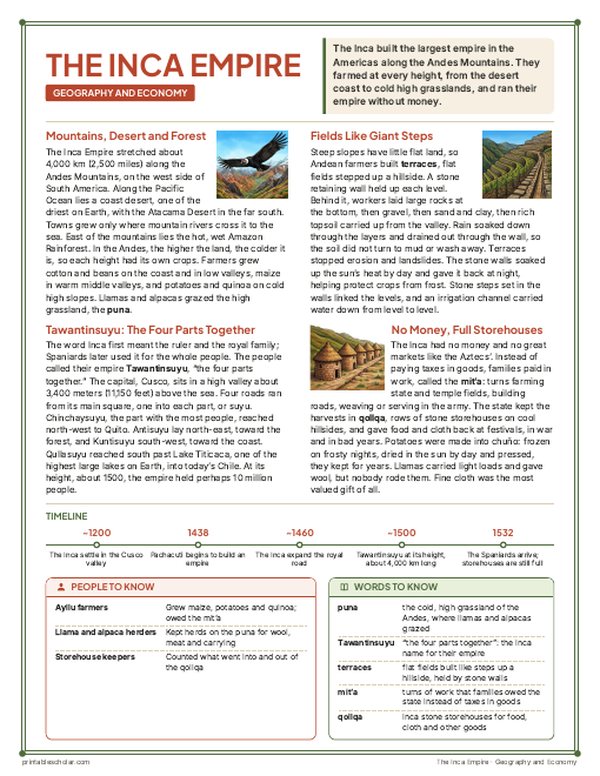
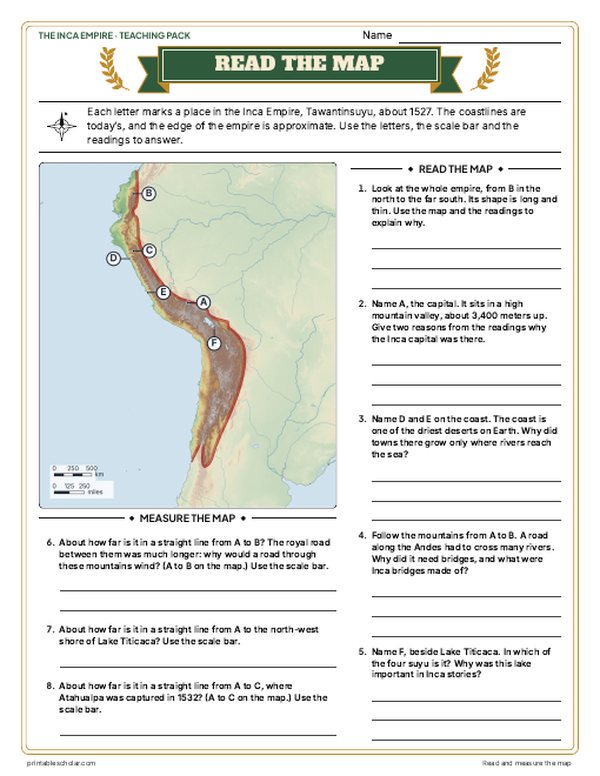
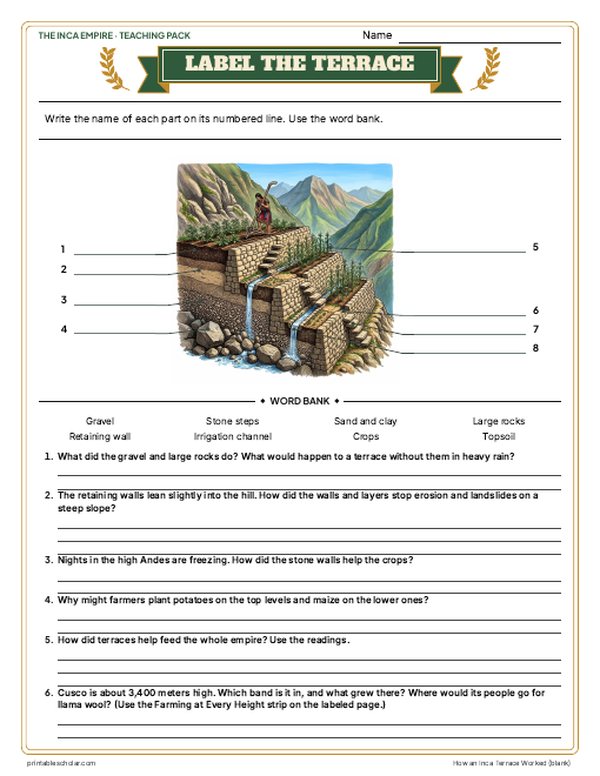
Two weeks of lessons in one download: slides to present, notes for students to fill in, and printable pages that use these maps and pictures.
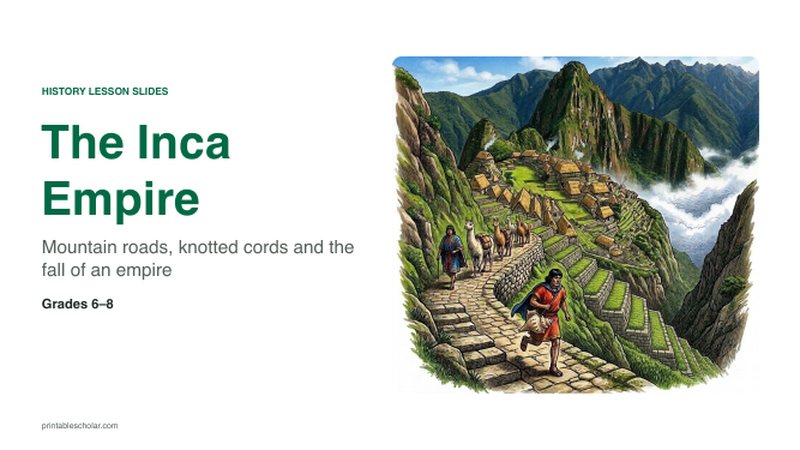
- 43 lesson slides (PowerPoint you can edit, teacher notes on every slide) and 2 pages of guided notes
- 4 illustrated reading pages and a GRAPES organizer
- Maps: labeled, blank, Read and Measure the Map, and "Plan the Royal Road": choose a route from Cusco to Quito on a real relief map, then the reveal
- Activities: a labeled bird's-eye picture of Machu Picchu, a chasqui relay picture study, how an Inca terrace worked (labeled and blank, with farming at every height), reading and tying quipu numbers and a census quipu, who was who, how 168 Spaniards captured an emperor, Cieza de Leon and Garcilaso de la Vega, the Inca and the Aztecs compared, and a timeline sort
- A 15-question quiz, a teacher guide with a two-week plan, and answer keys for everything
Every answer is in the pack. The readings, slides, maps and pictures teach everything the sheets and quiz ask, so no textbook is needed.
Get the Inca Empire pack for $7One-time purchase. Instant download. Color and ink-saving black-and-white editions. Secure checkout by Stripe.
How a quipu stores a number
The cords
A thick main cord holds a fringe of pendant cords. Each pendant cord records one number. A top cord rising above the main cord can hold the total of a group of pendant cords.
Places, like our numbers
Read a cord from the top down. The place nearest the main cord is the biggest, and each place is worth ten times the one below it. The ones are at the bottom. An empty space where a place should be means zero.
Three kinds of knots
Single knots stand for the tens, hundreds and thousands: count one for each knot. In the ones place a long knot with 2 to 9 turns gives the number of turns, and a figure-eight knot means 1.
Who read them
Quipucamayoc, the quipu keepers, made and read the cords for officials. After the Spanish conquest, Spanish officials and courts also used quipu records. In 1912 Leland Locke showed how the knots on Inca quipus in a New York museum stood for numbers.
Frequently asked questions
Did the Inca have writing?
The Inca had no alphabet. They kept records on quipus, knotted cords that stored numbers in base 10. Scholars are still studying whether some quipus also recorded words or stories.
How do you show zero on a quipu?
With an empty space: no knots in the place where a digit would go. So 205 is two knots in the hundreds, a gap in the tens and a long knot of five turns in the ones.
Who was a quipucamayoc?
A quipu keeper: an official trained to tie and read quipus for the census, the storehouses and the labor each community owed.