 Printable Scholar
Justinian’s Code: A Primary Source Worksheet
Justinian, emperor of the Byzantine Empire from 527 to 565, ordered a team of lawyers led by Tribonian to collect and clean up centuries of Roman law. They made the Code (529, revised 534), the Digest (533) and the Institutes (533), a short textbook for law students; later scholars called the whole set the Corpus Juris Civilis, the Body of Civil Law. These free pages print real passages of the Institutes, in J. B. Moyle’s public-domain English translation, beside plain English: what justice is, things that belong to everyone, a wild animal and who owns it, and a limit on masters.
Free to print
The primary source worksheet
PDFs sized for US Letter paper, in color and black and white.
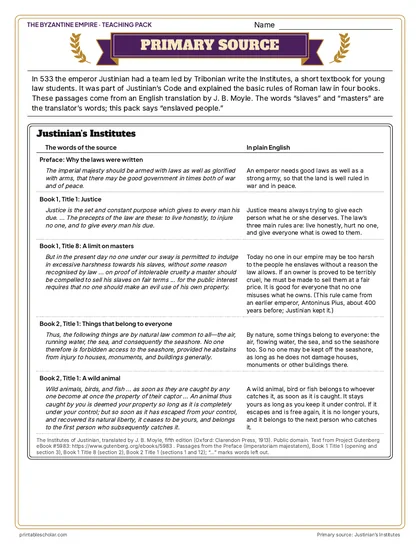
Justinian’s Institutes: the passages
Five passages in the translator’s words beside plain English.
Download PDF Black and white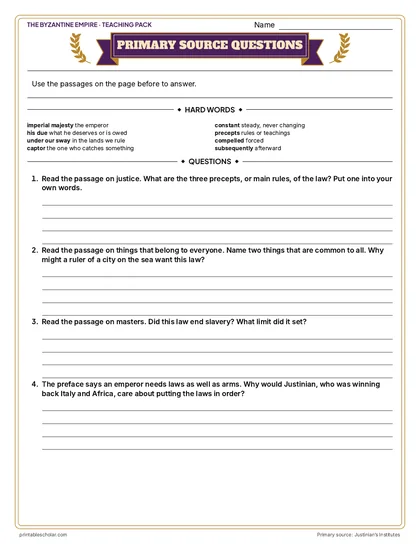
Justinian’s Institutes: questions
Hard words explained and document questions.
Download PDF Black and white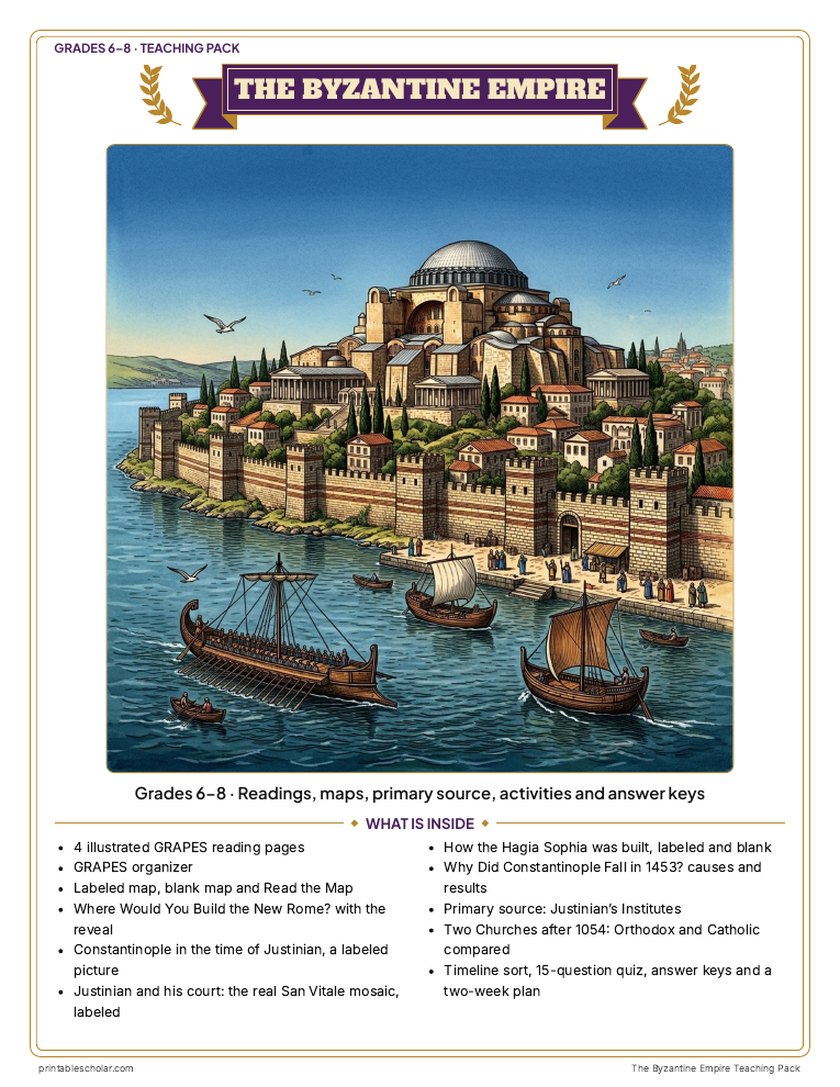
Teaching pack · Grades 6–8
Teaching the Byzantine Empire? The whole unit, ready to teach.
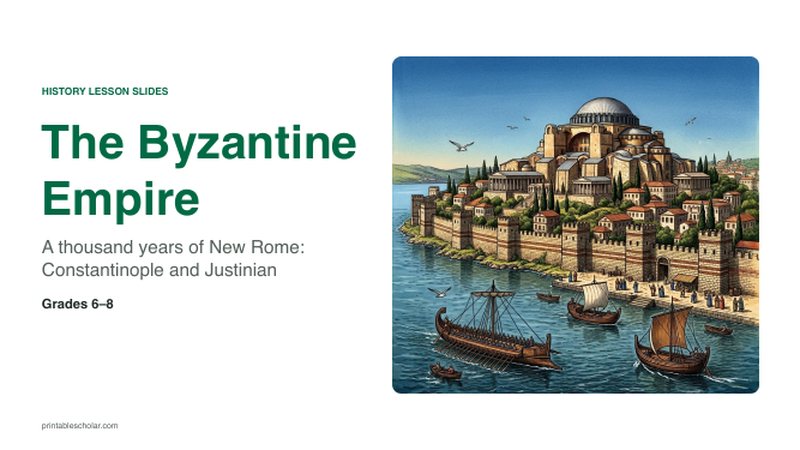
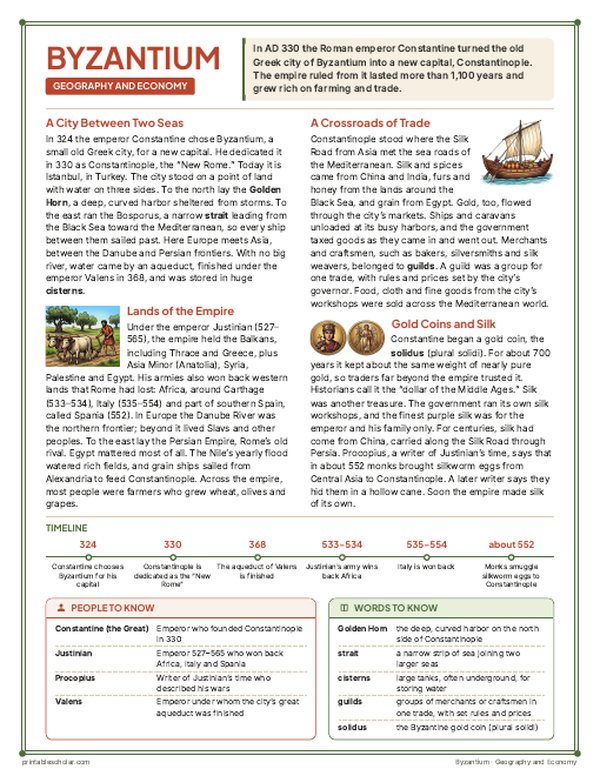
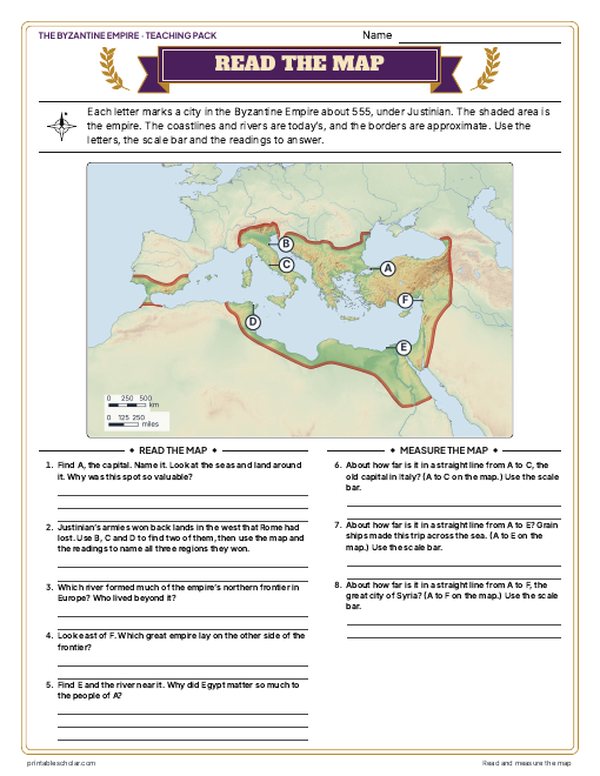
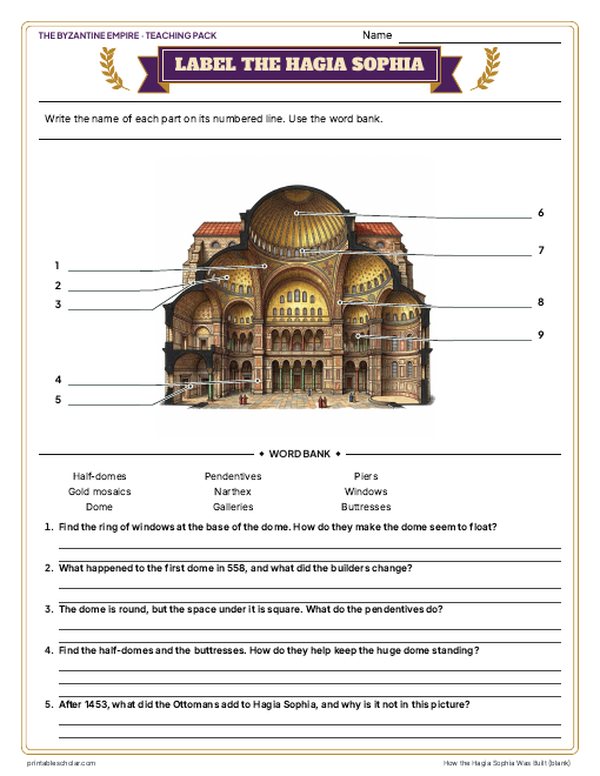
Two weeks of lessons in one download: slides to present, notes for students to fill in, and printable pages that use these maps and pictures.
- 41 lesson slides (PowerPoint you can edit, teacher notes on every slide) and 2 pages of guided notes
- 4 illustrated reading pages and a GRAPES organizer
- Maps: labeled, blank, Read and Measure the Map, and "Where Would You Build the New Rome?": choose a site for Constantine's capital on a real relief map of the straits, then the reveal
- Activities: a labeled view of Constantinople about 565, Justinian and his court on the real San Vitale mosaic, how the Hagia Sophia was built (labeled and blank), why Constantinople fell in 1453, Justinian's Institutes as a primary source, the Orthodox and Catholic churches after 1054 compared, and a timeline sort
- A 15-question quiz, a teacher guide with a two-week plan, and answer keys for everything
Every answer is in the pack. The readings, slides, maps and pictures teach everything the sheets and quiz ask, so no textbook is needed.
Get the Byzantine Empire pack for $7Teaching more than one? Get all four medieval world packs (West Africa, the Silk Road, the Byzantines and the Ottomans) for $19, with a bonus chart comparing all four: about eight weeks of lessons.
Get all 4 packs for $19See all four packsOne-time purchase. Instant download. Color and ink-saving black-and-white editions. Secure checkout by Stripe.
Why Justinian’s Code matters
One clear set of laws
Roman law had piled up for a thousand years, and much of it contradicted itself. Justinian’s team kept what still worked and threw out the rest.
A textbook for students
The Institutes taught young lawyers the basics in four short books: people, things, how things pass on, and how to bring a case.
Lost and found
In western Europe the Digest was nearly forgotten until scholars in Italy studied it again about 1070-1100, at Bologna. From there it shaped the law of much of Europe.
Frequently asked questions
What was Justinian’s Code?
A collection of Roman law made under the emperor Justinian between 529 and 534: the Code, the Digest and the Institutes, with later new laws (the Novels). Together they are called the Corpus Juris Civilis.
Who wrote Justinian’s Code?
A team of lawyers led by Tribonian, working for Justinian. They collected and edited older Roman laws and legal writings.
Why is Justinian’s Code important?
It saved Roman law in one organized set. When it was studied again in Italy from about 1100, it became a base for the law of much of Europe.