Buck's real story (stolen from a sunny ranch, sold into the frozen north, fighting to survive as a sled dog in the gold rush) told in short sentences and everyday words for readers who find chapter books too hard. Every chapter was checked to read at about a 2nd to 3rd grade level, and each one is a single sitting.
Good to know: this is a gritty survival story. Dogs are beaten and some die, each told in a line and never shown.
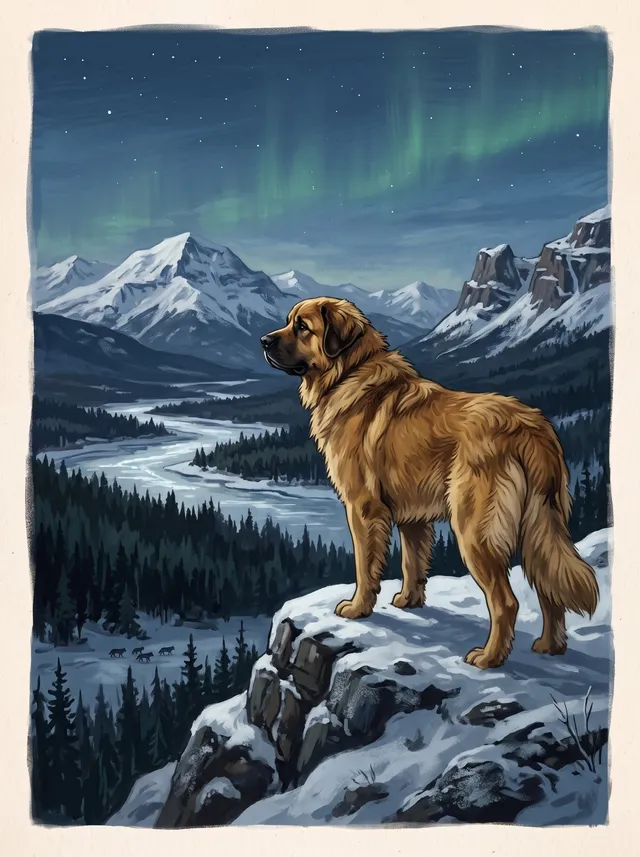
In 1897, a ship sailed into Seattle carrying a ton of gold. The gold came from the Klondike, a wild, cold land far in the north of Canada. The news spread fast. Soon, tens of thousands of people were rushing north to get rich. This was the Klondike Gold Rush.
The Klondike is in a part of Canada called the Yukon, just east of Alaska. It is a land of mountains, forests and huge rivers. In winter, the snow is deep, and it can be fifty or sixty below zero. In the middle of winter, the sun is up for only a few hours.
To get there, gold seekers took a ship up the coast to a beach called Dyea, in Alaska. Then they climbed the steep Chilkoot Pass over the mountains into Canada. After that, they went down the Yukon River to the gold town of Dawson.
There were no roads and no trains. In winter, the only way to carry food, tools and mail was on a sled pulled by dogs. Small dogs were no use. People needed big, strong dogs with thick coats. All at once, a dog like that was worth a lot of money. Some people would even steal one.
A sled dog team runs in a long line in front of the sled. The lead dog is at the very front. It finds the trail and sets the pace. The wheel dog runs at the back, nearest the sled, and it takes the most weight. Leather straps called traces join each dog to the sled. The driver walks or rides behind the sled. To make the dogs go, the driver shouts, "Mush!"
Buck did not read the news. If he had, he would have known that trouble was on its way. It was coming for every big, strong dog with a warm, thick coat on the west coast.
Buck lived at Judge Miller's place in the Santa Clara Valley, in sunny California. It was a big house set back from the road, with wide green lawns and tall trees. There were barns and rows of grapes. There was also a pool where the Judge's boys swam on hot summer days.
Buck was four years old, and he was king of it all. His father was a Saint Bernard, a huge dog bred to find people lost in the snow. His mother was a Scotch shepherd, a smart farm dog that herds sheep. From his father, Buck got his great size, and he weighed 140 pounds. From his mother, he got his quick mind.
Buck walked with the Judge in the mornings. He swam with the boys and kept the girls safe on their walks. On cold nights, he lay at the Judge's feet by the fire. Other dogs came and went at the ranch, but none of them mattered, because Buck ruled them all.
But far to the north, in a cold land called the Klondike, men had found gold. Word of it spread fast, and soon thousands of men were rushing north to dig for it. This was the gold rush, and it changed everything.
The Klondike was a land of snow and ice. There were no roads and no trains up there. The only way to move food and tools was by sled. A sled needs dogs to pull it, and not small dogs. It needs big, strong dogs with thick coats to keep out the frost. Dogs like Buck.
One of the men who worked at the ranch was Manuel, the gardener. Manuel had a bad habit. He loved to gamble, which means to bet money on games of chance. He lost far more than he won. Now he owed money that he could not pay.
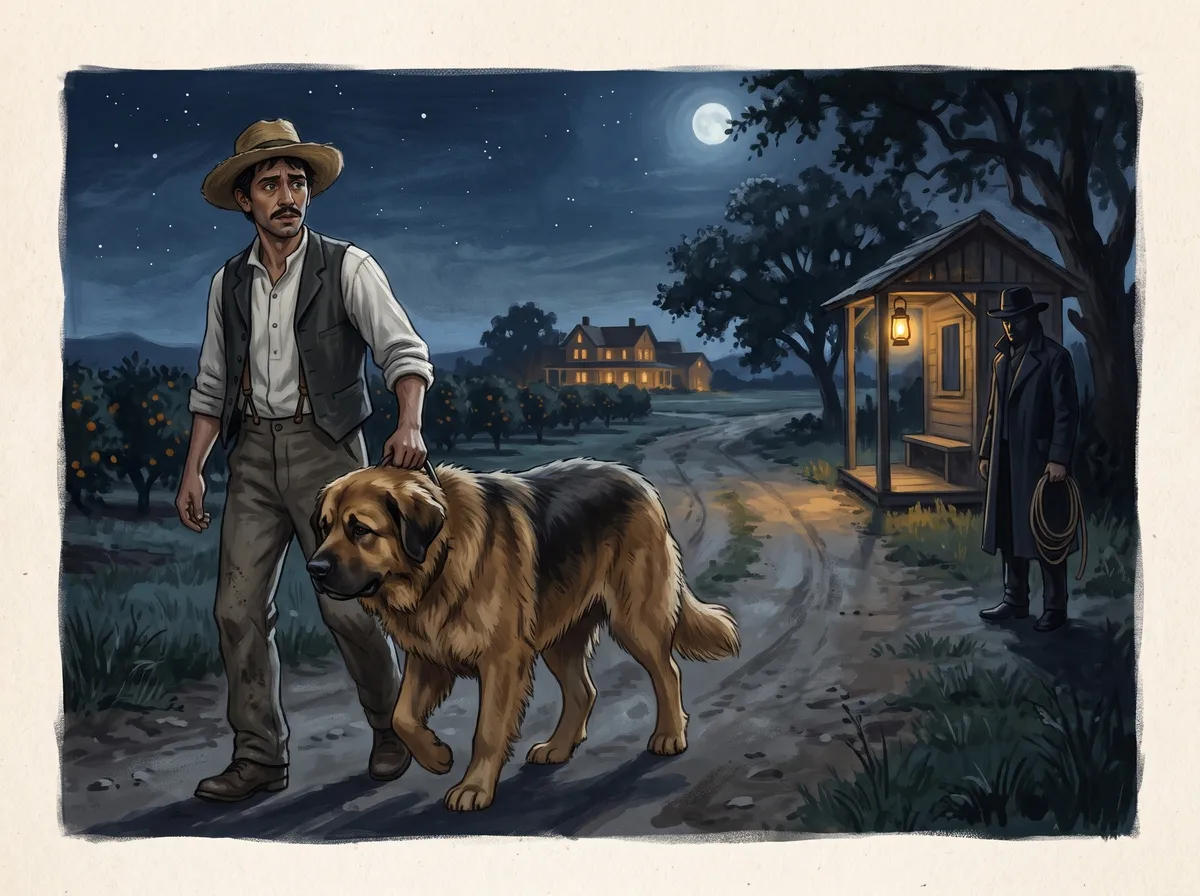
One night, the Judge was away at a meeting, and the boys were busy at home. Manuel called Buck, and Buck went with him. Why not? He knew Manuel well. The two of them walked through the trees and down the dark road to a small train stop.
A strange man was waiting there. Coins clinked as they passed from hand to hand. Then Manuel tied a rope around Buck's neck.
Buck let him do it. He had learned to trust the men he knew. But when the stranger took the end of the rope, Buck gave a low growl. It was a warning.
The man pulled the rope tight around his neck. Buck could not breathe, so he jumped at the man, but the man was too quick for him. The man twisted the rope hard, and Buck fell on his back. He had never been treated like this in his whole life. Then everything went dark.
When Buck woke up, he was lying on the floor of a train car. It rocked and shook and roared as it rushed along, and his throat was sore. The man with the rope sat near him.
Buck sprang at him, and his jaws closed on the man's hand. Then the rope choked him down again.
For two days and two nights, the train rolled north. Buck had no food and no water, and his eyes turned red with rage. He was no longer a pet. He was a prisoner, and he was headed for a city called Seattle.
Chapter 1 as a print-ready PDF with its picture and questions, or get the whole printable book with the novel study below.
Chapter 1 PDF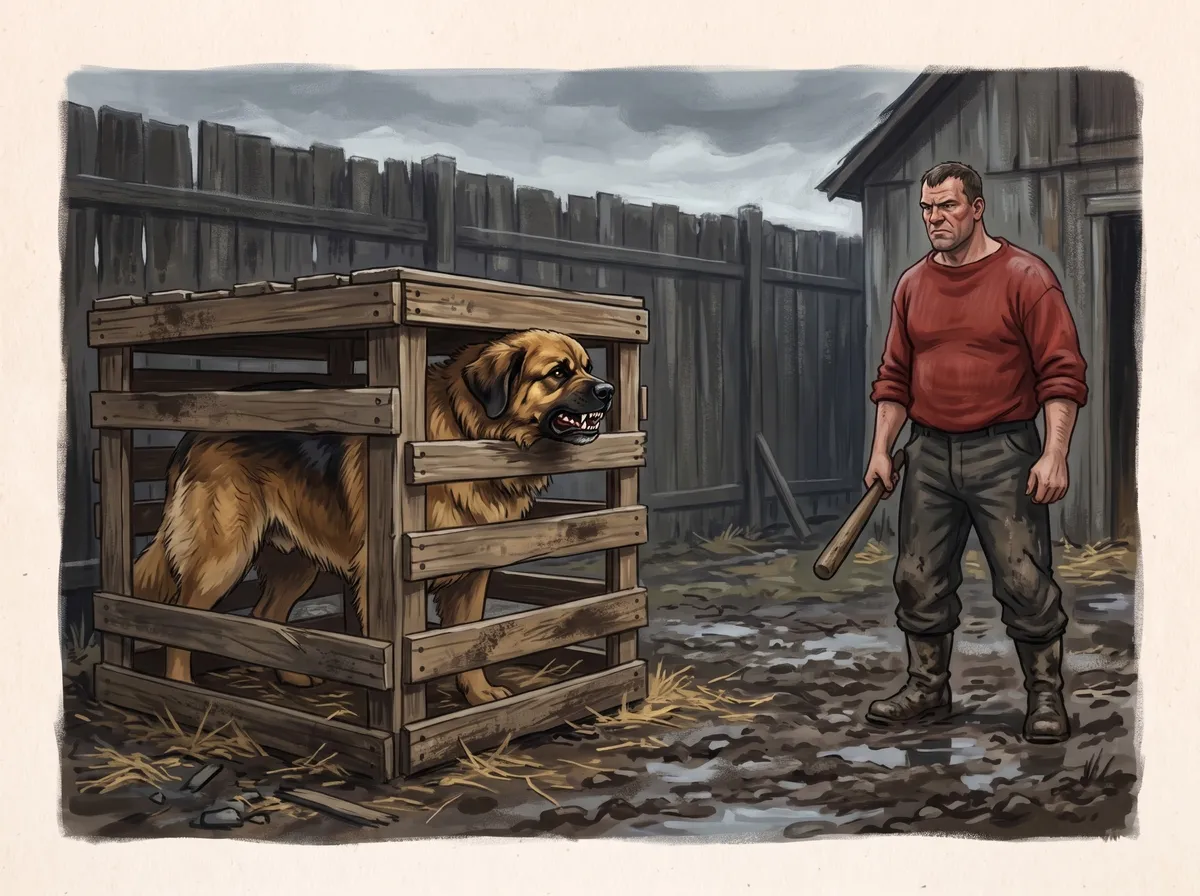
In Seattle, the men pushed Buck into a crate. A crate is a big wooden box with gaps between the boards, like a cage. It was just big enough for him to stand up and turn around.
Buck threw himself at the boards and bit at them until his mouth was sore. Men came to look at him and poke him with sticks, and they laughed when he growled. Buck hated them all.
At last, a wagon carried the crate to a small yard with a high wooden fence. A thick, strong man in a red sweater came out to meet it. He held a hatchet in one hand. In the other was a heavy club, a thick stick of wood made for hitting.
"You're not going to take him out now?" the wagon driver asked.
"Sure," said the man in the red sweater. He began to chop at the crate.
Buck's hair stood up. He snarled and foamed at the mouth, and his red eyes glared through the gaps. He was ready to fight.
When the crate broke open, Buck sprang out, all 140 pounds of him, and flew at the man.
In mid-air, the club hit him, and he crashed to the ground. He did not know what had struck him, so he got up and charged again.
Each time, the club knocked him down. At last he could not stand, and he lay on the ground and shook.
"There," said the man in the red sweater. "You've learned your place, and I know mine. Be a good dog, and all will go well."
The man brought him water, and Buck drank it. Then the man brought him meat, chunk by chunk, and Buck took it from his hand.
Buck was beaten, but he was not broken. He had learned something new, and he would never forget it. A man with a club was a master. He did not have to be loved, but he had to be obeyed. This was the law of the club, and Buck would follow it to stay alive.
Over the next days, more dogs came to the yard. Some came in crates and some came on ropes. Some were calm, and some raged as Buck had. Each one met the man in the red sweater, and each one learned the law of the club.
Now and then, strangers came to the yard. They looked at the dogs and paid money for them. Then they took those dogs away, and those dogs never came back.
One day, a small, thin man with a brown face came. His name was Perrault, and he carried the mail for Canada. He needed strong dogs to pull his sled across the frozen north. When he saw Buck, his eyes lit up.
"That is one dog in a thousand," he said. He paid a lot for Buck, and he also bought Curly, a friendly dog with soft, curly fur.
Perrault led them to a man with a black beard. This was Francois, who drove Perrault's sled. The two men were hard but fair. They knew dogs, and dogs could not fool them.
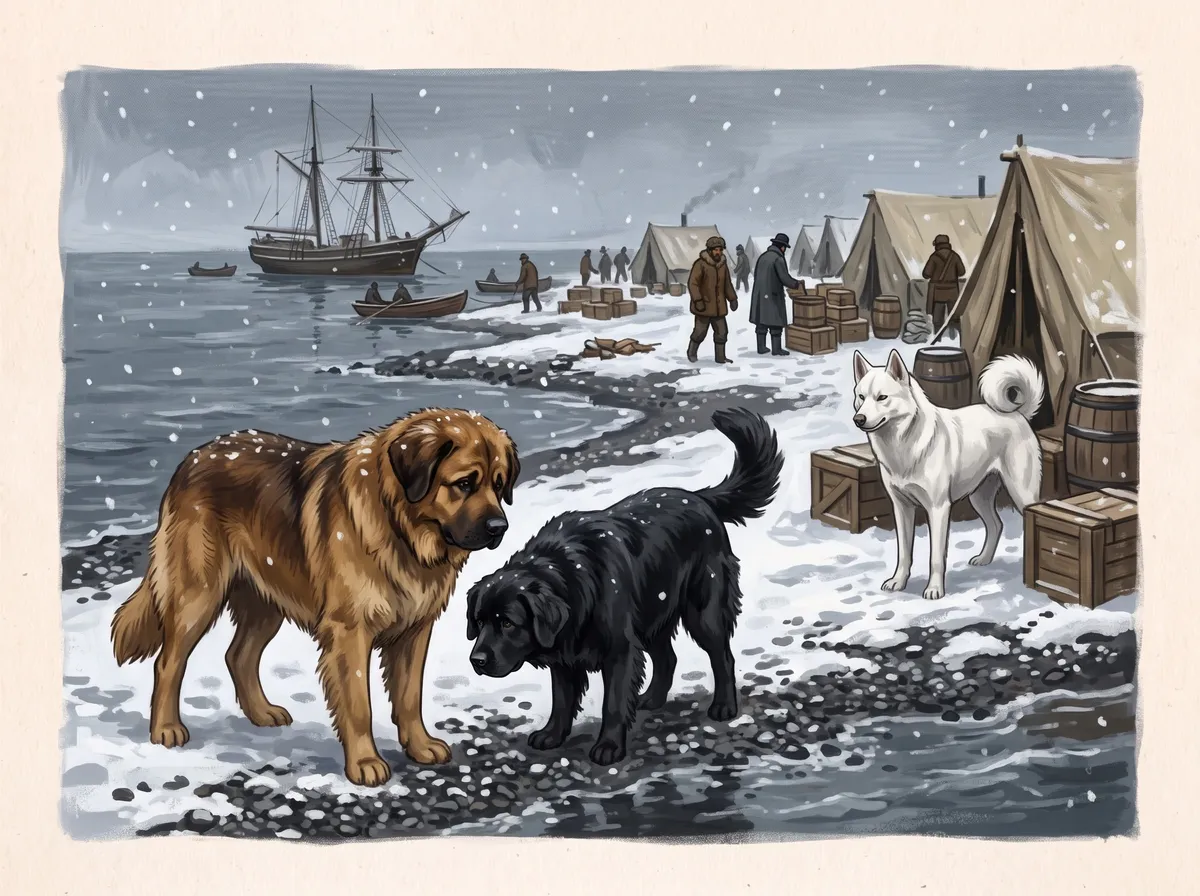
Perrault and Francois took Buck and Curly onto a ship. The ship sailed north for many days, and the air grew colder each day. Buck did not know it, but he was leaving the warm south forever.
Curly was Buck's friend on the ship. She was a big, gentle dog who liked everyone. She wagged her tail at every man and sniffed every dog hello. On deck, she always walked close at Buck's side. At night, they slept back to back for warmth, and Buck was glad to have her near.
There were two other dogs on board. One was a large white husky named Spitz. A husky is a tough sled dog from the far north. Spitz was sly, and he would grin at you while he stole your food. The other dog was Dave, who was gloomy and only wanted to be left alone.
At last, the ship stopped at a beach called Dyea. Francois led the dogs onto the land. Buck's feet sank into something white and soft. It was cold and wet, and he jumped back. More of it was falling from the sky, so he sniffed it and licked it. It bit like fire and then was gone. The men laughed, and Buck felt foolish. It was the first snow he had ever seen.
Dyea was not like the Judge's ranch. Men shouted and dogs fought, and Buck had to watch every way at once.
Curly saw a husky by a pile of logs. He was the size of a wolf, but not half as big as she was. She trotted over to say hello in her friendly way.
The husky gave no warning. He leaped in, snapped, and leaped away. This was how wolves fight, with a quick strike and then a jump clear.
Thirty or forty huskies ran up and made a silent ring around them. Their eyes were bright. Curly rushed at the husky, but he struck again and jumped away. Then she slipped in the snow and fell.
That was what the huskies were waiting for. They closed in, and Curly never got up again.
It all happened so fast. Francois ran in with an ax and drove the huskies off, but it was too late.
Buck could not forget it. So this was the way of this new land, where there was no fair play. Once you were down, you were done. Buck made up his mind that he would never go down.
Then he saw Spitz. The white husky was watching, with his red tongue hanging out. He was grinning, and from that moment, Buck hated Spitz with a deep and bitter hate.
That same day, Francois put Buck in a harness. A harness is a set of leather straps that fits around a dog's chest and back. Long straps called traces joined the harness to a sled. Buck had seen horses pull carts at the ranch, and now he was the horse.
Buck's pride was hurt, but he was too wise to fight. He pulled, and he learned as he went. Dave was the wheel dog, the one closest to the sled. When Buck made a mistake, Dave nipped his back legs. Spitz was the lead dog, out in front, and he growled to steer Buck. By the end of the day, Buck knew to stop at "Ho!" and to go at "Mush!"
That night, Buck had a new problem. Where would he sleep? He went into the tent, but the men chased him out. Outside, the wind cut like a knife, and his feet froze. Every spot in the camp was cold.
Where were the other dogs? Then the snow under his feet moved. Buck jumped back with a snarl. But it was only Billee, a friendly young husky that Perrault had just bought. Billee was curled up in a warm hole under the snow, and he wagged his tail and whined.
So that was the trick. Buck picked a spot and dug his own hole. He curled up in it, and the heat of his body filled the small space. Snow fell over him like a blanket, and soon he was asleep.
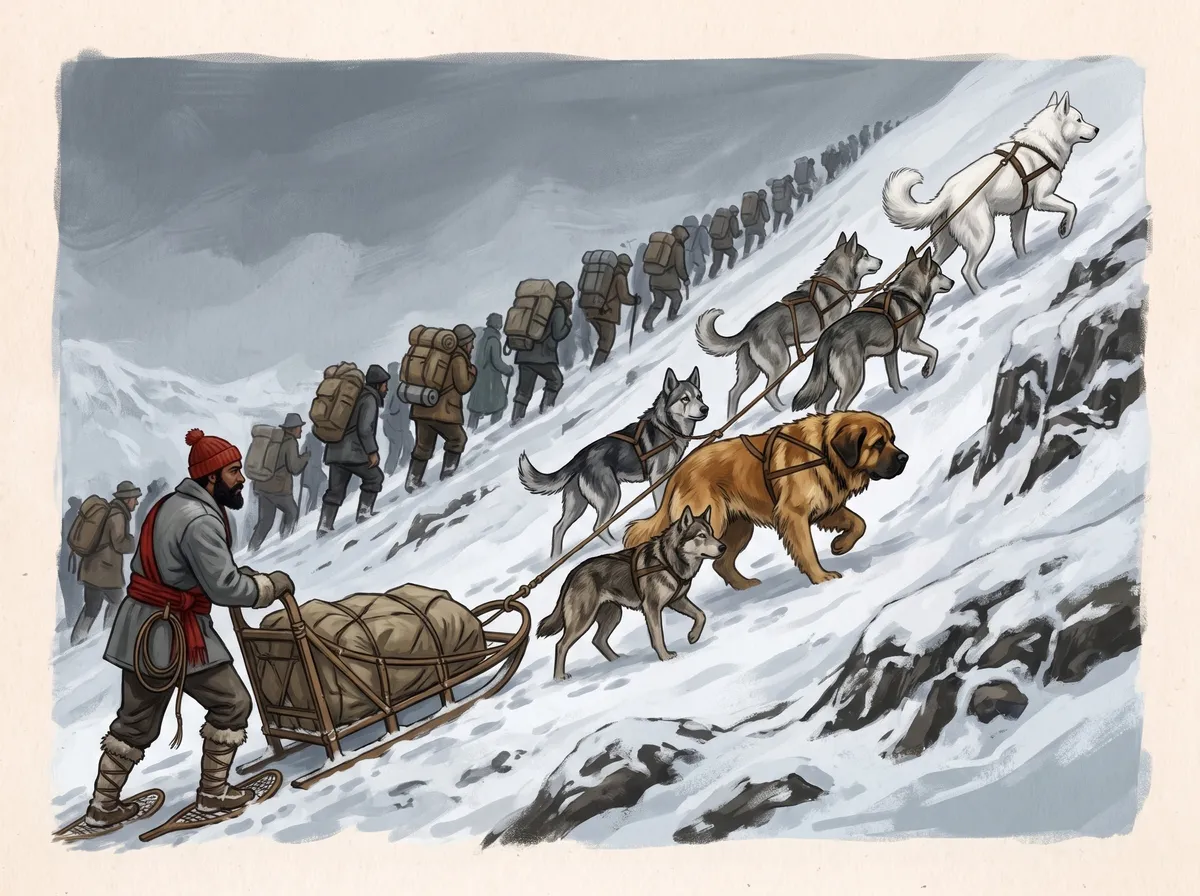
The next morning, Francois put the team in harness, and they set off. Perrault had bought more dogs, because the trail ahead was long. Billee's brother Joe was one, and another was Sol-leks, an old husky with only one eye. He did not like anyone to come at him from his blind side. Buck found that out when Sol-leks bit his shoulder, and after that, he kept to his good side.
Spitz was the lead dog, out at the front. Dave was the wheel dog, nearest the sled. Francois put Buck between Dave and Sol-leks. That way, the two old dogs could teach him.
And they did. In camp, Dave and Sol-leks were sleepy and grumpy, but in the traces, they came alive. They loved the work more than anything. When Buck got his traces tangled, they nipped him, and when he slowed down, they nipped him harder. Buck learned fast.
The trail climbed up into the mountains. This was the Chilkoot Pass, a steep, narrow gap between the peaks. Thousands of gold seekers were climbing it with heavy packs on their backs. The dogs pulled the sled over ice and rock, while the wind howled and snow stung their eyes.
On the far side, the trail dropped down to a chain of frozen lakes. Beyond the lakes lay the Yukon River. The Yukon is a huge river that runs through the cold north for two thousand miles. In winter, it freezes so hard that the ice becomes a road. That was their road now, all the way to Dawson.
Each day was the same. They got up in the dark and ran until dark again. Then they made camp, ate, and slept in the snow. Buck was always hungry. Each dog got one pound of dried fish a day, and for Buck, it was not enough. The huskies were small, and they had been born to this life. Buck was big, and he had been born on a ranch.
Buck ate slowly, the way he had at home. But the other dogs ate fast, and then they stole what he had left. So Buck learned to eat fast too. Then he watched Pike, one of the new dogs, steal bacon when Perrault's back was turned. The next day, Buck did the same, and he got clean away with a big piece of bacon.
At the ranch, Buck would never have stolen. There, it was wrong to take what was not yours. But up here, the old rules did not work. A dog who kept them would starve. Buck did not stop to think about it. It was instinct, a deep way of knowing what to do without being taught.
And his body changed. His muscles grew as hard as iron, and he could eat anything, no matter how bad it tasted. He learned to bite the ice out from between his toes. He learned to break the ice on a water hole with his front legs. He could smell the wind and know when a storm was coming.
One night, in a camp on a lake shore, the dogs woke to a terrible noise. Wild huskies had smelled the food. There were eighty or a hundred of them, all skin and bone. Their eyes burned in the dark as they poured into the camp like a flood.
Perrault and Francois swung clubs to drive them back. The team dogs fought for their lives. Three wild dogs went for Buck at once. He fought them off, but he was cut in a dozen places. At last the team broke free and ran for the woods.
When they crept back at dawn, half the food was gone, and every dog was hurt. Perrault looked at his team and shook his head. There were still many hard miles to Dawson, and now there was less food to get them there.
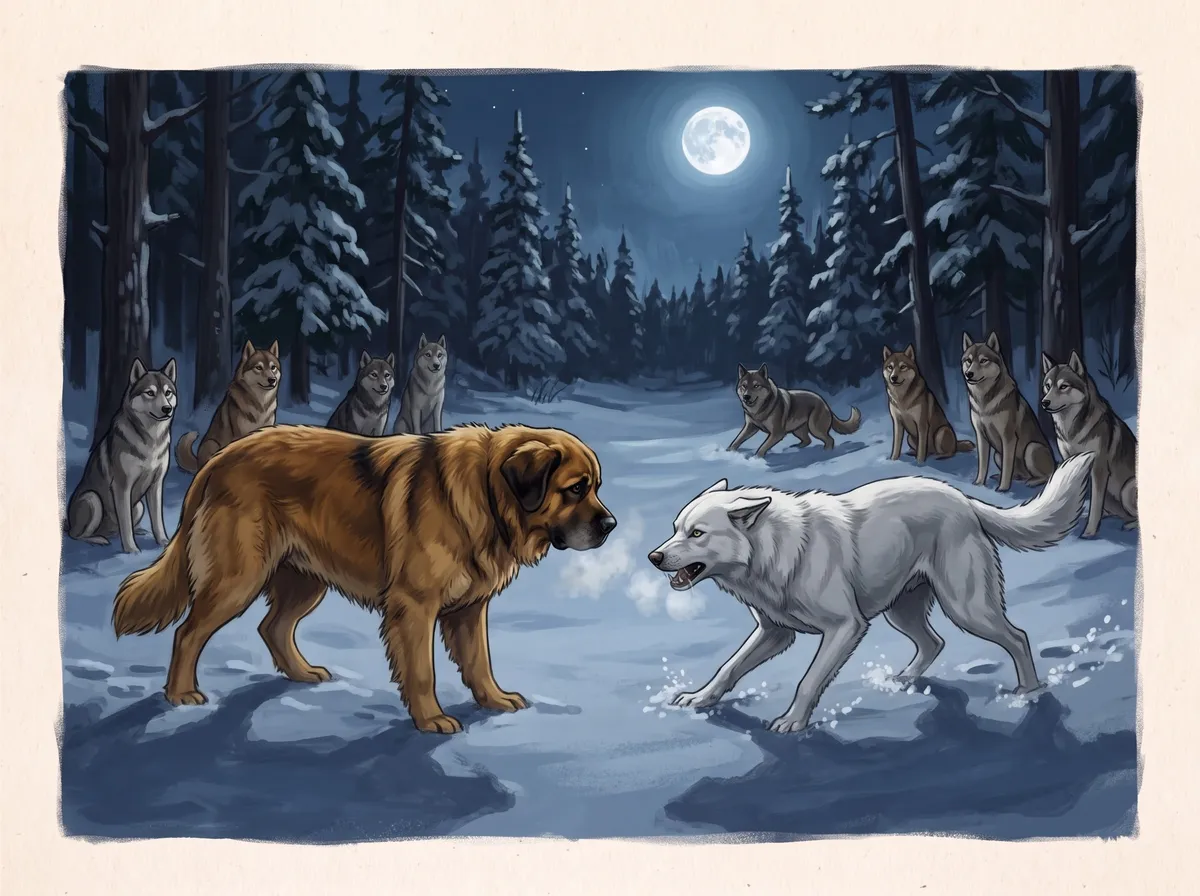
Spitz was the lead dog, and he ruled the team. He was strong and clever, and he liked to bully the weaker dogs. But Spitz could tell that Buck was different, because Buck was not afraid of him.
Buck and Spitz were rivals now. A rival is someone who wants the same thing as you, when only one can have it. They both wanted to rule the team. Spitz knew that one day Buck would try to take his place.
Buck began to stand in Spitz's way. When Spitz went to punish a lazy dog, Buck stepped between them. The other dogs saw it, and they grew bold and stopped obeying Spitz. There were fights in camp every night. The team began to fall apart.
"One day those two will fight," Francois said, "and only one will walk away."
One night after supper, a young dog named Dub spotted a snowshoe rabbit. It was a small white rabbit with big back feet for running on top of the snow. Dub ran after it, and the whole team went too, yelping. Fifty huskies from a camp nearby joined in. Buck ran at the front of the pack.
The rabbit flashed down a frozen creek, and Buck raced after it. The moon was bright on the snow, and something old and wild woke up in Buck. He wanted to hunt and catch the living thing with his own teeth. He ran and ran, and he howled with the joy of it.
But Spitz did not follow the creek. He cut across a bend in the land. When the rabbit came around the turn, Spitz leaped out in front of it and caught it.
Buck did not stop. He crashed into Spitz, and they rolled in the snow. Spitz was up first. He slashed Buck's shoulder and sprang away with his lips curled back in a snarl.
Buck knew the time had come. The two dogs circled each other in the moonlight. Their ears were back and their eyes were narrow, and all was still. The other dogs made a ring around them and waited. Their breath rose in the cold air like smoke.
Spitz was an old fighter. He had fought many dogs in many lands, and he had always won. He never rushed. He waited, and when he struck, he was fast. Buck charged again and again, but each time Spitz met him tooth for tooth. Buck could not get through.
Buck was hurt and breathing hard. Spitz was still fresh. Then Buck did something new, and he used his head. He rushed at Spitz as if to go high for his shoulder. At the last second, he dropped low, and his jaws closed on Spitz's front leg. Spitz fell back on three legs.
Spitz fought on, but now he was slow. Buck did it again, to the other front leg. Spitz could hardly stand, and he swayed in the snow and snarled, trying to stay on his feet.
The ring of dogs moved closer, for they could see that Spitz was finished. Buck stood still for a moment. There was no pity in this land. Pity was for the warm south.
Then Buck sprang in one last time, and Spitz went down. The ring closed over him, and he was gone.
Buck stood back and watched. He was hurt and tired, but he had won. He was the master now, and the wild thing inside him was glad.
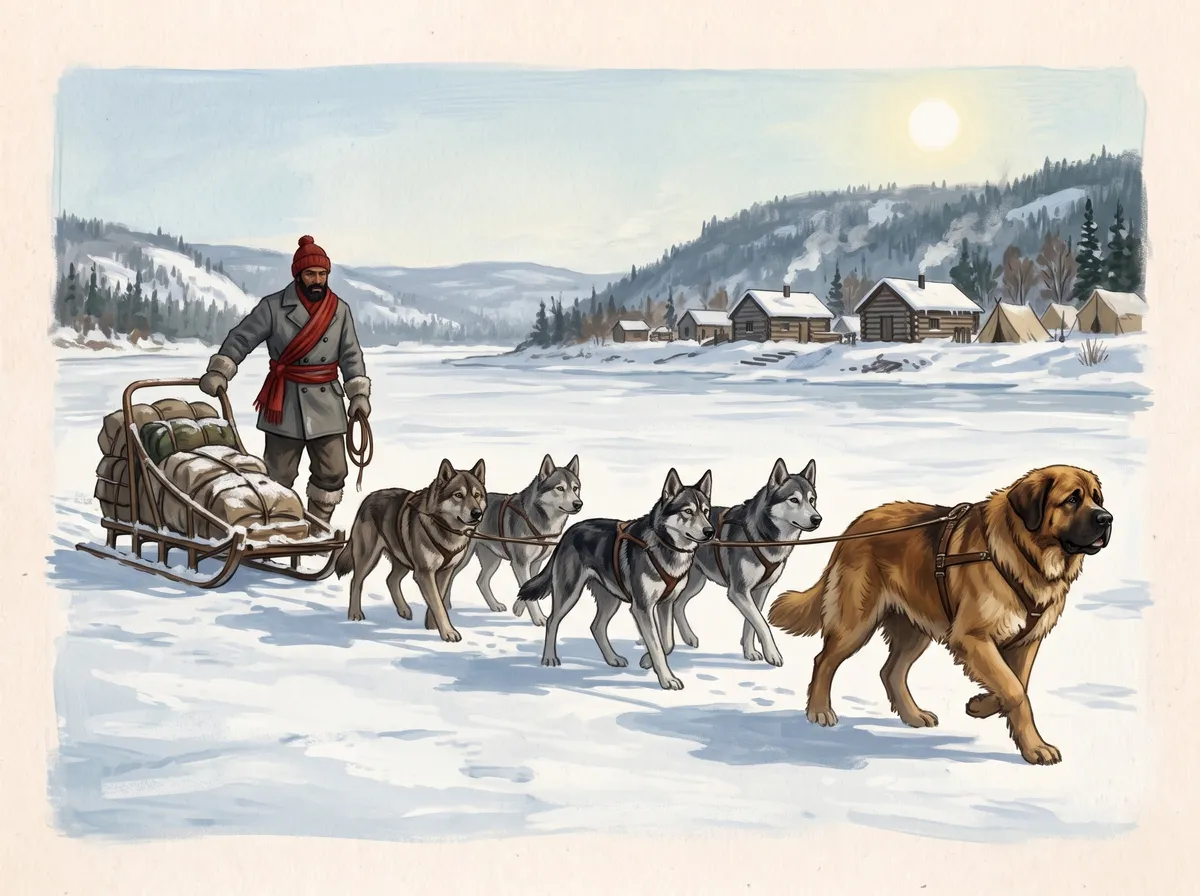
The next morning, Francois found Spitz gone and Buck covered in cuts. "That Buck fights like two devils," he said. Then he led Sol-leks to the lead spot.
Buck did not like that, so he walked up, pushed Sol-leks aside and took the lead place.
Francois laughed and dragged him back, and then he picked up a club. But Buck knew the law of the club, so he did not attack. He just stayed out of reach, past the end of the club, and waited. He wanted the lead, and he would take nothing else.
For an hour, the men chased him. At last, Perrault shook his head, because they were losing time. "Give him what he wants," he said. Francois led Sol-leks back to his old place, and Buck trotted to the front of the team.
As lead dog, Buck was even better than Spitz. He was smart and fast, and he set the pace and found the trail. When the dogs fought, he stopped them. When a dog was lazy, Buck taught him to pull. Soon the team pulled as one. Joe stopped whining, and even sly Pike pulled his share. Francois could hardly believe it.
"Never such a dog as that Buck," he said. "He is worth a thousand dollars."
The team flew down the Yukon and made record time. One day they ran forty miles, and the next day they did it again. Snow, ice and wind could not stop them, and at last they pulled into Dawson.
Dawson was the heart of the gold rush. It was a busy town of tents and log cabins beside the frozen river. Men came there from all over the world to stake a claim. A claim is a piece of land where a person has the right to dig for gold.
In Dawson, new orders came for Perrault and Francois. Francois put his arms around Buck and cried, and then the two men were gone from his life.
A new driver took over the team. With other mail teams, they set off on the long run back to the coast. The sleds were heavy with letters from the men in the gold fields. It was hard, dull work, day after day.
The dogs did not get much rest, and they grew thin and tired. Their feet were sore, with no time to heal. Frostbite nipped at their toes and ears. Frostbite is when cold air freezes a part of the body and hurts it.
Old Dave had the worst of it. Something was wrong inside him, and he grew moody and cross. When he lay down in camp at night, he cried out in pain. Still, he pulled, and in the traces he would let no other dog do his work.
One day, he fell in the traces. The driver took him out of harness and put Sol-leks in the wheel spot. Dave was meant to rest now and trot free behind the sled, but he would not have it.
Dave struggled through the deep snow beside the team. He howled and whined, and he tried to push Sol-leks out of his place. When the sled stopped, Dave limped to his old spot next to it and stood there.
The driver did not have the heart to send him off again. He put Dave back in his harness. Dave pulled all that day, proud and glad, even though he cried with each step.
The next morning, Dave could not stand. He crawled toward the team on his front legs, trying to reach his place. The sled went on without him, and old Dave died in the snow behind them.
Buck ran at the front and did not look back. But for a long time, the team ran slowly, as if something heavy rode with them.
When the mail run ended, the team was worn out. They had run more than two thousand miles in five months. Their feet were raw, and Buck had lost so much weight that his ribs showed. They needed a long rest, but instead, they were sold.
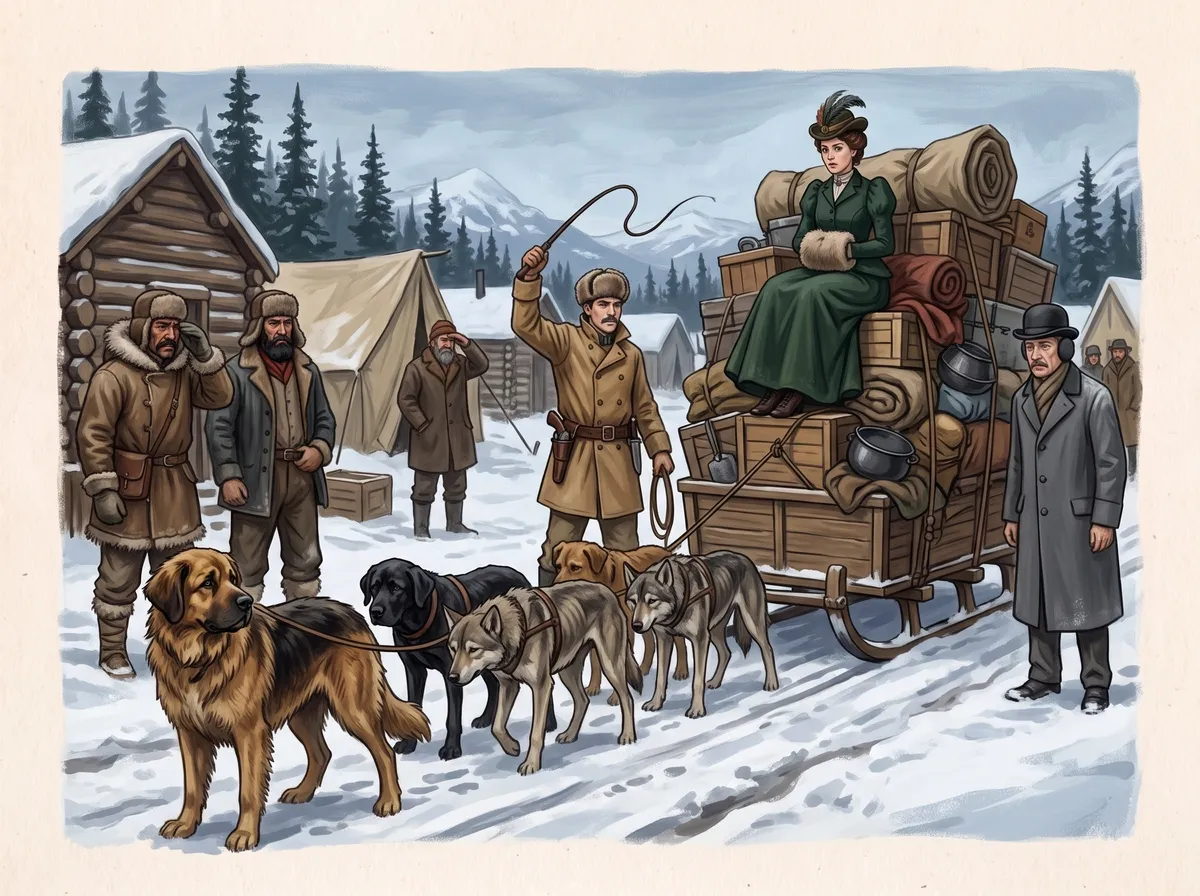
Two men and a woman from the south bought them. Hal was a young man with a big gun and a hunting knife on his belt. Charles was older, with weak, watery eyes, and Mercedes was Charles's wife and Hal's sister. None of them knew anything about the north. They had come up to find gold, but they did not even know how to pack a sled.
They piled the sled high with a tent, tin dishes, clothes, blankets and boxes. Men from a camp nearby came to watch and grinned. "That load is too heavy," one man said. "And you won't need that tent."
"Nonsense," said Mercedes, with a toss of her head.
Hal cracked his whip. "Mush!" he shouted. The dogs threw their weight into their harness, but the sled did not move, so Hal whipped them. "Oh, the poor dogs!" Mercedes cried. But she did nothing to help them.
A man stepped up. "Break the runners loose first," he said. The runners are the two long strips under a sled that slide over the snow. They were frozen to the ground. Hal pushed the sled loose, and the dogs pulled it away. At the first turn, the top-heavy load tipped over. Boxes and pans spilled out into the street. The dogs ran off with the empty sled, and everyone laughed.
They tried again, with less on the sled. Hal bought more dogs from the south, so now there were fourteen in the team. He thought more dogs meant more speed. But he did not think about food. Fourteen dogs need a lot of food, and the sled could not carry enough for the whole trip.
They started late every day and stopped early, and they did not know how to make camp. At first, Hal fed the dogs too much. Then the food began to run out, so he fed them less and less. The dogs were starving.
The new dogs from the south died first. Then Billee fell in the traces and did not get up. Others dropped after him, one by one, but Buck kept going. He pulled the way Dave had taught him, even when his legs shook. He was only skin and bones now.
The three people fought all the time. Mercedes cried, and she rode on the sled when she was tired, which made the load even heavier. Hal and Charles shouted at each other, and no one was kind to the dogs.
By then, winter was ending. The sun shone longer each day, and water dripped from the trees. Under the snow, the frozen river began to crack and groan. The ice was melting from below.
At last, the sled came to a camp on the river bank. The dogs dropped in the snow. A man named John Thornton sat there alone, carving a handle for an ax. He had come north to look for gold, like so many others. Hal asked him about the trail ahead.
Thornton looked out at the river. "The ice is too thin," he said. "It could break at any moment. If I were you, I would not cross it."
Hal laughed at him. "They told us the same thing back there," he said, "but here we are." He turned to the dogs and cracked his whip. "Get up! Mush!"
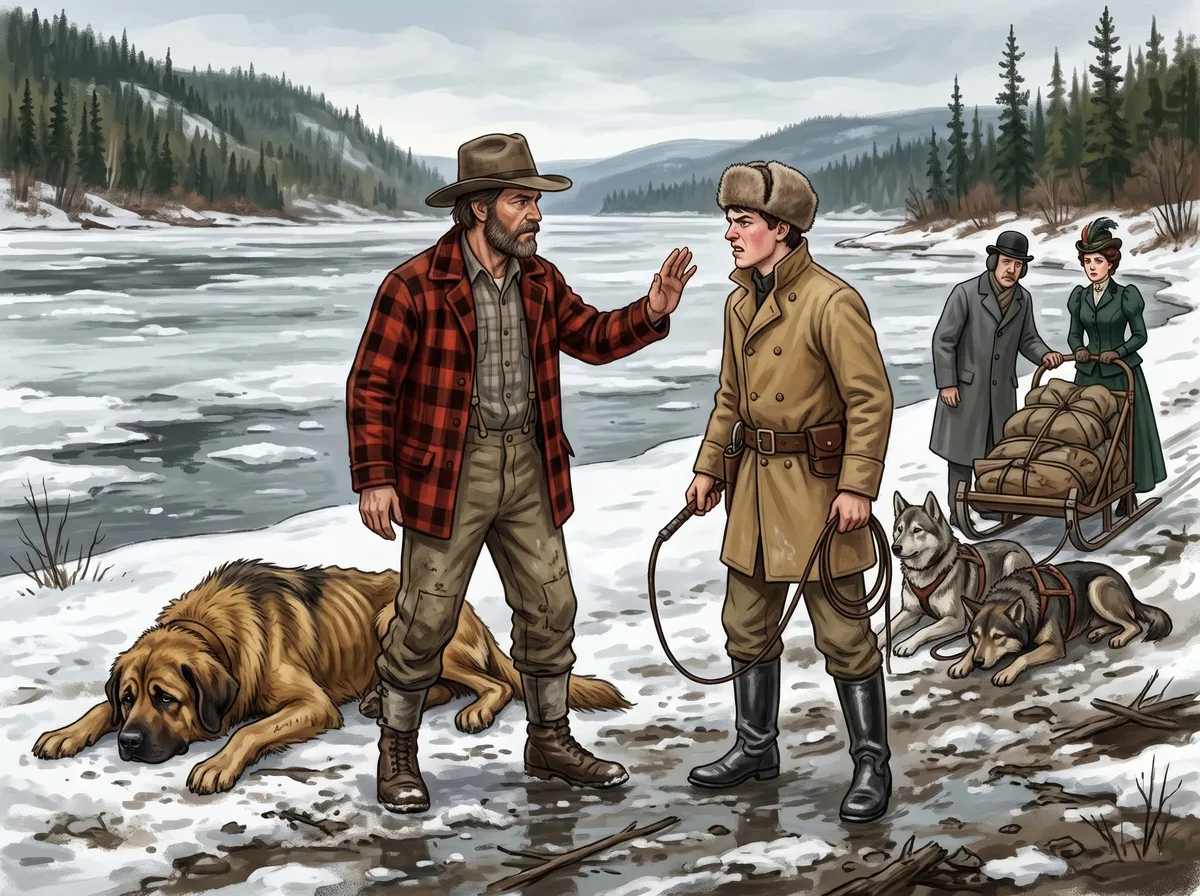
The dogs got up slowly, one by one. But Buck did not get up, and he lay where he had fallen. He could feel danger in the ice ahead. Something deep inside told him not to go. It was instinct, and he trusted it more than any whip.
Hal whipped him, but Buck did not move. So Hal picked up the club and struck him again and again. Still Buck did not get up, and he hardly felt the blows now. He was too tired, and his body seemed far away.
All at once, John Thornton jumped up. He pushed Hal back so hard that Hal stumbled, and then he stood over Buck.
"If you strike that dog again, I will stop you," he said. His voice shook with anger.
"It's my dog," Hal said. "Get out of my way."
Thornton did not move, and Hal reached for his long knife. Thornton knocked it out of his hand with the ax handle. Then Thornton picked up the knife, bent down and cut through Buck's traces, and Buck was free.
Hal had no fight left in him. Buck was half dead and of no more use to him anyway. So Hal cracked his whip at the other dogs, and the sled pulled out onto the river.
Buck lifted his head to watch them go. Thornton knelt beside him and felt gently for broken bones. Out on the river, the sled crawled along the ice. Then the ice gave way, and the sled and all of them were gone.
Thornton and Buck looked at each other.
"You poor thing," Thornton said softly, and Buck licked his hand.
That winter, Thornton had frozen his feet, and he was waiting for them to heal. His partners, Hans and Pete, had gone up the river to cut logs for a raft. So Thornton and Buck rested together on the river bank in the spring sun.
Thornton gave Buck food and water and let him sleep. He cleaned Buck's cuts, and little by little, Buck got his strength back. His ribs filled out, and his coat grew thick and shiny again.
At the Judge's ranch, Buck had been a friend to the Judge. On the trail, he had worked hard for Perrault and Francois. But with John Thornton, it was different. For the first time in his life, Buck felt love. It was a deep, wild love that filled his whole heart.
Thornton talked to Buck as if he were a friend. He held Buck's big head in his rough hands and shook it back and forth. He called him silly names that were really love words. Buck would open his mouth and take Thornton's hand gently in his teeth. It was not a real bite. It was his way of showing love.
Buck could not bear to let Thornton out of his sight. When Thornton left the tent, Buck followed him. At night, he woke and crept to the tent to listen to his master breathe. He was afraid that Thornton would leave him, the way all the others had.
When Hans and Pete came back with the raft, the men set off down the river to Dawson. Buck went too. He would go anywhere Thornton went.
One day, the men were taking a boat down a stretch of rapids. Rapids are a part of a river where the water runs fast and wild over rocks. Hans and Pete walked along the bank, holding a rope tied to the boat. Thornton stayed in the boat and kept it off the rocks with a pole.
Then the boat hit a rock and flipped over, and Thornton was thrown into the water. The river swept him away toward the worst part of the rapids, where the water boiled white. No swimmer could live in there.
Buck jumped in at once. He swam hard through the rushing water until he reached Thornton. Thornton grabbed his tail, and Buck turned and swam for the bank with all his strength. But the river was too strong, and it pulled them both down toward the rocks.
Thornton was thrown against a rock, and he grabbed it and held on. "Go, Buck! Go!" he shouted over the roar.
Buck could not stay. The water carried him away, and he fought his way to the bank. Hans and Pete pulled him out.
They knew Thornton could not hold on for long. They tied the rope around Buck's neck and shoulders, careful not to choke him. Then Buck jumped back in. The first time, he missed Thornton, and they had to pull him back. He was half drowned, but he got up and went in again.
This time, Buck swam straight for Thornton, and Thornton threw his arms around Buck's neck. Hans and Pete pulled on the rope with all their might. Buck and Thornton were dragged under the water, over the rocks and up onto the bank.
Thornton woke up first, and his first thought was of Buck. Buck lay still, and Thornton was afraid he was dead. Then Buck opened his eyes. The men found that he had three broken ribs. The men made camp right there until he could travel again.
That winter, in a saloon in Dawson, men began to brag about their dogs. A saloon is a place where people drink and talk and make bets. One man said his dog could pull a sled with five hundred pounds. Another said six hundred.
"Buck can pull a thousand pounds," Thornton said.
A rich man named Matthewson slapped a bag of gold on the bar. "I bet a thousand dollars he can't," he said. "There's a sled outside with a thousand pounds of flour on it. It has been there for hours, and the runners are frozen to the snow. Let him pull it a hundred yards."
Thornton's face went red. He did not have a thousand dollars, and he had spoken too fast. But Hans and Pete gave him all their gold, and an old friend lent him the rest. The bet was on.
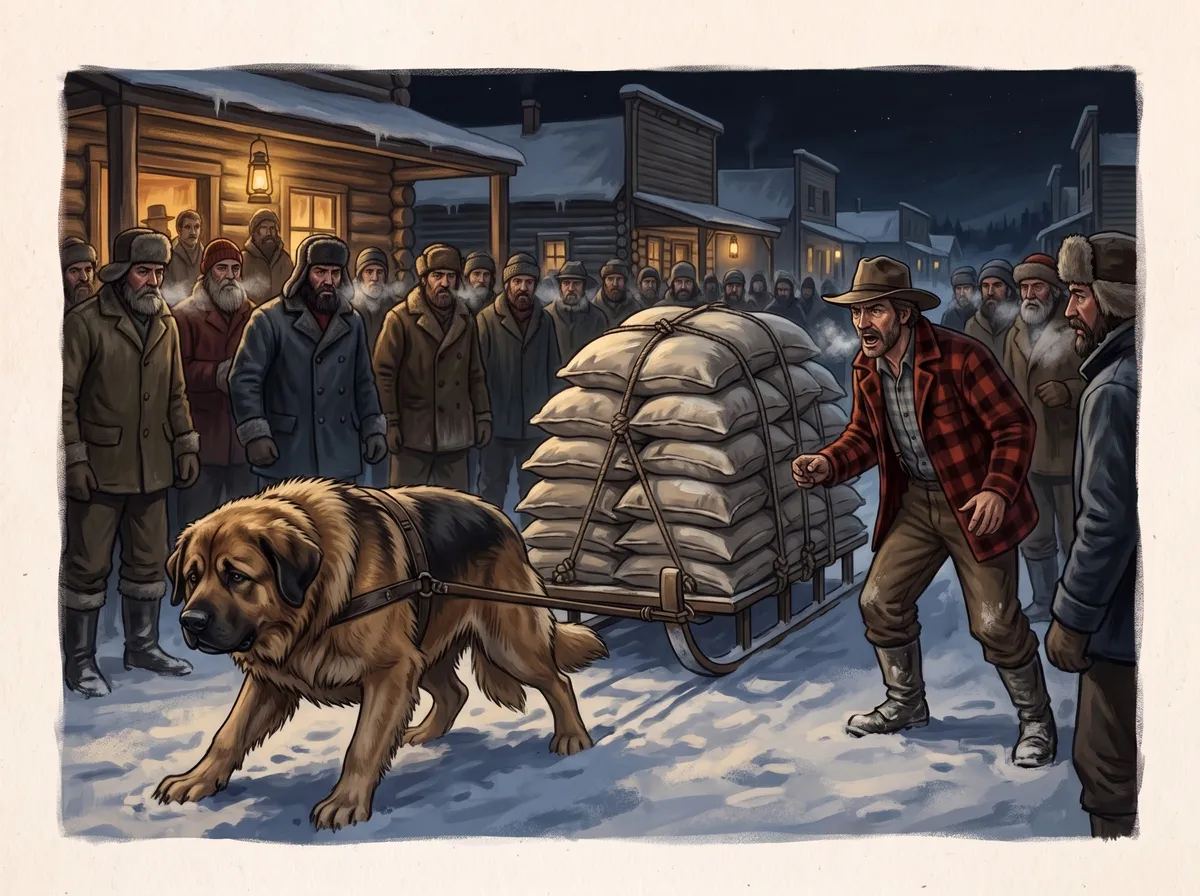
Everyone went out into the street to watch, though it was sixty below zero. The sled sat in the snow with twenty sacks of flour on it. Men stood in a wide ring, and most of them bet against Buck. "He can't even break it out," they said.
Thornton knelt beside Buck. He took Buck's head in his hands and spoke softly in his ear. "As you love me, Buck. As you love me." Buck whined and took Thornton's hand in his teeth, and then Thornton stepped back.
"Now, Buck," he said.
Buck swung to the right, then to the left, and the frozen runners cracked loose. "Now, mush!" Thornton shouted. Buck threw himself forward. His chest was low to the ground, and his claws dug into the hard snow. The sled shook and slid an inch, then a few more. Then it began to move. Buck pulled it the whole hundred yards.
The crowd went wild. Men threw their hats in the air and shook hands with anyone near them. Thornton fell on his knees beside Buck, and the two of them held each other close.
With the money from the bet, Thornton and his partners set off east into the wild for gold.
They went far into land that was on no map. They hunted and fished. Buck loved it. But as the days went on, he began to hear something.
At night, as he lay by the fire, a sound came from deep in the forest. It was a long, lonely howl that pulled at him. It was the call of the wild, asking him to come and run free.
Buck felt torn in two. Part of him belonged to Thornton. Part of him belonged to the forest.
One night, Buck followed the howl into the woods. In an open place among the trees, he found a tall, thin wolf with gray fur. The wolf sat with his nose pointed at the sky, and when he saw Buck, he ran. Buck ran after him, not to fight but to make friends. At last the wolf stopped, and they sniffed noses and played like pups.
The wolf trotted off and looked back, as if to say, Come. Buck ran beside him all night, over streams and hills. He felt as if he were coming home. He had found a wolf brother.
But in the morning, Buck thought of Thornton. He turned and ran back to camp. The wolf sat down and howled sadly as Buck went.
For two days, Buck did not leave Thornton's side, but the call came again. Soon Buck was gone from camp for days at a time. He hunted alone, fished for salmon and grew into a true wild hunter. And still, he always came back to Thornton.
One evening, Buck was coming home from a long hunt. A few miles from camp, he caught a strange smell in the air. The hair rose on his back, and he moved like a shadow through the trees.
The camp was wrecked. The tent was torn down. Strange men were moving through the camp, taking what they wanted. Raiders had come while Buck was away. Buck looked for John Thornton. Then he knew that his master and his partners were dead.
Rage filled Buck, more rage than he had ever felt. He forgot the law of the club, and he forgot about guns. He leaped out of the dark like a storm. He moved so fast that the raiders could not see him. They cried out and ran into the forest, and they never came back to that valley again.
When it was over, Buck was alone. He stood by the empty camp, and there was a great, hollow ache inside him. The last thing that held him to the world of men was gone. But he had faced men with clubs and guns, and he was not afraid of them anymore.
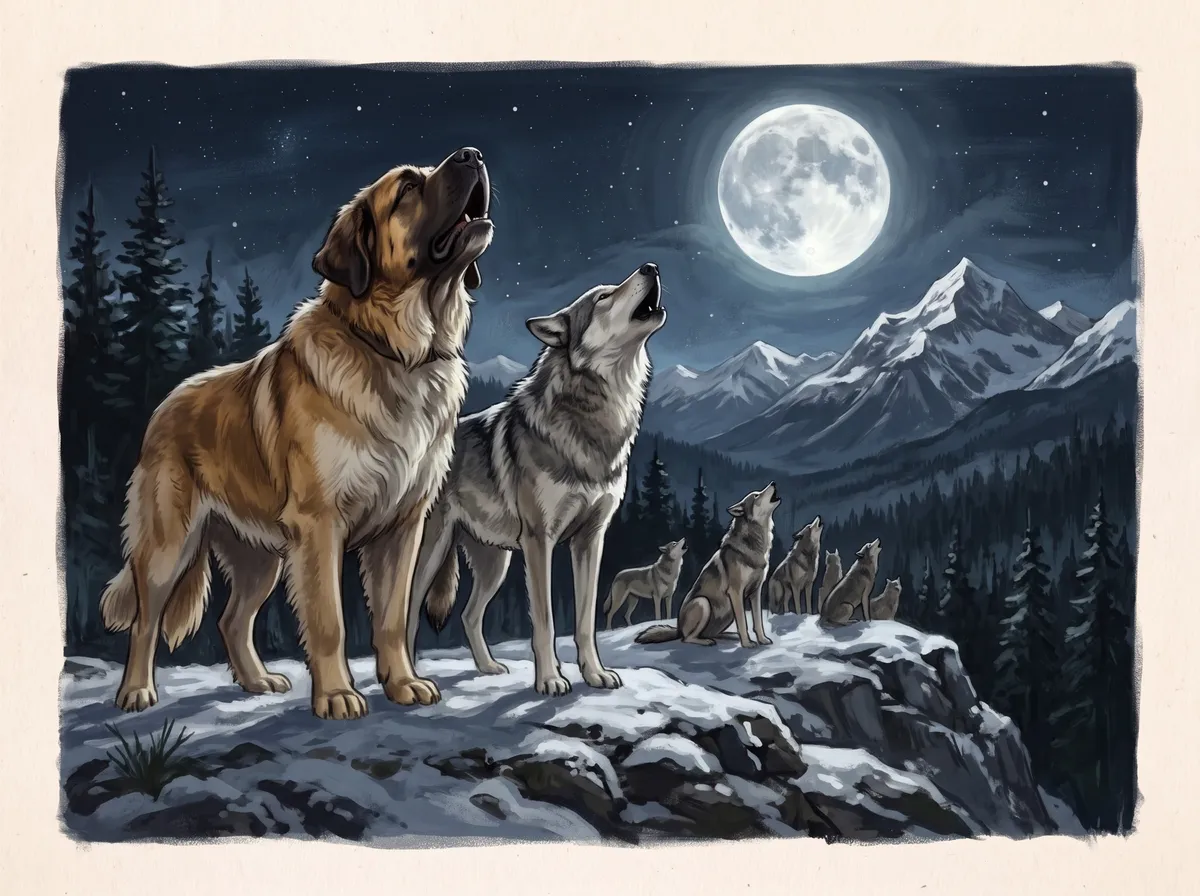
That night, the call came again, louder than ever. And this time, a whole wolf pack came with it. A wolf pack is a family of wolves that hunts and lives together. The wolves poured into the moonlit clearing and stared at Buck. Then the boldest one rushed at him. Buck struck back, and the wolf sprang away. Others came, but none of them could beat him.
Then one wolf came forward slowly. It was his wolf brother, and they touched noses. Then an old gray wolf sat down, pointed his nose at the moon and howled. The others sat and howled too, and Buck howled with them.
When the pack ran into the forest, Buck ran with them, side by side with his brother.
Years later, the gold miners and trappers began to tell a story. They said a Ghost Dog runs at the head of the wolf pack. It is much bigger than any wolf, with a broad head and golden-brown fur. Some say they have seen it in the moonlight, and others have only heard its howl.
Every summer, the story goes, the Ghost Dog comes to the quiet valley where Thornton's camp once stood. He stays a while and howls a long, sad howl. Then he turns and runs back into the forest. He is free with his pack, under the cold stars.
Everything on this page, ready to print, plus the worksheets to teach it.
Teaching the original novel? See the free Call of the Wild activities: a map of Buck's journey and a sled-dog poster.
 Printable Scholar