 Printable Scholar
The Gettysburg Address
On November 19, 1863, four months after the Battle of Gettysburg, President Abraham Lincoln spoke at the dedication of a cemetery for the Union soldiers who died there. The main speaker, Edward Everett, talked for about two hours. Lincoln spoke for about two minutes, in fewer than 300 words. He said the soldiers had died so that the nation could have a new birth of freedom, and that government of the people, by the people, for the people would not perish from the earth.
Free to print
The speech with a plain-English version, and the questions
PDFs sized for US Letter paper, in color and black and white.
The Gettysburg Address, with plain English
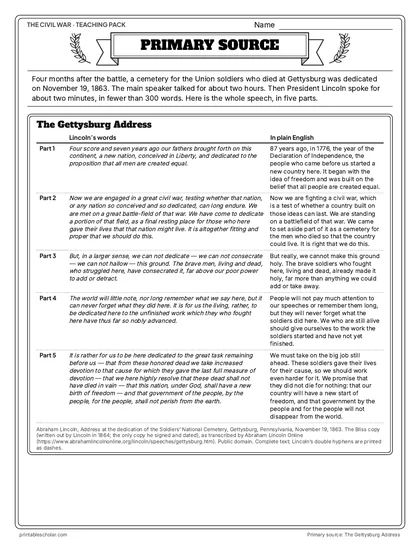
Lincoln’s words in five parts (the Bliss copy), each beside a plain-English version.
Download PDF Black and white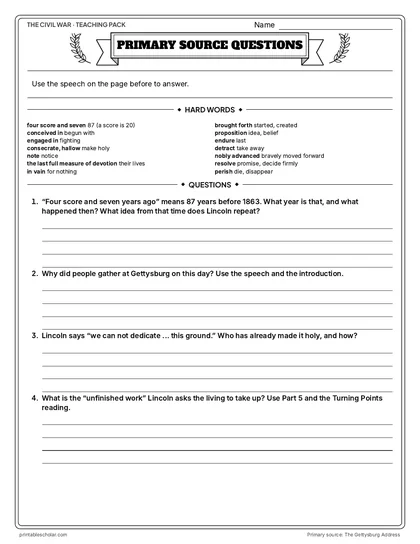
Hard words and questions
The hard words explained, and four questions about the speech.
Download PDF Black and white
Teaching pack · Grades 5–8
Teaching the Civil War? The whole unit, ready to teach.
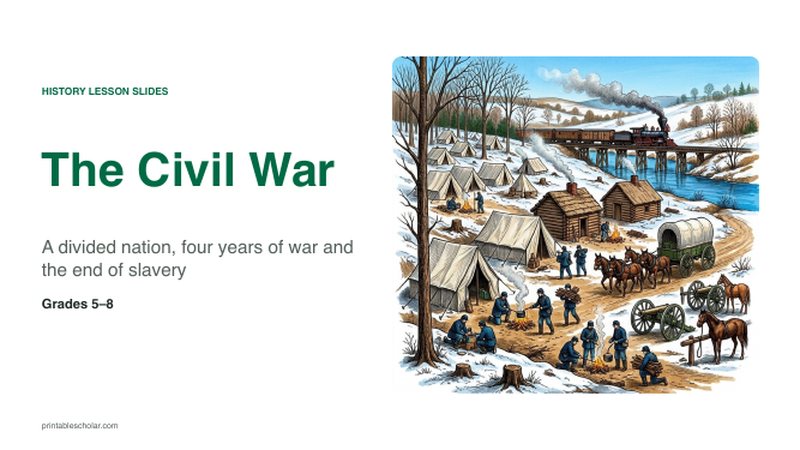
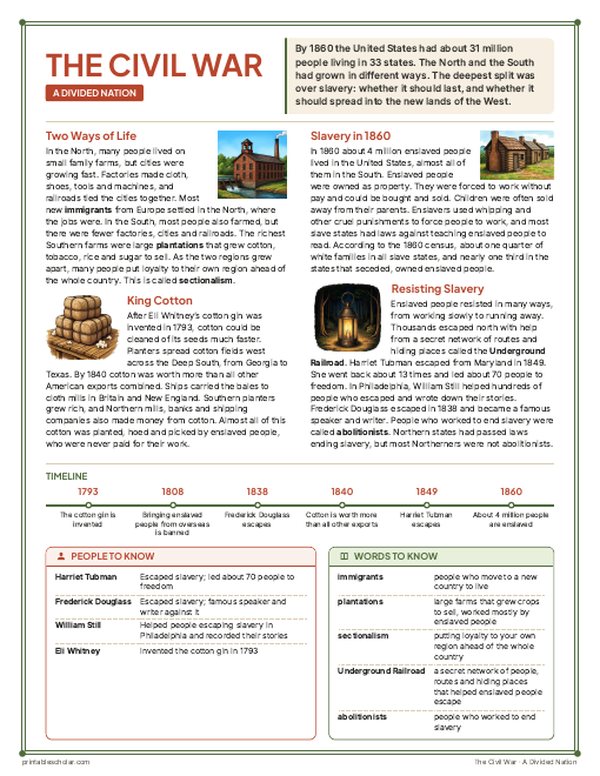
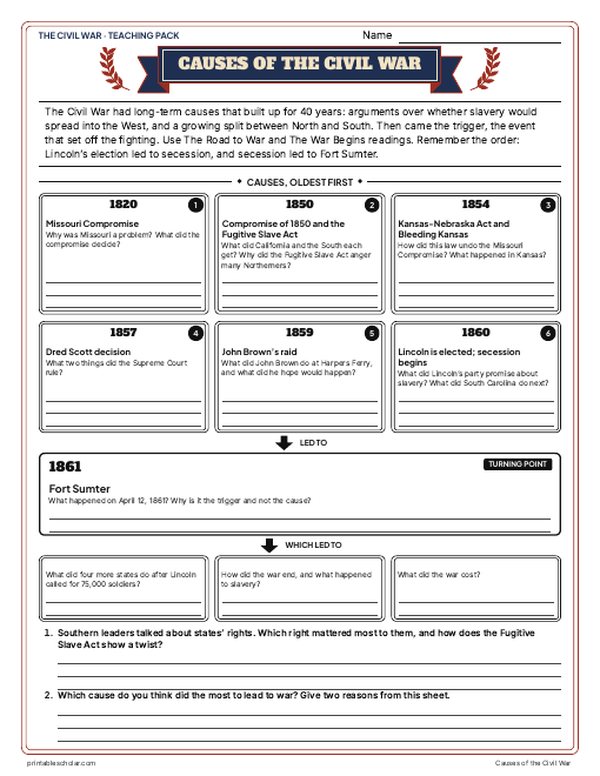
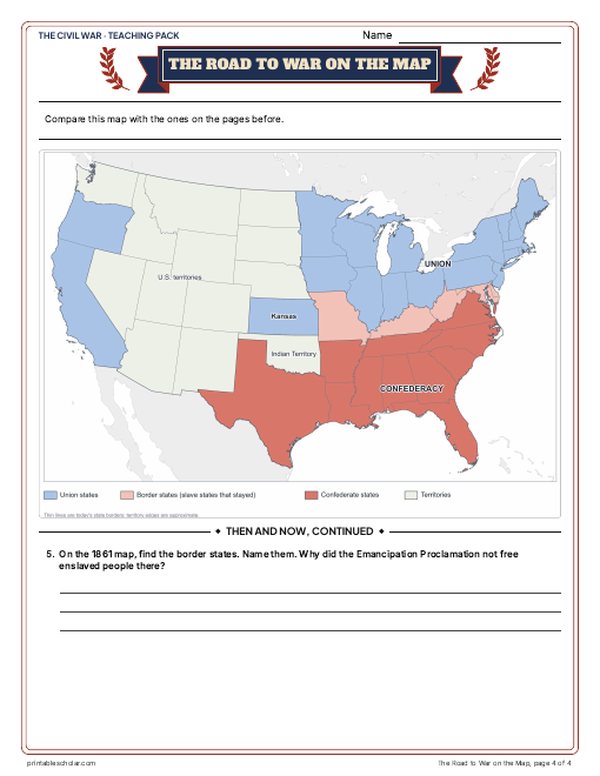
Two weeks of lessons in one download: slides to present, notes for students to fill in, and printable pages that use these maps and pictures.
- 40 lesson slides (PowerPoint you can edit, teacher notes on every slide) and 2 pages of guided notes
- 6 illustrated reading pages, a Union vs. Confederacy chart and a causes sheet
- Maps: labeled, blank, Read and Measure the Map, four road-to-war maps (1820 to 1861), a campaigns map and a "Where should the Union strike?" decision with the reveal
- Primary sources: the secession declarations, soldiers' letters from both sides, and the Gettysburg Address, each with plain English beside it; picture studies of a real 1862 camp photograph and an 1872 Underground Railroad engraving
- Grant and Lee, a timeline sort, a 15-question quiz, a teacher guide with a two-week plan, and answer keys for everything
Every answer is in the pack. The readings, slides, maps and pictures teach everything the sheets and quiz ask, so no textbook is needed.
Get the Civil War pack for $7One-time purchase. Instant download. Color and ink-saving black-and-white editions. Secure checkout by Stripe.
The speech, part by part
Part 1
Four score and seven years ago our fathers brought forth on this continent, a new nation, conceived in Liberty, and dedicated to the proposition that all men are created equal. In plain English: 87 years ago, in 1776, the year of the Declaration of Independence, the people who came before us started a new country here. It began with the idea of freedom and was built on the belief that all people are created equal.
Part 2
Now we are engaged in a great civil war, testing whether that nation, or any nation so conceived and so dedicated, can long endure. We are met on a great battle-field of that war. We have come to dedicate a portion of that field, as a final resting place for those who here gave their lives that that nation might live. It is altogether fitting and proper that we should do this. In plain English: Now we are fighting a civil war, which is a test of whether a country built on those ideas can last. We are standing on a battlefield of that war. We came to set aside part of it as a cemetery for the men who died so that the country could live. It is right that we do this.
Part 3
But, in a larger sense, we can not dedicate — we can not consecrate — we can not hallow — this ground. The brave men, living and dead, who struggled here, have consecrated it, far above our poor power to add or detract. In plain English: But really, we cannot make this ground holy. The brave soldiers who fought here, living and dead, already made it holy, far more than anything we could add or take away.
Part 4
The world will little note, nor long remember what we say here, but it can never forget what they did here. It is for us the living, rather, to be dedicated here to the unfinished work which they who fought here have thus far so nobly advanced. In plain English: People will not pay much attention to our speeches or remember them long, but they will never forget what the soldiers did here. We who are still alive should give ourselves to the work the soldiers started and have not yet finished.
Part 5
It is rather for us to be here dedicated to the great task remaining before us — that from these honored dead we take increased devotion to that cause for which they gave the last full measure of devotion — that we here highly resolve that these dead shall not have died in vain — that this nation, under God, shall have a new birth of freedom — and that government of the people, by the people, for the people, shall not perish from the earth. In plain English: We must take on the big job still ahead. These soldiers gave their lives for their cause, so we should work even harder for it. We promise that they did not die for nothing: that our country will have a new start of freedom, and that government by the people and for the people will not disappear from the world.
Frequently asked questions
When was the Gettysburg Address given?
On November 19, 1863, at the dedication of the Soldiers’ National Cemetery in Gettysburg, Pennsylvania, four months after the battle.
How long is the Gettysburg Address?
Fewer than 300 words. Lincoln spoke for about two minutes.
What does "four score and seven years ago" mean?
A score is 20, so four score and seven is 87. Eighty-seven years before 1863 was 1776, the year of the Declaration of Independence.