Your child reads 8 words for each level, real and made-up, and you tap whether they got each one. It stops where the words get hard, and that's the level to start at. About 3 to 5 minutes.
Point to the word and ask your child to read it. Give about 3 seconds. Don't help.
Picture them reading each line out loud. Pick the first one where they would stop or guess.
Your child isn't reading whole words yet, and that's the right place to begin. These help them hear the first sound in a word and learn the sound each letter makes, the two things Level 1 books need.
The road ahead: once they know most letter sounds, Level 1 books are next.
Kindergarten · brand-new readers
Short-vowel words your child can sound out letter by letter — cat, hat, sit, dog. The very first step in learning to read. Start here.
The road ahead: Level 1 now, then Level 2 and Level 3 as the words get easy. Most children move up a level in a few months.
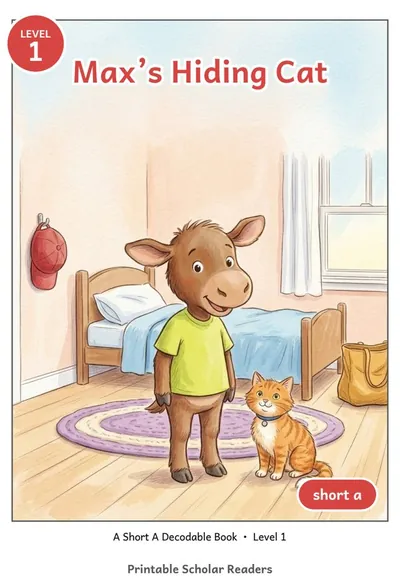 Or start free: print Max's Hiding Cat, a Level 1 book →
When in doubt, start one level lower. Easy wins build confidence, and you can always move up.
Grade 1 · early readers
Two-letter sounds and consonant clusters — ship, chin, that, stop, hand. The next step once short-vowel words feel easy.
The road ahead: Level 2 now, then Level 3 and Level 4 as the words get easy. Most children move up a level in a few months.
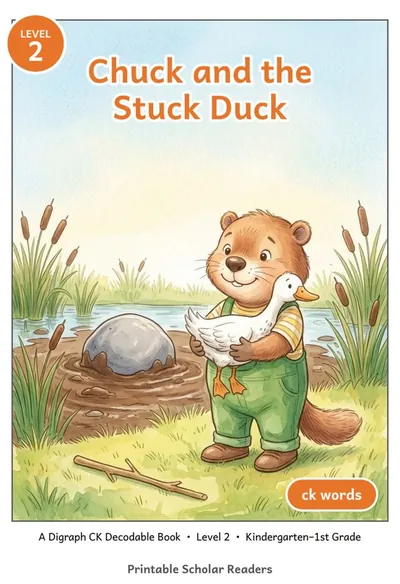 Or start free: print Chuck and the Stuck Duck, a Level 2 book →
When in doubt, start one level lower. Easy wins build confidence, and you can always move up.
Grade 1 · growing readers
Words where the vowel "says its name" — cake, bike, hope, cute. Magic-e and the first long-vowel patterns.
The road ahead: Level 3 now, then Level 4 and Level 5 as the words get easy. Most children move up a level in a few months.
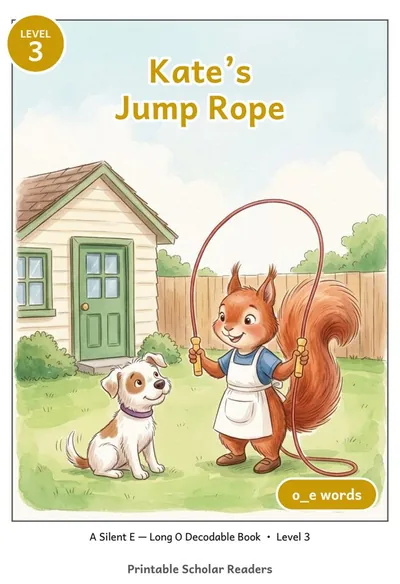 Or start free: print Kate's Jump Rope, a Level 3 book →
When in doubt, start one level lower. Easy wins build confidence, and you can always move up.
Grades 1–2 · confident readers
The last of the single-syllable patterns — vowel teams (rain, boat), r-controlled vowels (bird, fort), and diphthongs (coin, cow). Next comes putting them together into longer words.
The road ahead: Level 4 now, then Level 5 and Level 6 as the words get easy. Most children move up a level in a few months.
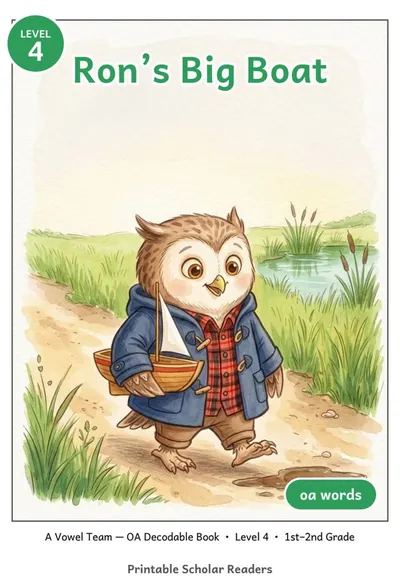 Or start free: print Ron's Big Boat, a Level 4 book →
When in doubt, start one level lower. Easy wins build confidence, and you can always move up.
Grades 2–3 · advancing readers
Longer two- and three-syllable words broken into readable chunks (sun·set, rab·bit, un·lock), plus the prefixes and suffixes that build them (un-, re-, -ing, -ful). The bridge from sounding out single words to reading real books and chapter stories.
The road ahead: Level 5 now, then Level 6 as the words get easy. Most children move up a level in a few months.
 Or start free: print A Wet Night, a Level 5 book →
When in doubt, start one level lower. Easy wins build confidence, and you can always move up.
Grades 3–4 · fluent readers
Your child read every row. Level 6 is our top level: start there to practice the word roots, or move on to chapter books.
The building blocks inside long words — roots like -port-, -struct-, bio-, and graph- that unlock hundreds of new words at once. Once you know the parts, long academic words become readable.
 Or start free: print The Big Dam Portage, a Level 6 book →
When in doubt, start one level lower. Easy wins build confidence, and you can always move up.
The same six rows of words on paper: a page the child reads from and a scoring sheet for you, with the stop rule and the level for each row. One child at a time, a few minutes each.
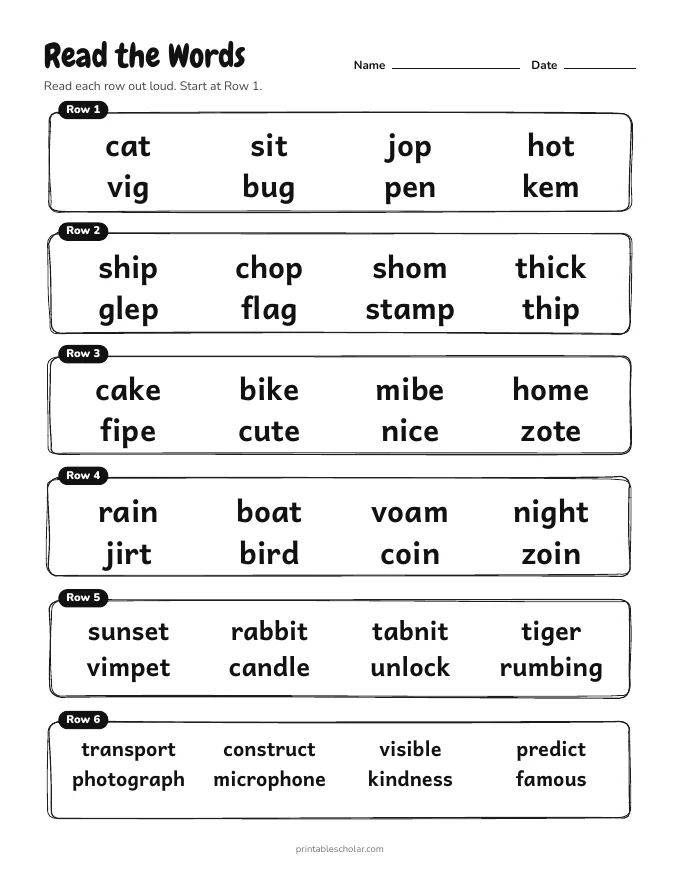
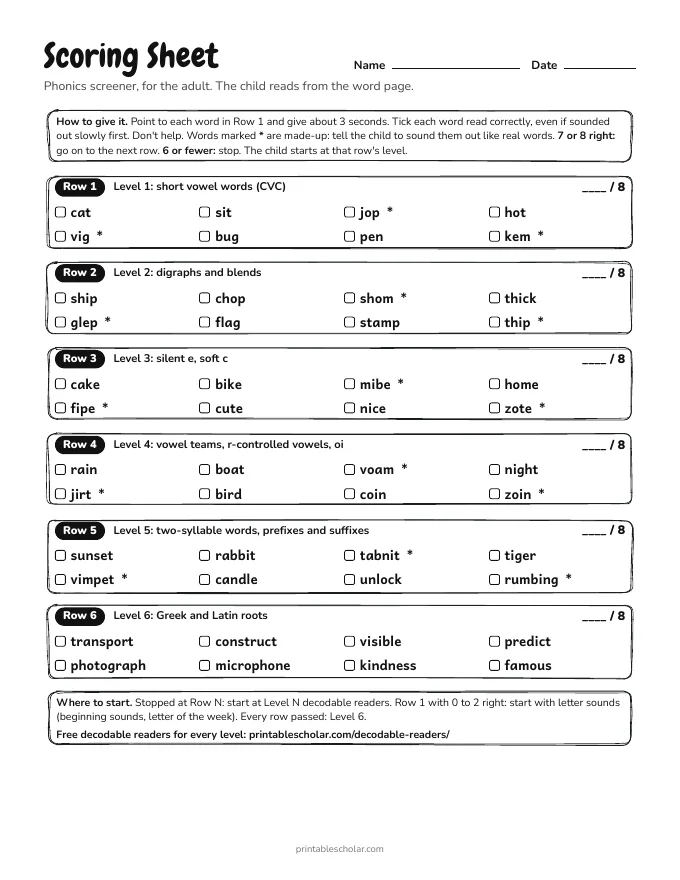
A short check of which spelling patterns a child can already read. The child reads a few words for each pattern, from short vowel words like cat up to long words with Greek and Latin roots, and the first pattern they get stuck on is where teaching should start. This one is matched to our six levels of decodable readers, so the result is the level of books to read next.
A child may know a real word like cat from memory, but a made-up word like jop can only be read by sounding it out. If a child reads the real words and gets stuck on the made-up ones, they are remembering words, not decoding them yet. Teachers call this a nonsense word check. Levels 1 to 5 have three made-up words each; Level 6 uses only real words.
Sit with your child and show one word at a time. Ask them to read it out loud and give them about three seconds. Tap Read it if they read it correctly, even if they sounded it out slowly first, and Missed it if they could not. Don’t help. The check moves to the next level after 7 or 8 right, and stops at 6 or fewer. Most children finish in 3 to 5 minutes.
The level where your child stopped is the level to read next: those are the patterns they are ready to learn. A child who reads 7 or 8 words at every level is ready for Level 6, our top level. A child who reads 2 or fewer of the first short vowel words is not reading words yet, so start with letter sounds.
Yes. The printable version has the same six rows of words: a page for the child to read from and a scoring sheet for you, with the stop rule and the level for each row. Give it one child at a time; it takes a few minutes each.
Every two or three months, or when the books at their level start to feel easy. Use it as a guide alongside what you see when your child reads.
 Printable Scholar