 Printable Scholar
Cultural Diffusion: How Ideas Traveled the Silk Road
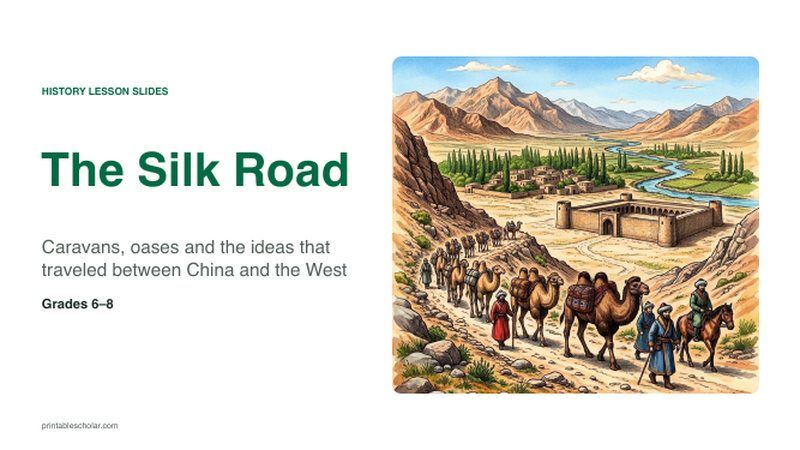
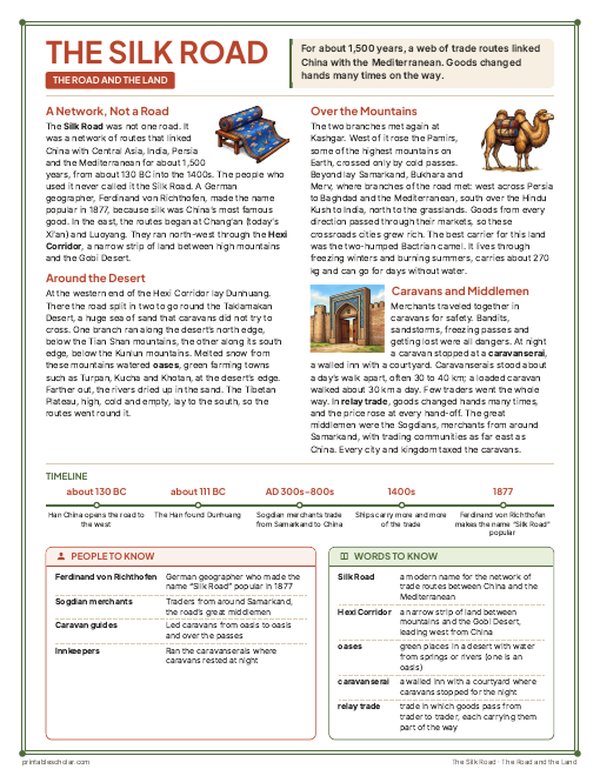
Cultural diffusion is the spread of ideas, beliefs, inventions and ways of life from one people to another. Trade routes are one of the main ways it happens, and the Silk Road, the network of routes that linked China with the Mediterranean for about 1,500 years, is the classic example. Monks carried Buddhism from India into China. Paper went west from China to Samarkand, Baghdad and Spain. Islam spread east into Central Asia. Gunpowder moved west in the 1200s. And disease traveled too: the Black Death reached Europe along the trade routes in 1346 and 1347. This free map shows all five, with a chart for students to fill in.
Free to print
Free cultural diffusion map and worksheet
PDFs sized for US Letter paper, in color and black and white.
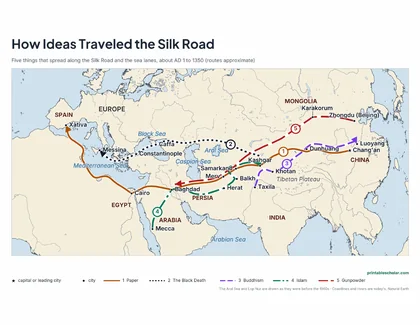
How Ideas Traveled the Silk Road, the map with its key
Five numbered arrows on a map from Spain to China, with the key naming each one.
Download PDF Black and white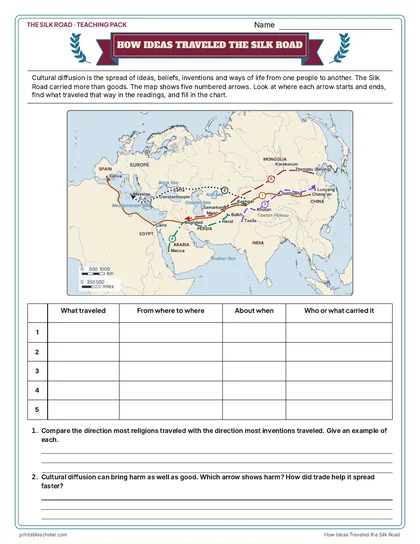
How Ideas Traveled the Silk Road, worksheet
The same map without the key: students name each arrow, where it went, when and who carried it, then answer two questions.
Download PDF Black and white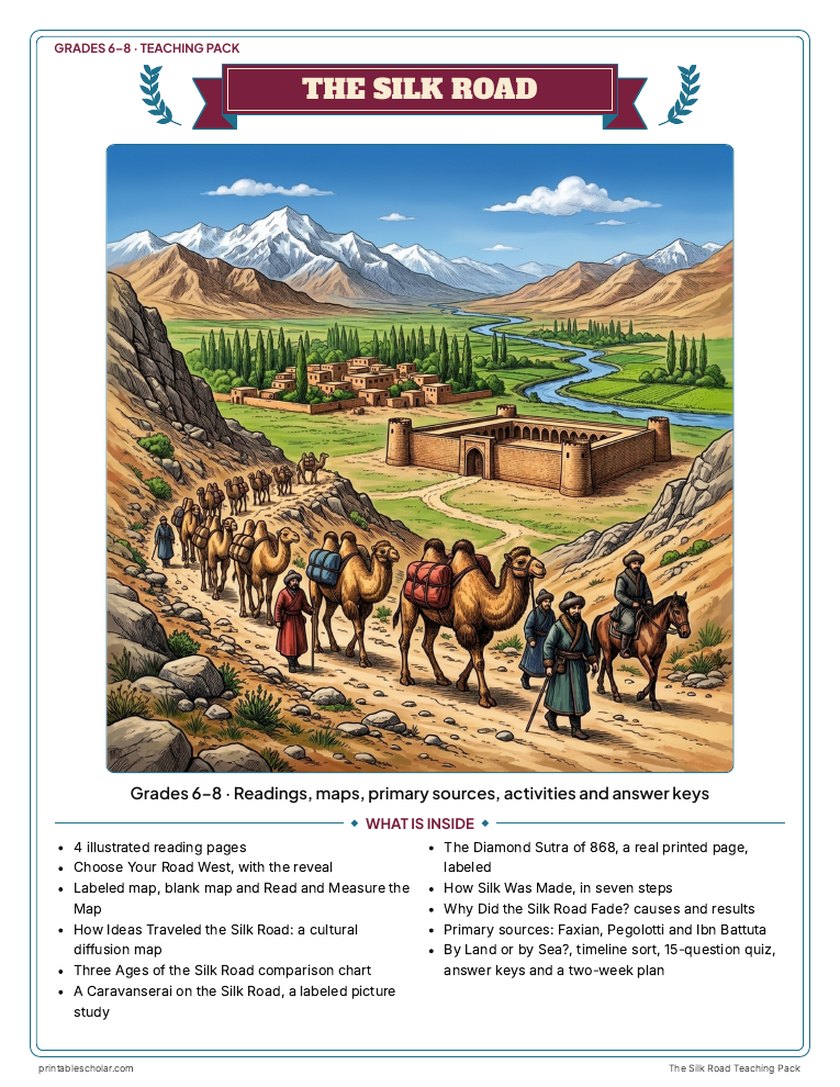
Teaching pack · Grades 6–8
Teaching the Silk Road? The whole unit, ready to teach.
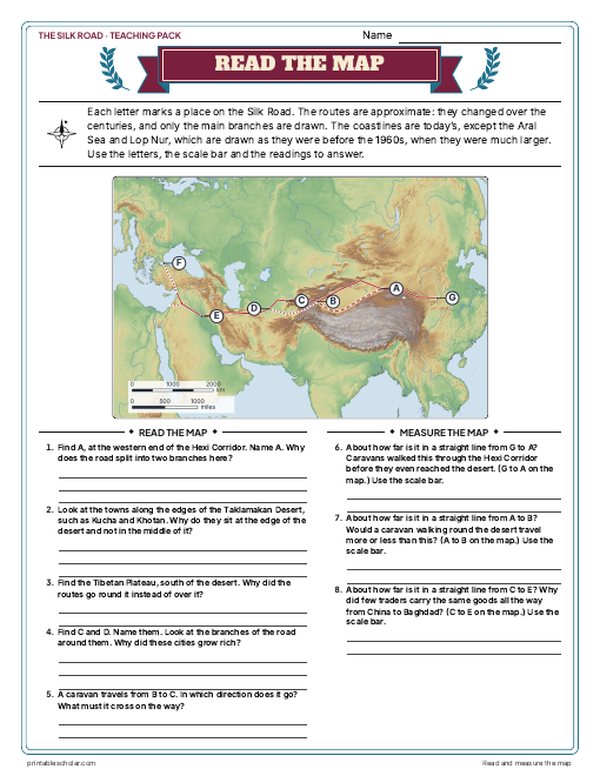
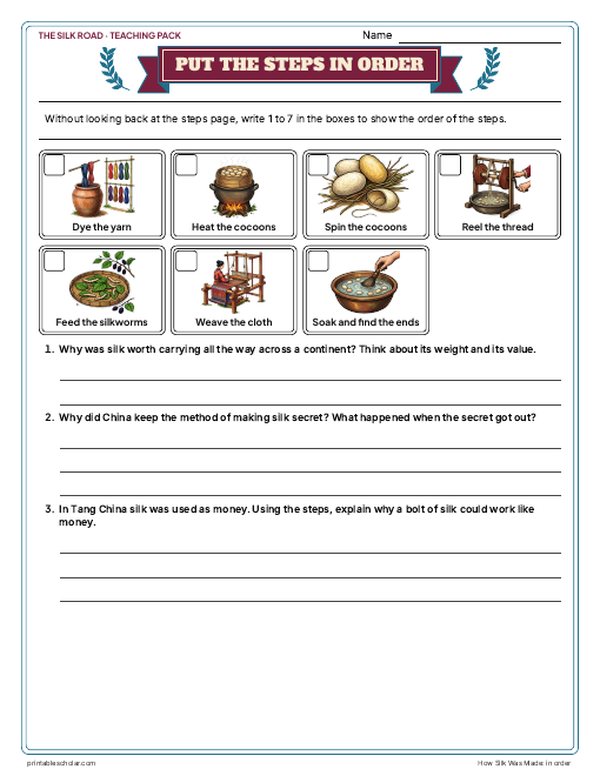
Two weeks of lessons in one download: slides to present, notes for students to fill in, and printable pages that use these maps and pictures.
- 42 lesson slides (PowerPoint you can edit, teacher notes on every slide) and 2 pages of guided notes
- 4 illustrated reading pages and a Three Ages of the Silk Road comparison chart
- Maps: labeled, blank, Read and Measure the Map, "Choose Your Road West": pick a route from Dunhuang to Balkh on a real relief map, then follow the monk Xuanzang's real journey, and How Ideas Traveled the Silk Road
- Activities: a labeled caravanserai, the real Diamond Sutra of 868, how silk was made, why the Silk Road faded, Faxian, Pegolotti and Ibn Battuta, By Land or by Sea?, and a timeline sort
- A 15-question quiz, a teacher guide with a two-week plan, and answer keys for everything
Every answer is in the pack. The readings, slides, maps and pictures teach everything the sheets and quiz ask, so no textbook is needed.
Get the Silk Road pack for $7Teaching more than one? Get all four medieval world packs (West Africa, the Silk Road, the Byzantines and the Ottomans) for $19, with a bonus chart comparing all four: about eight weeks of lessons.
Get all 4 packs for $19See all four packsOne-time purchase. Instant download. Color and ink-saving black-and-white editions. Secure checkout by Stripe.
Five things that traveled the Silk Road
Buddhism, east
From the AD 1st century, monks and merchants carried Buddhism from India over the mountains to Khotan, Kucha and Dunhuang, and on into China.
Paper, west
Paper was made in China long before it was known in the West. It was used at Samarkand by the 700s, made in Baghdad by about 794, and reached Egypt about 900 and Spain by the 1100s.
Islam, east
Arab armies took Persia and Merv by 651 and Bukhara and Samarkand in the early 700s; merchants and teachers carried Islam on, and Kashgar’s rulers became Muslim in the 900s.
Gunpowder and the Black Death, west
Gunpowder, invented in China, became known in Persia and the Arab lands in the 1200s, probably carried by the Mongols and by trade. In 1346 the plague reached Caffa on the Black Sea, and ships carried it to Constantinople and Italy in 1347.
Frequently asked questions
What is cultural diffusion?
The spread of ideas, beliefs, inventions and ways of life from one people or place to another, through trade, travel, migration or conquest.
What are examples of cultural diffusion on the Silk Road?
Buddhism spreading from India to China, papermaking spreading from China to the Islamic world and Europe, Islam spreading into Central Asia, and gunpowder moving west.
Can cultural diffusion be harmful?
Yes. Diseases travel with people and goods: the Black Death spread along the trade routes and killed perhaps a third or more of Europe’s people between 1347 and 1351.