 Printable Scholar
Chinampas: How the Aztecs Farmed the Lake
Chinampas were long, narrow fields that the Aztecs and their neighbors built up from the bed of the shallow, fresh lakes in the Valley of Mexico. People call them "floating gardens," but they did not float. Farmers drove posts into the lake bed, wove fences of reeds and branches between them, and piled up layers of lake mud and water plants until the field rose above the water. Willow trees along the edges rooted it in place. Canals on every side carried canoes and kept the soil wet, so a chinampa could give several harvests a year and help feed Tenochtitlan’s 200,000 people.
Free to print
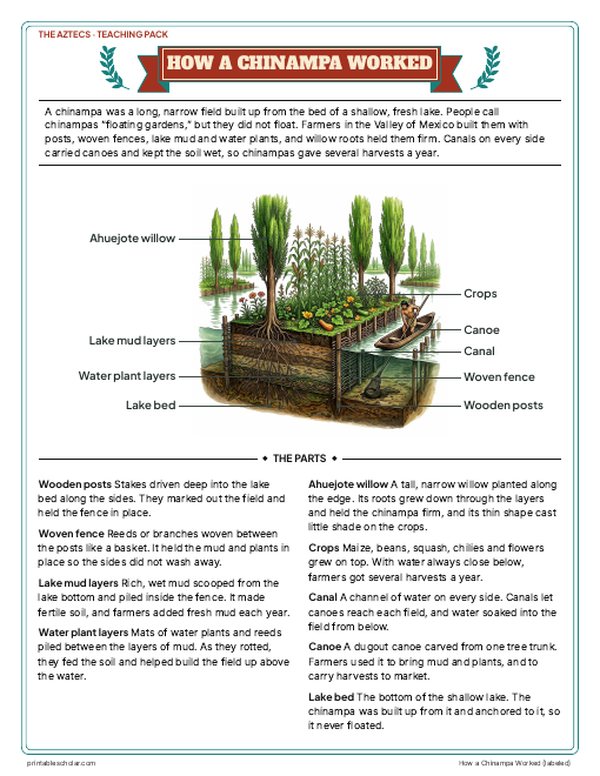
Labeled and blank chinampa diagram
PDFs sized for US Letter paper, in color and black and white.
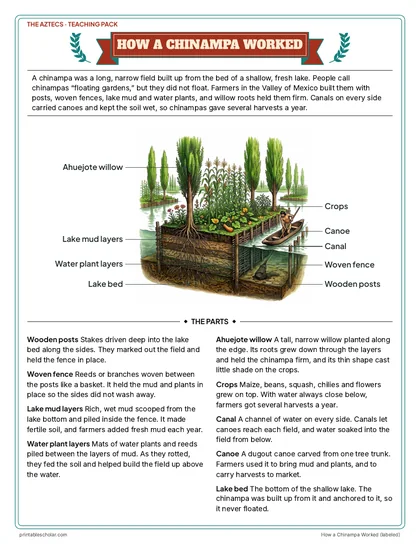
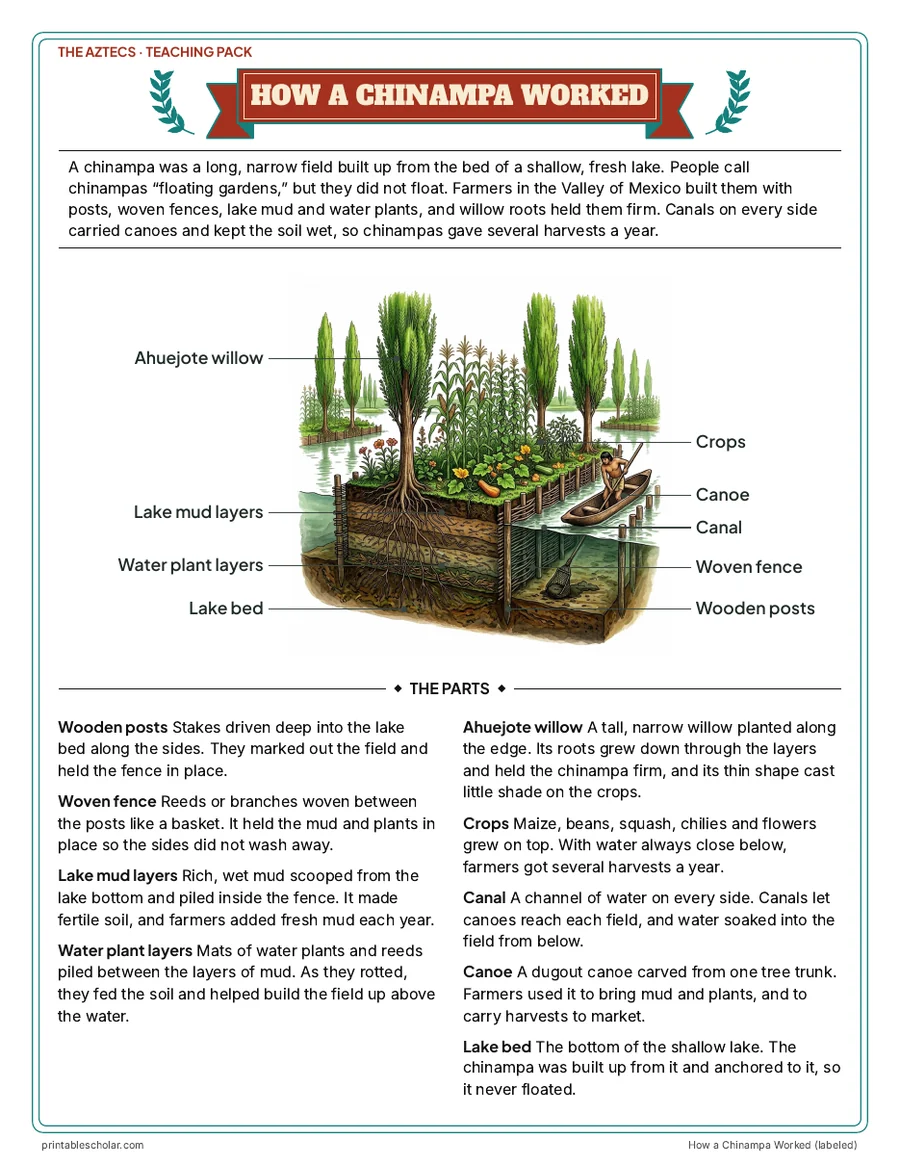
How a Chinampa Worked, labeled
A cutaway of one chinampa with nine parts labeled and what each part did.
Download PDF Black and white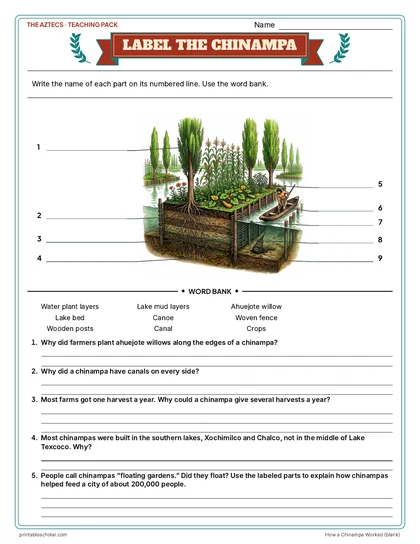
Label the Chinampa
The same cutaway with numbered blank labels, a word bank and five questions.
Download PDF Black and white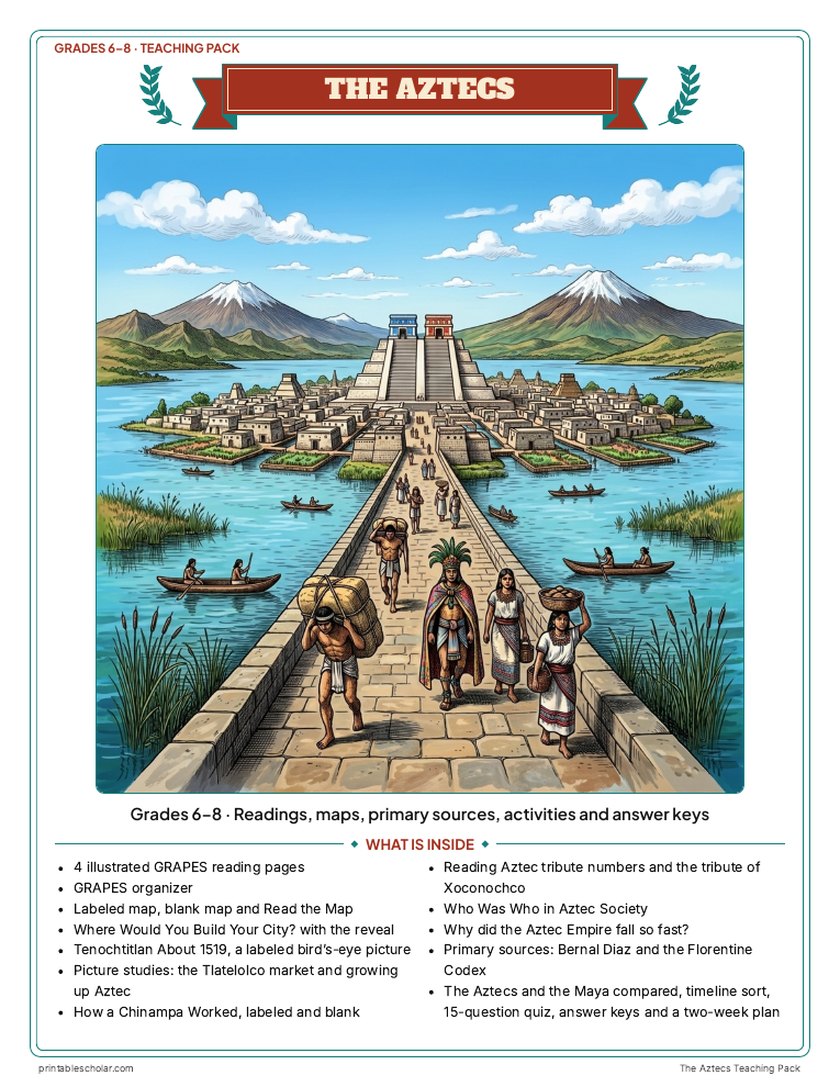
Teaching pack · Grades 6–8
Teaching the Aztecs? The whole unit, ready to teach.
Two weeks of lessons in one download: slides to present, notes for students to fill in, and printable pages that use these maps and pictures.
- 42 lesson slides (PowerPoint you can edit, teacher notes on every slide) and 2 pages of guided notes
- 4 illustrated reading pages and a GRAPES organizer
- Maps: labeled, blank, Read and Measure the Map, and a "Where would you build your city?" decision on the Valley of Mexico lakes with the reveal
- Activities: a labeled bird's-eye picture of Tenochtitlan, picture studies of the Tlatelolco market and growing up Aztec, how a chinampa worked (labeled and blank), Aztec tribute numbers and the tribute of Xoconochco, who was who, why the empire fell so fast, Bernal Diaz and the Florentine Codex, the Aztecs and the Maya compared, and a timeline sort
- A 15-question quiz, a teacher guide with a two-week plan, and answer keys for everything
Every answer is in the pack. The readings, slides, maps and pictures teach everything the sheets and quiz ask, so no textbook is needed.
Get the Aztecs pack for $7One-time purchase. Instant download. Color and ink-saving black-and-white editions. Secure checkout by Stripe.
How a chinampa was built
Posts and fences
Farmers drove wooden stakes into the shallow lake bed to mark out a long, narrow field, then wove reeds or branches between them like a basket wall to hold everything in.
Mud and water plants
Inside the fence they piled rich mud scooped from the lake bottom, in layers with mats of water plants. As the plants rotted they fed the soil, and the field rose above the water. Fresh mud went on every year.
Willow roots
Tall, narrow ahuejote willows were planted along the edges. Their roots grew down through the layers and held the field firm, and their thin shape cast little shade on the crops.
Canals and harvests
A canal ran on every side. Water soaked up into the soil from below, and canoes brought mud and carried crops to market. Maize, beans, squash, chilies and flowers could give several harvests a year.
Frequently asked questions
Did chinampas really float?
No. "Floating gardens" is a nickname. Chinampas were built up from the bottom of a shallow lake and held in place by posts, fences and willow roots.
Why were chinampas built in the southern lakes?
Lakes Xochimilco and Chalco in the south were fresh water. Lake Texcoco in the middle was salty in its eastern part, and salt water ruins crops.
Are there still chinampas today?
Yes. Farmers still work chinampas in Xochimilco, in the south of Mexico City, where boats travel the old canals.