 Printable Scholar
The Bill of Rights
The Bill of Rights is the first ten amendments, or changes, to the Constitution. Many Americans, called Anti-Federalists, refused to back the Constitution of 1787 because it had no list of rights. James Madison proposed amendments in Congress in June 1789, Congress sent twelve to the states, and ten were ratified on December 15, 1791. In 1791 they limited only the national government. The printables below set the exact words beside plain English, ask four questions, and give ten everyday situations for students to match to the right amendment.
Free to print
The Bill of Rights in plain English, questions and a scenario worksheet
PDFs sized for US Letter paper, in color and black and white.
The Bill of Rights, with plain English
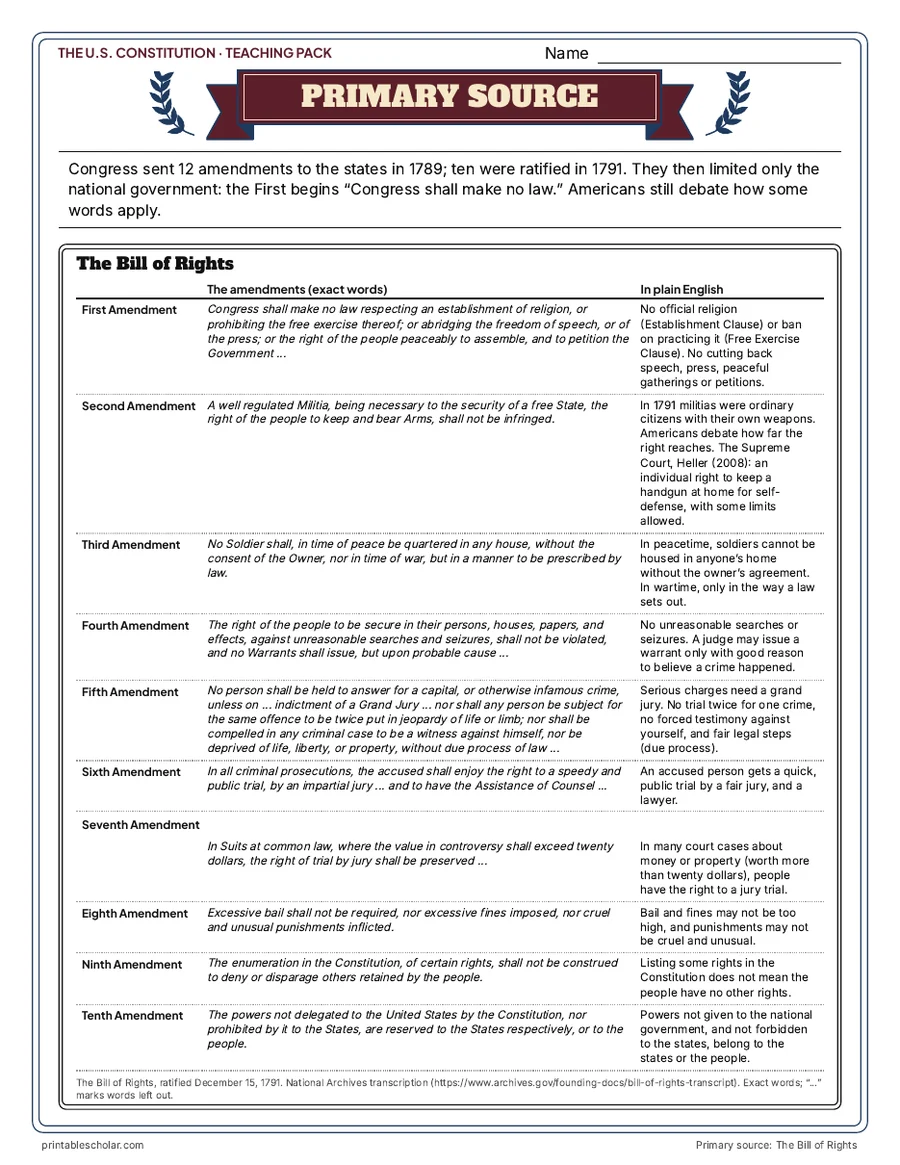
All ten amendments in their exact words (National Archives text, long ones shortened) beside a plain-English version.
Download PDF Black and white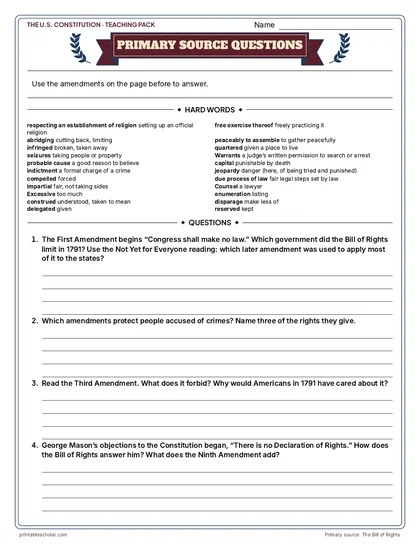
Hard words and questions
The hard words explained, and four questions about the Bill of Rights.
Download PDF Black and white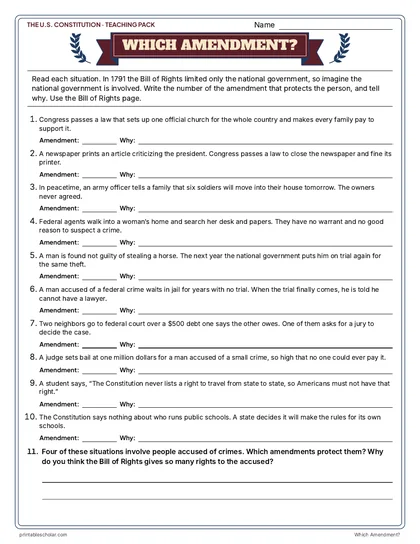
Which Amendment? worksheet
Ten situations: students write the amendment that protects the person, and why.
Download PDF Black and white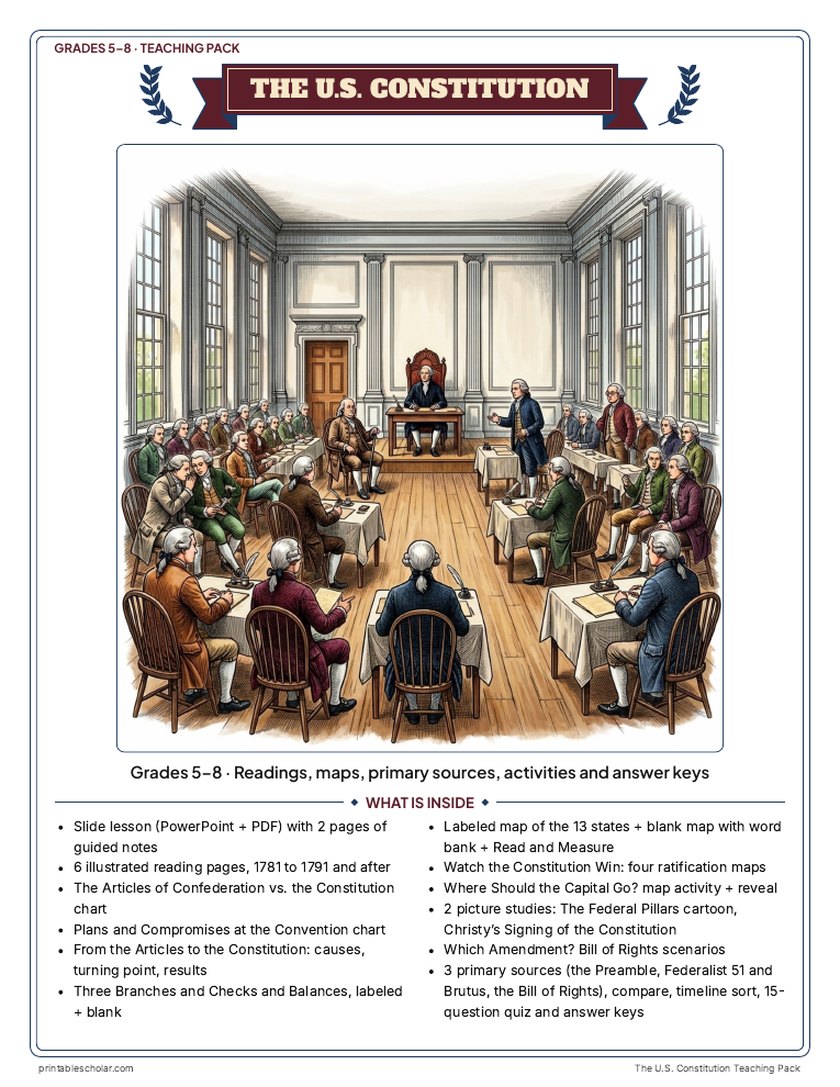
Teaching pack · Grades 5–8
Teaching the U.S. Constitution? The whole unit, ready to teach.
Two weeks of lessons in one download: slides to present, notes for students to fill in, and printable pages that use these maps and pictures.
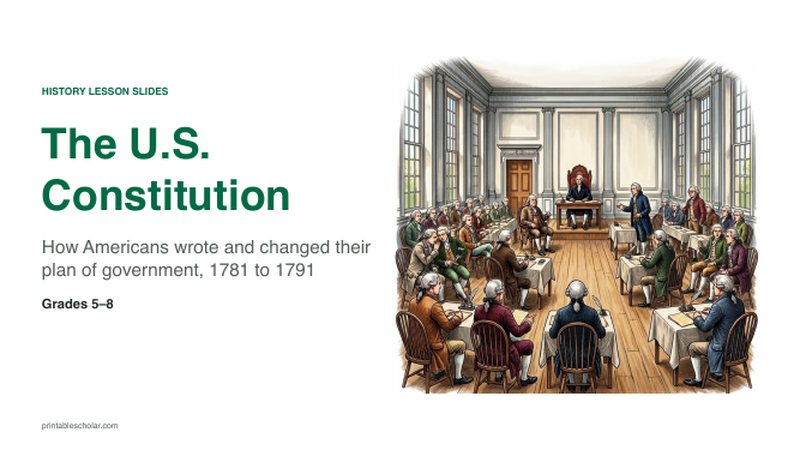
- 38 lesson slides (PowerPoint you can edit, teacher notes on every slide) and 2 pages of guided notes
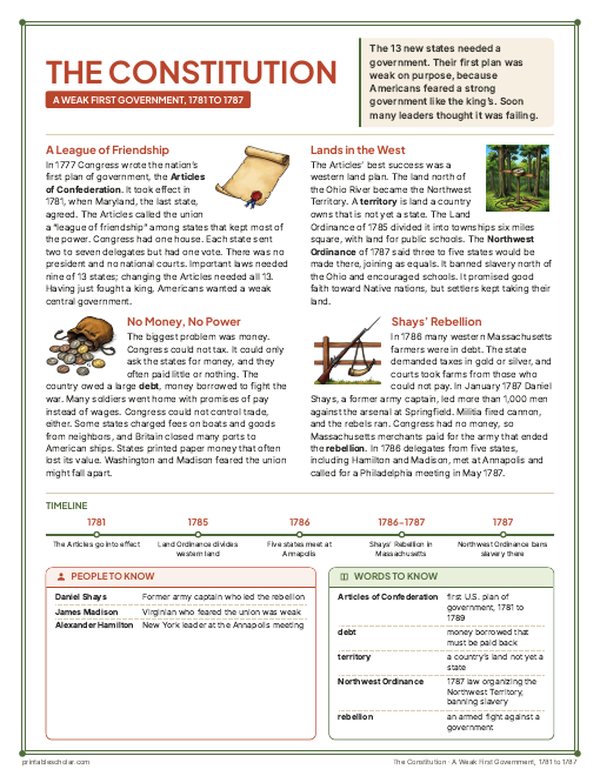
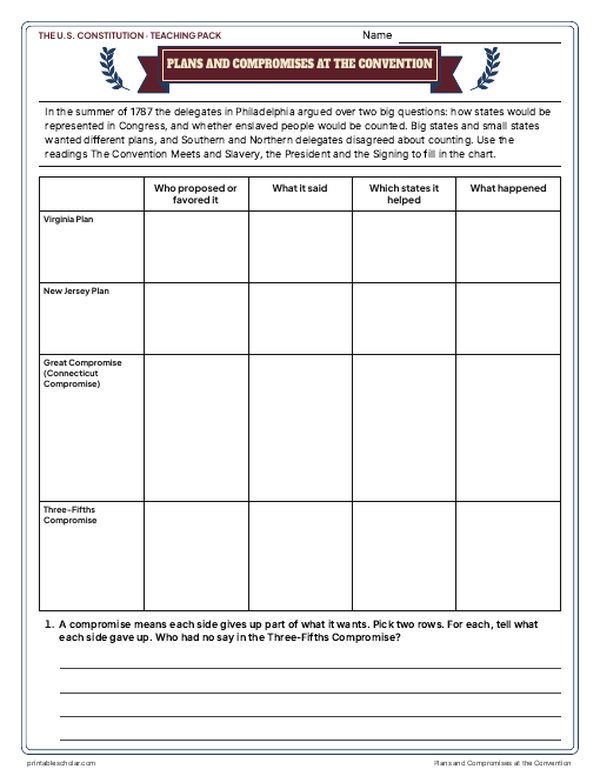
- 6 illustrated reading pages, 1781 to 1791, an Articles vs. Constitution chart, a Plans and Compromises chart and a causes sheet
- Three Branches and Checks and Balances (study page + practice), Which Amendment? Bill of Rights scenarios
- Maps: the 13 states in 1790, labeled and blank, Read and Measure the Map, four ratification maps, and Where Should the Capital Go? with the reveal
- Primary sources: the Preamble, Federalist No. 51 beside Brutus No. 1, and the Bill of Rights, each with plain English beside it; picture studies of the 1788 Federal Pillars cartoon and Christy's Signing painting
- Federalists vs. Anti-Federalists, a timeline sort, a 15-question quiz, a teacher guide with a two-week plan, and answer keys for everything
Every answer is in the pack. The readings, slides, maps and pictures teach everything the sheets and quiz ask, so no textbook is needed.
Get the U.S. Constitution pack for $7Teaching more than one? Get all five US history packs (the 13 Colonies, the American Revolution, the Constitution, Westward Expansion and the Civil War) for $24: about ten weeks of lessons.
Get all 5 packs for $24One-time purchase. Instant download. Color and ink-saving black-and-white editions. Secure checkout by Stripe.
The ten amendments, one by one
First Amendment
Congress shall make no law respecting an establishment of religion, or prohibiting the free exercise thereof; or abridging the freedom of speech, or of the press; or the right of the people peaceably to assemble, and to petition the Government ... In plain English: No official religion (Establishment Clause) or ban on practicing it (Free Exercise Clause). No cutting back speech, press, peaceful gatherings or petitions.
Second Amendment
A well regulated Militia, being necessary to the security of a free State, the right of the people to keep and bear Arms, shall not be infringed. In plain English: In 1791 militias were ordinary citizens with their own weapons. Americans debate how far the right reaches. The Supreme Court, Heller (2008): an individual right to keep a handgun at home for self-defense, with some limits allowed.
Third Amendment
No Soldier shall, in time of peace be quartered in any house, without the consent of the Owner, nor in time of war, but in a manner to be prescribed by law. In plain English: In peacetime, soldiers cannot be housed in anyone’s home without the owner’s agreement. In wartime, only in the way a law sets out.
Fourth Amendment
The right of the people to be secure in their persons, houses, papers, and effects, against unreasonable searches and seizures, shall not be violated, and no Warrants shall issue, but upon probable cause ... In plain English: No unreasonable searches or seizures. A judge may issue a warrant only with good reason to believe a crime happened.
Fifth Amendment
No person shall be held to answer for a capital, or otherwise infamous crime, unless on ... indictment of a Grand Jury ... nor shall any person be subject for the same offence to be twice put in jeopardy of life or limb; nor shall be compelled in any criminal case to be a witness against himself, nor be deprived of life, liberty, or property, without due process of law ... In plain English: Serious charges need a grand jury. No trial twice for one crime, no forced testimony against yourself, and fair legal steps (due process).
Sixth Amendment
In all criminal prosecutions, the accused shall enjoy the right to a speedy and public trial, by an impartial jury ... and to have the Assistance of Counsel ... In plain English: An accused person gets a quick, public trial by a fair jury, and a lawyer.
Seventh Amendment
In Suits at common law, where the value in controversy shall exceed twenty dollars, the right of trial by jury shall be preserved ... In plain English: In many court cases about money or property (worth more than twenty dollars), people have the right to a jury trial.
Eighth Amendment
Excessive bail shall not be required, nor excessive fines imposed, nor cruel and unusual punishments inflicted. In plain English: Bail and fines may not be too high, and punishments may not be cruel and unusual.
Ninth Amendment
The enumeration in the Constitution, of certain rights, shall not be construed to deny or disparage others retained by the people. In plain English: Listing some rights in the Constitution does not mean the people have no other rights.
Tenth Amendment
The powers not delegated to the United States by the Constitution, nor prohibited by it to the States, are reserved to the States respectively, or to the people. In plain English: Powers not given to the national government, and not forbidden to the states, belong to the states or the people.
Frequently asked questions
What is the Bill of Rights?
The first ten amendments to the Constitution, ratified on December 15, 1791. They protect freedoms such as religion, speech, the press and assembly, and the rights of people accused of crimes.
Why was the Bill of Rights added?
The Constitution of 1787 had no list of rights. Anti-Federalists such as George Mason (’There is no Declaration of Rights’) feared a strong national government. Several states ratified only after recommending amendments, and James Madison proposed them in the first Congress.
Who did the Bill of Rights protect in 1791?
It limited only the national government, not the states. Enslaved people had none of its protection, and under state laws most women and most free Black Americans could not vote. Later amendments, starting with the 14th in 1868, extended its protections.
How many amendments did Congress send to the states in 1789?
Twelve. Ten were ratified in 1791 and became the Bill of Rights. One of the other two, about Congress’s pay, was finally ratified in 1992 as the 27th Amendment.