 Printable Scholar
What Is a Ziggurat?
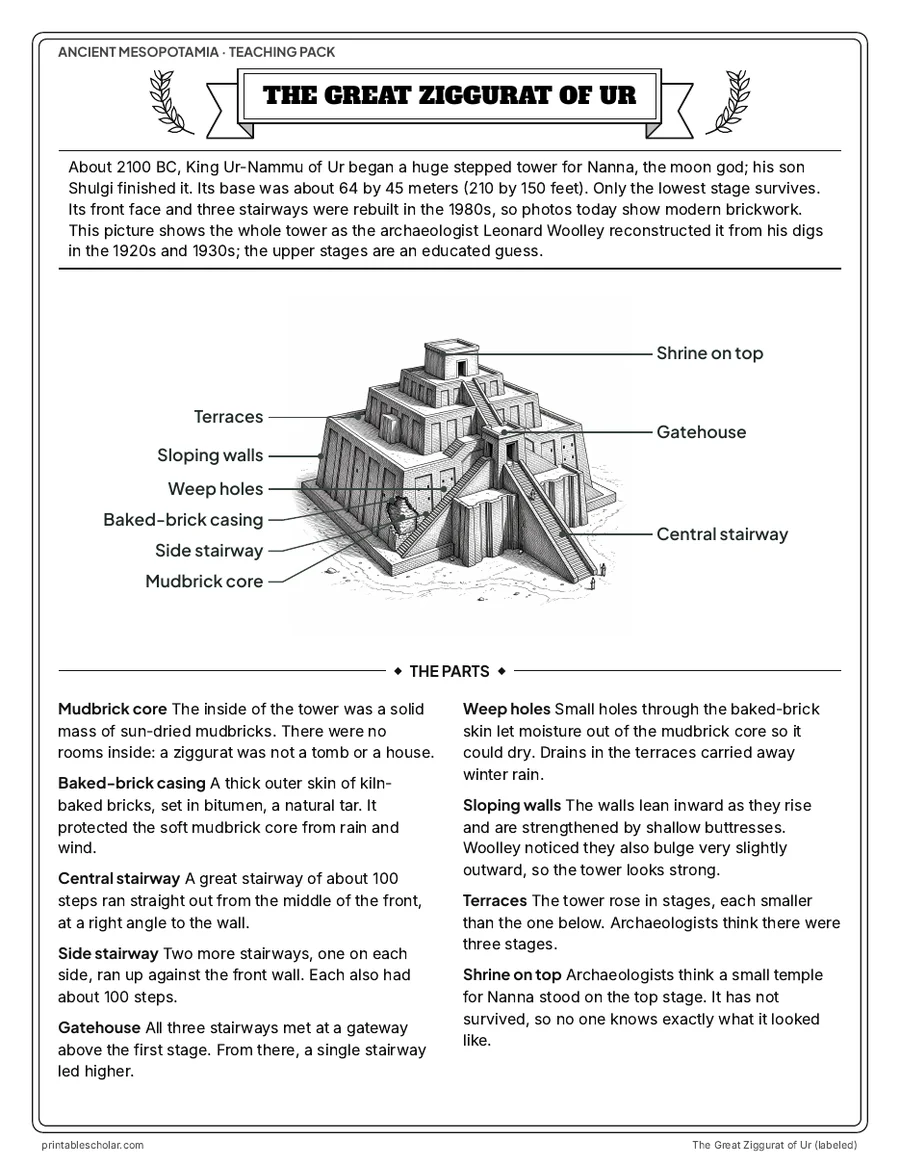
About 2100 BC, King Ur-Nammu of Ur began a huge stepped tower for Nanna, the moon god; his son Shulgi finished it. Its base was about 64 by 45 meters (210 by 150 feet). Only the lowest stage survives. Its front face and three stairways were rebuilt in the 1980s, so photos today show modern brickwork. This picture shows the whole tower as the archaeologist Leonard Woolley reconstructed it from his digs in the 1920s and 1930s; the upper stages are an educated guess.
Free to print
A labeled ziggurat, a blank one to label, and the building steps to put in order
PDFs sized for US Letter paper, in color and black and white.
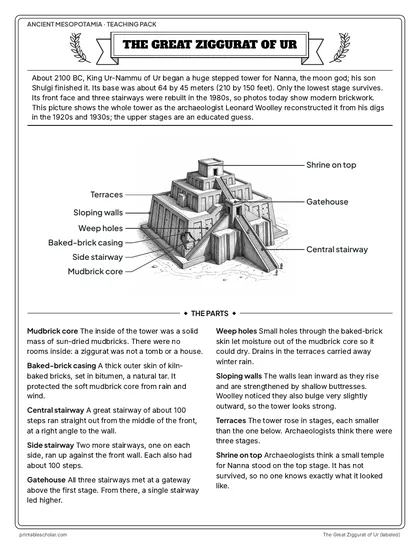
The Great Ziggurat of Ur, labeled
The 9 parts of the Great Ziggurat of Ur with leader lines, and what each part was for.
Download PDF Black and white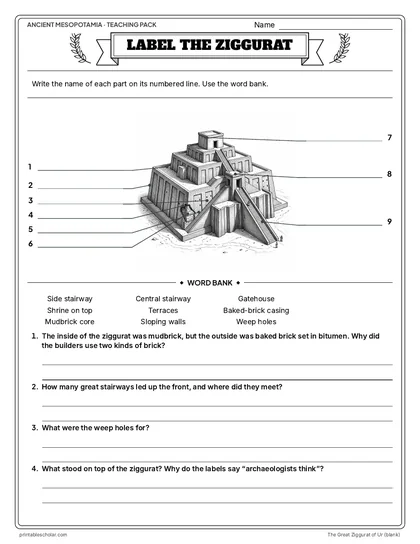
Label the Ziggurat
The same ziggurat with numbered blanks, a word bank and four questions.
Download PDF Black and white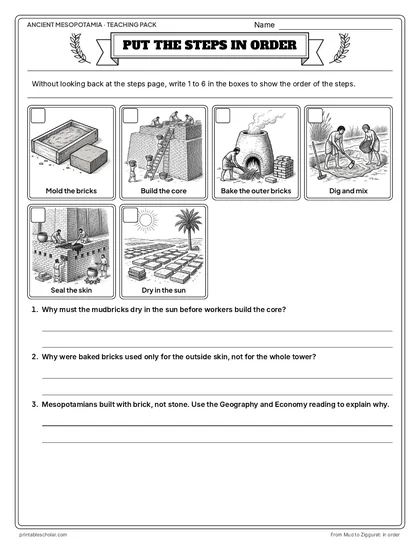
From Mud to Ziggurat: put the steps in order
Six steps from river mud to a finished tower, out of order, with three questions.
Download PDF Black and white
Teaching pack · Grades 5–7
Teaching Ancient Mesopotamia? The whole unit, ready to teach.
Two weeks of lessons in one download: slides to present, notes for students to fill in, and printable pages that use these maps and pictures.
- 30 lesson slides (PowerPoint you can edit, teacher notes on every slide) and 2 pages of guided notes
- 4 illustrated reading pages and a GRAPES organizer
- Maps: labeled, blank, Read and Measure the Map, and a "Where would you build your city?" decision with the reveal
- Activities: picture studies of Ur and a scribe school, the Great Ziggurat of Ur (labeled, blank and the building steps), who was who, reading real cuneiform signs and Babylonian numbers, the Code of Hammurabi, a timeline sort and four empires compared
- A 15-question quiz, a teacher guide with a two-week plan, and answer keys for everything
Every answer is in the pack. The readings, slides, maps and pictures teach everything the sheets and quiz ask, so no textbook is needed.
Get the Ancient Mesopotamia pack for $7One-time purchase. Instant download. Color and ink-saving black-and-white editions. Secure checkout by Stripe.
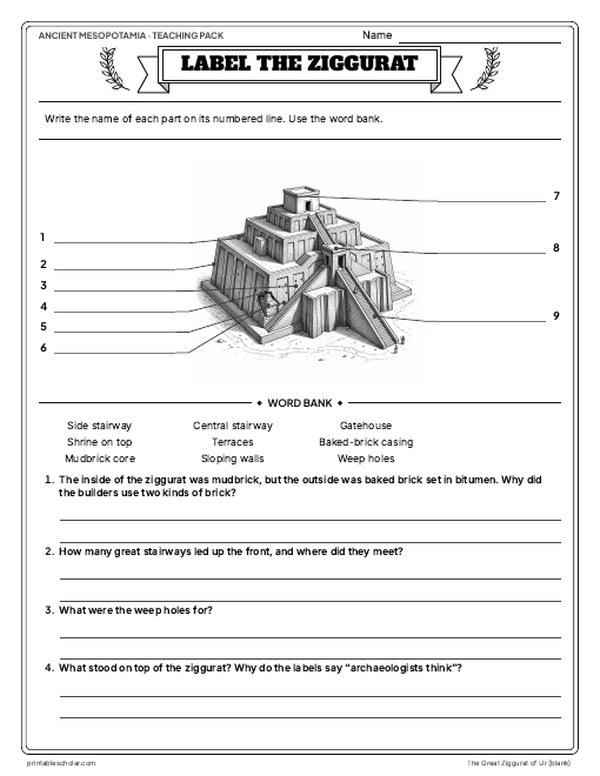
The parts of the Great Ziggurat of Ur
Mudbrick core
The inside of the tower was a solid mass of sun-dried mudbricks. There were no rooms inside: a ziggurat was not a tomb or a house.
Baked-brick casing
A thick outer skin of kiln-baked bricks, set in bitumen, a natural tar. It protected the soft mudbrick core from rain and wind.
Central stairway
A great stairway of about 100 steps ran straight out from the middle of the front, at a right angle to the wall.
Side stairway
Two more stairways, one on each side, ran up against the front wall. Each also had about 100 steps.
Gatehouse
All three stairways met at a gateway above the first stage. From there, a single stairway led higher.
Weep holes
Small holes through the baked-brick skin let moisture out of the mudbrick core so it could dry. Drains in the terraces carried away winter rain.
Sloping walls
The walls lean inward as they rise and are strengthened by shallow buttresses. Woolley noticed they also bulge very slightly outward, so the tower looks strong.
Terraces
The tower rose in stages, each smaller than the one below. Archaeologists think there were three stages.
Shrine on top
Archaeologists think a small temple for Nanna stood on the top stage. It has not survived, so no one knows exactly what it looked like.
Frequently asked questions
What is a ziggurat?
A huge stepped tower of mudbrick built in Mesopotamian cities, with a shrine for the city’s god on top. It was solid brick inside: not a tomb and not a building with rooms.
Who built the Great Ziggurat of Ur?
King Ur-Nammu of Ur began it about 2100 BC for Nanna, the moon god, and his son Shulgi finished it. Its base was about 64 by 45 meters (210 by 150 feet).
What is left of the Ziggurat of Ur today?
Only the lowest stage of the ancient tower survives, near Nasiriyah in Iraq. Its front face and three stairways were rebuilt in the 1980s, and the upper stages are an archaeologist’s reconstruction.