 Printable Scholar
Cuneiform for Kids
Cuneiform is one of the world’s first writing systems. It began in Sumer, in southern Mesopotamia, about 3200 BC as small pictures drawn in clay to keep track of grain and animals. Scribes then pressed the marks in with a cut reed, so the pictures turned into groups of wedges. These free sheets use real cuneiform signs, set in a cuneiform font, so students see how the signs changed, match twelve of them to their meanings, read Babylonian numbers and decode a scribe’s clay receipt.
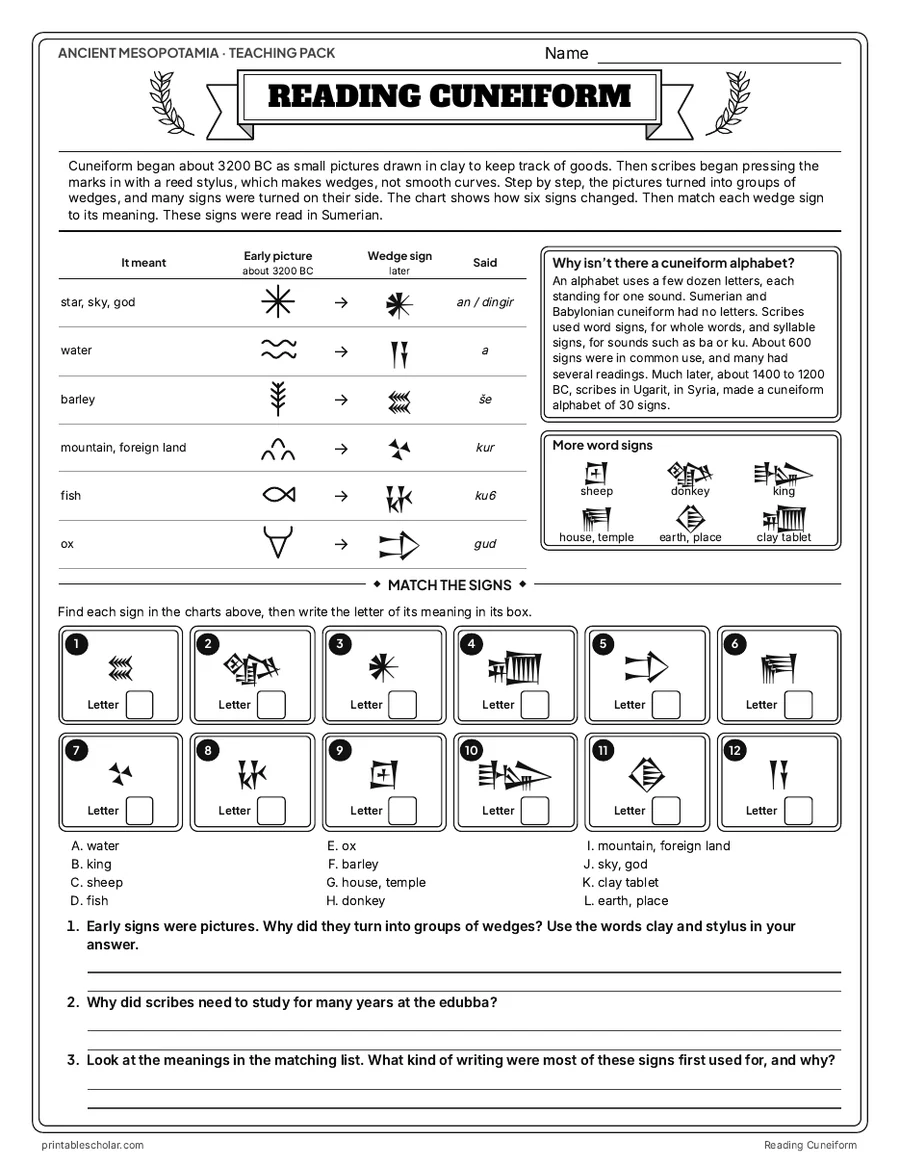
Free to print
Match real cuneiform signs, then read Babylonian numbers and a clay receipt
PDFs sized for US Letter paper, in color and black and white.
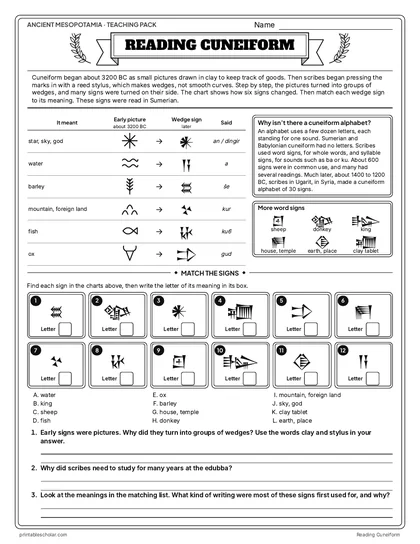
Reading Cuneiform
How five signs changed from pictures to wedges, why there is no cuneiform alphabet, and twelve real signs to match to their meanings.
Download PDF Black and white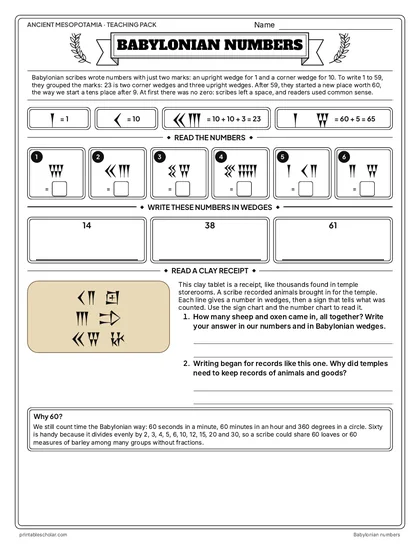
Babylonian Numbers
Read and write numbers in wedges, base 60, read a scribe’s clay receipt, and find out why an hour has 60 minutes.
Download PDF Black and white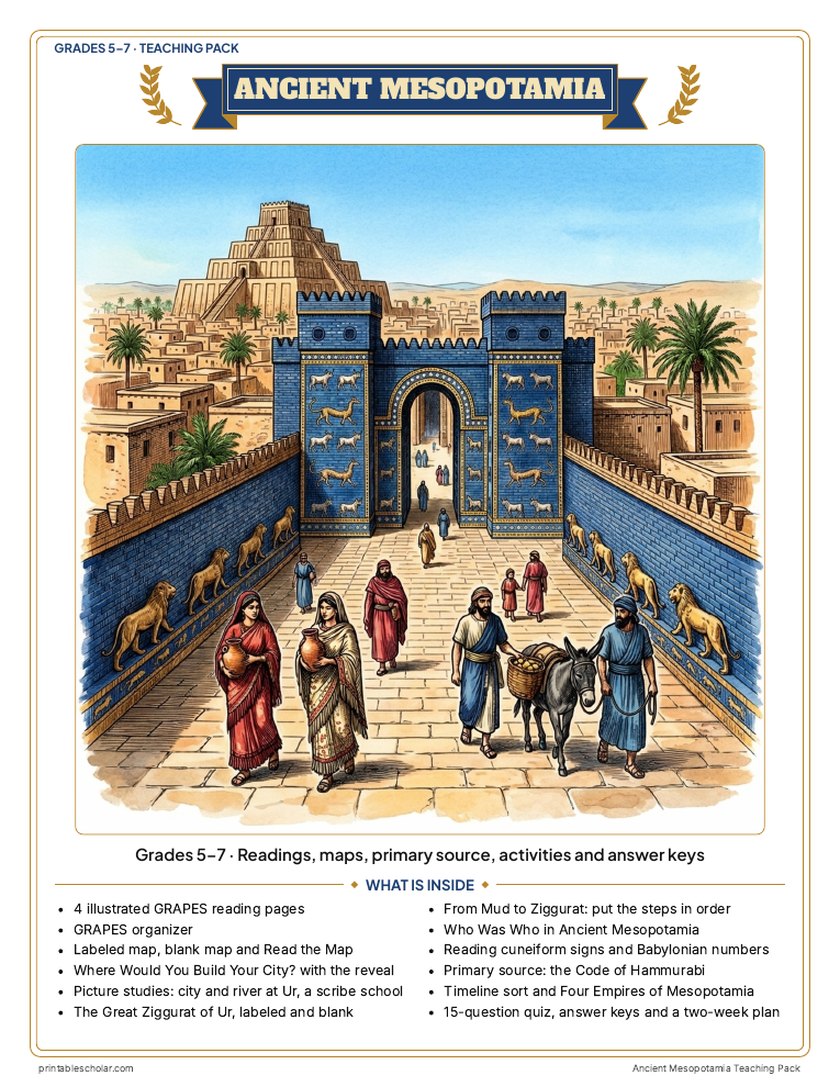
Teaching pack · Grades 5–7
Teaching Ancient Mesopotamia? The whole unit, ready to teach.
Two weeks of lessons in one download: slides to present, notes for students to fill in, and printable pages that use these maps and pictures.
- 30 lesson slides (PowerPoint you can edit, teacher notes on every slide) and 2 pages of guided notes
- 4 illustrated reading pages and a GRAPES organizer
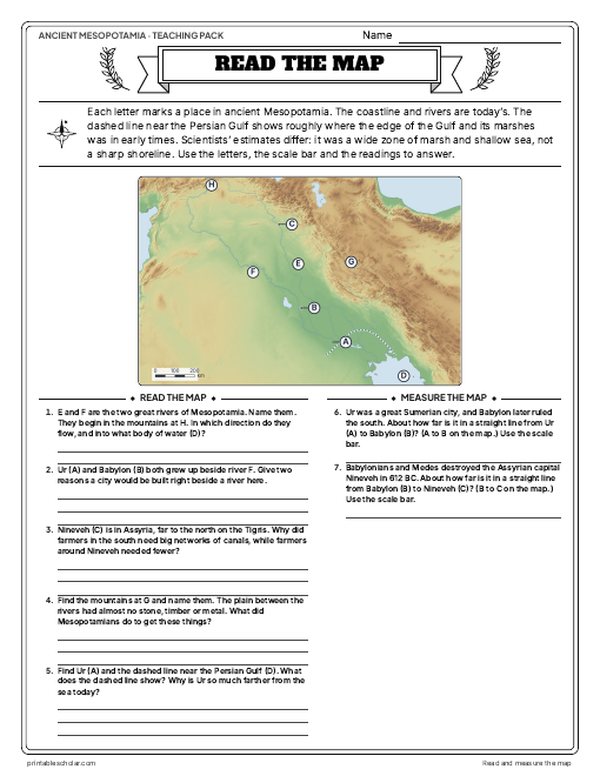
- Maps: labeled, blank, Read and Measure the Map, and a "Where would you build your city?" decision with the reveal
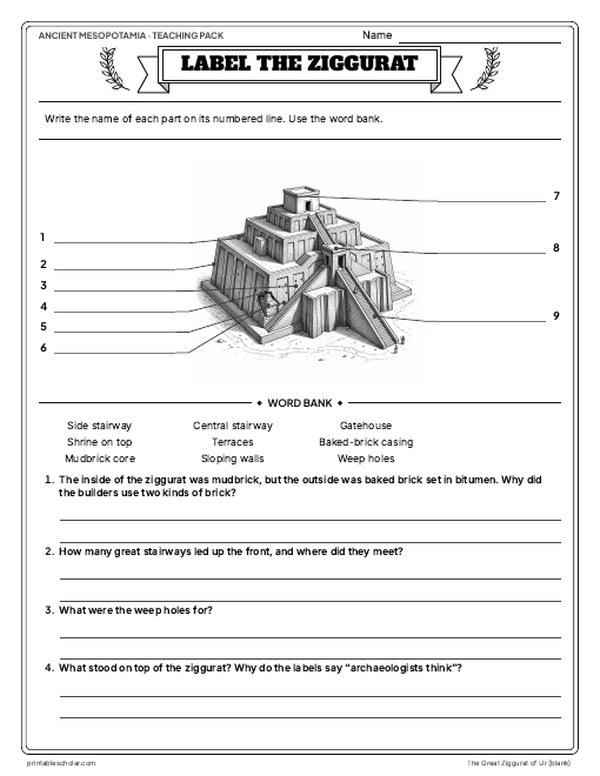
- Activities: picture studies of Ur and a scribe school, the Great Ziggurat of Ur (labeled, blank and the building steps), who was who, reading real cuneiform signs and Babylonian numbers, the Code of Hammurabi, a timeline sort and four empires compared
- A 15-question quiz, a teacher guide with a two-week plan, and answer keys for everything
Every answer is in the pack. The readings, slides, maps and pictures teach everything the sheets and quiz ask, so no textbook is needed.
Get the Ancient Mesopotamia pack for $7One-time purchase. Instant download. Color and ink-saving black-and-white editions. Secure checkout by Stripe.
Why isn’t there a cuneiform alphabet?
Word signs and syllable signs
An alphabet uses a few dozen letters, each standing for one sound. Sumerian and Babylonian cuneiform had no letters. Scribes used word signs, for whole words, and syllable signs, for sounds such as ba or ku. About 600 signs were in common use, and many had several readings. Much later, about 1400 to 1200 BC, scribes in Ugarit, in Syria, made a cuneiform alphabet of 30 signs.
Why 60?
We still count time the Babylonian way: 60 seconds in a minute, 60 minutes in an hour and 360 degrees in a circle. Sixty is handy because it divides evenly by 2, 3, 4, 5, 6, 10, 12, 15, 20 and 30, so a scribe could share 60 loaves or 60 measures of barley among many groups without fractions.
Frequently asked questions
Is there a cuneiform alphabet?
Not for Sumerian or Babylonian cuneiform. Scribes used word signs and syllable signs, about 600 in common use. Much later, about 1400 to 1200 BC, scribes in Ugarit, in Syria, made a cuneiform alphabet of 30 signs.
How did cuneiform start?
About 3200 BC officials drew small pictures in clay to keep track of goods. Scribes then pressed the marks in with a cut reed stylus, so the pictures turned into groups of wedges.
How did Babylonians write numbers?
With two marks: an upright wedge for 1 and a corner wedge for 10. After 59 they started a new place worth 60, which is why we still have 60 minutes in an hour and 360 degrees in a circle.